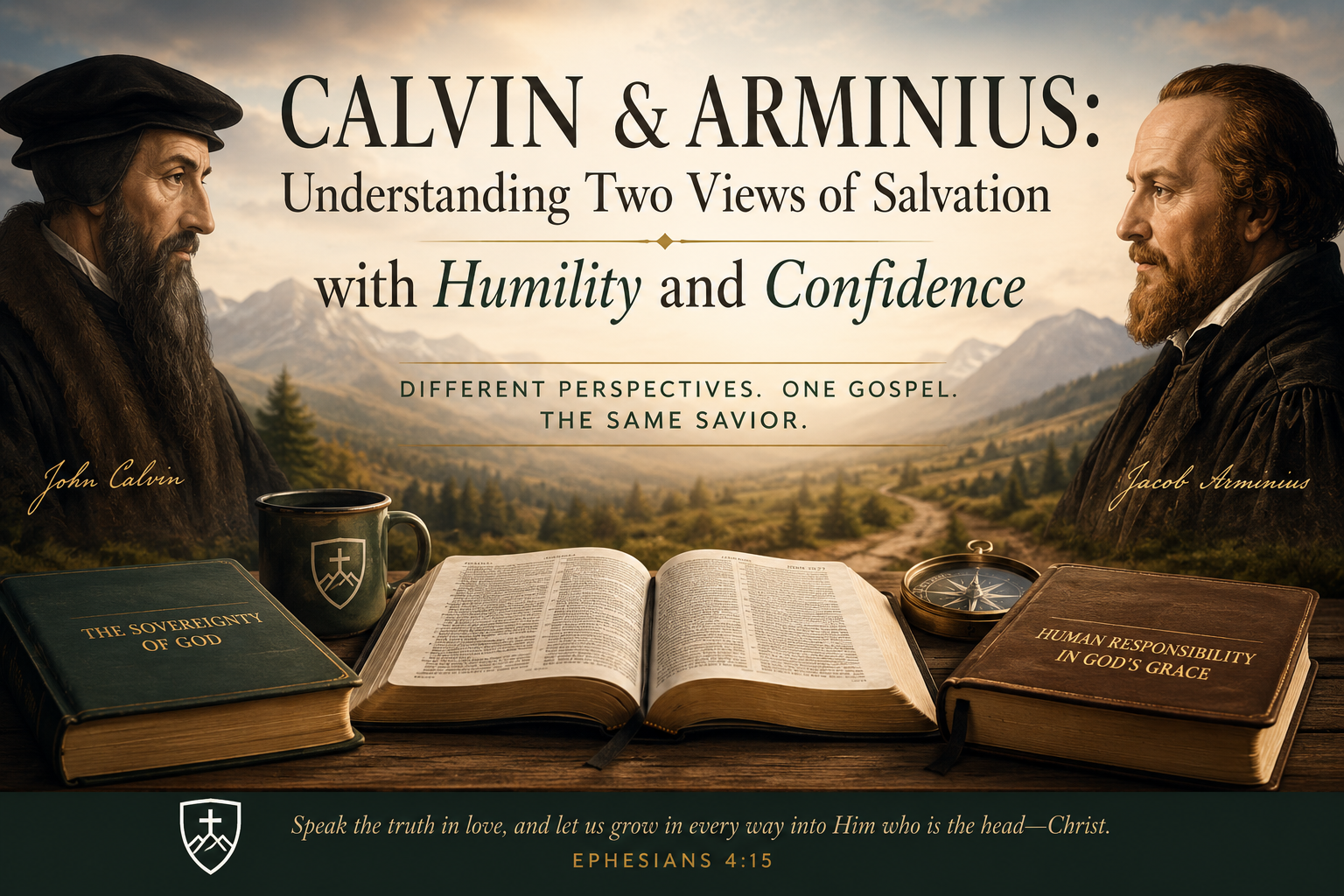
Calvin and Arminius: Understanding Two Views of Salvation with Humility and Confidence
The debate between Calvin and Arminius is not a tribal squabble between competing theological clubs. It is a four-hundred-year wrestling match with one of the deepest questions a thinking person can ask: If God is truly sovereign, what does my choice actually mean? And if my choice actually means something, is God truly sovereign? The good news is that Scripture does not force us to choose. It forces us to think harder — and then to worship.
Here is a question that stops people cold — not just in seminaries, but at kitchen tables, in hospital rooms, and late at night when a person finally gets honest with himself: If God already knows who will be saved, does my decision actually mean anything? And the version of that question that runs in the other direction is just as sharp: If my faith is the thing that tips the scales, what happens to grace?
These are not questions that arose in the sixteenth century and stayed there. They are perennial human questions about freedom, responsibility, and whether the universe has a God who can be trusted. The Calvin-Arminius debate is the church’s most sustained attempt to answer them from Scripture — and four hundred years later, serious people still disagree.
What follows is not a declaration of a winner. It is an attempt to do what the best theological thinking always does: take the questions seriously, represent both sides honestly, and then let Scripture do what it does — not resolve every philosophical tension, but reorient the whole conversation around the God who saves.
Why Skeptics Find This Debate Interesting
Thoughtful people outside the church often find this debate more interesting than Christians expect. The underlying questions — about determinism and free will, about whether human choices are real if God knows the future, about what it means for love to be genuine if it cannot be refused — are not uniquely religious questions. They show up in philosophy departments, in discussions about neuroscience and moral responsibility, in arguments about whether rehabilitation makes sense if behavior is simply the product of prior causes.
The secular world has its own version of this tension, and it has not resolved it either. Hard determinists say free will is an illusion — your choices are the output of prior causes stretching back before you were born. Hard libertarians say free will is absolute — your choices are genuinely yours and not determined by anything outside yourself. Neither position is satisfying on its own terms, and most thoughtful people sense that.
What is worth pointing out to a skeptic — and to a Christian who has never thought about it this way — is that the Calvin-Arminius debate is not evidence that Christianity is confused. It is evidence that Christianity is grappling honestly with one of the hardest problems in human thought, doing so from within the constraints of a text it takes seriously as revelation. The two sides are not making up answers. They are following different threads in the same Scripture to their logical ends and finding that both threads are real.
That is not a weakness. That is what happens when honest people take a hard problem seriously.
The Men Behind the Names
John Calvin (1509–1564) was a French lawyer turned theologian who became the dominant reforming voice in Geneva. His Institutes of the Christian Religion — first published when he was twenty-six years old — became one of the most influential works of systematic theology in the history of the church. Calvin was not the first to teach what bears his name. He was drawing deeply from Augustine of Hippo (354–430), whose theology of grace and predestination had shaped Western Christianity for over a thousand years. Calvin sharpened it, systematized it, and made it the backbone of Reformed theology.
Jacobus Arminius (1560–1609) was a Dutch theologian who had actually studied under Calvin’s successor Theodore Beza in Geneva before returning to the Netherlands. He did not set out to found a rival system. He became convinced, through careful study of Romans 9, that the strict Calvinist reading created problems that Scripture itself did not endorse — particularly around the character of God and the genuineness of human responsibility. His followers after his death produced the Five Articles of the Remonstrance (1610), which prompted the Reformed churches to convene the Synod of Dort (1618–1619), which formalized the Calvinist response in what became known as the five points of Calvinism.
Neither man was a theological lightweight. Neither was operating outside the stream of serious biblical scholarship. The disagreement is real, but it is a disagreement between people who knew the same text very well and came to different conclusions about how its pieces fit together.
What Both Sides Actually Agree On
Before examining the differences, it is worth pausing on the common ground — because it is more extensive than the debate sometimes suggests.
Both sides affirm that Scripture alone is the final authority. Both affirm the Trinity and the full deity and humanity of Christ. Both affirm that humanity is genuinely and deeply corrupted by sin — not merely inconvenienced by it, not capable of pulling itself toward God by moral effort. Both affirm that salvation is entirely by grace and not by human works. Both affirm that Christ’s death and resurrection are the only ground of redemption. Both preach the gospel to all people and call every listener to repentance and faith.
The disagreement is not about whether grace saves. It is about how grace operates — whether it is extended universally or particularly, whether it can be finally refused, whether election is conditioned on God’s foreknowledge of faith or is the unconditional source of that faith. Those distinctions matter. But they sit on top of a very large shared foundation.
That is worth saying clearly, because the tone of some Calvinist-Arminian debates would lead you to believe the two camps are preaching different gospels. They are not. They are preaching the same gospel with different accounts of its underlying architecture.
The Calvinist Case: Grace All the Way Down
The heart of the Calvinist argument is this: if salvation is genuinely by grace — if it is truly undeserved and unearned — then the initiative must lie entirely with God, all the way down to the very faith by which we receive it. Because if faith is the one thing we contribute, and God’s grace is given in response to our faith, then in the most important moment in human existence, we are the ones who made the decisive difference. And that looks less like grace and more like a transaction.
The Calvinist reads Romans 9 and finds that argument already made by Paul. “It does not, therefore, depend on man’s desire or effort, but on God’s mercy” (Romans 9:16). Paul goes out of his way to choose examples — Jacob and Esau, Moses and Pharaoh — where the outcomes cannot be explained by foreseen merit. The whole point of those examples is that God’s choice precedes and does not depend on human response.
The five points of Calvinism are best understood not as five separate doctrines but as a single coherent argument about the nature of grace:
Total Depravity means that sin has corrupted not just our behavior but our desires and our will. Paul writes that “the mind governed by the flesh is hostile to God; it does not submit to God’s law, nor can it do so” (Romans 8:7). A person in spiritual death (Ephesians 2:1) does not merely need assistance choosing God — he needs resurrection. You cannot help a corpse make a better decision.
Unconditional Election follows from total depravity. If the human will is not free to choose God, then the only explanation for why anyone comes to faith is that God, in sovereign mercy, chose to change their heart. Paul writes that God “chose us in him before the creation of the world” (Ephesians 1:4) — not on the basis of anything foreseen in us, but “according to his good pleasure and will” (Ephesians 1:5).
Particular Redemption holds that Christ’s death actually accomplished — not merely made possible — salvation for those the Father gave him. “I lay down my life for the sheep,” Jesus said (John 10:15). The atonement is not an open offer that may or may not find takers; it is the effectual rescue of a particular people.
Irresistible Grace means that when God purposes to save someone, He does not merely issue an invitation and wait. He changes the heart so that the person genuinely, freely, and willingly comes to Christ. “All that the Father gives me will come to me” (John 6:37). This is not coercion — it is transformation. God does not drag an unwilling person to salvation. He makes the person willing.
Perseverance of the Saints is the logical conclusion: those whom God has genuinely saved will not finally fall away, because the same God who initiated their salvation sustains it. “He who began a good work in you will carry it on to completion” (Philippians 1:6).
The Calvinist sees these five points not as harsh doctrines but as the most radical possible statement of grace — the insistence that God saves people completely and not partially, that He does not merely offer salvation and leave the outcome in human hands, that the security of the believer rests in the faithfulness of God and not the consistency of human will.
The Arminian Case: Grace That Can Be Refused Is Still Grace
The Arminian argument begins in a different place — not with the logic of grace but with the character of God and the genuine texture of Scripture’s language about human response.
The Arminian looks at passages like Matthew 23:37, where Jesus weeps over Jerusalem: “How often I have longed to gather your children together, as a hen gathers her chicks under her wings, and you were not willing.” If the unwillingness of Jerusalem is not genuine — if God had simply not chosen to give them the grace that would have made them willing — then the lament seems hollow. You cannot meaningfully mourn a refusal that was never a real possibility. The Arminian reads that lament as evidence that something real is happening when grace is refused — that God genuinely extends salvation and is genuinely grieved when it is rejected.
Or take Stephen’s indictment of the council in Acts 7:51: “You always resist the Holy Spirit!” If grace is irresistible by definition, what does it mean to resist the Holy Spirit? The Arminian argues that Scripture’s language of resistance, refusal, and rejection requires a genuine human freedom to do those things.
The five Arminian points follow from this starting point:
Human Depravity with Prevenient Grace. Arminius agreed entirely that sin has ruined human nature. No one can come to God on his own. But he argued that God extends prevenient grace — grace that goes before conversion — to all people, which restores the moral capacity to respond to the gospel. Without grace, no one can come to God. With prevenient grace, everyone genuinely can.
Conditional Election. God’s election of believers is real, but it is conditioned on His foreknowledge of who will freely respond in faith. Peter writes of “God’s elect…chosen according to the foreknowledge of God” (1 Peter 1:1–2), and Paul states that “those God foreknew he also predestined” (Romans 8:29). The foreknowledge comes first; the predestination follows from it. Election is certain, but its basis is God’s knowledge of human response rather than an unconditional divine decree.
Unlimited Atonement. Christ died for every person, making salvation genuinely available to all. “He is the atoning sacrifice for our sins, and not only for ours but also for the sins of the whole world” (1 John 2:2). God “wants all people to be saved and to come to a knowledge of the truth” (1 Timothy 2:4). The invitation is not an empty formality extended to people who have no real possibility of accepting it.
Resistible Grace. God’s saving grace is genuine and powerful, but it can be finally refused. This is not a weakness in grace — it is the condition that makes love possible. A grace that cannot be refused is not an invitation; it is a compulsion. And compelled love is not love.
Conditional Security. This is the point on which Arminians themselves are divided. Some hold that a genuine believer can apostatize — fall away through persistent unbelief and rejection of grace — citing passages like Hebrews 6:4–6 and Hebrews 10:26–31 as warnings addressed to real Christians about a real danger. Others within the Arminian tradition affirm eternal security, arguing that a truly regenerate person will be kept by God. This is a live internal debate, not a settled Arminian consensus.
The Five Points Side by Side
| Point | Calvinist Position | Arminian Position |
|---|---|---|
| Depravity | Total — no ability to seek or choose God; regeneration must precede faith | Total — but prevenient grace restores the ability to respond to the gospel |
| Election | Unconditional — based solely on God’s sovereign will, not foreseen faith | Conditional — based on God’s foreknowledge of who will freely believe |
| Atonement | Particular — Christ effectively secured redemption for the elect | Universal — Christ made salvation genuinely available to every person |
| Grace | Irresistible — God’s saving purpose transforms the will and cannot ultimately fail | Resistible — grace enables genuine response but can be finally refused |
| Perseverance | Assured — God preserves all the truly regenerate to the end | Divided — some affirm eternal security; others allow for apostasy |
The Tension Scripture Refuses to Resolve
Here is the apologetic point that deserves the most careful attention: the reason this debate has continued for four hundred years is not that one side has clearly won the biblical argument and the other side refuses to concede. It is that Scripture itself holds both sides of this tension in place simultaneously — and does not appear to be embarrassed by that.
In the same chapter of John, Jesus says “No one can come to me unless the Father who sent me draws them” (John 6:44) and “Whoever comes to me I will never drive away” (John 6:37). The first statement grounds coming to Christ entirely in divine initiative. The second statement opens the door to whoever comes. Both are in the same speech. Jesus does not appear to feel the need to reconcile them philosophically.
Paul writes “Everyone who calls on the name of the Lord will be saved” (Romans 10:13) — as universal and open an invitation as you can find in the New Testament. In the same letter he writes that God “predestined” and “called” and “justified” and “glorified” his people in an unbroken chain that appears to leave no room for human failure at any link (Romans 8:29–30). Both are in the same letter. Paul does not appear to feel the tension as an embarrassment.
What do we do with that? A few things are worth saying.
First, the fact that two serious positions can be derived from the same text does not mean both positions are equally correct. It means that the text is richer than either system fully captures, and that both traditions are tracking something real. The Calvinist is tracking real biblical data. The Arminian is tracking real biblical data. The honest student of Scripture has to sit with both before settling convictions.
Second, the failure to resolve this tension philosophically is not evidence against Christianity. It is evidence that Christianity is operating with a concept of God that genuinely transcends human categories. Every philosophical tradition that has tried to think about an infinite, eternal God who acts in a finite, temporal world has run into versions of this problem. The Christian is not alone in finding it difficult. He is simply being honest about the difficulty within the framework of a revelation he takes seriously.
Third — and this is the point Paul himself makes at the end of Romans 11, after three chapters on election and human rejection of the gospel — the right response to this tension is not a tidy resolution. It is worship.
“Oh, the depth of the riches of the wisdom and knowledge of God! How unsearchable his judgments, and his paths beyond tracing out!”
— Romans 11:33 (KJV)
Paul does not end with a philosophical solution. He ends on his knees. That is not an evasion. It is the posture that corresponds to reality — the reality of a God whose purposes are genuinely larger than the categories we bring to them.
What the Debate Does to the Person Who Engages It Honestly
If you engage this debate in the spirit it deserves — really sitting with the Calvinist texts, really sitting with the Arminian texts, really feeling the weight of both — something happens that does not happen if you simply pick a side and stop thinking.
You find that the Calvinist doctrine of grace, taken seriously, is actually deeply humbling. If God chose you not on the basis of foreseen merit or superior spiritual sensitivity, but entirely according to His own mercy — then there is no ground for pride. None. Whatever faith you have is itself a gift. Whatever perseverance you show is itself sustained by God. The proper response to that is not superiority toward people who believe differently. It is astonishment that God bothered with you at all.
And you find that the Arminian insistence on genuine human responsibility, taken seriously, carries its own weight of gravity. If grace can be refused — if the invitation is real and the refusal is real — then every person who hears the gospel stands at an actual crossroads with actual stakes. That is not a comfortable thought. It is a serious one. The proper response to that is not casualness toward the gospel. It is urgency.
Both positions, when taken seriously rather than used as weapons, produce the same things: humility before God and urgency about the gospel. That is a significant datum. It suggests that both traditions, at their best, are oriented toward the same reality — a God who saves sinners by grace, and sinners who are genuinely accountable for what they do with that grace.
What Both Traditions Have Actually Produced
One of the most useful tests of a theological tradition is not what it says on paper but what it produces in practice. And here the evidence is striking.
The Calvinist tradition has produced some of the most passionate evangelists and missionaries in the history of the church. William Carey, who almost single-handedly launched the modern Protestant missionary movement in India, was a convinced Calvinist. David Brainerd, whose journal of ministry among Native Americans shaped generations of missionaries including Jim Elliot, was Reformed to the bone. George Whitefield crossed the Atlantic thirteen times preaching the gospel in open fields to tens of thousands. Charles Spurgeon filled the Metropolitan Tabernacle in London week after week for decades and still found time to establish an orphanage, a college, and an enormous publishing ministry. All of them believed in unconditional election. None of them used it as an excuse to stop preaching.
The Arminian tradition has been equally fruitful. John Wesley rode a hundred thousand miles on horseback preaching the gospel across England and built a movement that eventually became Methodism and fueled enormous social reform — the abolition of slavery in Britain being among its fruits. The holiness movement, much of the nineteenth-century American revivalism, and large sections of global Pentecostalism trace their roots to the Arminian emphasis on grace available to all and genuine human response. The Salvation Army, doing extraordinary work among the most vulnerable people in urban centers around the world, stands in this stream.
The conclusion is not that both positions are equally correct on every point. It is that genuine, saving faith in Christ is not the exclusive possession of either camp — and that the God who works through human means apparently works through theologians on both sides of this debate.
Where MVM Stands and Why It Still Matters
MVM stands in the Reformed tradition. We believe the Calvinist account of sovereign grace gives the most coherent reading of the full biblical witness — that total depravity is real, that election is unconditional, that Christ’s death accomplished rather than merely offered redemption, that God’s saving grace is effectual, and that the perseverance of God’s people is ultimately grounded in God’s faithfulness rather than their own consistency.
We hold that conviction with confidence. But we also hold it with the awareness that the Arminian tradition represents a serious, Scripture-engaged alternative held by people who love the same Christ and preach the same gospel. The lines between these positions matter for theological precision, for how we handle specific pastoral questions, and for how we read the whole counsel of God. They do not divide the body of Christ at the level of the gospel itself.
What should never happen — and what both Calvin and Arminius would insist on — is that the debate about how grace operates becomes more important than the grace it is about. The gospel is not ultimately about Calvin or Arminius. It is about this:
“God commendeth his love toward us, in that, while we were yet sinners, Christ died for us.”
— Romans 5:8 (KJV)
Both traditions are attempting to understand the mechanics beneath that sentence. Neither tradition invented the sentence. And a person who trusts that sentence — whatever his view of the mechanics — is standing on the same ground as every other believer who has ever put his weight on the finished work of Christ.
Key Takeaways
- The Calvin-Arminius debate is not a tribal dispute — it is a serious engagement with one of the hardest questions in human thought. The tension between divine sovereignty and genuine human freedom is not unique to Christianity. Christianity is just the tradition that takes it most seriously within the constraints of revealed Scripture.
- Both sides share the same essential gospel and the same commitment to Scripture. The disagreement is about the architecture of grace — how it operates — not about whether it saves or whether Christ alone is the ground of salvation.
- The Calvinist argument is fundamentally an argument about the radicality of grace. If faith itself is the one human contribution to salvation, then salvation is not entirely by grace. The Calvinist insists that grace goes all the way down — including the faith by which grace is received.
- The Arminian argument is fundamentally an argument about the genuineness of God’s character and human responsibility. A love that cannot be refused is not love. A warning addressed to people who have no real possibility of falling is not a warning. The Arminian insists Scripture’s language means what it says.
- Scripture holds both sides of this tension in place without resolving it philosophically — and that is the right place to land. The proper response to the unsearchable judgments of God is not a tidy system. It is what Paul modeled at the end of Romans 11: worship.
Final Word
The debate between Calvin and Arminius will continue until Christ returns, and that is probably as it should be. When a question is genuinely difficult — when it arises from the intersection of divine infinity and human finitude, and when the Scripture that addresses it holds both sides of the tension without forcing a philosophical resolution — the appropriate posture is not to declare it settled and move on. It is to keep reading, keep thinking, and keep worshipping the God whose ways are higher than our categories.
What should not happen is for the debate to become the center. The center is Jesus Christ — his life, his death, his resurrection, and his offer of forgiveness to every person who will trust him. Whether you end up persuaded by Calvin’s account of sovereign grace or by Arminius’s account of grace extended and genuinely received, that center is not in dispute.
And here is the thing worth saying to anyone who finds the whole debate frustrating or even a little frightening: the uncertainty you feel about the mechanics does not change the stability of the promise. “Whoever comes to me I will never drive away” (John 6:37). That is not a Calvinist verse or an Arminian verse. It is a Jesus verse. And it is the word on which a person can actually rest.
“For of him, and through him, and to him, are all things: to whom be glory for ever. Amen.”
— Romans 11:36 (KJV)
Key Scriptures:
Ephesians 1:4–5 | Romans 9:16 | John 6:37, 44 | 1 Peter 1:1–2
1 John 2:2 | Romans 8:29–30 | Philippians 1:6 | Romans 11:33–36
Mountain Veteran Ministries
Find Your Next Bearing
Every journey needs a direction. If you're wondering where to go from here, choose the path that best fits where you are today.
⚒️ I Want to Live Faithfully
Discover practical wisdom for following Christ in today's world.
→ Living as a Christian Today✝️ I Want to Understand the Gospel
Learn what salvation means and why Jesus came.
→ Understanding Salvation📖 I Want to Understand the Bible
Explore why Christians trust Scripture and how to read it well.
→ Understanding the Bible❓ I Still Have Questions
Explore thoughtful answers to some of Christianity's hardest questions.
→ Hard Questions