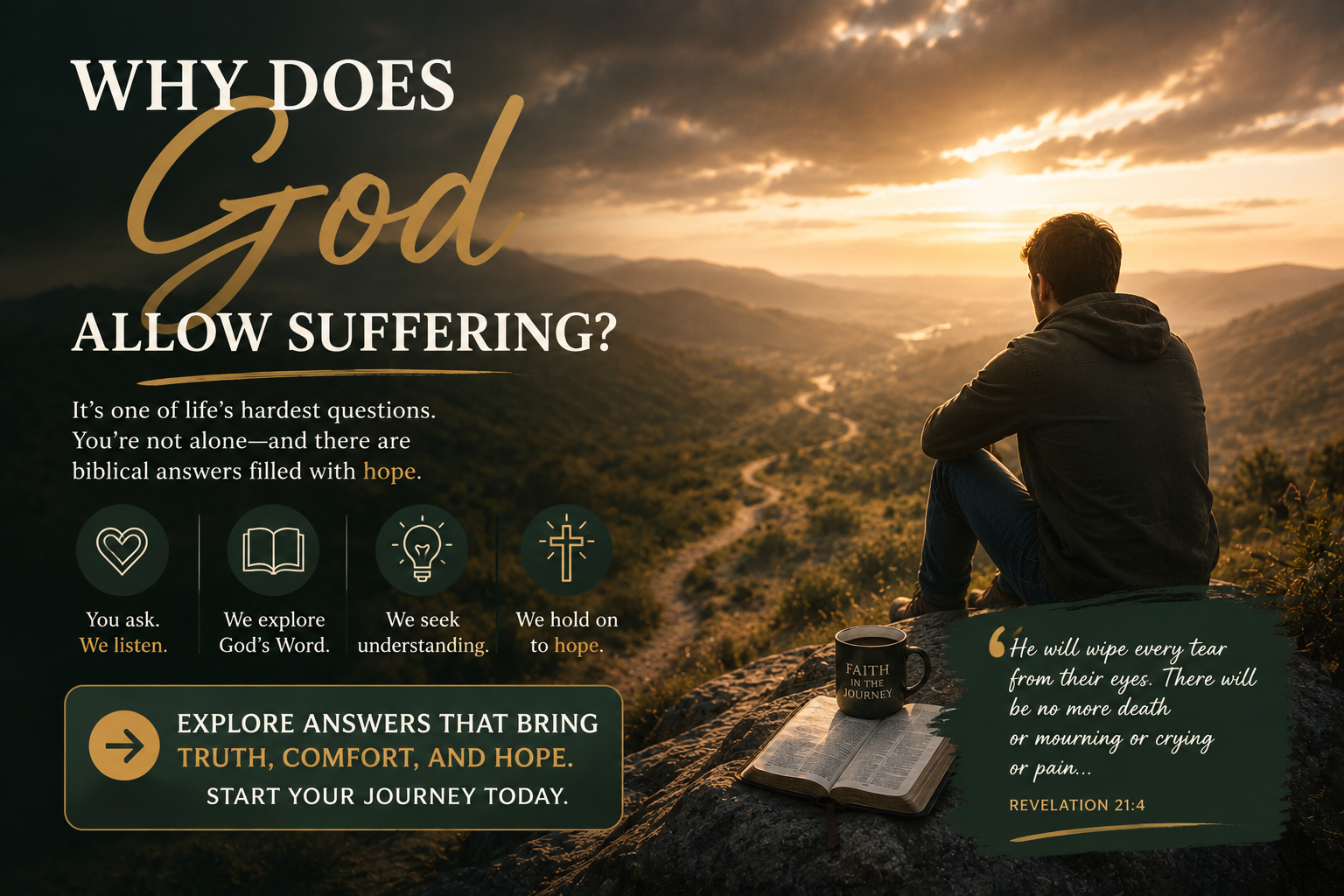
The Big Question: Why does God Allow Suffering?
Let’s start where this question actually lives — not in a philosophy class, but in real life.
A man comes home from three combat deployments carrying things he cannot put down. A woman watches her husband of forty years disappear into dementia one conversation at a time. A family buries a child. A veteran who made it home loses the battle anyway — alone, in the dark, on a Tuesday night nobody saw coming.
And somewhere in all of that, the question surfaces. Sometimes it comes out as anger. Sometimes as silence. Sometimes as a quiet resignation that maybe there is no God after all — because if there were, how could He watch this and do nothing?
That question deserves a serious answer. Not a quick one. Not a bumper sticker. A real one.
First — The Question Itself Is Evidence of Something
Here is something worth noticing before we try to answer the question. The very fact that suffering feels wrong — that it strikes us as an outrage, an injustice, something that should not be — is itself a clue worth following.
If the universe is purely physical, with no God and no moral order behind it, then suffering is simply what happens. Molecules collide. Cells malfunction. People die. There is no wrong about it — it just is. A universe with no God has no grounds for calling anything unjust. Things happen. That is all.
But nobody actually lives that way. When a child dies, nobody says “well, that’s just molecules rearranging.” They say it is wrong. Deeply, fundamentally wrong. That moral outrage — that insistence that things should be different — points toward a standard outside ourselves by which we are measuring reality and finding it short.
Tim Keller made this observation in his work on suffering: the very indignation we feel about evil and pain actually presupposes a moral order that a purely material universe cannot provide. In other words, the intensity of our objection to suffering is, in a strange way, evidence that the universe was made for something better. Which is exactly what the Bible claims.
What the Bible Actually Says About Suffering
The Bible does not explain suffering away. It does not tell people to smile and pretend the pain is not real. What it does is something more honest and more useful — it tells the truth about where suffering comes from, what God thinks about it, and what He has done about it.
The world God made was good. That is not a sentimental claim — it is the Bible’s starting point in Genesis 1. Creation was designed for flourishing, for relationship, for life. The suffering we experience now is not what God built. It is what entered when the creation turned away from Him. Paul writes in Romans that “the whole creation has been groaning” under the weight of that turning (Romans 8:22) — not as God’s original design, but as the consequence of a world bent out of its true shape by human rebellion.
That matters because it means God is not the author of suffering. He is not sitting unmoved in heaven, indifferent to what is happening on the ground. He made a world for goodness. Something went wrong with it. And the entire arc of Scripture is the story of what He is doing about that.
The Hardest Objection — and the Honest Answer
Someone will say — and it is a fair thing to say — that even if sin explains suffering in general, it does not explain why God does not stop specific instances of it. Why does He not intervene? Why does He allow the cancer to spread, the accident to happen, the predator to harm the innocent? If He is all-powerful and all-loving, the suffering that actually occurs seems to demand an explanation.
This is the sharpest edge of the question, and it does not have a simple answer. But it has a real one.
Part of the answer is that a world in which God intervened to prevent every painful consequence of human freedom would not be a world of genuine freedom at all. It would be a controlled environment — and the love that grows in a controlled environment is not real love. God made creatures capable of genuine relationship with Him, which required the possibility of genuine rejection. That rejection has consequences that ripple outward into the world. The freedom that makes love possible is the same freedom that makes suffering possible.
But that answer, taken alone, can feel cold. And the Bible does not leave it there.
God Did Not Stay on the Sidelines
The most important thing to say about suffering is not a philosophical argument. It is a historical event.
The God who made the world entered it. He was born in a stable in a backwater town. He grew up in poverty in an occupied country. He was misunderstood by His family, betrayed by His friends, tortured by the authorities, and executed publicly in the most humiliating manner the ancient world had devised. He cried at a graveside (John 11:35). He sweat drops of blood in a garden the night before He died (Luke 22:44). He cried out from the cross — using the words of Psalm 22 — “My God, my God, why have you forsaken me?” (Matthew 27:46).
That is not the behavior of a distant God who watches suffering from a safe remove. That is a God who walked into the worst of it — not to explain it from the outside, but to bear it from the inside.
Isaiah, writing seven hundred years before the cross, described it this way:
“Surely he took up our pain and bore our suffering… he was pierced for our transgressions, he was crushed for our iniquities; the punishment that brought us peace was on him, and by his wounds we are healed.”
— Isaiah 53:4–5 (NIV)
The Christian answer to suffering is not primarily an argument. It is a Person — one who did not exempt Himself from the human condition but entered it fully, absorbed its worst, and came out the other side in resurrection. That changes the question. It does not make the pain disappear. But it means the person in pain is not alone in it — and that the God they are asking about is not untouched by what they are going through.
What Suffering Can Do — and What It Cannot
C. S. Lewis — who lost his wife to cancer after a late-in-life marriage he did not expect to find — wrote honestly about the experience of grief and suffering from the inside. He described the feeling of God going silent in the worst moments, of doors seeming to slam shut when you needed them most. He did not paper over it with easy answers.
But Lewis also observed something that many people in hard circumstances have found to be true: suffering has a way of stripping away what is not solid and leaving only what is. The comfortable assumptions, the easy faith, the things we trusted without examining — suffering tests all of them. And what survives that testing is something real.
Paul, writing from a prison cell, said something that sounds impossible until you have seen it in someone’s life:
“We also glory in our sufferings, because we know that suffering produces perseverance; perseverance, character; and character, hope.”
— Romans 5:3–4 (NIV)
That is not a cheerful spin on a bad situation. It is an observation about what God is capable of doing with pain — not wasting it, but working through it toward something that cannot be produced any other way. The hope Paul is talking about is not wishful thinking. It is a confidence forged in difficulty that the God who brought His Son through the grave is not finished with His people yet.
The Promise That Holds
The Bible does not promise that suffering will make sense on this side of eternity. Job — a man who lost everything and demanded an explanation from God — did not get a tidy answer. He got something better. He got God Himself, showing up in the whirlwind, making it plain that the God behind the universe is larger than any framework Job had been using to measure Him (Job 38:1–4).
What the Bible does promise is that suffering is not the last word. Paul writes that “our present sufferings are not worth comparing with the glory that will be revealed in us” (Romans 8:18). John, in Revelation, describes the end of the story in these terms:
“He will wipe every tear from their eyes. There will be no more death or mourning or crying or pain, for the old order of things has passed away.”
— Revelation 21:4 (NIV)
That is not escapism. It is the logical conclusion of a story that began with a good creation, moved through a broken world, passed through a cross and an empty tomb, and ends with everything wrong being made right by the God who never abandoned what He made.
The suffering is real. The grief is real. The questions are real. But so is the God who entered the suffering, bore it in His own body, and promises to bring His people through it to something that will make the hardest chapters of this life look, in retrospect, like the darkness before dawn.
Key Takeaways
- The moral outrage we feel about suffering is itself a clue. If there were no God and no moral order, suffering would simply be what happens — there would be no grounds to call it wrong. Our insistence that it is wrong points toward a standard outside ourselves and a world made for something better.
- God is not the author of suffering — but He has not stayed distant from it. The Bible traces suffering to the consequences of a creation bent out of its true shape. And the God who made the world entered it in Christ — not to explain suffering from the outside, but to bear it from the inside.
- The cross is the center of the Christian answer to suffering. Jesus did not exempt Himself from pain, betrayal, grief, or death. He walked through all of it. That means no one who suffers is suffering in territory God has not already crossed.
- Suffering is not wasted in God’s hands. Paul’s witness — written from a prison cell — is that God works through difficulty to produce something that cannot be produced any other way: a hope forged in reality rather than built on comfort.
- Suffering is not the last word. The Bible’s promise is not that everything will make sense now, but that the God who raised Jesus from the dead is not finished. Every tear, every loss, every unanswered question is held by a God who has promised to make all things new.
A Final Word
If you are reading this in the middle of something hard — not as an intellectual exercise but because you are actually in pain and genuinely wondering where God is — then the most important thing to say is this:
He is not absent. He is not indifferent. And He is not surprised by what you are going through.
The God of the Bible is not a distant force watching events unfold from a safe distance. He is the God who showed up in the middle of human suffering in the person of Jesus Christ, who wept at Lazarus’s tomb, who sweat blood in Gethsemane, who cried out from the cross. He knows what it costs. He paid it Himself.
You may not get the explanation you are looking for — not yet, maybe not in this life. But you can have the presence of the One who has already been through the worst of it and came out the other side. And in the end, that is not a small thing.
That is everything.
Key Scriptures:
Romans 8:18–28 | Isaiah 53:4–5 | John 11:35 | Romans 5:3–4
Job 38:1–4 | Matthew 27:46 | Revelation 21:4 | Psalm 22:1
Mountain Veteran Ministries
Find Your Next Bearing
Every journey needs a direction. If you're wondering where to go from here, choose the path that best fits where you are today.
⚒️ I Want to Live Faithfully
Discover practical wisdom for following Christ in today's world.
→ Living as a Christian Today✝️ I Want to Understand the Gospel
Learn what salvation means and why Jesus came.
→ Understanding Salvation📖 I Want to Understand the Bible
Explore why Christians trust Scripture and how to read it well.
→ Understanding the Bible❓ I Still Have Questions
Explore thoughtful answers to some of Christianity's hardest questions.
→ Hard Questions