Why Is God So Morbidly Violent in the Old Testament?
How Walton, Copan, Keller, Wright, Longman, Boyd, and Stott Address One of Scripture’s Hardest Questions
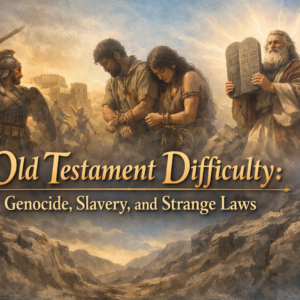
There are parts of the Bible that make us genuinely uncomfortable — and intellectual honesty requires saying so. One of the hardest questions believers and skeptics alike ask is this: why is God so violent in the Old Testament? Is He different from the loving Jesus of the New Testament?
Cities destroyed. Nations wiped out. Divine commands to make war. What are we supposed to make of all that?
This is not a question to sidestep. Christian leaders and scholars have engaged it seriously, and their answers form a coherent — if multi-layered — response. Here are seven frameworks they offer for understanding what is happening in those difficult texts, and how they connect to the God revealed in Christ.
“In the past God spoke to our ancestors through the prophets at many times and in various ways, but in these last days he has spoken to us by his Son.” — Hebrews 1:1–2
Seven Frameworks for Understanding God and Violence in the Old Testament
Framework One
Context Is Essential — God Was Working Within a Violent World
The first thing to understand is the cultural and historical context. The Old Testament did not occur in a stable, peaceful society. It was written in and about the ancient Near East — a world where war, conquest, and political violence were embedded in the normal structure of life in ways that are difficult for modern Western readers to appreciate.
John Walton argues that many of God’s commands — including those that seem most troubling to us — were accommodations to that ancient world rather than endorsements of it. God was not working with angels. He was working with people shaped by a culture saturated with violence, gradually leading them toward a righteousness that could not be imposed overnight. Understanding the accommodation does not explain everything, but it changes the interpretive frame significantly.
Framework Two
Divine Judgment Has a Moral Basis — This Was Not Arbitrary Violence
One of the most contested passages is God’s command to destroy the Canaanite nations (Deuteronomy 7:1–5, Joshua 6). To modern ears this sounds like ethnic cleansing. But Paul Copan and other scholars have pressed back on that framing: the Canaanites were not peaceful neighbors minding their own business. They practiced child sacrifice, ritual temple prostitution, and widespread violence that had corrupted the land for generations. Their destruction was not arbitrary — it came after centuries of accumulating moral horror, and after God had waited for the kind of repentance that never came.
This is not a comfortable answer. But it is a theologically coherent one. A God who is genuinely holy and genuinely just cannot be permanently indifferent to radical evil. The question is not whether evil eventually faces judgment — it’s whether we trust God’s assessment of when and how that judgment is warranted.
Framework Three
Mercy Always Preceded Judgment — God Was Never Quick to Destroy
Tim Keller reminds readers that God’s first move was consistently mercy, not judgment. The story of Nineveh is the clearest demonstration: the Assyrians were among the most brutal empire-builders in the ancient world, and yet when Jonah brought them warning, they repented — and God immediately relented (Jonah 3:10). He was looking for exactly that response. With Israel itself, Exodus 34:6 describes God as “the compassionate and gracious God, slow to anger, abounding in love and faithfulness.” That is the same God who eventually disciplines and judges.
Even the Canaanite judgment was not sudden. God told Abraham four centuries in advance that the judgment was coming — and that it was not yet time because the iniquity of the Amorites was “not yet full” (Genesis 15:13–16). Four hundred years of patience before judgment fell. The God of the Old Testament is not hair-trigger in His wrath. He is patient to a degree that strains human comprehension.
Framework Four
Progressive Revelation — Jesus Is the Full and Final Picture of God
Scripture is not a flat document in which every part carries equal revelatory weight. It is a progressive unfolding — each stage building on what came before, each clarifying what remained partially understood. The Old Testament is the foundation; Jesus is the fulfillment. He is not a contradiction of the Old Testament God but His most complete self-disclosure.
Greg Boyd takes this further than most, arguing that some depictions of divine violence may reflect the human authors’ misunderstanding of what God was doing — a view that not all evangelicals share. But his broader point is widely affirmed: what appears partial or difficult in the Old Testament is clarified and resolved in Christ. Hebrews 1:1–2 makes this explicit. God has spoken at many points and in many ways — but His final, definitive word is His Son. Read the Old Testament through that lens, and the picture becomes coherent in ways it cannot be when each passage is read in isolation.
Framework Five
Not All Biblical Violence Is Commanded — Some Is Simply Human Rebellion Recorded
A critical interpretive principle: the Bible records many things it does not endorse. Judges 19 contains one of the most disturbing accounts in all of Scripture — the abuse and murder of a Levite’s concubine, followed by tribal warfare and mass violence. This was not God’s will. It was what happened when, as the book of Judges repeatedly observes, “everyone did what was right in their own eyes” (Judges 21:25). The text is a description of human depravity, not a divine prescription for it.
Tremper Longman III and others press this point: much of the violence in the Old Testament is there as honest testimony to what humans do when they reject God’s order — not as a model for what God desires. Reading descriptive passages as prescriptive ones is an interpretive error that generates false problems. The Bible is not always saying “do this.” Sometimes it is saying “this is what happens when you don’t.”
Framework Six
The Arc of Scripture Bends Toward Peace — God’s Endgame Is Shalom
Whatever role war and judgment play in specific Old Testament episodes, they are not the destination Scripture is heading toward. The prophetic vision consistently moves in a different direction: swords beaten into plowshares, enemies reconciled, the nations streaming to Zion, a King who comes not on a war horse but on a donkey. The Prince of Peace. The trajectory is unmistakable.
Christopher Wright argues that you cannot understand any part of the Old Testament without understanding the whole — and the whole is moving toward redemption and restoration. The violence is in the story, but it is not the story’s destination. Revelation 21 describes the final state as a place with no more death, sorrow, crying, or pain. That is what God has always been building toward, even through the painful episodes that preceded it.
Framework Seven
The Cross Redeems the Narrative — God Takes the Violence on Himself
This is the framework that holds all the others together. The God of the Old Testament does not stand at a safe distance from judgment and violence — He enters into it. In Jesus, God does not merely punish sin. He takes the punishment on Himself. The cross is the place where justice and mercy, wrath and grace, judgment and forgiveness collide — and are resolved in a way that no earlier act of divine judgment could have achieved.
John Stott made this the center of his theology: if you want to understand God’s relationship to violence and suffering, look at the cross. There you find God not as the wielder of violence but as its ultimate absorber. Whatever God required of others in the Old Testament, He ultimately required of Himself — at infinite cost. That is the climax toward which every act of Old Testament judgment was pointing, and the reality in which they find their final meaning.
Seven Frameworks — in Summary
If you’ve ever read the Old Testament and wondered how a loving God could do what you’re reading — you’re not alone. The Bible never asks us to enjoy divine judgment. But it does ask us to trust that God sees what we cannot, and that the same God who acts with perfect justice also acts with immeasurable mercy.
The Christian answer to these hard texts is not to ignore them or explain them away. It’s to read them through the lens of Jesus — who shows us the full heart of God — and to trust that the One who bears the wounds of the cross is the same One who pronounced judgment in Canaan. That God, it turns out, is not two different Gods. He is one God, whose justice and love were always heading toward the same place: a cross, an empty tomb, and a world made new.
“He was pierced for our transgressions, he was crushed for our iniquities; the punishment that brought us peace was on him, and by his wounds we are healed.” — Isaiah 53:5
Key Scriptures: Hebrews 1:1–2 · Genesis 15:13–16 · Isaiah 53:5; 2:4 · Leviticus 18:24–25 · Jonah 3:10 · Exodus 34:6 · Judges 21:25 · Revelation 21:4 · Isaiah 9:6
Want to Go Deeper?
This is one of the most serious questions in biblical apologetics. These companion posts and resources address the broader framework it requires:
- Can God Command Evil? — the companion MVM post examining the Euthyphro dilemma and the specific hard passages (Abraham/Isaac, the Canaanite conquest) with the theological tools they deserve
- What Is Truth? — why the God who pronounces judgment in the Old Testament and the God who absorbs it at the cross are the same God, and what that tells us about the unity of Scripture
- The Cost of Forgiveness — how the cross resolves the justice-mercy tension that runs through every act of divine judgment in the Old Testament
- Is God a Moral Monster? — Paul Copan; the most thorough scholarly engagement with the difficult Old Testament passages at a level accessible to non-specialists
- The God I Don’t Understand — Christopher Wright; a senior Old Testament scholar’s honest and pastoral treatment of the passages that trouble us most
- Subscribe to get new posts delivered straight to your inbox — gospel-rooted, plain-spoken truth for the week ahead.
“The Lord is compassionate and gracious, slow to anger, abounding in love.” — Psalm 103:8
Mountain Veteran Ministries
Find Your Next Bearing
Every journey needs a direction. If you're wondering where to go from here, choose the path that best fits where you are today.
⚒️ I Want to Live Faithfully
Discover practical wisdom for following Christ in today's world.
→ Living as a Christian Today✝️ I Want to Understand the Gospel
Learn what salvation means and why Jesus came.
→ Understanding Salvation📖 I Want to Understand the Bible
Explore why Christians trust Scripture and how to read it well.
→ Understanding the Bible❓ I Still Have Questions
Explore thoughtful answers to some of Christianity's hardest questions.
→ Hard Questions