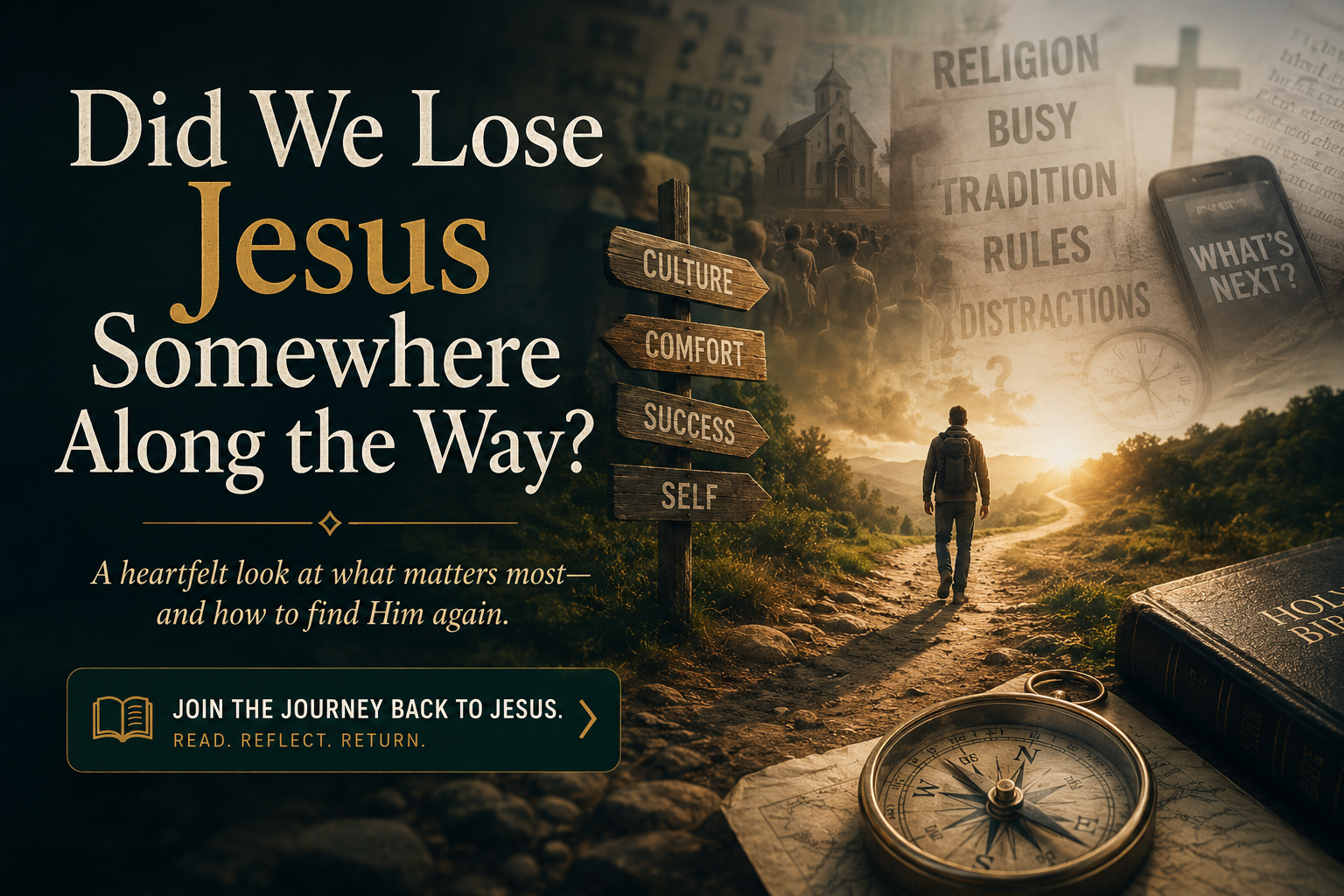
Did We Lose Jesus Somewhere Along the Way?
If centuries of competing theologies and thousands of denominations have left you wondering whether we’ve lost the real Jesus somewhere along the way, you’re not alone — and you’re not crazy. Jesus himself warned that false teachers and conflicting voices would multiply, so the noise you’re hearing isn’t proof Christianity failed; it’s proof He was right. This article offers a clear, biblical test for sorting the traditions of men from the voice of the Good Shepherd, and a reminder that following Jesus was always meant to be a verb, not just a position paper.
Two thousand years of theology, thousands of denominations, and one Savior who never changes — here’s how to tell the difference between the traditions of men and the voice of the Good Shepherd.
The Vertigo Is Honest
You didn’t come here looking for a nice, safe answer, so I’m not going to hand you one. If you’ve spent any real time in church history, you’ve felt the vertigo. Peter walked dusty roads with Jesus. James was his half-brother, sat across the table from him at family meals. And within a few centuries, that plain, dirt-road gospel had grown into ecumenical councils, warring creeds, splintering denominations, and shelves heavy enough with systematic theology to build a house from. Fast-forward two thousand years and you’ve got tens of thousands of denominations, each with a preacher who’s certain he’s got it figured out, each one pointing you toward a different shelf. Add a culture that’s hostile to the whole project, and it’s honest to ask: did we lose Jesus somewhere along the way? Is anybody actually still following him, or are we all just following each other now?
That question isn’t unbelief. It’s the beginning of discernment waking up. And Scripture has more to say about it than you might expect.
Jesus Told Us This Would Happen
Here’s the first thing worth knowing: none of this surprised Jesus. He told his disciples plainly that false prophets would come dressed to look exactly like the real thing — wolves in sheep’s clothing (Matthew 7:15). Paul, saying goodbye to the elders of Ephesus, warned them just as bluntly: after he left, savage wolves would come in among the flock — and some of that distortion would rise up from inside their own ranks, men twisting the truth to build a following for themselves (Acts 20:29-30). He’d already watched it happen in Galatia, where believers he’d personally led to Christ were turning to a different gospel within months of his leaving (Galatians 1:6).
So when two thousand years of competing theologies leave you wondering how it got this complicated, here’s the honest answer: this is exactly what Jesus and Paul said would happen. The noise isn’t proof the gospel failed. It’s proof they were telling the truth about what would come after them.
The Ground That Doesn’t Move
Here’s the second thing, and it’s the one that actually holds you steady: the real Jesus was never lost. Hebrews 13:8 says he’s the same yesterday, today, and forever — not a moving target reinvented by every century’s theologians, but a fixed person whose words and life are preserved in the four Gospels, documents rooted in eyewitness testimony and written within living memory of the events they describe. The original mission you’re longing to find isn’t buried under layers of tradition. It’s sitting right there in Matthew, Mark, Luke, and John, available to anyone willing to actually read it.
Jesus himself had strong words for religious leaders who buried God’s actual commands under human tradition. He told the Pharisees they had let go of the commandment of God to hold onto the traditions of men — tidy religious practice, dressed up to look like obedience, but hollow at the center (Mark 7:8-9). Paul echoed the same warning to the Colossians: watch out for anyone who takes you captive through hollow philosophy and human tradition rather than through Christ (Colossians 2:8). And he told Timothy that Scripture itself — not the latest theologian, not the most charismatic preacher — is what makes a person complete and equipped for every good work (2 Timothy 3:16-17).
Put those together and you get something important: testing a tradition against Scripture isn’t disrespecting two thousand years of church history. It’s exactly what Jesus told you to do.
“The original mission you’re longing to find isn’t buried under layers of tradition. It’s sitting right there in Matthew, Mark, Luke, and John, available to anyone willing to actually read it.”
A Test Anyone Can Run
So how do you actually sort through the noise? Scripture gives you a method, not just a warning.
When Paul preached in Berea, Luke tells us the believers there were more noble than the ones in Thessalonica, because they didn’t just take his word for it — they searched the Scriptures every day to see whether what he said was true (Acts 17:11). Think about that. An actual apostle, personally commissioned by the risen Christ, and the Bereans still checked his sermons against the text. If Paul’s preaching had to pass that test, so does every preacher, podcast, denomination, and theological system since.
John gives the same instruction from another angle: don’t believe every spirit, test them, because many false prophets have gone out into the world (1 John 4:1). Paul tells the Thessalonians to test everything and hold fast to what’s good (1 Thessalonians 5:21). Practically, that means when a teacher or tradition asks for your allegiance, you ask: does this match what the Gospels actually show Jesus saying and doing? Does it hold up against the whole of Scripture, or is it built on one verse pulled out of context and propped up on its own?
Not Every Disagreement Is Betrayal
Now, a word of caution, because this is where a lot of sincere people swing too far. Not every denominational difference is a departure from Jesus. Paul spent a whole chapter telling the Roman church not to pass judgment on each other over disputable matters — things believers could genuinely disagree on in good conscience without either side abandoning the gospel (Romans 14:1-12).
There’s a real difference between essentials and secondary matters. The deity of Christ, his bodily resurrection, salvation by grace through faith, the authority of Scripture — these are the hills worth dying on. Church government, the finer points of end-times timelines, worship style — these are the foothills. Most of the thousands of denominations that trouble you aren’t thousands of different gospels; they’re one gospel, applied across different cultures, church-government convictions, and secondary readings of secondary passages. Sorting essentials from secondary matters won’t erase all the confusion, but it cuts it down to something you can actually navigate.
Following Jesus Is Still a Verb
Here’s the last piece, and it might be the most important one: the surest test of a tradition isn’t just what it teaches — it’s who it produces. Jesus didn’t say the world would know his disciples by their doctrinal statements. He said they’d know them by their love for one another (John 13:34-35). He told his followers that following him meant taking up a cross daily — real, ongoing, costly obedience, not just a settled position paper (Luke 9:23). Micah put it plainly centuries earlier: what does the Lord require but to do justice, love kindness, and walk humbly with your God (Micah 6:8).
A hostile, divided world doesn’t need one more perfectly footnoted argument. It needs to see people who actually look like Jesus — humble, honest, sacrificial, quick to forgive, slow to grandstand. Whatever tradition you land in, that’s the fruit that proves the root is good.
The Church Jesus Is Still Building
So where does that leave you? Standing on ground steadier than it feels. Jesus promised that the gates of hell would not prevail against the church he builds (Matthew 16:18) — his church, not any single denomination’s franchise of it. And on the night before he died, he prayed that his followers would be one, so that the world would believe (John 17:20-23). That prayer hasn’t expired. It’s still being answered, imperfectly, in every believer who tests what they’re taught against Scripture, holds the essentials with conviction and the secondary matters with grace, and follows Jesus with an actual, daily life instead of just a doctrinal position.
You don’t need to master two thousand years of theology to follow him well. You need Scripture in your hand, humility in your heart, and a willingness to test everything you hear — including this article — against the record of the man who walked out of that tomb.
Key Takeaways
- The confusion is not new. Jesus and Paul both warned that false teachers and competing voices would multiply — their presence confirms His words rather than undermining them.
- Scripture is the test, not tradition. Every preacher, denomination, and theological system answers to the Gospels and the whole of Scripture — not the other way around.
- Not every disagreement is heresy. Distinguish the essentials of the gospel from secondary matters believers can disagree on in good conscience.
- Doctrine proves itself in obedience. A tradition’s soundness shows up in whether it produces people who love, serve, and walk humbly like Jesus did.
- Christ is still building His church. Fracture and confusion do not have the final word — Jesus promised His church would stand.
Key Scriptures: Matthew 7:15-20; Matthew 16:18; Mark 7:1-13; Luke 9:23; John 13:34-35; John 17:20-23; Acts 17:10-12; Acts 20:29-30; Romans 14:1-12; Galatians 1:6-9; Colossians 2:8; 1 Thessalonians 5:21; 2 Timothy 3:14-17; Hebrews 13:8; 1 John 4:1; Micah 6:8
Mountain Veteran Ministries
Find Your Next Bearing
Every journey needs a direction. If you're wondering where to go from here, choose the path that best fits where you are today.
⚒️ I Want to Live Faithfully
Discover practical wisdom for following Christ in today's world.
→ Living as a Christian Today✝️ I Want to Understand the Gospel
Learn what salvation means and why Jesus came.
→ Understanding Salvation📖 I Want to Understand the Bible
Explore why Christians trust Scripture and how to read it well.
→ Understanding the Bible❓ I Still Have Questions
Explore thoughtful answers to some of Christianity's hardest questions.
→ Hard Questions