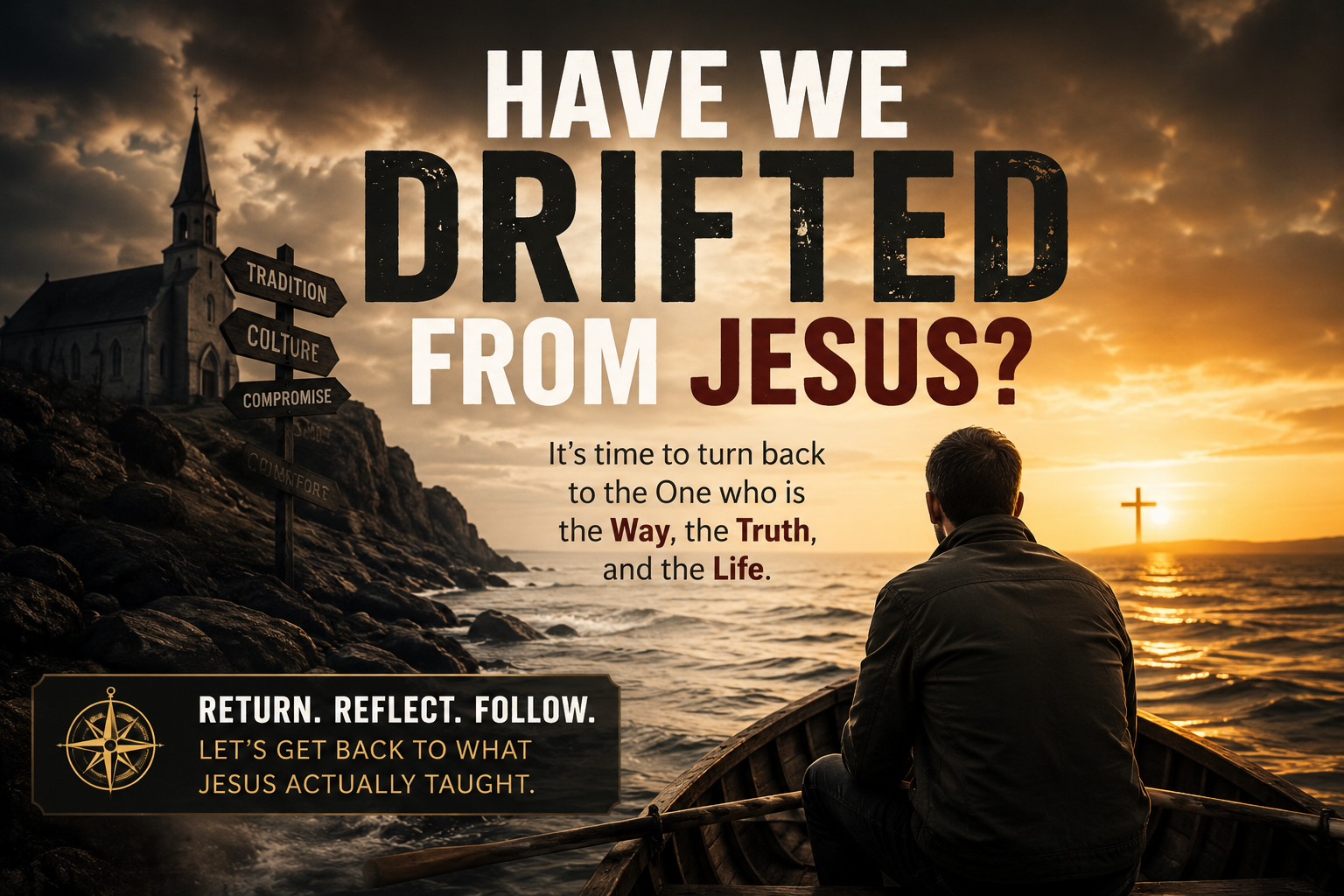
Have We Drifted from Jesus?
There’s a question that’s been working on a lot of serious Christians lately: have we made following Jesus more complicated than He ever intended it to be? After two thousand years of denominations, creeds, controversies, and our favorite teachers, how much of what we call “Christianity” actually came from Christ Himself — and how much is us? That’s worth clearing the table to find out.
Sometimes the road back to Jesus runs straight through everything we’ve built up around Him.
I’ve been an Elder in this church long enough to know a hard truth about myself: it’s a lot easier to defend my theological system than it is to sit quietly under Jesus. And I don’t think I’m alone in that. A question has been working on a lot of serious Christians lately, and it’s not a comfortable one. After two thousand years of denominations, creeds, confessions, movements, controversies, and our favorite teachers — how much of what we call “Christianity” actually came from Christ Himself, and how much of it is us?
Now hear me clearly. That’s not an argument against theology. I’ve spent a good part of last years of my life studying it, teaching it, and I believe it matters. It’s not an argument against the church either — Christ died for His church, and He’s not finished with her. It’s certainly not an argument that two thousand years of Christian thought should get thrown in the ditch.
But it is an argument for clearing the table every once in a while.
Put aside Calvinism and Arminianism for a minute. Put aside Reformed, Baptist, Methodist, Pentecostal, dispensational, and covenantal labels. Put aside our favorite preacher, whoever that is for you. Put aside even the great teachers we admire — Lewis, Keller, MacArthur, Calvin, Augustine, Spurgeon. Then open the Gospels and ask a simple question: Jesus, what did You actually say?
That might be one of the most important questions facing the church today.
The Problem Didn’t Start with Denominations
The tension between God’s Word and man’s religious tradition didn’t begin with us. Jesus confronted it Himself, standing across from men who knew Scripture better than most of us ever will. They studied it. They debated it. They built detailed systems to explain how God’s people ought to live. And Jesus looked at them and said something that ought to make every Christian tradition — including mine, including yours — a little uncomfortable.
“You have let go of the commands of God and are holding on to human traditions.” — Mark 7:8
He wasn’t done.
“Thus you nullify the word of God by your tradition that you have handed down.” — Mark 7:13
Notice something. Tradition itself wasn’t the sin. The danger showed up when the interpretation surrounding God’s Word got so heavy that people couldn’t tell the difference anymore between what God actually commanded and what religious folks had concluded about it. That danger didn’t retire after the resurrection. If anything, two thousand more years have given us a lot more opportunity to do the exact same thing.
An Old House with a Lot of Additions
Picture an old farmhouse that’s been remodeled by every generation that’s lived in it. One owner added a room. Another enclosed the porch. Another moved a wall. Another ran new plumbing and wiring. Walk through that house today and you might have a hard time telling which parts were there from the start.
Christianity can feel a lot like that old house. The foundation is still there — Jesus Christ, His death, His resurrection, repentance, faith, grace, forgiveness, the kingdom of God, the Holy Spirit, love of God and neighbor, discipleship, the hope of resurrection. But around those truths, Christians have built enormous structures. Some of them are genuinely helpful. Some protect biblical truth. Some had to be built because false teaching demanded an answer. But some have grown so large that the structure starts getting more attention than the foundation it was supposed to protect.
And a man can find himself defending his theological system’s explanation of Jesus more passionately than he’s actually listening to Jesus.
Lewis: Find the Hallway Again
C. S. Lewis is a good place to start, and not because he wanted a watered-down faith. He wasn’t building a religion palatable to everybody. He was trying to identify the great center of Christianity — the faith Christians across the centuries had broadly confessed, long before anybody walked into the rooms of denominational disagreement.
Lewis pictured Christianity as a house. “Mere Christianity” was the hallway. The different Christian traditions were the rooms branching off it. He never said believers should camp out in the hallway forever — eventually you’ve got to walk into an actual room, worship in an actual church, live in an actual Christian community. But the hallway reminds us of something important: the room isn’t the house. Our denomination isn’t Christianity. Our tradition isn’t Christianity. Our favorite preacher isn’t Christianity. Our political tribe certainly isn’t Christianity.
At the center stands Christ. That gives us a useful question to ask about our own churches — not “are we winning the theological argument,” not “is attendance climbing,” not “are we conservative enough or progressive enough,” but: are people becoming more like Jesus Christ? That question cuts clean across every Christian tribe there is.
MacArthur: Scripture Is Enough
John MacArthur comes at this from a more explicitly Reformed, Protestant direction than Lewis, and his central concern is the sufficiency of Scripture — that God’s Word gives His people everything they need for salvation, sanctification, church life, ministry, and hope. No add-on is required to complete what God has already revealed.
That should produce real humility in us, because every generation feels the pull to add something. Tradition says, “You need Scripture plus our tradition.” Culture says, “You need Scripture plus contemporary morality.” Politics says, “You need Scripture plus our program.” Consumer religion says, “You need Scripture plus techniques for a successful life.” Celebrity Christianity says, “You need Scripture interpreted through this one teacher.” MacArthur’s warning underneath all of it is simple: God has already spoken. The church doesn’t stand above His Word. Neither does the preacher, the denomination, or the theologian. We stand under it.
But here’s the irony worth sitting with — we can proclaim Scripture alone with our mouths while quietly practicing “Scripture plus my interpretation of Scripture” with our hearts. The Bible is infallible. I am not. The Bible is authoritative. My theological system isn’t equally authoritative. A Calvinist can read the text through Calvinist assumptions, an Arminian through Arminian ones, a dispensationalist can find dispensational categories everywhere he looks, and a man convinced he’s above all systems can build the tallest system of all. Recognizing that we all bring something to the text doesn’t destroy biblical authority — it should make us more dependent on it, not less.
Keller: Right Doctrine, Wrong Center
Tim Keller adds a piece that’s easy to miss. He was thoroughly committed to historic Christian doctrine, and he still warned that correct doctrine doesn’t automatically produce a gospel-centered church. In his book Center Church, Keller drew a line between a church’s doctrinal foundation and what he called its “theological vision” — the way those doctrines actually get lived out in a particular culture and ministry. His conviction was that the gospel of grace has to reshape everything a church does, or the doctrine on paper stops matching the life in the pews.
A church can hold an orthodox statement of faith and still slowly drift to being centered on something else entirely — politics, culture wars, end-times speculation, church growth numbers, moral improvement, social causes, national identity, denominational loyalty, a favorite doctrine, a charismatic pastor, even theology itself. None of those things start out as enemies of the gospel. The danger comes when any one of them becomes the center. That gives us two honest questions to ask of any church, including our own: what does the statement of faith say, and what does the church actually talk about most? Those two answers aren’t always the same, and that gap is worth examining.
Back to Jesus Himself
This brings us back where we belong — the Gospels. When Jesus opened His ministry, Mark sums it up this way:
“The time has come. The kingdom of God has come near. Repent and believe the good news!” — Mark 1:15
Jesus didn’t just invite people to agree with a list of propositions. He said, “Come, follow me” (Matthew 4:19). That’s a good deal more demanding than nodding along. Christianity begins with believing something about Jesus, but biblical faith leads to trusting and following Jesus Himself.
“If you love me, keep my commands.” — John 14:15
He tells Nicodemus, “You must be born again” (John 3:7). He tells Martha, “I am the resurrection and the life” (John 11:25). He tells His disciples, “I am the way and the truth and the life. No one comes to the Father except through me” (John 14:6). And He tells everyone worn out by life, “Come to me, all you who are weary and burdened, and I will give you rest” (Matthew 11:28). Notice who keeps showing up in every one of those sentences. Not a system. Not a tradition. Him.
Christianity, at bottom, isn’t faith in Christianity. It’s faith in Christ.
Paul Never Left Jesus Behind
Sometimes we unintentionally put daylight between Jesus and Paul, as if Paul went off and built the theology while Jesus just told stories. Paul himself refuses that split. His message centers on Christ:
“For I resolved to know nothing while I was with you except Jesus Christ and him crucified.” — 1 Corinthians 2:2
And when Paul lays out the gospel he received and passed on, he starts with Christ’s death for our sins, His burial, and His resurrection (1 Corinthians 15:1-4). Paul did build theology — deep theology, the kind that’s kept scholars busy for two thousand years in the book of Romans alone. But Paul’s theology was never meant to replace Jesus. It was meant to explain just how enormous the reality of who Jesus is and what He accomplished truly is.
Theology works like a telescope. A good telescope makes the object clearer. Nobody spends the evening admiring the telescope — you look through it. Theology is valuable when it helps us see Christ more clearly. It gets dangerous the moment we become more fascinated with the instrument than with the Savior it was built to reveal.
How a System Quietly Takes Over
This rarely happens on purpose. It usually starts with a fair question. How does God’s sovereignty relate to human freedom? A system develops. How will Christ return? A system develops. How should a church be governed? A structure develops. How should we worship? A tradition develops. None of that is necessarily wrong — in fact, most of it is unavoidable. The trouble starts when we forget which direction authority is supposed to flow.
The right order runs: Christ, then Scripture, then theology, then tradition, then practice. The dangerous reversal runs the other way: tradition shapes theology, theology selects which Scriptures get emphasized, and the selected Scriptures shape our picture of Christ. When that happens, we’ve stopped letting Jesus challenge our system. Our system has started deciding beforehand what Jesus is allowed to mean.
Jesus had a warning for people who knew their Bibles extremely well:
“You study the Scriptures diligently because you think that in them you have eternal life. These are the very Scriptures that testify about me, yet you refuse to come to me to have life.” — John 5:39-40
A man can study Scripture hard and still miss Christ. That doesn’t mean we need less Bible. It means we need to understand what the Bible is actually pointing at. There’s a real danger in theological study that goes beyond simply getting a doctrine wrong — a man can become so occupied with Christianity that he loses sight of Christ Himself.
What’s Actually at the Center
Strip away the accumulated layers and what’s left isn’t a vague spirituality or “Jesus was a good teacher.” It’s something far stronger. There is one God. Humanity is created by Him and alienated from Him by sin. Jesus Christ is the Son of God who entered human history, proclaimed the kingdom, lived the life we failed to live, died for our sins, and rose bodily from the dead. Salvation is God’s gift of grace, and we’re called to repent and believe. Those united to Christ receive forgiveness and new life through the Holy Spirit. His followers are called to become disciples — loving God, loving one another, pursuing holiness, caring for the vulnerable, forgiving enemies, making disciples, and bearing witness to Christ. He will return. The dead will be raised. God will judge evil. And His people will dwell with Him in a renewed creation.
That’s not shallow religion. It’s astonishingly deep. Lewis’s “mere Christianity” was never meant as minimal Christianity. It means central Christianity.
Tradition Isn’t the Enemy
There’s an opposite error worth naming here. A man frustrated with churches might say, “Forget theology, forget tradition, I’ll just follow Jesus.” That sounds attractive on the porch, but it doesn’t hold up in the field. The Christians who came before us wrestled with enormous questions — who is Jesus, is He truly God, is He truly man, what is the Trinity, what is grace, what books belong in Scripture. We benefit tremendously from their labor. Lewis respected historic Christianity. Keller worked consciously inside the Reformed tradition. MacArthur teaches from a clearly defined Protestant framework. None of these men actually practiced “Bible without theology,” and neither can we. The moment you say “I think this verse means…,” you’re doing theology.
So the question was never “Bible or theology.” The question is whether our theology stays accountable to the Bible — and whether it keeps leading us toward Jesus Christ.
The Church Isn’t the Enemy Either
Disillusionment with a church can tempt a believer toward a solitary faith, just him and his Bible. But the New Testament doesn’t hand us that option. Lewis himself was clear that Christianity isn’t fundamentally solitary — believers belong to the Body of Christ and need the common life of the church. Acts describes the earliest Christians gathering for apostolic teaching, fellowship, breaking bread, prayer, generosity, worship, and shared life. The answer to an unhealthy church isn’t no church. The answer is a healthier understanding of church.
The church was never meant to be a religious corporation handing out spiritual products. She is the Body of Christ, and her head is not the pastor.
“Christ is the head of the church, his body.” — Ephesians 5:23
That truth alone ought to reshape church leadership from top to bottom. Pastors are shepherds. Elders are servants. Teachers are stewards. Christ remains Lord.
Seven Questions to Ask of Any Church
This calls for discernment more than anger. No church perfectly reflects the New Testament, no pastor perfectly interprets Scripture, and no congregation perfectly embodies Christ. The question isn’t perfection — it’s direction. A few questions can help.
Is Jesus actually central, not just mentioned? Does the preaching keep returning people to His identity, His cross, His resurrection, His teachings, His grace, His kingdom, His lordship, and His call to discipleship? Is Scripture allowed to challenge the church, or does the theological system already know beforehand what every passage must mean? Is the gospel producing humility — because grace should make Christians humble, and a theology that keeps producing superiority deserves a hard look? Are secondary doctrines being treated as tests of Christian legitimacy, when faithful Christians have disagreed on them for centuries? Are people actually becoming more like Jesus — growing in love, joy, peace, patience, kindness, goodness, faithfulness, gentleness, and self-control, the fruit Paul names in Galatians 5:22-23? Can honest questions be asked without being treated as rebellion? And finally, does the church make disciples of Jesus, or mainly defenders of its own system?
The Hardest Examination
It’s easy to examine a church. It’s harder to examine yourself. If I believe my church has grown captive to tradition, I have to ask whether I’ve grown captive to my reaction against tradition. If I believe others are too committed to Calvinism, Arminianism, dispensationalism, or politics, I have to ask whether I’ve made “being above all those systems” into my own system. If I believe others are proud of their theological certainty, I have to ask whether I’m becoming proud of my theological independence.
Jesus’ warning in Mark 7 applies to reformers every bit as much as it applies to traditionalists. We’re all extraordinarily capable of turning almost anything into an idol — including being right about other people’s idolatry. So the answer can’t be “my interpretation is better than theirs.” The answer has to stay: take me back to Christ.
A Way Forward
Maybe the way forward starts with a simple discipline. Read the New Testament again like you’re meeting Jesus for the first time. Start with Luke, then John, then Acts, then Romans, then the rest. Keep a notebook and ask a handful of honest questions. What does this tell me about Jesus? What does He say about salvation? What does He ask His followers to believe, and to do? What did the apostles teach the earliest Christians? Which things I presently believe come clearly from Scripture, and which come mainly from my tradition, or my culture? And the hardest one of all — what would I have to change if Jesus is right and I am wrong?
Don’t begin with Calvin. Don’t begin with Arminius. Don’t begin with Keller, MacArthur, or even Lewis. Begin with Jesus. Then let the great teachers of the faith sit around the table with you. Listen to them. Respect them. Learn from them. But never give any one of them the chair at the head of the table. That chair belongs to Christ.
If you’ve found yourself questioning what you’ve been taught, take heart — that questioning isn’t automatically a crisis of faith. Sometimes it’s a journey back through the accumulated layers of religion toward the One who’s been standing at the center all along. The answer was never to abandon what two thousand years of Christians have learned, and it was never to assume they got nothing right either. The answer is to recover the proper order: Christ at the center, Scripture as our authoritative witness, the gospel shaping everything, the Spirit doing the transforming, the church as Christ’s body rather than man’s institution, theology as servant rather than master, tradition as wisdom rather than revelation, and teachers as guides rather than final authorities — with the rest of us humble enough to keep learning.
The goal was never to win every theological argument or belong to the correct religious tribe. The invitation Jesus gave at the very beginning is still the invitation standing in front of us today: “Follow me.” When Christianity starts feeling bewilderingly complicated, that’s exactly where we need to begin again — not by throwing out everything the church has learned, but by laying all of it once more at the feet of Jesus Christ, and asking Him: Lord, what did You actually teach — and am I willing to follow wherever Your word leads?
Key Takeaways
- Tradition isn’t the enemy, but it isn’t infallible either. Jesus warned religious people who knew Scripture well that they could nullify God’s Word through their own tradition — a warning every generation, including ours, needs to hear.
- The room is not the house. Our denomination, tradition, or favorite teacher is not Christianity itself; Christ alone stands at the center that every genuine Christian tribe shares.
- Scripture must remain the standard, even over our own interpretations. We can affirm the Bible’s authority with our mouths while quietly elevating our reading of it above correction.
- Correct doctrine doesn’t guarantee a gospel-centered church. A congregation can hold an orthodox statement of faith while something other than the gospel actually shapes its life and ministry.
- Theology is a telescope, not the object. It’s valuable exactly to the degree that it helps us see Jesus more clearly — and dangerous the moment we admire the instrument more than the Savior.
- The way forward is Christ, not less church or more system. The remedy for an unhealthy church isn’t no church, and the remedy for shallow faith isn’t discarding theology — it’s laying everything back at the feet of Jesus and following Him.
Keep Digging Into God’s Word
If this stirred something in you, don’t stop here. Mountain Veteran Ministries has Bible studies and devotionals built for exactly this kind of honest, unhurried walk back to the center of the faith — Scripture-first, no jargon required.
“Your word is a lamp for my feet, a light on my path.” — Psalm 119:105
Key Scriptures: Mark 1:15; Mark 7:8, 13; John 3:7; John 5:39-40; John 11:25; John 14:6, 15; Matthew 4:19; Matthew 11:28; Matthew 28:19; Acts 17:11; Romans 3:27; 1 Corinthians 2:2; 1 Corinthians 15:1-4; Galatians 5:22-23; Ephesians 5:23
Mountain Veteran Ministries
Find Your Next Bearing
Every journey needs a direction. If you're wondering where to go from here, choose the path that best fits where you are today.
⚒️ I Want to Live Faithfully
Discover practical wisdom for following Christ in today's world.
→ Living as a Christian Today✝️ I Want to Understand the Gospel
Learn what salvation means and why Jesus came.
→ Understanding Salvation📖 I Want to Understand the Bible
Explore why Christians trust Scripture and how to read it well.
→ Understanding the Bible❓ I Still Have Questions
Explore thoughtful answers to some of Christianity's hardest questions.
→ Hard Questions