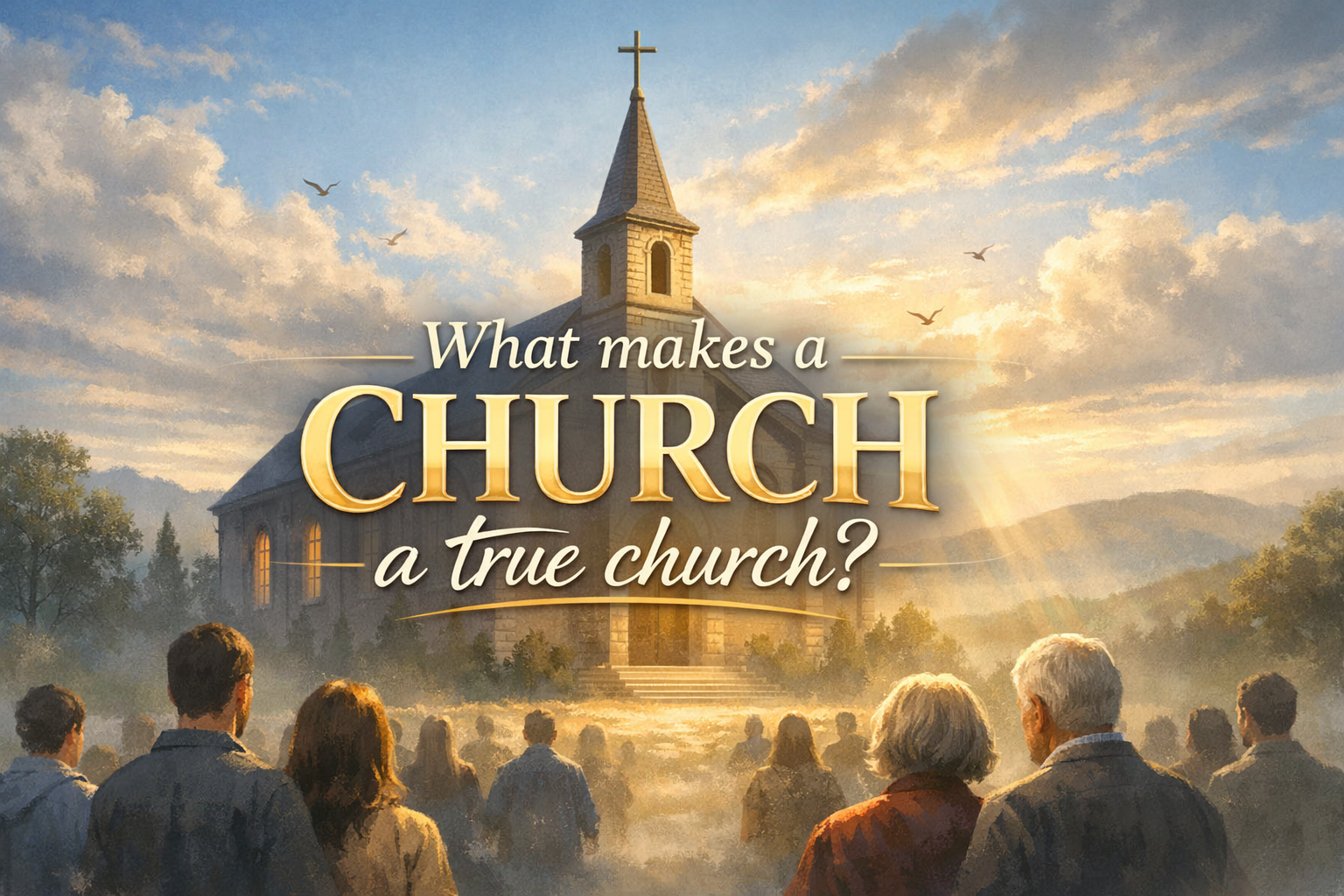
What makes a church a true church?
Not everything that puts a cross on its sign is the same thing. The Reformers had a precise answer to this question — and it’s more practical than it sounds.
Most people pick a church the way they pick a restaurant. Good parking. Friendly people. Music they like. Sermons that don’t run long. Programs for the kids. These aren’t bad things — but they’re not how the church has historically answered the question of what makes a gathering of people a true church of Jesus Christ rather than a religious club with better branding.
The question matters more than it might seem. If a church can be anything — any gathering, any message, any practice, any combination of beliefs as long as people feel good about it — then the word “church” means nothing. And if the word means nothing, the institution it names can become anything, including something that actively harms the people it claims to serve.
History has no shortage of examples. Churches that blessed slavery. Churches that funded genocide. Churches that denied the resurrection. Churches that replaced the gospel with therapeutic self-improvement. Churches that replaced the Word of God with the opinions of their most charismatic leader. At some point, someone has to be willing to ask: was that a church? Is this a church?
The Reformers of the sixteenth century asked that question with great precision — because they had to. They were breaking away from the Roman Catholic Church, which had declared itself the only true church, and they needed to articulate what actually constitutes a church rather than simply exchanging one claim to authority for another. What they arrived at has been the touchstone of Protestant ecclesiology ever since.
The Three Marks of the True Church
The Reformed tradition, drawing on Calvin, Luther, and the confessional documents of the sixteenth and seventeenth centuries, identified three marks — three essential characteristics — that distinguish a true church from a false one. These are not preferences or cultural choices. They are the structural load-bearing walls of the building. Remove any one of them and the building is not a church — it may be something, but it is not that.
The Pure Preaching of the Word
The first and most foundational mark is that the Word of God — Scripture — is faithfully, accurately, and centrally proclaimed. Not referenced occasionally. Not quoted to decorate other ideas. Not filtered through what the congregation wants to hear. Preached — expounded, applied, and held up as the authoritative word of God over the life of the congregation.
This is what distinguishes Christian preaching from religious speaking. A motivational speaker draws on whatever material serves the moment. A preacher of the Word submits himself and his congregation to what Scripture says, whether it is comfortable or not. Paul’s charge to Timothy is the standard: “Preach the word; be ready in season and out of season; reprove, rebuke, and exhort, with complete patience and teaching” (2 Timothy 4:2). In season and out of season — meaning when it’s welcome and when it isn’t.
The Reformers were specific about what “pure preaching” meant. It meant preaching that centers on the gospel — Christ crucified and risen for sinners. A church that preaches Scripture accurately but never arrives at the person and work of Jesus Christ has missed the point of the text. And a church that preaches Jesus sentimentally — as a life coach, a moral example, an affirming presence — without preaching the cross and the resurrection is preaching a different Jesus than the one the New Testament presents.
The Right Administration of the Sacraments
The second mark is the proper celebration of the two sacraments — baptism and the Lord’s Supper — as Christ instituted them. These are not optional additions to the Christian life. Jesus commanded them. “Go and make disciples of all nations, baptizing them in the name of the Father and of the Son and of the Holy Spirit” (Matthew 28:19). “Do this in remembrance of me” (Luke 22:19).
The sacraments are not magic. They don’t save you by being performed. But they are the God-ordained visible signs of the gospel — the Word made visible and tangible. Baptism is the sign of entry into the covenant community, of dying and rising with Christ, of being washed and set apart. The Lord’s Supper is the ongoing proclamation of Christ’s death until he comes, the repeated sealing of the covenant between Christ and his people.
A gathering that never baptizes and never takes communion is missing something structural. The sacraments keep the gospel concrete and embodied — they guard against the tendency of Christianity to drift into pure abstraction, a set of beliefs held privately with no communal expression.
The Reformers argued about exactly what happens in the sacraments — and those debates have produced real and lasting divisions between Lutheran, Reformed, and Baptist traditions. But all agreed that the sacraments must be observed, and that they must be connected to the Word — not performed as ritual disconnected from the gospel they signify.
The Faithful Exercise of Church Discipline
The third mark is the one most churches in our era have quietly abandoned — and its absence is doing serious damage. Church discipline is the loving, ordered process by which a congregation holds its members accountable to the life they have professed, addresses unrepentant sin, seeks restoration, and — as a last resort — removes from membership those who persistently and publicly reject the gospel they claim to believe.
Jesus establishes the principle in Matthew 18:15–20. Paul exercises it in 1 Corinthians 5 when he instructs the Corinthian church to remove the man living in unrepentant sexual immorality. The goal is not punitive — it is restorative. “When such a person is handed over to Satan for the destruction of the flesh, the spirit may be saved in the day of the Lord” (1 Corinthians 5:5). The discipline is severe. The goal is mercy.
A church without discipline is a church that cannot say “no” — and a church that cannot say “no” cannot say “yes” with any meaning. If membership means nothing, profession means nothing, and the church becomes a collection of people who have opted into a social group rather than a covenant community under the lordship of Christ.
This doesn’t mean churches should be harsh, trigger-happy, or spiritually abusive — those are real dangers and real failures. It means that genuine love for people requires genuine accountability. A shepherd who lets wolves into the flock because confronting them feels unkind is not a kind shepherd. He is a negligent one.
What Doesn’t Make a Church True
The three marks clarify what makes a church true. Equally important is what doesn’t — because the things people typically use to evaluate churches are largely beside the point.
❌ Size
A congregation of 6,000 with celebrity preaching and a coffee bar can be a false church. A congregation of 40 in a rented building can be a true one. The marks have nothing to do with attendance numbers.
❌ Emotion
Powerful worship experiences, tears, visible enthusiasm — these are not marks of a true church. Cults produce emotional intensity. The question is whether the Word governs the experience or the experience governs the Word.
❌ Social impact
A church that feeds the poor, builds schools, and runs excellent community programs may be doing genuinely good work — and may still be a false church if it has abandoned the gospel that gives that work its meaning and motivation.
❌ Tradition
Age and tradition do not make a church true. The Roman Catholic Church has unbroken historical continuity to the early church — and has also, at various periods, departed dramatically from the gospel the early church preached. Age is not the standard. The marks are.
❌ Relevance
A church that has perfectly adapted to its surrounding culture — speaking the language, addressing the concerns, fitting the aesthetic — may be culturally relevant and theologically bankrupt. The gospel is not designed to fit the culture. It is designed to confront it.
❌ Acceptance
Many people choose a church because they feel welcomed and unjudged. Feeling accepted is not a mark of a true church. A bar feels welcoming too. The question is whether the welcome is accompanied by the truth that transforms.
How Different Traditions Handle the Marks
The three marks framework originated in the Reformed tradition, but the underlying concerns are shared across Protestant Christianity. Different traditions have emphasized different aspects.
Lutheran
Luther emphasized two marks — the preaching of the Word and the administration of the sacraments — and placed enormous weight on the Word as the primary distinguishing characteristic. Where the Word is preached purely, he argued, the church is present. Discipline was less prominent in his formulation, though later Lutheran confessional documents include it.
Reformed / Presbyterian
Calvin and the Reformed confessions typically name all three marks. The Belgic Confession (1561) — one of the most precise documents in Protestant history — lays them out clearly: “The true church can be recognized if it has the following marks: the church engages in the pure preaching of the gospel; it makes use of the pure administration of the sacraments as Christ instituted them; it practices church discipline for correcting faults.”
Baptist
Baptist ecclesiology shares the concern for pure preaching and proper sacraments (though Baptists understand the sacraments as ordinances — symbolic rather than means of grace). They add an emphasis on a regenerate church membership — the idea that the church should be composed of genuinely converted believers, not just cultural Christians. This concern drives their insistence on believer’s baptism rather than infant baptism.
Roman Catholic
Catholic ecclesiology locates the true church primarily in apostolic succession — the unbroken chain of ordained bishops traceable to the apostles — and in submission to the authority of Rome. The marks of the true church in Catholic teaching are one, holy, catholic (universal), and apostolic. The Protestant Reformers accepted these four characteristics but argued that they were found where the three marks were present — not where Rome claimed authority.
Non-Denominational / Independent
Many contemporary non-denominational churches have little formal ecclesiology at all — they are organized around a gifted pastor, a ministry vision, or a target demographic rather than a confession of faith or an ordered ecclesiology. This can produce churches with powerful preaching and zero accountability structures — which is precisely the environment where spiritual abuse and doctrinal drift thrive. The lack of formal ecclesiology is not a virtue. It is a vulnerability.
A True Church Can Still Be a Sick Church
Here’s a clarification the Reformers were careful to make: the three marks identify whether a gathering is a true church, not whether it is a healthy church. A congregation can have all three marks present in a weakened or compromised form and still be a true church — though a struggling one.
Calvin distinguished between a pure church and a true church. The pure church — one where all three marks are perfectly expressed — probably doesn’t exist this side of glory. Every congregation has people who shouldn’t be members and doesn’t have people who should be. Every sermon falls short of the perfection of the text it expounds. Every sacramental administration carries human imperfection. That doesn’t make these gatherings false churches. It makes them imperfect churches — which is what every church on earth is.
What makes a church false is the deliberate denial or abandonment of the marks — not the imperfect expression of them. A church where the gospel is not preached but actively denied is a false church. A church where the sacraments have been replaced with something else entirely is a false church. A church where there is no accountability whatsoever — where anything goes and no one is ever confronted with sin — has lost the third mark.
The practical implication: don’t leave a true but imperfect church for a false but polished one. And don’t confuse a church’s weaknesses with its falsehood. The question is not “does this church do everything well?” It is “does this church have the marks — even imperfectly?”
Why This Matters for Veterans
Veterans tend to be good at evaluating institutions. They’ve served in an institution with clear standards — where you either met them or you didn’t, where there were real consequences for failure, where the mission defined the organization rather than the organization defining itself by how comfortable it made everyone. That instinct is an asset when it comes to evaluating a church.
A lot of veterans who’ve been burned by the church — or who came home and found that the polished suburban congregation had nothing for the weight they were carrying — gave up on the church entirely. That’s understandable. But it’s worth asking whether what they gave up on was actually a true church or a social institution wearing church clothing.
A true church preaches the whole counsel of God — including the hard parts about suffering, sin, death, and judgment that a therapeutic congregation will never touch. A true church administers baptism and communion — physical, embodied acts that ground faith in something more than feeling. A true church exercises discipline — which means it takes seriously what its people do and who they are, not just what they say they believe on Sunday morning.
That kind of church is what veterans coming home from war, carrying things they can barely name, actually need. Not a place that makes them comfortable. A place that tells them the truth and walks with them through it.
“The church is not a gallery for the exhibition of eminent Christians, but a school for the education of imperfect ones.” — Henry Ward Beecher
What to Do With This
If you’re looking for a church — or evaluating the one you’re in — the three marks give you a framework that cuts through the surface-level evaluation most people do.
Sit under the preaching for a few weeks and ask honestly: Is this preacher submitting himself to the text or making the text submit to him? Am I hearing the gospel — Christ crucified and risen for sinners — or am I hearing religious self-improvement? Is Scripture treated as the Word of God or as one resource among many?
Ask about the sacraments. Are they celebrated? Are they explained? Do they mean something in this community, or are they ceremonial boxes to be checked twice a year?
Ask about accountability. Does membership mean anything? Are there elders or leaders who will tell the truth when someone needs to hear it? Is there any mechanism for the community to lovingly hold one another to the life they profess?
You won’t find a perfect church. You’re not looking for one — you wouldn’t fit in anyway. You’re looking for a true church. Those do exist, in more places than people think, often in modest buildings without great parking or elaborate programs. They are worth finding and worth staying in.
The church is not a building, a denomination, or a brand. It is the gathered people of God, under the Word of God, marked by the ordinances of God, ordered by the discipline of God. Where those things are present — imperfectly, honestly, genuinely — Jesus Christ promised to be in the midst of them.
“For where two or three are gathered in my name, there am I among them.” — Matthew 18:20
That promise is still in effect. The question is whether you’re gathered around the right things.
Key Takeaways
- A true church is not defined by size, style, or emotional intensity — it is defined by three marks. The Reformers identified the pure preaching of the Word, the right administration of the sacraments, and the faithful exercise of church discipline as the essential characteristics that distinguish a true church from a false one.
- The first mark — pure preaching — means the Word of God governs the pulpit, not the preferences of the congregation. In-season and out-of-season preaching that centers on the gospel of Christ crucified and risen is the irreducible requirement. A church where the preacher tells people what they want to hear has lost the first mark.
- The second mark — the sacraments — keeps the gospel concrete and embodied. Baptism and the Lord’s Supper are not decorative traditions. They are Christ’s own commanded signs of the covenant — visible proclamations of the gospel that guard against Christianity drifting into pure abstraction.
- The third mark — church discipline — is the most neglected and the most necessary. A church without any accountability structure cannot say “no” — and a church that cannot say “no” has made membership meaningless. Discipline, practiced in love, is what makes the community a covenant people rather than a social club.
- True churches are not perfect churches. The marks can be present in weakened or imperfect form. What makes a church false is the deliberate denial or abandonment of the marks — not their imperfect expression. Don’t confuse a sick true church with a healthy false one.
- These marks matter most to people who need truth rather than comfort. Veterans and others carrying real weight need a church that will tell them the whole truth, hold them accountable, and walk with them through it — not a congregation that will make them feel temporarily better without addressing what’s actually broken.
Key Scriptures: Matthew 16:18 · Matthew 18:15–20 · Acts 2:42 · 2 Timothy 4:2 · Matthew 28:19 · Luke 22:19 · 1 Corinthians 5:5 · 1 Corinthians 11:26 · Ephesians 4:11–13 · Hebrews 10:24–25
Finding a True Church
If you’re a veteran trying to figure out whether the church you’re attending — or avoiding — is worth your time, the three marks give you a real framework. Not a perfect-church checklist, but a true-church test. Use it.
- Sanctification — what happens to you inside a true church over time
- What Is Salvation? — the gospel that the first mark requires the church to preach
- Humility — the posture required to sit under authority and receive discipline
- Subscribe to get new posts delivered straight to your inbox — gospel-rooted, plain-spoken truth for the week ahead.
“For where two or three are gathered in my name, there am I among them.” — Matthew 18:20
Mountain Veteran Ministries
Find Your Next Bearing
Every journey needs a direction. If you're wondering where to go from here, choose the path that best fits where you are today.
⚒️ I Want to Live Faithfully
Discover practical wisdom for following Christ in today's world.
→ Living as a Christian Today✝️ I Want to Understand the Gospel
Learn what salvation means and why Jesus came.
→ Understanding Salvation📖 I Want to Understand the Bible
Explore why Christians trust Scripture and how to read it well.
→ Understanding the Bible❓ I Still Have Questions
Explore thoughtful answers to some of Christianity's hardest questions.
→ Hard Questions