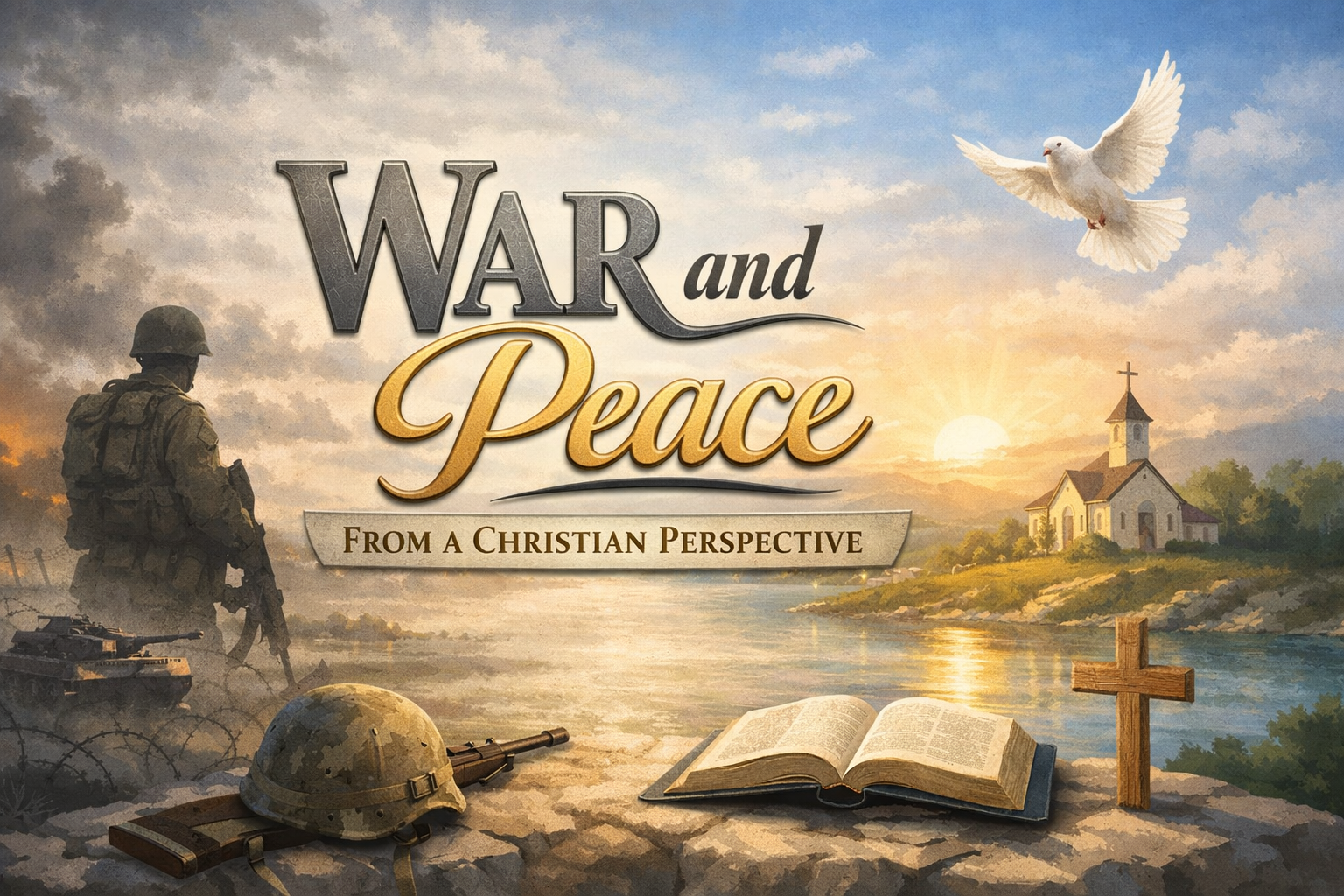
War and Peace from a Christian Perspective
War reaches down into the bones. It is not just a matter for politicians and generals — it touches families, gravesides, churches, consciences, and kitchen tables. Can a Christian support war? Can a Christian serve in the military? Does loving your enemy mean never fighting? What does it mean to seek peace when evil is real and dangerous? Christians have wrestled with these questions for two thousand years, and five of the most thoughtful Christian voices of our day still do not all agree.
In this post we listen to five prominent Christian thinkers — Russell Moore, John Piper, N.T. Wright, Stanley Hauerwas, and Miroslav Volf — and how each approaches the subject of war, peace, justice, and the way of Christ. They do not all agree. That is precisely what makes the conversation useful. They represent several of the strongest living Christian voices speaking into one of the hardest questions the church faces.
The aim here is not to flatten their differences. It is to listen carefully, compare fairly, and ask what their combined wisdom might teach believers trying to follow Christ in a violent world.
The Starting Point: Peace Is Not Optional
Before meeting the five thinkers, we need one baseline truth: peace is not a side issue in Christianity.
Matthew 5:9 — “Blessed are the peacemakers: for they shall be called the children of God.”
Romans 12:18 says: “If it be possible, as much as lieth in you, live peaceably with all men.” The prophet Isaiah called the coming Messiah “The Prince of Peace” (Isaiah 9:6). No Christian can talk about war as if it were clean, simple, exciting, or spiritually harmless. Even those who believe force may sometimes be justified must still say plainly that peace is the better way, the desired way, and the kingdom way.
The question is not whether peace matters. It does — fully and without apology. The question is whether there are times in a broken world when the use of force becomes morally necessary to protect others, restrain evil, or fulfill a God-given responsibility in civil government. That is where these five leaders begin to part company.
Five Christian Voices
Moore stands in the just war tradition, though he speaks with a sobriety that keeps him far from anything triumphal or bloodthirsty. He believes Christians must take evil seriously — there are real aggressors in the world, real tyrants, real regimes that brutalize the weak. He argues from Romans 13:4 that government has a God-given duty to restrain evil, and that under certain conditions the use of force may be tragically necessary. The state’s responsibility differs from the personal ethics of the individual believer.
But Moore is careful to warn Christians not to confuse conviction with bravado. He has noted that convictional pacifists and convictional just-war Christians often have more in common with each other than either has with someone who simply loves military power, revenge, or nationalistic swagger. Christians should never develop a taste for destruction. Even when force may be justified, it must be treated as a sorrowful last resort — never a source of excitement.
His strength: Moral realism without moral coldness. He takes the biblical truth about government’s responsibilities seriously while refusing to let Christians become war cheerleaders. The challenge critics raise: Once believers accept war as sometimes legitimate, the line becomes easier to move. History shows how quickly churches slide from sober moral reasoning into patriotic baptizing of national ambition.
Piper also rejects absolute pacifism, but his approach is framed less by political theory and more by a careful moral distinction. He places heavy emphasis on the difference between personal retaliation and public justice. Scripture is plain: “Dearly beloved, avenge not yourselves” (Romans 12:19). A Christian may not take vengeance into his own hands, nurse hatred, or act out of personal bitterness. But Piper argues this does not automatically mean a Christian can never serve as a soldier, police officer, or civil official — because the call to private forgiveness does not erase God’s ordering of civil authority.
In Piper’s framework, a Christian may serve in a coercive role provided he does so as an agent of public justice rather than private revenge. A police officer who restrains a violent criminal and a man who slaps his enemy back are not performing the same moral act, even if both involve force.
His strength: He forces Christians to examine the heart, not just the action. Supporting justice is not the same thing as dressing up vengeance in nicer clothing — and Piper insists believers know the difference from the inside. The challenge critics raise: Pacifists argue this distinction does not go far enough. Jesus did not merely clean up our motives — He called His people into a radically different way of life marked by enemy-love even in the face of real threat.
Wright often sounds different from both the pure just-war voice and the pure pacifist voice. He is deeply committed to peace and the kingdom of God, but also deeply aware of historical complexity. He is suspicious of simplistic answers to messy moral problems, and he recognizes that in a fallen world some choices are genuinely tragic. Doing nothing can itself become a form of moral failure.
Wright wants Christians to resist two temptations at once: the temptation to believe violence can save the world, and the temptation to believe the world’s hardest problems can always be solved by simply refusing involvement. What do you do when an aggressor is slaughtering civilians? When refusal to act leaves the weak to be crushed? Wright puts himself in a morally serious middle lane — insisting on the kingdom of peace while refusing to pretend that public life in a broken world comes without agonizing responsibilities.
His strength: He does not let us live in cartoons. He knows evil is real, power corrupts, governments overreach, and peace cannot be achieved through slogans alone. The challenge critics raise: He does not always give neat yes-or-no answers. Some find that frustrating. But moral seriousness often does feel uncomfortable — and Wright helps us face it honestly.
Hauerwas represents the clearest Christian pacifist voice in this group. He believes the church is called to embody the way of Jesus so fully that it becomes an alternative community in a violent world. The main Christian question, for him, is not “How can we make war more moral?” — it is “How can the church be formed into a people who actually believe Jesus meant what He said?” And Jesus said it plainly: “Love your enemies” (Matthew 5:44), “Put up again thy sword into his place” (Matthew 26:52).
Hauerwas argues that Christians have too often let the nation-state set the terms of moral discussion. Governments ask “When is war justified?” Hauerwas asks “Why has the church allowed Caesar to teach it what realism is?” Once the church becomes the chaplain of national power, it stops being the church in any meaningful New Testament sense.
His strength: He calls the church back to Jesus Himself — to the Sermon on the Mount as actual marching orders rather than devotional wallpaper. He exposes how easily believers mix the cross with nationalism. The challenge critics raise: What about the innocent? What about the defenseless facing invasion, genocide, or violent assault? Hauerwas would insist violence cannot finally save us — but many Christians find that answer difficult when placed next to a desperate victim.
Volf brings something especially valuable because his theology has been shaped by societies torn apart by violence and ethnic hatred. He knows war is not just about battlefields. It is about memory, trauma, resentment, humiliation, and the long poison of revenge. His burden is reconciliation — not merely stopping the fighting, but actually building peace. A ceasefire is not the same thing as peace. Silence is not reconciliation.
Volf points toward the gospel at this point. The heart of Christianity is not merely that sinners are restrained but that sinners are reconciled to God through Christ (2 Corinthians 5:18). For Volf, the church must become a people who forgive, tell the truth, remember honestly, and refuse to let identity be built on perpetual hostility. That does not mean ignoring justice or pretending evil never happened — but it does mean Christians cannot live forever in the moral psychology of revenge.
His strength: He keeps the church’s eyes on what war leaves behind — the dead, the broken, the bitter, the ones who still have to live in the same land. Peace is more than the absence of conflict; it is the presence of restored relationship. The challenge critics raise: Volf is strongest in helping us see how peace is rebuilt, and somewhat less direct on the immediate question of when force may or may not be necessary.
Where All Five Agree
- War is never something Christians should celebrate, romanticize, or treat as exciting
- Peace is central to Christian discipleship — not optional or peripheral
- Personal revenge has no place in the Christian heart, regardless of one’s view on force
- The church must not become captive to nationalism or baptize any nation’s agenda as God’s agenda
- The cross stands over this entire conversation — Christ conquered by dying for His enemies, not slaughtering them
That last shared conviction deserves special weight. Not one of these leaders — just-war or pacifist — treats war like a game, a thrill, or a source of national pride. That common sobriety would itself clean up a significant amount of Christian talk about these subjects in our day.
Where They Differ Most
The biggest dividing line is simple: May a Christian ever support or participate in lethal force?
Moore says sometimes yes, under just and careful limits. Piper says yes, if it is public justice rather than private revenge. Wright says the issue is morally complex, and there may be tragic cases where force is necessary. Hauerwas says no — the church must live by the nonviolent way of Jesus. Volf leans strongly toward reconciliation and nonviolence, though his primary burden is the work of healing and peace after conflict.
So the real argument is not between people who care about justice and people who care about peace. It is between Christians who believe justice may sometimes require force and Christians who believe fidelity to Jesus forbids killing altogether. That is the great divide — and it is one that honest, Scripture-honoring people have not resolved in two thousand years.
The Biblical Tension That Keeps This Alive
The reason this debate never goes away is that the Bible gives us truths that all must be held together — and they do not always sit comfortably with each other.
Jesus calls His people to enemy-love. Matthew 5:38–48 cannot be watered down. “Love your enemies” is not a suggestion for unusually spiritual believers — it is the command of the King.
Government is given authority to restrain evil. Romans 13:1–4 cannot be erased. The civil sword is there in the text, and Paul does not apologize for it.
Human sin corrupts power. Any appeal to war must be treated with suspicion, humility, and the fear of God. The history of Christian nations going to war is not a history that invites confidence.
Peace is the aim of God’s kingdom. The final vision of Scripture is not endless conflict but a restored world under Christ — swords beaten into plowshares (Isaiah 2:4). The trajectory of redemption points toward peace.
So the Christian view must be strong enough to face evil, tender enough to love enemies, humble enough to distrust human power, and hopeful enough to keep longing for peace. That is no small task — and it is why thoughtful Christians keep returning to these questions with seriousness.
Practical Lessons for Ordinary Christians
Let us bring this off the shelf and onto the porch.
Never talk lightly about war. War means sons buried, mothers grieving, bodies broken, towns burned, consciences scarred, and memories that do not go away. Christians should not sound casual about such things — ever.
Be careful not to baptize your politics. It is easy to make Christ a mascot for your tribe. A nation may do right in one matter and wrong in another. No party, flag, or government carries the full authority of the kingdom of God, and the church that acts as if it does has already lost something it cannot afford to lose.
Keep your heart free from hatred. Even if you conclude that force is sometimes necessary, hatred is never righteous. Bitterness, cruelty, mockery, and bloodlust are not Christian virtues, whatever the provocation.
Pray for peace before, during, and after conflict. Too many believers only pray for victory. Scripture leads us higher than that — to pray for restraint, the protection of the innocent, wisdom for leaders, repentance of evil, and the coming of real peace.
Honor those who serve, but do not idolize war. A Christian can respect sacrifice without romanticizing violence. Those are not the same thing.
Remember that the church’s calling is larger than geopolitics. The church must preach Christ, make disciples, care for the suffering, tell the truth, and model reconciliation. It must not become an echo chamber for national talking points — regardless of which direction those points blow.
The cross stands over this whole conversation. Jesus was not naïve about evil — He faced it head-on. But He showed that the deepest Christian victory is not found in domination, but in sacrificial love, truth, obedience, and resurrection hope. Christians may continue to differ on whether war can ever be justified. But no faithful Christian should differ on this: we are called to be people of peace, people of truth, and people whose consciences are governed by Christ rather than by rage. And in a loud, saber-rattling world, that is no small witness.
Key Takeaways
- Peace is not optional for Christians — it is central to Christian discipleship. Before engaging any debate about war, this must be the unshakeable starting point. The question is not whether peace matters, but what faithfulness to Christ requires in a world where evil is also real.
- The five voices divide primarily on one question: may a Christian ever support or participate in lethal force? Moore and Piper say yes, under careful just-war conditions. Hauerwas says no. Wright holds to moral complexity. Volf focuses on reconciliation and healing. All five reject vengeance, nationalism, and the romanticizing of war.
- The great shared conviction across all five is that the church must not become captive to nationalism. No flag, party, or government carries the full authority of the kingdom of God — and a church that acts as if its own nation is always right has already compromised something essential.
- The biblical tension is real and must be held honestly. Enemy-love is commanded. Government authority to restrain evil is also affirmed. Human sin corrupts power. The kingdom aims at peace. All four truths must be held together — and collapsing any one of them produces a distorted Christianity.
- Volf’s contribution is often overlooked but may be the most practically urgent. After the fighting stops, somebody still has to bury the dead, tell the truth, forgive sins, and learn how to live without hatred. The church’s ministry of reconciliation is not optional — and it begins long before the last shot is fired.
- The posture Scripture clearly calls for cuts across every view. Be watchful. Keep your heart free from hatred. Pray for peace. Do not baptize your politics. Honor sacrifice without idolizing war. And keep looking to Jesus when the world starts rattling its sabers.
Key Scriptures: Matthew 5:9, 38–48 · Matthew 26:52 · Romans 12:17–21 · Romans 13:1–4 · 2 Corinthians 5:18–20 · Ephesians 2:13–18 · Isaiah 2:4 · Isaiah 9:6 · James 3:17–18 · Psalm 46
Mountain Veteran Ministries
Find Your Next Bearing
Every journey needs a direction. If you're wondering where to go from here, choose the path that best fits where you are today.
⚒️ I Want to Live Faithfully
Discover practical wisdom for following Christ in today's world.
→ Living as a Christian Today✝️ I Want to Understand the Gospel
Learn what salvation means and why Jesus came.
→ Understanding Salvation📖 I Want to Understand the Bible
Explore why Christians trust Scripture and how to read it well.
→ Understanding the Bible❓ I Still Have Questions
Explore thoughtful answers to some of Christianity's hardest questions.
→ Hard Questions