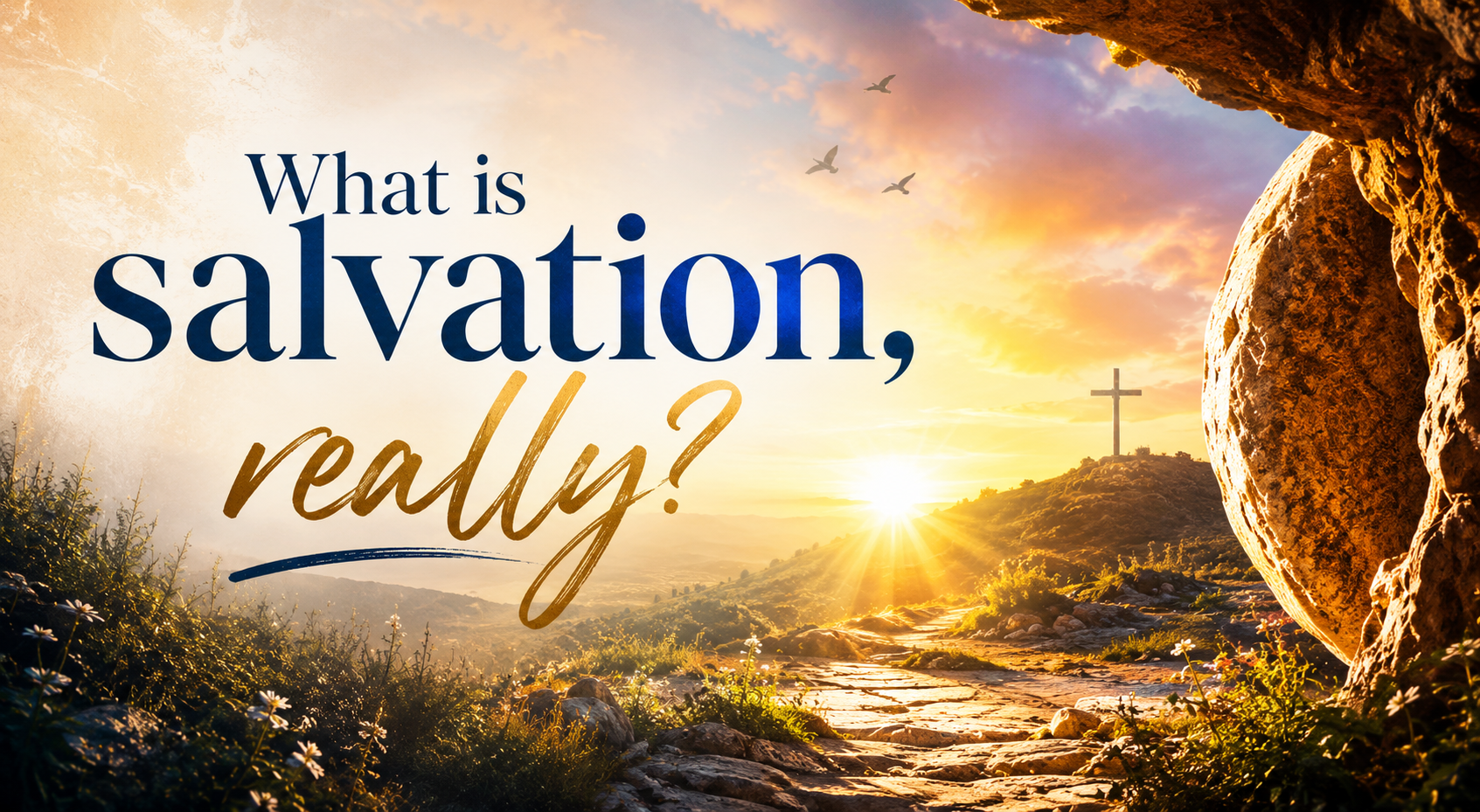
What is salvation, really?
What is salvation, really? Not the bumper-sticker version, but what Scripture actually means by the word. This post walks through the problem salvation answers — sin’s guilt, power, and penalty — and the rescue God accomplished through Christ’s death on the cross. It traces the order of salvation from election through glorification, and explains why salvation is by grace through faith alone, not earned by good behavior. Whether you’re examining your own faith or explaining it to someone else, this is a clear, Scripture-grounded look at the most important word in the Christian vocabulary.
Resources Are Being Developed
Mountain Veteran Ministries is a growing ministry. Many of the topics highlighted throughout this site represent resources, studies, and videos that are currently in development and will be added over time.
In the meantime, we invite you to watch our Introduction Video to learn more about the mission and vision of Mountain Veteran Ministries.
It’s a word Christians use constantly — and assume everyone understands. Here’s what the Bible actually means by it.
Ask ten people in a church parking lot what salvation means and you’ll get ten different answers. “Going to heaven when you die.” “Being a good person.” “Getting your life together.” “Being forgiven.” Some of those answers brush up against the truth. None of them captures it.
That’s a problem, because salvation is not a side topic in Christianity. It’s the whole point. The Bible isn’t a book of moral advice with a bonus chapter on the afterlife — it’s the story of God rescuing a people who could not rescue themselves, at a cost He alone could pay. If we get salvation wrong, we don’t get a minor doctrine wrong. We get the gospel wrong.
So let’s slow down and ask the question seriously: what is salvation? Not the bumper-sticker version — the biblical one.
Saved From What?
You can’t define salvation without first defining the danger. A rescue only makes sense in light of what someone is being rescued from. So before we talk about what salvation gives us, we need to talk honestly about what it delivers us from.
Scripture is unflinching here. Every person is born in a condition of rebellion against God — not merely making occasional mistakes, but spiritually dead, alienated, and under judgment. Paul puts it plainly to the Ephesians: “And you were dead in the trespasses and sins in which you once walked… like the rest of mankind, [we] were by nature children of wrath” (Ephesians 2:1, 3). That’s not poetic exaggeration. It’s a diagnosis.
This is where a lot of modern explanations of salvation go soft. They treat sin as a behavioral problem — something you manage with better choices — rather than what the Bible says it is: a condition that has broken our relationship with God, corrupted our nature, and left us facing real judgment. Romans 3:23 doesn’t say “all have made some mistakes.” It says “all have sinned and fall short of the glory of God” — and the wages of that sin, Paul says two chapters later, is death (Romans 6:23).
So salvation, at minimum, has to answer three problems, not one:
- The guilt of sin — we are legally liable before a holy God, and that liability has to be dealt with.
- The power of sin — we are not just guilty, we are enslaved, unable on our own to stop sinning or to love God as we should.
- The penalty of sin — physical death, and beyond that, eternal separation from God’s presence, which Scripture calls wrath.
Any definition of salvation that doesn’t deal with all three isn’t biblical salvation. It’s therapy with a cross on the wall.
Salvation Defined
At its root, the biblical word for salvation — sōtēria in the Greek New Testament, yasha in the Hebrew Old Testament — means rescue, deliverance, being brought out of danger into safety. It’s the word used when Israel is delivered from Egypt, when David is delivered from his enemies, when a drowning man is pulled from the water.
Applied to the gospel, salvation is God’s gracious act of rescuing sinners from the guilt, power, and penalty of sin, and reconciling them to Himself through the person and work of Jesus Christ. That’s the short definition. Nearly every word in it matters, so let’s unpack it piece by piece.
It’s God’s act. Salvation is not something we accomplish and offer up to God for His approval. It originates with Him. “Salvation belongs to the Lord” (Psalm 3:8). We are the ones in the water. We are not the lifeguard.
It’s gracious. Grace means unearned favor — given to people who, by definition, don’t deserve it. If salvation could be earned, it wouldn’t need to be called grace; it would be called wages. Paul is emphatic about this: “For by grace you have been saved through faith. And this is not your own doing; it is the gift of God, not a result of works, so that no one may boast” (Ephesians 2:8–9).
It rescues from something specific. As we just covered — guilt, power, and penalty. Salvation is not generic spiritual uplift. It is targeted rescue from a real and specific danger.
It reconciles. The goal isn’t just escape from punishment. It’s restored relationship. Paul writes that “while we were enemies we were reconciled to God by the death of his Son” (Romans 5:10). Salvation ends hostility and brings us into the family of God as adopted sons and daughters (Romans 8:15–17).
It happens through Christ. This is the non-negotiable center. There is no salvation plan that bypasses Jesus. Peter told the Sanhedrin point-blank: “And there is salvation in no one else, for there is no other name under heaven given among men by which we must be saved” (Acts 4:12). Whatever else salvation includes, it is found in a Person, not a program.
Salvation is not God grading on a curve. It’s God satisfying His own justice and extending His own mercy — at the same time, through the same cross.
The Cross: Where Salvation Was Won
Here’s where the rubber meets the road. How exactly does God rescue sinners without compromising His own justice? He can’t simply wave away sin — He is holy, and a holy God cannot pretend guilt doesn’t exist. But He also doesn’t want to destroy the people He created and loves. So what does He do?
He sends His Son to bear the penalty Himself. This is the doctrine of the atonement, and at its heart is substitution — Christ standing in our place, absorbing what we owed. Isaiah saw it seven hundred years before it happened: “He was pierced for our transgressions; he was crushed for our iniquities… and with his wounds we are healed” (Isaiah 53:5).
Paul names the mechanism directly: “For our sake he made him to be sin who knew no sin, so that in him we might become the righteousness of God” (2 Corinthians 5:21). Jesus, who had no sin of His own, was treated as if He did — so that we, who have nothing but sin of our own, could be treated as if we didn’t. That’s not a slogan. That’s the actual exchange that happened at Calvary.
This is why the cross isn’t a footnote to salvation — it is salvation, accomplished. Everything before it in redemptive history points toward it. Everything after it flows from it. There is no version of “what is salvation” that can be answered honestly without landing squarely on a Roman execution device outside Jerusalem two thousand years ago, where the Son of God took the wrath His people deserved.
How Salvation Reaches Us: The Order of Salvation
If the cross is where salvation was accomplished, how does it actually reach an individual sinner two thousand years later? Theologians have traced out what’s often called the ordo salutis — the order of salvation — the steps by which God’s saving work is applied to a person’s life. It’s not a man-made formula; it’s an attempt to track what Scripture itself describes happening.
Election. Before any of us did anything, God set His love on a people for Himself. Paul tells the Ephesians that God “chose us in him before the foundation of the world” (Ephesians 1:4). Salvation begins not with our decision, but with God’s.
Calling. God brings the gospel to bear on a person’s life — through preaching, through Scripture, through the ordinary means He has appointed — and effectually draws them to Himself. Jesus says “All that the Father gives me will come to me” (John 6:37).
Regeneration. Because we are spiritually dead, not merely sick, we need more than encouragement — we need new life. This is the new birth Jesus describes to Nicodemus: “unless one is born again he cannot see the kingdom of God” (John 3:3). God replaces a heart of stone with a heart that can actually respond to Him (Ezekiel 36:26).
Faith and repentance. The regenerated heart responds — turning from sin and trusting Christ. This is the human side of the equation, and Scripture commands it directly: “Repent, and believe in the gospel” (Mark 1:15). Faith isn’t a work that earns salvation; it’s the empty hand that receives a gift already purchased.
Justification. The moment a sinner trusts Christ, God declares them righteous — not because they suddenly became righteous in themselves, but because Christ’s righteousness is credited to their account. “Therefore, since we have been justified by faith, we have peace with God through our Lord Jesus Christ” (Romans 5:1). This is a legal verdict, settled and final, the moment faith is exercised.
Sanctification. Justification is instant; sanctification is a process. From the moment of saving faith onward, God works in the believer to make them actually holy, conforming them to the image of Christ over a lifetime. Paul describes this as being “transformed by the renewal of your mind” (Romans 12:2) — slow, real, ongoing change.
Glorification. The final chapter. When Christ returns or when we die in faith, the work is completed — sin’s presence removed entirely, our bodies raised and made new, and we are with God forever. “We shall be like him, because we shall see him as he is” (1 John 3:2).
Notice the shape of this: salvation is not a single event with no before or after. It has a past dimension (you were saved — justification, a finished verdict), a present dimension (you are being saved — sanctification, an ongoing process), and a future dimension (you will be saved — glorification, a certain hope). Anyone who tells you salvation is only a past decision, or only a present feeling, or only a future hope, is telling you a third of the truth.
A question worth sitting with: If someone asked you right now, “Are you saved, and how do you know?” — could you answer from Scripture, or would you answer from a feeling? Salvation is too important to rest on a vague sense that things are probably fine between you and God.
Salvation Is Not a Reward for Good Behavior
It’s worth pausing here because this is where so much confusion creeps back in, even among church-going people. There’s a persistent instinct — maybe the most natural religious instinct there is — to think that God’s favor must be earned. That if we’re sincere enough, moral enough, religious enough, we’ll tip the scales in our favor.
The Bible demolishes that instinct repeatedly. Titus 3:5 is about as direct as Scripture gets: “he saved us, not because of works done by us in righteousness, but according to his own mercy.” Not because of works. Not even partly. The text doesn’t say our works contributed 10% and grace covered the other 90%. It says our works were not the basis at all.
This matters pastorally as much as theologically. If salvation depended even slightly on our performance, no one could ever have assurance — because none of us perform consistently enough to be sure we’ve cleared the bar. But because salvation rests entirely on Christ’s finished work, received by faith, assurance becomes possible. Not presumption — assurance. There’s a difference, and it’s worth a separate conversation, but the difference exists precisely because salvation is grounded in what Christ did, not in what we manage to do.
So What Do You Do With This?
If you’ve never trusted Christ, the implication is direct: the danger described above is real, and the rescue described above is available, and the only appropriate response is the one Scripture calls for — repent and believe. Not “try harder.” Not “turn over a new leaf.” Trust the One who already paid the debt.
If you have trusted Christ, the implication is just as direct, but it points a different direction: rest in the verdict already rendered over you (justification is finished, not provisional), and engage seriously with the process still underway in you (sanctification is real work, not optional). Salvation isn’t a ticket you punch and forget about. It’s a rescue that reshapes the rest of your life.
Either way, salvation is not a vague spiritual mood. It’s a specific, historical, accomplished rescue — won at a specific cross, applied by a specific Spirit, received through specific faith in a specific Savior. That specificity isn’t a limitation. It’s the only thing that makes the word mean anything at all.
Key Takeaways
- Salvation answers a real problem. Sin leaves every person guilty before God, enslaved to sin’s power, and facing death’s penalty — salvation has to address all three, not just one.
- Salvation is God’s gracious act, not our achievement. Ephesians 2:8–9 is clear: it’s a gift received by faith, not a wage earned by works.
- The cross is where salvation was accomplished. Christ bore our penalty as our substitute, satisfying God’s justice and extending His mercy at the same time.
- Salvation unfolds in stages. Election, calling, regeneration, faith and repentance, justification, sanctification, and glorification trace how God’s saving work reaches and transforms a person.
- Salvation has past, present, and future dimensions. You were justified, you are being sanctified, and you will be glorified — all part of one rescue.
- Assurance is possible because salvation rests on Christ, not on us. A finished work outside ourselves is the only stable ground for confidence before God.
Key Scriptures: Ephesians 2:1–10; Romans 3:21–26; Romans 5:1–11; Isaiah 53:5; 2 Corinthians 5:21; Titus 3:5; John 3:3; 1 John 3:2.
Mountain Veteran Ministries
Find Your Next Bearing
Every journey needs a direction. If you're wondering where to go from here, choose the path that best fits where you are today.
⚒️ I Want to Live Faithfully
Discover practical wisdom for following Christ in today's world.
→ Living as a Christian Today✝️ I Want to Understand the Gospel
Learn what salvation means and why Jesus came.
→ Understanding Salvation📖 I Want to Understand the Bible
Explore why Christians trust Scripture and how to read it well.
→ Understanding the Bible❓ I Still Have Questions
Explore thoughtful answers to some of Christianity's hardest questions.
→ Hard Questions