The Man in the Mirror Doesn’t Lie — confronting who we’ve become vs. who God called us to be
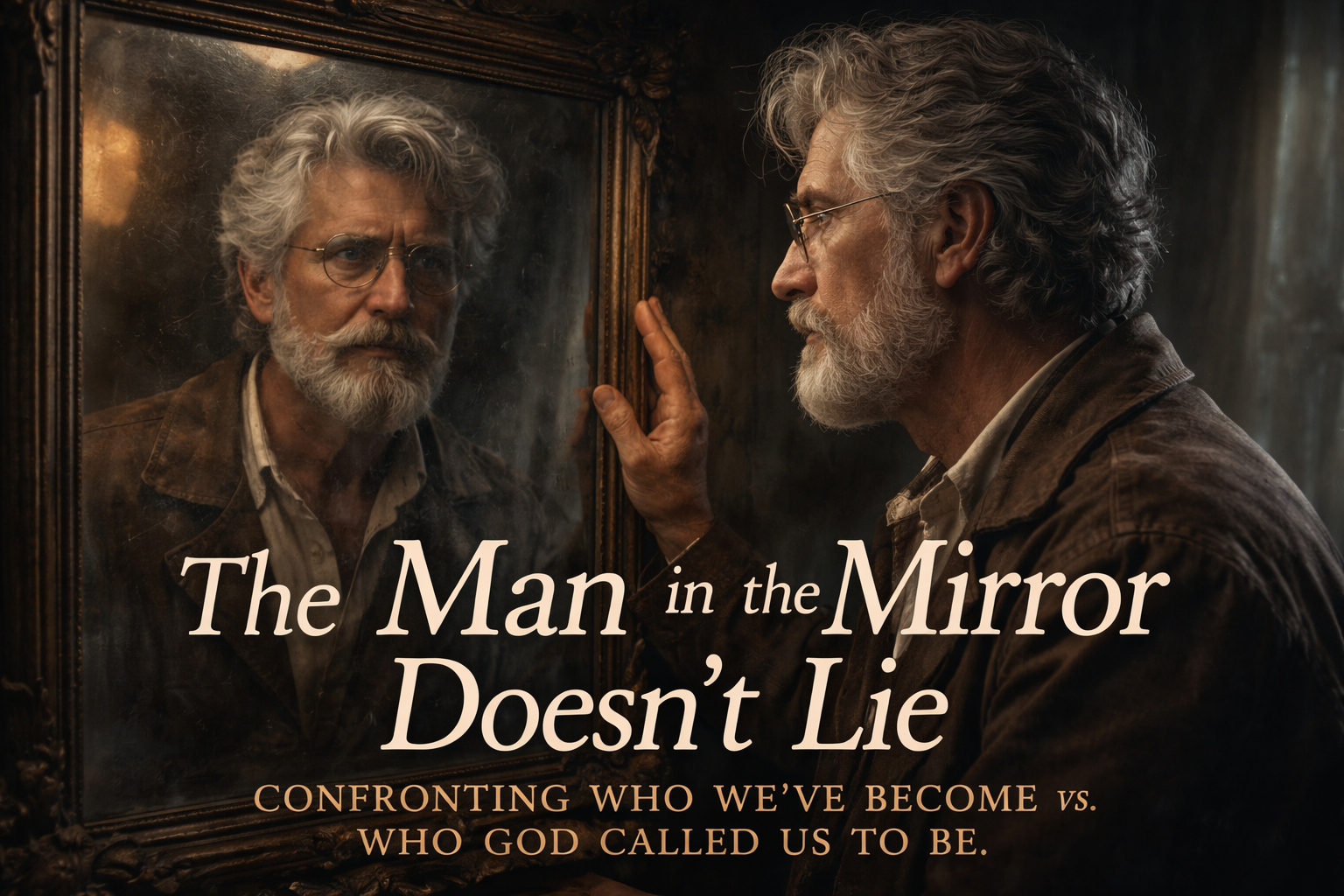
Most of us have become very skilled at not looking too closely. We manage our image, justify our patterns, and keep just busy enough that the deeper questions never quite catch up to us. But God has a way of arranging moments of clarity — and in those moments, the man in the mirror doesn’t lie.
There’s a moment most men have had — though few talk about it. You catch a glimpse of yourself. Not necessarily in a mirror, though sometimes literally that. It might be in the reaction on your wife’s face. In the silence from your kids when you walk in the room. In the way a hard conversation went — or the way you avoided one that needed to happen. And for just a second, before the defenses kick in, you see it: the gap between the man you intended to be and the man you actually are.
Most of us close that gap as fast as we can. We explain it away, minimize it, hand the blame to circumstances or other people or the season of life we’re in. We get very busy. We manage our image carefully enough that the deeper question stays at arm’s length. We get remarkably good at looking in the mirror without actually seeing.
But God keeps arranging those moments of clarity. He is not in the business of letting his people sleepwalk through their own lives. And the man in the mirror — if you hold the gaze long enough — doesn’t lie.
This post is about what it means to look honestly, what we’re likely to find, and what God actually does with men who are willing to face it.
The Mirror That Tells the Truth
James 1:23-25 gives us one of the most striking images in the New Testament. A man looks at his face in a mirror, walks away, and immediately forgets what he looked like. James uses that image to describe what it means to hear the Word of God without letting it do anything to you. You read it, nod at it, close the book, and go back to being exactly who you were before you opened it.
But then James describes the other man — the one who looks into “the perfect law, the law of liberty,” and perseveres. Who doesn’t walk away and forget. Who lets what he sees actually form him. That man, James says, will be blessed in what he does.
The Word of God is a mirror. It shows you what you actually look like — not the version you present to the world or the version you tell yourself you are in your better moments, but the real thing. The question is whether you come to it to be confirmed or to be confronted. Whether you are reading to check a box or to be seen.
“Search me, O God, and know my heart! Try me and know my thoughts! And see if there be any grievous way in me, and lead me in the way everlasting.” — Psalm 139:23-24
David wrote that prayer at the end of a psalm about God’s total and relentless knowledge of him — the God who knows when you sit and when you rise, who understands your thoughts from afar, who knows the word on your tongue before you speak it. David’s response to being that fully known is not to hide. It is to invite the examination deeper. That is the posture of a man who has decided he actually wants to see.
Who God Called You to Be
Before we can honestly reckon with the gap, we need to establish what we’re measuring against. Not the idealized version of yourself you carried at twenty-two. Not the man across the aisle at church who seems to have it together in the ways you don’t. The measure is what God himself says about who you are and what you are for.
You Were Made for the Image
Genesis 1:27 is the foundation of everything: “So God created man in his own image, in the image of God he created him; male and female he created them.” Whatever else is true about you, this is true — you were made to reflect something of the character of God into the world around you. Not to be God. But to image him. To be a creaturely echo of his wisdom, his faithfulness, his strength used in service of the weak, his covenant love that holds when circumstances argue for walking away.
The fall fractured that image. It did not destroy it — there is still something of God’s image in every person — but it cracked and smudged it badly. And the entire work of redemption in Christ is, at its core, the restoration of that image. Romans 8:29 tells us that God’s purpose for everyone he calls is to be “conformed to the image of his Son.” That is the destination. That is who you were called to be — a man being progressively reshaped into the likeness of Jesus Christ, from the inside out, over the whole course of your life.
You Were Called to Specific Faithfulness
Beyond the broad calling to image-bearing, God has placed each man in specific roles with specific responsibilities. Husband. Father. Son. Brother. Friend. Employer. Neighbor. Elder. Each of those roles has a shape — a biblical description of what faithfulness looks like from that particular seat.
Ephesians 5 describes the husband who loves his wife as Christ loved the church — sacrificially, sanctifyingly, without conditions attached. Ephesians 6 describes the father who does not provoke his children to anger but raises them in the discipline and instruction of the Lord. Proverbs 27:17 describes the friend who sharpens his brother the way iron sharpens iron — not the friend who flatters him or keeps the peace at the expense of truth. These are not vague spiritual aspirations. They are specific descriptions of what a man actually living into his calling looks like in ordinary life.
The confronting question is not “am I a good person, generally speaking?” The confronting question is: “Am I being faithful in the specific roles God has given me?”
What We’re Likely to Find
This is the uncomfortable middle of the mirror. If you hold the gaze long enough — with an open Bible, a willing heart, and the honest input of people who know you well enough to tell you the truth — here is something of what tends to come into focus.
Drift
Rarely does a man wake up one morning and decide to become someone he doesn’t want to be. It happens by drift. Small compromises, small neglects, small redirections of attention and energy, repeated over months and years until the cumulative distance is alarming. Hebrews 2:1 puts it plainly: “We must pay much closer attention to what we have heard, lest we drift away from it.” Drift is the default. It doesn’t require a decision. It just requires inattention.
The man who drifted from his faith didn’t storm out of the church. He just got busy. The man who drifted from his marriage didn’t stop loving his wife in one dramatic moment. He just stopped prioritizing her, incrementally, until there was a distance between them that surprised even him. The man who drifted from his integrity didn’t make one catastrophic choice. He made a hundred small ones, each a little easier than the last.
Drift is quiet. The mirror reveals it — but only if we’re willing to look at where we actually are, not where we assume we’d still be.
The Gap Between Public and Private
One of the most clarifying questions a man can sit with is this: would the people who know me best describe me the same way the people who know me least would? The man who is warm and patient and engaged at church but cold and critical and checked-out at home is not a whole man. He is a managed one. And management is exhausting, and it is not holiness.
Luke 16:10 cuts right to the root of this: “One who is faithful in a very little is also faithful in much, and one who is dishonest in a very little is also dishonest in much.” The little things, in this context, are the private things — the things nobody is grading you on, the things that don’t affect your reputation. How you treat your family when you’re tired. How you handle money in the small decisions. What you give your eyes to when the screen is just yours. What you say about people when they aren’t in the room.
That is the man you actually are. And the mirror will show it, if you let it.
Patterns We Inherited and Never Examined
Many men are living out scripts they received from their fathers, their families of origin, their cultural formation — scripts they have never actually chosen, examined against Scripture, or decided to keep or discard. Patterns of emotional distance. Patterns of explosive conflict or perpetual conflict avoidance. Patterns of using work as an escape from the harder relational work at home. Ways of relating to authority, to weakness, to money that came from somewhere else entirely and were never interrogated.
This is not an invitation to blame your father. It is an invitation to take responsibility for what you have received and decide — as a man now under the authority of Christ — what you are going to pass on. Because you will pass something on. The only question is whether it will be examined and refined by the Word, or simply inherited and repeated.
Excuses That Have Outlived Their Season
Every man carries explanations for why his life looks the way it does — why he hasn’t become who he meant to become, why he isn’t doing what he knows he should. Some of those reasons are legitimate. Genuine hardship, genuine trauma, genuine limitation — these are real and deserve honest acknowledgment. But most men, if they are honest, have been carrying some of those explanations well past their expiration date. At some point the excuse becomes the cage.
The paralyzed man at the Pool of Bethesda had been lying there thirty-eight years. When Jesus asked him “Do you want to be healed?”, his first response was to explain why he hadn’t been healed yet (John 5:6-7). Jesus did not engage the explanation. He said, “Get up, take up your bed, and walk.” Sometimes the most merciful thing the Lord does is refuse to accept the explanation and simply call us to move.
What God Does With Men Who Look
Here is where the good news enters — and it is genuinely good. The purpose of honest self-examination before God is not guilt management. It is not condemnation. Romans 8:1 still stands: “There is therefore now no condemnation for those who are in Christ Jesus.” The mirror is not God’s instrument of punishment. It is his instrument of transformation.
He Meets Honesty With Grace
The prodigal son, in Luke 15, has his mirror moment in a far country — sitting in a pig pen, broke and starving and far from home. Luke says he “came to himself.” One of the most beautiful phrases in the Gospels. He looked at where he was and who he had become, and he didn’t pretend otherwise. He rehearsed what he would say, got up, and started walking home. And while he was still a long way off, his father saw him and ran.
That is the pattern of God’s response to honest reckoning. Not a lecture. Not a probationary period before restoration. The father runs. Grace moves faster than shame. That is who you are dealing with when you finally stop managing your image and tell God the truth about where you are.
He Gives You a New Name to Grow Into
When God deals with a man honestly, he doesn’t just expose what the man has been. He speaks into what the man can become. He called Abram — a wandering pagan with an infertile wife — “Abraham,” the father of many nations, before a single nation existed. He called Gideon “mighty man of valor” while Gideon was hiding from his enemies in a winepress. He called Simon — impulsive, unreliable, the man who would deny him three times — “Peter,” the rock.
God names you by your destination, not your current location. The confrontation with who you have become is always paired, in his hands, with the call toward who he is making you. That call is costly. It will require you to actually change. But it is real, and it is his.
He Provides the Community for the Work
No man becomes who God called him to be in isolation. The New Testament assumes community as the environment of transformation. Hebrews 10:24-25 calls us to “stir up one another to love and good works, not neglecting to meet together.” Galatians 6:1-2 describes the community that restores a man caught in a fault and that bears one another’s burdens. James 5:16 calls us to confess our sins to one another and pray for one another, that we may be healed.
The mirror moment is personal. But the journey that follows is not meant to be solitary. If you don’t have men around you who know the real version of you — who can speak honest words into your life and hold you to the man God is calling you to be — that is itself something worth examining.
How to Actually Do This
A post like this is easy to read and agree with in the abstract. The harder thing is actually sitting down with the mirror. Here are some handles for doing that well.
Start with Scripture, not self-analysis. Don’t begin by asking “what’s wrong with me?” Begin by asking “what does God say I am called to?” Read Ephesians 4-6. Read the Sermon on the Mount. Read Proverbs. Let the Word establish the standard before you measure yourself against it.
Ask the people closest to you. Not in a loaded, emotionally volatile way — but genuinely. Ask your wife if there are ways she feels unseen or deprioritized. Ask a trusted friend if there are blind spots he notices in you. Ask your kids, if they’re old enough, what they wish was different. You don’t have to act on everything you hear, but you need to hear it.
Give it time and quiet. This kind of examination doesn’t happen in five minutes between tasks. It requires the kind of quiet most of us work hard to avoid. An hour alone with God, a journal, and an honest prayer is not a luxury — for a man who wants to be formed, it is a necessity.
Write it down. There is something about naming a thing in writing that makes it concrete in a way that vague mental acknowledgment does not. If the Spirit surfaces something specific — a relationship neglected, a pattern repeating, a thing being avoided — write it down. Name it. Then take it to God and ask what to do with it.
Make one move. Don’t try to fix everything at once. Identify one specific, concrete thing you can do differently this week — one conversation to have, one apology to make, one habit to interrupt, one commitment to keep. Sanctification is not a project completed over a long weekend. It is the patient, persistent work of a lifetime. Start with one brick.
The Man God Is Making
Philippians 1:6 carries a promise worth holding onto through all of this: “I am sure of this, that he who began a good work in you will bring it to completion at the day of Jesus Christ.” The God who arranged that moment of clarity — the glimpse in the mirror, the silence in the room, the weight that settled on your chest and wouldn’t leave — is the same God who is committed to finishing what he started in you.
He is not surprised by what the mirror shows. He has known it all along. What he is waiting for is your willingness to look — to stop managing and start surrendering, to stop explaining and start walking home.
The man in the mirror doesn’t lie. But neither does the God who redeems him.
Hold the gaze. Let it do its work. He is faithful.
Take the Next Step
If this post stirred something in you, don’t let the feeling pass without doing something with it. Set aside an hour this week — away from screens, away from noise — with your Bible open to Psalm 139 and a willingness to pray David’s prayer: Search me, O God. See what he shows you. Then take one step in response to what you find.
And if you’re a veteran or serviceman navigating questions of identity, purpose, and who God has called you to be, Mountain Veteran Ministries exists to walk that road with you. Browse our resources and reach out — you don’t have to do this alone.
“And we all, with unveiled face, beholding the glory of the Lord, are being transformed into the same image from one degree of glory to another. For this comes from the Lord who is the Spirit.” — 2 Corinthians 3:18