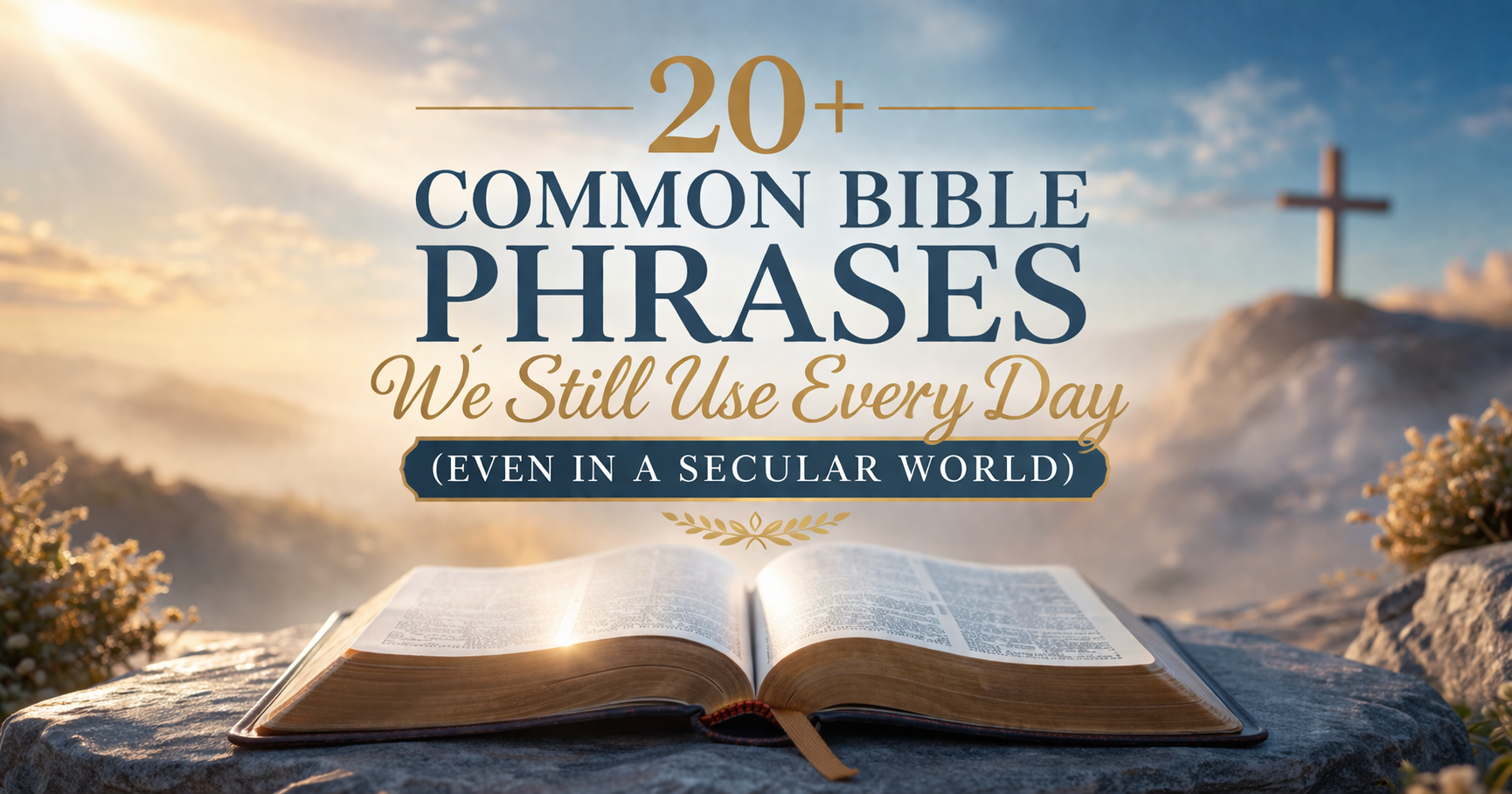
20+ Common Bible Phrases We Still Use Every Day (Even in a Secular World)
20+ Common Phrases That Came Straight from Scripture — and Most People Have No Idea
If you’ve ever told someone to “go the extra mile,” called someone a “Good Samaritan,” or mentioned “the writing on the wall,” congratulations — you just quoted the Bible. The English language is filled with expressions that come straight out of Scripture, even though most people using them have no idea where they came from.
For centuries, the Bible — especially the King James Version — wasn’t just a book read in church. It was the book. Its words shaped literature, politics, music, and everyday speech. Even in our increasingly secular society, biblical language has stuck. These phrases are short, powerful, and poetic. They capture human experience so well that they’ve lasted for hundreds — and in some cases, thousands — of years.
“And ye shall know the truth, and the truth shall make you free.” — John 8:32 (KJV)
20 Phrases You Use — and Where They Actually Came From
“The Powers That Be”
Romans 13:1 (KJV)
Refers to authorities or the system in charge. Used for governments, corporations, management — any entrenched power structure.
“The Writing on the Wall”
Daniel 5:5–31
A divine warning literally written on King Belshazzar’s wall. Now means: you can see clearly that something bad is coming.
“By the Skin of Your Teeth”
Job 19:20 (KJV)
Job’s lament about barely surviving. Now means: narrowly escaping disaster by the thinnest possible margin.
“Nothing New Under the Sun”
Ecclesiastes 1:9
The Preacher’s weary observation about human history. Now means: everything’s been done before — including that “revolutionary” idea.
“Cast the First Stone”
John 8:7
Jesus’s challenge to the woman’s accusers. Now means: don’t judge others harshly when you’re not without fault yourself.
“Salt of the Earth”
Matthew 5:13
From the Sermon on the Mount. Now describes someone humble, steady, reliable, and genuinely good — the best kind of neighbor.
“Labor of Love”
Hebrews 6:10; 1 Thessalonians 1:3
Work done purely out of love, not obligation or pay. The kind of effort that can’t really be explained by incentives alone.
“The Straight and Narrow”
Matthew 7:14 (KJV)
The narrow way that leads to life. Now means: living with discipline and moral integrity — keeping yourself out of trouble.
“To Everything There Is a Season”
Ecclesiastes 3:1
One of Scripture’s most quoted lines. Now means: everything has its proper time — don’t force what isn’t ready.
“Eat, Drink, and Be Merry”
Ecclesiastes 8:15; Luke 12:19
Originally a warning about misplaced priorities. Now used to mean: enjoy life while you have it.
“A House Divided”
Mark 3:25
Jesus’s observation about self-defeating division. Abraham Lincoln famously borrowed it. Now means: any group torn by internal conflict will fail.
“Am I My Brother’s Keeper?”
Genesis 4:9
Cain’s evasive, defiant response to God after killing Abel. Now used — often sarcastically — to question responsibility for others.
“Good Samaritan”
Luke 10:25–37
Jesus’s parable of the outsider who stopped to help. Now: a person who helps a stranger in need. Good Samaritan laws protect them legally.
“Scapegoat”
Leviticus 16:10
A goat that symbolically carried away Israel’s sins into the wilderness. Now: someone unfairly blamed for the wrongs of others.
“Go the Extra Mile”
Matthew 5:41
Jesus’s countercultural teaching on generosity under compulsion. Now: doing more than what’s required or expected of you.
“Forbidden Fruit”
Genesis 3
The fruit Adam and Eve were told not to eat. Now: anything tempting precisely because it’s off-limits.
“Wolf in Sheep’s Clothing”
Matthew 7:15
Jesus’s warning about false prophets. Now: anyone who disguises dangerous intentions behind a trustworthy appearance.
“Prodigal Son”
Luke 15:11–32
Jesus’s parable of the wandering son who returns. Now: anyone who strays far from where they belong, then comes home.
“An Eye for an Eye”
Exodus 21:24
Originally a principle of proportional justice — limiting revenge to match the offense. Now: getting back exactly what was given to you.
“The Truth Will Set You Free”
John 8:32
Jesus’s promise to those who abide in His word. Now quoted about honesty, transparency, and the liberating power of reality over deception.
Why Do These Phrases Stick Around?
📖 The Bible Shaped English
The King James Bible (1611) wasn’t just a religious text — it shaped the English language itself. Its translators wrote with rhythm and beauty, making the phrases nearly impossible to forget.
❤️ Universal Human Experience
Expressions like “by the skin of your teeth” and “scapegoat” paint clear, emotional word pictures that need no explanation. They name experiences everyone has, across every culture and era.
⚖️ Moral Weight
Even if you’re not a Christian, saying “a house divided cannot stand” feels weightier than “disunity is counterproductive.” Biblical language carries a gravity that bland equivalents don’t.
🎵 Cultural Reinforcement
Writers, politicians, musicians, and filmmakers have quoted the Bible for centuries, weaving it so deeply into the cultural fabric that its phrases outlast any individual’s knowledge of the source.
Biblical Phrases in Pop Culture
🎵 Music
The Byrds’ Turn! Turn! Turn! (1965) is almost word-for-word from Ecclesiastes 3. It became one of the defining songs of a generation — and most listeners had no idea they were singing Scripture.
🍔 Advertising
In-N-Out Burger prints “John 3:16” on the inside rim of their drink cups — a quiet, persistent testimony embedded in a fast-food chain that has served billions of burgers.
🏛️ Politics
Abraham Lincoln’s “A House Divided” speech (1858) — one of the most famous political speeches in American history — opens with a direct quote from Mark 3:25. Biblical language helped end slavery.
Common Misquotes — What People Think the Bible Says
A few popular “biblical” sayings actually aren’t in the Bible at all — or are taken so far out of context that the original meaning is lost entirely.
- “God helps those who help themselves.” Not in the Bible. Often attributed to Benjamin Franklin’s Poor Richard’s Almanac. The biblical message is closer to the opposite: God helps those who recognize they can’t help themselves.
- “Judge not” (full stop). Matthew 7:1 is routinely quoted to mean “don’t evaluate anything.” Read in context, Jesus is warning against hypocritical judgment — not forbidding all discernment. Verse 5 says to remove the plank from your own eye first, then help your brother.
- “All things work together for good.” Romans 8:28 is almost always quoted without the qualifying clause: “…for those who love God and are called according to his purpose.” It’s a promise with context, not a general optimism bumper sticker.
It’s remarkable that in a world where fewer people read the Bible, its words still shape our daily speech. Whether we realize it or not, we lean on these ancient texts to express some of life’s deepest truths: justice, love, hope, and humility.
These phrases have outlasted empires, survived translations, crossed oceans, and embedded themselves into languages that didn’t exist when they were first written. That kind of staying power doesn’t happen by accident.
Maybe there’s a reason the most enduring words about human experience are the ones that came from the God who made us.
“The grass withers and the flowers fall, but the word of our God endures forever.” — Isaiah 40:8
Key Scriptures referenced: Romans 13:1 · Daniel 5:5 · Job 19:20 · Ecclesiastes 1:9; 3:1 · John 8:7, 32 · Matthew 5:13, 41 · Matthew 7:14–15 · Hebrews 6:10 · Mark 3:25 · Genesis 3–4 · Luke 10:25–37; 12:19; 15:11–32 · Leviticus 16:10 · Exodus 21:24 · Isaiah 40:8
Which Phrase Surprised You?
Did you discover the origin of a phrase you use every day? Drop a comment below — let’s see how many of us have Scripture woven into our everyday speech without realizing it.
And if you found this one worth sharing, pass it along to someone who loves language, history, or both. The Bible has more cultural reach than most people ever imagine.
- Share it with someone who thinks the Bible is irrelevant to modern life — this post is a gentle, accessible conversation starter.
- Subscribe to get new posts delivered straight to your inbox — gospel-rooted, plain-spoken truth for the week ahead.
“Your word is a lamp to my feet and a light to my path.” — Psalm 119:105
Mountain Veteran Ministries
Find Your Next Bearing
Every journey needs a direction. If you're wondering where to go from here, choose the path that best fits where you are today.
⚒️ I Want to Live Faithfully
Discover practical wisdom for following Christ in today's world.
→ Living as a Christian Today✝️ I Want to Understand the Gospel
Learn what salvation means and why Jesus came.
→ Understanding Salvation📖 I Want to Understand the Bible
Explore why Christians trust Scripture and how to read it well.
→ Understanding the Bible❓ I Still Have Questions
Explore thoughtful answers to some of Christianity's hardest questions.
→ Hard Questions
Very interesting. I had no idea that some of these came from the Bible.