Pentecost and the Days Leading Up to It
God does not improvise. Every step from Easter morning to Pentecost Sunday was part of one unfolding plan. And every step has something to teach the church today.
Forty Days of Instruction
The Risen Christ Prepared His People With Truth Before He Empowered Them
After Jesus rose from the dead, He did not immediately ascend to heaven. According to Acts 1:3, He presented Himself alive to the apostles over forty days, “speaking of the things pertaining to the kingdom of God.” That is worth pausing over.
Jesus was not only proving He was alive. He was preparing His followers for what was coming next. The resurrection settled the question of His identity — He truly was the crucified and risen Lord. But the disciples still needed to understand their mission. Before the cross they had often misunderstood Him. After the resurrection He began opening their minds to the Scriptures and showing them how everything fit together.
Luke 24:44–49 tells us He explained how the Law, the Prophets, and the Psalms all pointed to Him — and that repentance and forgiveness of sins should be preached in His name to all nations. The forty days were days of instruction, clarification, and preparation. He formed His people by His Word before He sent them out in His power. That is still God’s pattern.
Still Incomplete — and Given a Mission
The disciples had seen the risen Christ, but they were still not fully ready. They believed — but they lacked boldness, clarity, and the spiritual power the task ahead demanded. The question they asked in Acts 1:6 shows it: “Lord, wilt thou at this time restore again the kingdom to Israel?” They were still thinking in narrow, national terms. Jesus did not rebuke them for the question, but He redirected them.
Acts 1:7–8 — “It is not for you to know the times or the seasons, which the Father hath put in his own power. But ye shall receive power, after that the Holy Ghost is come upon you: and ye shall be witnesses unto me both in Jerusalem, and in all Judaea, and in Samaria, and unto the uttermost part of the earth.”
That verse is one of the great hinges of the New Testament. The disciples wanted a timetable. Jesus gave them a mission. They wanted to know when. He told them what to do. They were looking for visible kingdom glory. He told them to wait for spiritual power. That is a word the church in every generation needs: stop trying to nail down every prophetic detail while neglecting the plain command to be Christ’s witnesses.
The Ascension — Christ Enthroned, the Spirit Coming
After those forty days, Jesus ascended into heaven before their eyes (Acts 1:9–11). The ascension is sometimes overlooked, but it is crucial to understanding Pentecost. The two events are not separate. They are directly connected.
Jesus had told His disciples in John 16:7 that it was to their advantage that He go away — because if He did not go away, the Helper would not come. The pouring out of the Spirit was tied to Christ’s exaltation. Peter makes this plain in his Pentecost sermon:
Acts 2:33 — “Therefore being by the right hand of God exalted, and having received of the Father the promise of the Holy Ghost, he hath shed forth this, which ye now see and hear.”
Pentecost was evidence that Jesus was not absent in defeat. He was reigning in victory. The ascension meant Christ had finished His earthly work of atonement and entered His heavenly reign. Pentecost was the public proof that the risen and ascended Christ now ruled — and was actively building His church from the throne.
The Waiting Room — Obedience Before Outpouring
Jesus commanded the disciples not to leave Jerusalem, but to wait for the promise of the Father (Acts 1:4–5). This waiting period was not wasted time. They were not told to build a strategy, launch a program, or organize a campaign. They were told to wait — and that waiting was an act of faith and obedience.
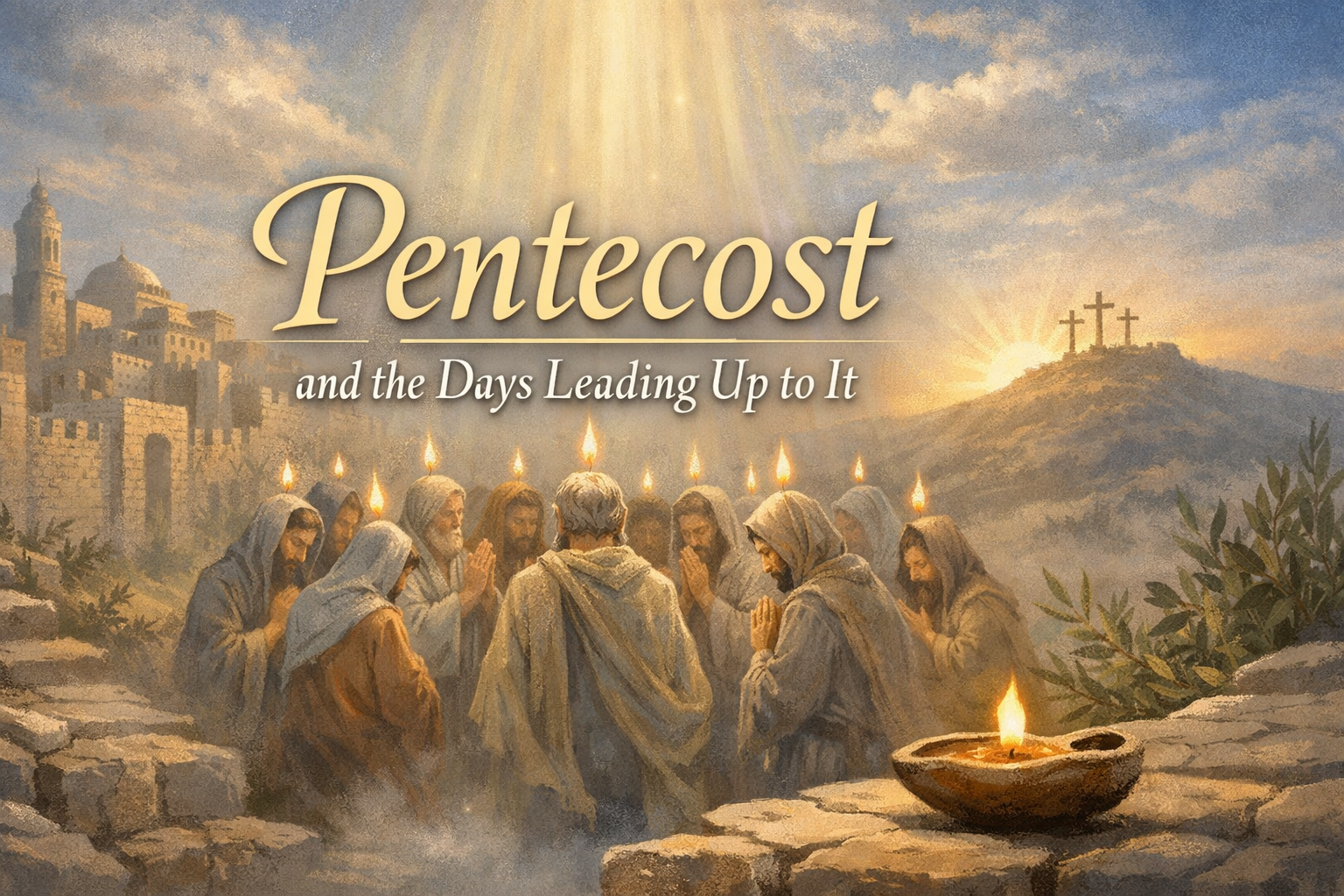
Acts 1:14 says they continued with one accord in prayer and supplication. So the ten days between the ascension and Pentecost were marked by prayer, unity, expectation, and dependence on God. The disciples had a real commission, but they were not ready to carry it out in their own strength. The church does not begin with human energy. It begins with divine enabling.
Too often people want the work of God without the dependence on God. Those early believers were made to wait, and in the waiting they were taught the most important lesson of their lives: the mission of Christ cannot be fulfilled by fleshly power. That is still true.
Pentecost — What It Actually Meant
Pentecost was originally a Jewish feast held fifty days after Passover. It drew Jews from many nations to Jerusalem. That timing was not accidental — God chose a feast when the city was full of people from many lands, so the gospel’s public launch would have immediate international reach.
When the Spirit came in Acts 2 — with the sound of a rushing mighty wind, tongues as of fire, and disciples speaking in other languages — the event signaled several things at once:
Peter’s Sermon — The Heart of Pentecost
The miracle of Pentecost was not the final point. The preaching of Christ was. The sound, the fire, and the languages got the crowd’s attention — but Peter explained the meaning. He did not turn Pentecost into a spectacle. He used it as a platform to preach Jesus.
His sermon in Acts 2:14–36 makes a chain of claims: this is the fulfillment of Joel’s prophecy; Jesus of Nazareth was attested by God through miracles; He was crucified by wicked hands; God raised Him from the dead; He is now exalted at the Father’s right hand; and the Spirit has been poured out by this exalted Christ. Therefore —
Acts 2:36 — “God hath made that same Jesus, whom ye have crucified, both Lord and Christ.”
That is the heart of Pentecost. Not religious excitement, not emotional experience, not signs for their own sake. Pentecost is the Father’s declaration, through the Spirit, that Jesus is risen, exalted, and reigning. And the Spirit does not draw attention away from Jesus. He always magnifies Jesus. Any view of Pentecost that makes Christ secondary has already missed the point.
The Response — Conviction, Conversion, Community
When the people heard Peter’s sermon, they were “pricked in their heart” (Acts 2:37). That is the Spirit’s work. The same crowd that had been spiritually dull now felt the full weight of truth. Peter called them to repent and be baptized in the name of Jesus Christ for the forgiveness of sins, and about three thousand souls were added that day.
So Pentecost was not only about power. It was about conversion. Not only signs, but salvation. Not only the Spirit poured out — but sinners brought in.
And the result was a new kind of community. Acts 2:42–47 describes a people devoted to the apostles’ teaching, fellowship, breaking of bread, prayer, generosity, worship, and witness. That is the fruit of Pentecost: a Christ-centered, Spirit-formed, truth-grounded, witnessing people. It did not make believers passive spectators. It made them participants in the mission of the risen King.
What Pentecost Teaches the Church Today
The Spirit of God cannot be replaced. Programs, talent, tradition, and human effort cannot substitute for what only the Spirit provides. A church may have activity and still lack life. Pentecost reminds us where life actually comes from.
Stay centered on Christ. The Spirit was poured out to magnify the Son. Any movement, any worship style, any spiritual experience that makes Christ secondary has missed what Pentecost is for.
Prayer is not optional. The disciples were in prayer when the Spirit came. A praying church is a dependent church. Dependence is not weakness — it is wisdom.
The Word must be preached. The miracle opened the door, but the sermon carried the truth. God still saves through the proclamation of the gospel — not through spectacle alone.
The mission moves outward. Acts 1:8 points from Jerusalem to Judea to Samaria to the uttermost part of the earth. Pentecost begins local, but it was never meant to stay local. Every generation of the church is responsible to carry that trajectory forward.
The Full Flow — From Cross to Church
Pentecost tells us that Jesus is alive, exalted, and active. It tells us the gospel is for all nations. It tells us the church must not run on human strength. And it reminds us that when God pours out His Spirit, timid disciples become bold witnesses, confused followers become faithful preachers, and dead sinners become living members of Christ’s body. That is the glory of Pentecost.
Key Takeaways
- Pentecost was prepared for, not improvised. The forty days of instruction, the ascension, and the ten days of prayer were all part of one plan. God formed His people by truth before He sent them out in power — and that is still His pattern.
- The ascension made Pentecost possible. The Spirit was poured out because Christ was enthroned. Pentecost is not evidence of Christ’s absence — it is evidence of His reigning victory at the Father’s right hand.
- The waiting room was not wasted time. God made His people wait so they would learn dependence. The mission of Christ cannot be carried out by fleshly power, and the disciples learned that before they were ever sent.
- Pentecost signaled the dawn of the new covenant age. The Spirit came in fulfillment of Joel’s prophecy, the church was publicly launched, and the division of Babel began to be answered as people from every nation heard the gospel in their own tongue.
- The heart of Pentecost is not the miracle — it is the message. Peter used the outpouring as a platform to preach Jesus: crucified, risen, exalted, and declared both Lord and Christ. The Spirit always magnifies the Son.
- Pentecost produces a witnessing community, not passive spectators. The fruit of Acts 2 was a people devoted to teaching, fellowship, prayer, worship, and witness — Spirit-formed and sent outward from Jerusalem to the ends of the earth.
Key Scriptures: Luke 24:44–49 · Acts 1:3–11 · Acts 1:14 · Acts 2:1–47 · John 16:7 · Acts 2:33 · Joel 2:28–32 · Genesis 11:1–9
Mountain Veteran Ministries
Find Your Next Bearing
Every journey needs a direction. If you're wondering where to go from here, choose the path that best fits where you are today.
⚒️ I Want to Live Faithfully
Discover practical wisdom for following Christ in today's world.
→ Living as a Christian Today✝️ I Want to Understand the Gospel
Learn what salvation means and why Jesus came.
→ Understanding Salvation📖 I Want to Understand the Bible
Explore why Christians trust Scripture and how to read it well.
→ Understanding the Bible❓ I Still Have Questions
Explore thoughtful answers to some of Christianity's hardest questions.
→ Hard Questions