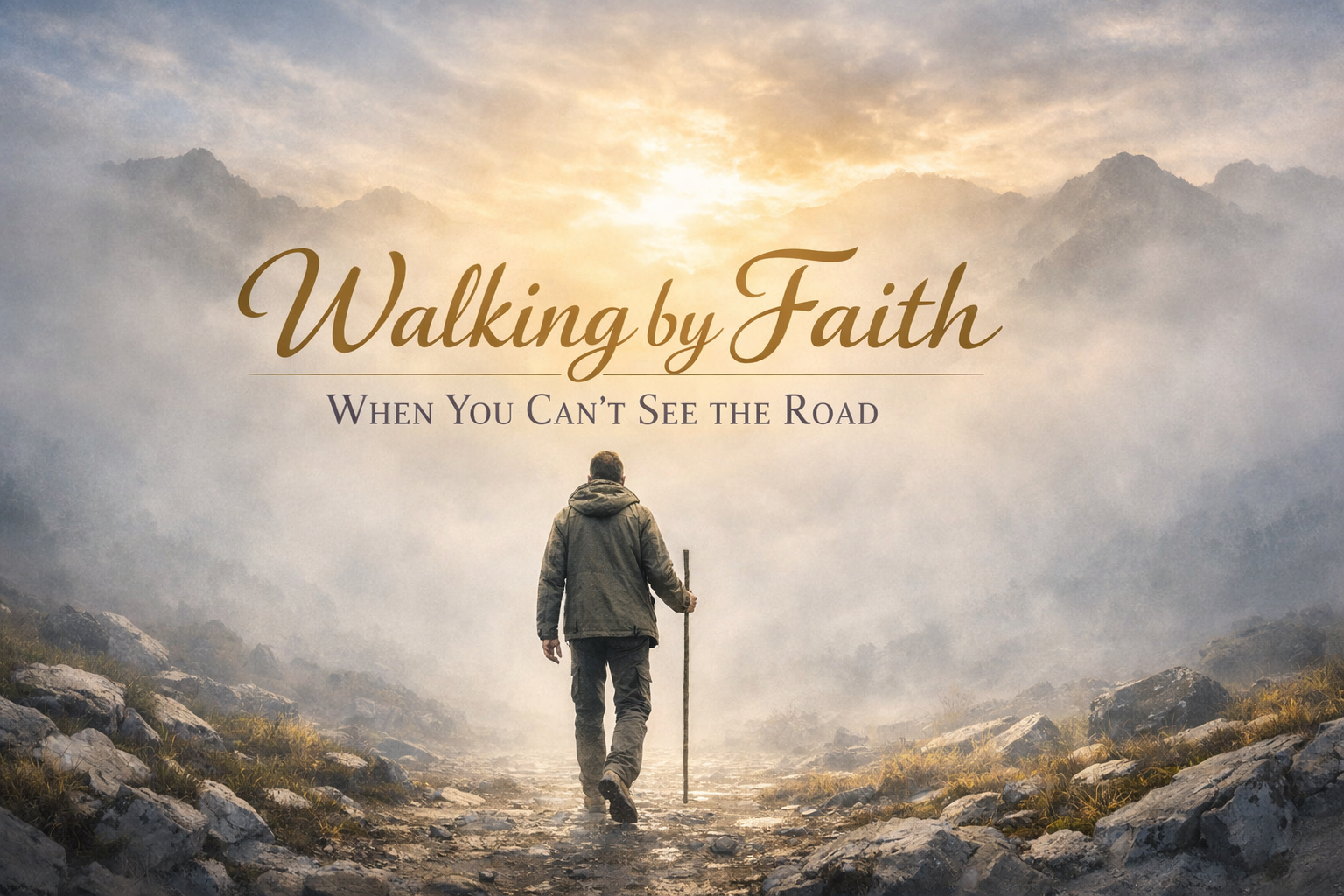
Walking by Faith When You Can’t See the Road
Faith isn’t the absence of uncertainty — it’s the decision to keep walking when the road ahead disappears. Scripture doesn’t promise us a clear view. It promises us a reliable Guide.
Faith isn’t the absence of uncertainty — it’s the decision to keep walking when the road ahead disappears. Scripture doesn’t promise us a clear view. It promises us a reliable Guide.
You’ve been there. Standing at a crossroads — job gone, marriage cracking, diagnosis unclear, future fogged in — and you know in your bones you’re supposed to trust God. People tell you to “just have faith.” You nod. You know the right answer. But when you’re lying awake at 2 a.m. and the path forward looks like nothing but darkness, faith can feel less like a rock and more like a rope that might or might not hold.
Here’s what I want to say to you: that feeling isn’t the opposite of faith. It might actually be the beginning of real faith.
Walking by faith when you can’t see the road is the central challenge of the Christian life. Not one of the challenges — the central one. And the Bible doesn’t sugarcoat it. It gives us real people in real darkness, and it shows us how they walked. Let’s look at what Scripture actually teaches us about this — not the bumper-sticker version, but the honest, theological, practical reality of trusting God when you can’t see where you’re going.
The Biblical Vocabulary of Unseen Roads
The Apostle Paul gives us what has become the flagship verse on this topic: 2 Corinthians 5:7 — “for we walk by faith, not by sight.” Seven words. Simple sentence. Profound weight.
Paul isn’t writing this from a comfortable study. He’s writing it from a life that included shipwrecks, beatings, imprisonments, and constant uncertainty. When he says “we walk by faith, not by sight,” he knows what he’s talking about. This isn’t a theology professor’s proposition. It’s a battle-hardened soldier’s testimony.
The word translated “walk” in the Greek is peripateo — it means to walk around, to conduct your life, to live your daily existence. This isn’t a one-time leap. It’s a sustained, daily, ordinary mode of living. Paul is saying: the way you conduct your whole life — the way you make decisions, move forward, get up in the morning — is to be governed by faith rather than by what you can verify with your eyes.
And the word for “faith” here (pistis) carries the full freight of trust, confidence, and reliance. It’s not wishful thinking or blind optimism. It’s a reasoned, committed trust in a Person whose character has been demonstrated and whose promises have been tested.
The contrast is with “sight” — eidos in Greek, meaning outward appearance, visible form, the data your senses can process. Paul isn’t saying sight is bad. He’s saying sight is limited. And when the visible data is incomplete, confusing, or terrifying, you don’t stop walking. You walk by something more reliable than the data in front of you.
That’s the vocabulary. Now let’s look at the gallery of people who actually lived it.
Abraham: The Father of the Foggy Road
If you want a case study in walking by faith when you can’t see the road, Abraham is your man. Hebrews 11:8 puts it plainly: “By faith Abraham obeyed when he was called to go out to a place that he was to receive as an inheritance. And he went out, not knowing where he was going.”
Not knowing where he was going. Read that again.
Abraham didn’t have a map. He didn’t have a five-year plan. He didn’t have a GPS or even a general direction. He had a word from God and a command to move. And he went. He packed up everything — family, livestock, servants, his elderly wife — and started walking into the unknown.
The author of Hebrews gives us a stunning description of what this looked like in practice: Hebrews 11:9-10 — “By faith he went to live in the land of promise, as in a foreign land, living in tents with Isaac and Jacob, heirs with him of the same promise. For he was looking forward to the city that has foundations, whose designer and builder is God.”
Notice that phrase: living in tents. Tents aren’t permanent. Tents are what you live in when you’re passing through. Abraham spent decades in tents because he understood that his ultimate destination wasn’t a piece of Canaan real estate — it was a city built by God. His faith oriented him toward an eternal horizon, which meant he could endure any temporal uncertainty along the way.
That’s not escapism. That’s precisely the kind of eternal perspective that makes you more grounded in the present, not less. When you know where you’re ultimately going, you can handle not knowing exactly where the road goes next.
Reformed theologian John Calvin saw in Abraham’s faith a model for all believers. For Calvin, Abraham’s obedience wasn’t heroic willpower — it was the fruit of a heart genuinely grasped by the word of God. The road was dark, but the promise was sure. And the sure promise was enough to move his feet.
What Faith Is Not
Before we go further, let’s clear some brush. Walking by faith is commonly misunderstood in ways that either make it seem easy (it’s not) or make it seem irrational (it isn’t).
Faith is not the suppression of doubt. The Psalms are full of anguished, honest, sometimes even accusatory prayers. Psalm 22 opens with Psalm 22:1 — “My God, my God, why have you forsaken me?” That’s not a faith failure. That’s a faith prayer. The psalmist is still talking to God, still addressing him as “my God.” Doubt and faith are not mutually exclusive. What faith does is keep you in the conversation even when you don’t like the silence.
Faith is not presumption. Walking by faith doesn’t mean ignoring wisdom, skipping due diligence, or leaping off buildings because God will catch you. Jesus rebuked that kind of “faith” in the wilderness when Satan tempted him to throw himself off the temple pinnacle. Real faith works within the natural order God has established, not around it. It trusts God for outcomes while still using the means God provides — counsel, community, hard work, medical care, careful planning.
Faith is not a feeling. Some of the greatest acts of faith in history were done by people who felt nothing. Corrie ten Boom didn’t feel victorious in the Nazi concentration camp. She walked by faith anyway. The Reformers who faced execution didn’t feel invincible. Many of them were terrified. But they trusted what they knew to be true about God even when every nerve in their body was screaming something different.
Genuine faith is a settled confidence in God’s character and promises that holds steady when emotions fluctuate. That doesn’t mean emotions don’t matter. God made emotions, and they’re real and valid. But they’re not the steering wheel. Faith is.
The Night Seasons: When God Seems Silent
One of the hardest stretches on the road of faith is when God seems to go quiet. You pray, and it feels like the words are hitting the ceiling. You search the Scripture, and everything feels dry. You look for signs of his movement, and the landscape is blank.
The mystics of the Christian tradition called this the “dark night of the soul” — a season of spiritual dryness and divine hiddenness that actually serves a purpose in the formation of faith. But you don’t have to be a medieval mystic to recognize the experience. Most honest Christians have been there.
The prophet Isaiah speaks directly to this condition. In Isaiah 50:10, he writes: “Who among you fears the Lord and obeys the voice of his servant? Let him who walks in darkness and has no light trust in the name of the Lord and rely on his God.”
This verse is remarkable for what it assumes. It assumes that the person walking in darkness and having no light is someone who fears the Lord. This isn’t describing a backslider or a rebel. This is describing a faithful servant who is temporarily in the dark. And the command isn’t to manufacture light or pretend the darkness isn’t there. The command is to trust in the name of the Lord — to lean hard on who God is — and to rely on him.
The next verse gives the alternative, and it’s a warning: Isaiah 50:11 — “Behold, all you who kindle a fire, who equip yourselves with burning torches! Walk by the light of your fire, and by the torches that you have kindled! This you have from my hand: you shall lie down in sorrow.”
When God goes quiet and we can’t see the road, there’s a powerful temptation to make our own light. To force a solution. To manufacture certainty. To take control. Isaiah says that path ends in sorrow. The self-lit road is a dead end. God’s hiddenness is not his absence — and the path forward is to trust the Guide even when you can’t see the trail.
Proverbs 3 and the Architecture of Trust
The most familiar passage on trusting God in the dark is probably Proverbs 3:5-6: “Trust in the Lord with all your heart, and do not lean on your own understanding. In all your ways acknowledge him, and he will make straight your paths.”
It’s familiar enough to have become wallpaper — we’ve heard it so many times it can slide right past us. But if you slow down and look at the architecture of what Solomon is actually saying, it’s stunning.
“Trust in the Lord with all your heart” — not just your intellect, not just your theology, not just your Sunday morning religion. With all your heart. The Hebrew word for heart (leb) encompasses the whole interior life: mind, will, and emotion. This is whole-person trust. It’s the kind of trust that doesn’t compartmentalize — that brings every decision, fear, and aspiration to God and holds it open before him.
“Do not lean on your own understanding” — this doesn’t mean stop thinking. God gave you a mind, and he expects you to use it. What it means is: don’t make your own perspective the final authority. Your understanding is partial. Your information is incomplete. Your assessment of your situation is filtered through fear, past experience, limited vantage point, and the distortions of a still-being-sanctified heart. Lean on that? Not as your primary support.
“In all your ways acknowledge him” — the Hebrew word here is yada, which means to know intimately, to recognize, to be rightly related to. In all your ways. Not the big spiritual decisions. All of them. The career call and the grocery run. The marriage crisis and the Tuesday afternoon email. Acknowledging God in all of it means living with a constant awareness of his presence and an ongoing submission to his direction.
“And he will make straight your paths” — the promise. Not that the road will always be paved and well-lit. But that God will make it straight — purposeful, directed, ultimately leading where it should go. The imagery is of a path through rough terrain that God levels and straightens. The obstacles don’t disappear. But your way through them is ordered by him.
The Role of the Word in the Dark
If you can’t see the road, you need a light source that doesn’t depend on your circumstances. The psalmist identifies exactly that source in Psalm 119:105: “Your word is a lamp to my feet and a light to my path.”
Notice the scale of the light. Not a floodlight illuminating the whole journey. A lamp to your feet. Enough to see the next step. That’s often all God gives — the next step. And the Scripture provides that step-by-step light through his revealed word.
This is why the discipline of regular Scripture reading is not optional for the Christian who wants to walk by faith. You cannot trust a God you don’t know. And you come to know him — his character, his promises, his ways, his track record — through his word. When the road goes dark, you fall back on what you know. And what you know is what you’ve put in.
J.I. Packer, in Knowing God, argued that the primary cause of weak faith is weak knowledge of God. People with a shallow, vague, sentimental picture of God will crumble when the road gets hard, because they’re trusting a construction of their own imagination rather than the God of the Bible. But those who have saturated themselves in Scripture — who know that God was faithful to Abraham, Joseph, Moses, David, Paul, and ten thousand unnamed saints since — those people have something to stand on when the ground starts shaking.
The word doesn’t just inform your faith. It forms it. It shapes the contours of your trust, giving it substance and ballast. Feed on it regularly, especially in the dark seasons.
Community: You Were Never Meant to Walk Alone
Walking by faith is not a solo sport. The New Testament vision of the Christian life is radically communal. We are a body, not a collection of independent atoms. And one of the great gifts of the body is that when one part can’t see the road clearly, other parts can help hold them on it.
Hebrews 3:13 gives us a striking command: “But exhort one another every day, as long as it is called ‘today,’ that none of you may be hardened by the deceitfulness of sin.” Every day. The writer is not thinking of weekly church attendance as the primary vehicle of this exhortation. He’s thinking of the daily fabric of life together — checking in, speaking truth, encouraging the faith of those around you.
Galatians 6:2 puts it another way: “Bear one another’s burdens, and so fulfill the law of Christ.” When the load of uncertainty gets too heavy for one person’s faith to carry alone, the community picks up the weight. This is not weakness. This is precisely how God designed the body to function.
I’ve seen this firsthand in pastoral ministry. The person who tries to white-knuckle their faith in isolation almost always ends up either pretending they’re fine or quietly falling away. The person who stays connected to the body — who lets others pray for them, speak truth to them, sit with them in the dark — almost always comes through. We were built for this kind of mutual strengthening.
Don’t let pride or embarrassment cut you off from the community’s faith when yours is thin. That’s not humility — it’s self-reliance dressed up as stoicism. Reach out. Let people in. Walk together.
The Sovereignty of God: Why the Dark Road Is Not Wasted
Here’s the theological anchor that makes all of this possible: God is sovereign over the dark roads, not just the lit ones.
Reformed theology has always insisted on this with particular force. God is not a passive observer of human suffering, wringing his hands while circumstances spiral. He is actively providential — working all things, including the confusion and darkness and suffering, toward a purposeful end. Romans 8:28 is not a platitude: “And we know that for those who love God all things work together for good, for those who are called according to his purpose.”
“All things.” That includes the diagnosis you didn’t expect. The relationship that collapsed. The door that slammed shut. The prayer that wasn’t answered the way you hoped. All of it is inside God’s sovereign care, being woven into something you can’t yet see.
This doesn’t mean every dark road is punishment. Job’s friends made that mistake, and God rebuked them for it. Sometimes the road is dark because we live in a fallen world where bad things happen to everyone. Sometimes it’s dark because God is stripping away something we were leaning on that wasn’t him. Sometimes it’s dark because he’s preparing us for something we couldn’t handle yet in full light.
The point is that the darkness is not outside his jurisdiction. There is no stretch of road that God hasn’t walked before you and isn’t walking with you now. Isaiah 43:2 promises: “When you pass through the waters, I will be with you; and through the rivers, they shall not overwhelm you; when you walk through fire you shall not be burned, and the flame shall not consume you.” Notice he says “when,” not “if.” He’s not promising you’ll avoid the dark water and the fire. He’s promising his presence in it.
Practical Traction: How to Walk When You Can’t See
Theology without traction is just interesting thinking. So what does walking by faith actually look like when you’re in the middle of the fog? Here are some concrete practices that have helped both in my own life and in the lives of people I’ve walked alongside pastorally.
Do the next right thing. When you can’t see the whole road, focus on the step directly in front of you. What does faithfulness look like today — right now? Do that. You don’t have to solve the whole problem tonight. You have to honor God with this hour. The path often becomes visible one step at a time, and obedience in the present unlocks clarity for the future.
Return to what you know.** When feelings are unreliable and circumstances are confusing, return to the theological bedrock. Not your experience of God — his character as revealed in Scripture. He is faithful. He has not abandoned his people. His purposes will not be thwarted. His promises are yes and amen in Christ. Rehearse those truths out loud. Pray them back to God. Let what you know anchor what you feel.
Keep the spiritual disciplines even when they feel empty. Pray even when it feels like talking to the ceiling. Read Scripture even when it feels dry. Gather with the church even when you’d rather stay home. The disciplines are not about generating feelings. They are about positioning yourself to receive what God gives — and sometimes what he gives comes after a long season of faithful waiting. Don’t abandon the means of grace just because the immediate return isn’t what you hoped for.
Tell someone the truth. Find a pastor, a trusted elder, a mature believer — someone who won’t just tell you everything is fine — and tell them what’s actually going on. Ask for prayer. Receive counsel. Let someone else carry part of the weight. Vulnerability in community is not weakness; it’s the body of Christ functioning the way God intended.
Look back before you look forward. Keep a record — mental or written — of God’s faithfulness in your past. The Israelites kept stumbling in the wilderness partly because they had short memories. The Psalms are full of remembrance: “I will remember the deeds of the Lord; yes, I will remember your wonders of old” (Psalm 77:11). When you can’t see forward, look backward. God has been faithful before. He will be faithful again.
A Word for the Veteran and the Weary
If you’ve served in the military, you know what it’s like to move through darkness with limited information, trusting training, trusting the mission, trusting the person to your left and right. That’s not a bad model for faith. You don’t need to see the whole map. You need a trustworthy Commander, a reliable word, and brothers and sisters who’ve got your back.
The dark roads are real. The fog is real. But so is Psalm 23:4: “Even though I walk through the valley of the shadow of death, I will fear no evil, for you are with me.” The Shepherd doesn’t avoid the valley. He walks through it with you.
That’s the promise. Keep walking.
Key Takeaways
- Faith is a sustained way of living, not a one-time leap. Paul’s language in 2 Corinthians 5:7 describes the daily conduct of the whole life — moving forward by trust in God’s character when visible data is incomplete or frightening.
- Abraham’s faith was fueled by an eternal horizon. He could endure temporal uncertainty — living in tents, wandering without a map — because he was oriented toward the city whose builder is God. An eternal perspective doesn’t make you less engaged; it makes you more resilient.
- Faith is not a feeling, and doubt is not its opposite. Genuine faith is a settled confidence in God’s character that holds steady when emotions fluctuate. Doubt honestly expressed in prayer is not unfaith — it may be the truest kind of faith there is.
- God’s word is the lamp for dark roads. You cannot trust a God you don’t know. Regular, sustained engagement with Scripture builds the reserves of theological knowledge that stabilize faith when circumstances turn dark.
- The dark road is not outside God’s sovereignty. Romans 8:28 covers all things — including the confusion, the suffering, and the unanswered prayers. Nothing you’re walking through is outside his jurisdiction or beyond his redemptive purposes.
- You were not meant to walk alone. The New Testament vision of faith is communal. When your own faith is thin, the community’s faith holds you. Let the body function the way God designed it — in mutual burden-bearing and daily exhortation.
Key Scriptures: 2 Corinthians 5:7 · Proverbs 3:5-6 · Isaiah 50:10 · Psalm 119:105 · Romans 8:28 · Hebrews 11:8 · Isaiah 43:2 · Psalm 23:4
Mountain Veteran Ministries
Find Your Next Bearing
Every journey needs a direction. If you're wondering where to go from here, choose the path that best fits where you are today.
⚒️ I Want to Live Faithfully
Discover practical wisdom for following Christ in today's world.
→ Living as a Christian Today✝️ I Want to Understand the Gospel
Learn what salvation means and why Jesus came.
→ Understanding Salvation📖 I Want to Understand the Bible
Explore why Christians trust Scripture and how to read it well.
→ Understanding the Bible❓ I Still Have Questions
Explore thoughtful answers to some of Christianity's hardest questions.
→ Hard Questions