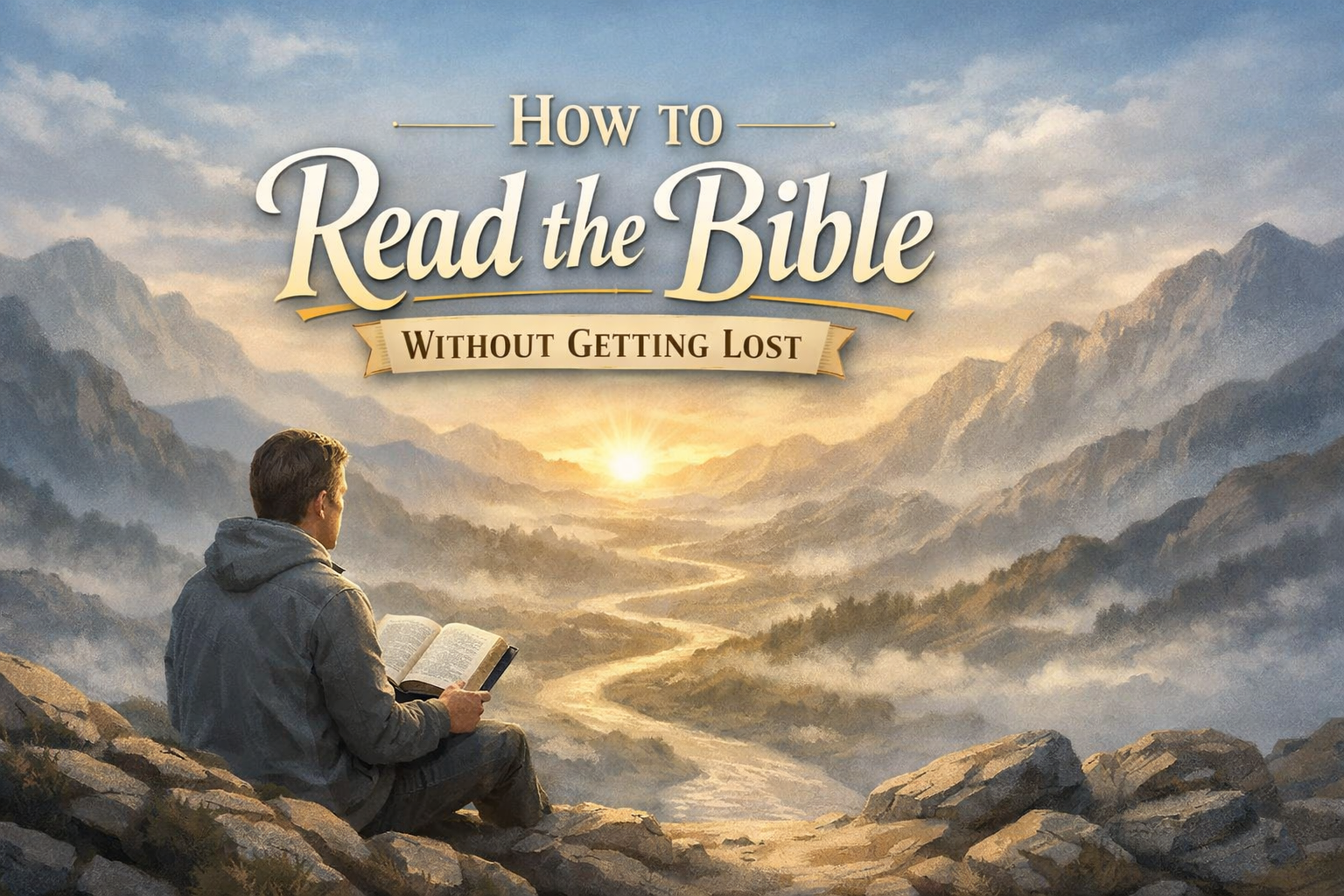
How to Read the Bible Without Getting Lost
A lot of people pick up the Bible with real intention. They start in Genesis, move through creation, the flood, the patriarchs — and then they hit Leviticus. Nineteen chapters of detailed instructions for sacrifices, skin diseases, and priestly garments. By Numbers, they’re done. The Bible goes back on the shelf, and somewhere in their mind a quiet conclusion forms: “I guess the Bible just isn’t for people like me.”
That conclusion is wrong. But the experience that produced it is real, and it’s almost universal. The Bible is unlike any other book you’ve ever tried to read — because it isn’t one book. It’s sixty-six books, written across roughly fifteen hundred years, in three languages, across dozens of genres, by authors ranging from kings to fishermen to a tax collector to a prisoner on a Roman island. Reading it cover-to-cover like a novel is like walking into a library, grabbing the first book off the shelf, and wondering why it doesn’t match the last one you read.
You don’t need a seminary degree to read Scripture well. You need a better map, some honest expectations, and a few simple tools. That’s what this post is for.
First: Understand What You’re Holding
Before any reading strategy makes sense, you need a working picture of what the Bible actually is — because the way you approach a book shapes everything about what you find in it.
The Bible is not a rulebook, an answer key, or a collection of inspirational quotes. It’s the story of God and humanity — a long, honest, sometimes messy narrative about what went wrong between the Creator and his creation, and what God did to fix it. Every part of the Bible belongs to that larger story, even the parts that seem disconnected or strange.
Theologians call this redemptive history — the unfolding drama of God working to redeem a fallen world. The Old Testament sets the stage, establishes the problem, and makes the promises. The New Testament shows how those promises are fulfilled in Jesus Christ. The whole thing is one story with one main character and one central plot line. Once you see that, a lot of the seemingly random material starts to make more sense.
“For everything that was written in the past was written to teach us, so that through the endurance taught in the Scriptures and the encouragement they provide we might have hope.” — Romans 15:4
Paul is writing to Roman Christians about the Old Testament — those ancient laws and histories and poems — and his claim is that all of it was written for our instruction. Not just the easy parts. Not just the Psalms and the Sermon on the Mount. All of it. That’s a bold claim, and it reshapes how we approach the hard sections.
The Big Map: How the Bible Is Organized
One of the best things you can do before you read is get a bird’s-eye view of the terrain. The Bible has a structure — not always obvious, but real and meaningful.
The Old Testament (39 books)
The Old Testament is itself organized into several broad categories:
The Law (Torah) — Genesis through Deuteronomy. These five books, also called the Pentateuch, lay the foundation for everything. Genesis gives you creation, the fall, and the patriarchs — Abraham, Isaac, Jacob, Joseph. Exodus through Deuteronomy covers Israel’s deliverance from Egypt and the giving of the Law at Sinai. Yes, there’s a lot of law in there. Most of it isn’t binding on Christians in the same way it was on ancient Israel, but it’s not meaningless either — it shows you God’s character, his holiness, and why a sacrifice would eventually be necessary.
The Historical Books — Joshua through Esther. These trace the story of Israel entering the Promised Land, the period of the Judges, the rise and fall of the monarchy (Saul, David, Solomon), the splitting of the kingdom, and eventually the exile to Babylon. It reads more like narrative history — people, battles, politics, failure, occasional faithfulness. This is where the story gets complicated in ways that feel very human.
The Wisdom and Poetry — Job through Song of Solomon. These books aren’t narrative. They’re meditation — on suffering (Job), on praise and lament (Psalms), on practical wisdom (Proverbs), on the nature of life (Ecclesiastes), on love (Song of Solomon). They’re meant to be read slowly, not consumed. Psalms especially functions as Israel’s prayer book, and it has served as the church’s prayer book for two thousand years.
The Prophets — Isaiah through Malachi. The prophets are the most misunderstood section of the Old Testament. They’re not primarily fortune-tellers. They’re covenant enforcers — men God sent to call Israel back to faithfulness when she wandered. Yes, they contain prophecy about the future, including extensive prophecy about Christ. But most of what they say is addressed directly to Israel in their own time. Context is everything here.
The New Testament (27 books)
The Gospels — Matthew, Mark, Luke, John. Four accounts of the life, death, and resurrection of Jesus. Each is written to a different audience with different emphases, which is why they don’t always read identically. That’s not contradiction — it’s perspective. Start here if you’re new to the Bible.
Acts. The history of the early church — the spread of the gospel from Jerusalem outward, following the apostles, especially Peter and Paul. Essential context for understanding the letters that follow.
The Epistles — Romans through Jude. Letters written to early Christian communities or individuals, addressing specific situations and theological questions. They’re theological depth charges packed into pastoral correspondence. Romans is probably the most systematically comprehensive; start there for doctrine. James for practical ethics. Hebrews for understanding how the Old Testament connects to Christ.
Revelation. Apocalyptic literature — a highly symbolic vision given to the apostle John during Roman persecution. This is not a newspaper decoded into prophecy. It’s a heavily symbolic pastoral letter written in a genre (apocalyptic) that had rules ancient readers understood and modern readers often don’t. Read it, but don’t start there.
Where to Start (Hint: Not Genesis)
If you’re new to the Bible, or coming back after a long time away, the single best piece of advice is this: start with the Gospels.
Specifically, start with the Gospel of Mark. It’s the shortest Gospel — sixteen chapters — and it moves fast. No long genealogies, no extended discourses. Just Jesus, in action, constantly. It’s the Gospel that reads most like a documentary. You can get through it in a few sittings and come away with a clear picture of who Jesus is and what he does.
From Mark, move to Luke — which gives you more context, more interaction with outcasts and the poor, and a richer picture of Jesus’ teaching. Then read Acts, which is Luke’s sequel. You’ll follow the story of what happened after the resurrection, which gives everything else in the New Testament a home to belong to.
After that, Romans. It’s the most systematic explanation of the gospel in Scripture. Heavy, but worth it. Then explore from there — Psalms when you need prayer, Proverbs when you need wisdom, the other Gospels when you want more of Jesus.
Genesis is worth reading — it’s foundational — but read it after you have the New Testament’s interpretive lens. When you know that Jesus is the fulfillment of the Abrahamic covenant, the promises to Abraham in Genesis 12:1–3 hit differently. When you know that Christ is the Lamb of God, the near-sacrifice of Isaac in Genesis 22 becomes something else entirely.
Three Questions to Ask Every Passage
The difference between reading the Bible and studying it often comes down to the questions you bring. Here are three that will serve you in almost any passage:
1. What did this mean to the original audience?
Every part of the Bible was written to someone in a specific time and place. Paul’s letter to the Romans was written to a specific community of believers in Rome in the first century, navigating specific tensions between Jewish and Gentile Christians. Amos’s prophecy was directed at a prosperous but corrupt Israel in the eighth century BC. Before you ask what a passage means for you, ask what it meant to them.
This is called reading in context, and it prevents a lot of bad Bible interpretation. Verses yanked out of context can be made to say almost anything. Verses read in context say what they actually say.
2. What does this reveal about God?
The Bible is first and foremost a book about God — his character, his ways, his purposes. Every passage reveals something: his holiness, his patience, his justice, his mercy, his faithfulness. Even the dark passages — the violence, the judgment, the hard commands — reveal something about who God is and what he takes seriously. Make it a habit to ask this question and you’ll find that even the dry sections start to yield something.
3. How does this connect to Jesus?
Jesus himself said that all of Scripture points to him. In Luke 24:27, after the resurrection, he walked two disciples through the Old Testament — “beginning with Moses and all the Prophets” — explaining how it all pointed to him. If Jesus read the Old Testament as a book about himself, that’s probably worth taking seriously.
This doesn’t mean you do interpretive gymnastics to make every verse about Jesus. It means you hold the big story in mind: where does this fit in the arc of God’s redemptive plan that culminates in Christ? Sometimes the connection is direct and explicit. Sometimes it’s a shadow or a pattern. Learning to see those connections is one of the deep pleasures of long-term Bible reading.
Tools That Actually Help
You don’t need a lot of equipment to read the Bible well, but a few tools make a real difference.
A Good Translation
Bible translations exist on a spectrum from word-for-word to thought-for-thought. For serious reading, the English Standard Version (ESV) or New American Standard Bible (NASB) give you accuracy and readability. The New International Version (NIV) is more accessible and still trustworthy. The New Living Translation (NLT) is excellent for narrative sections and general readability. The King James Version (KJV) is beautiful and has shaped the English language, but its archaic language can be a barrier for new readers.
Pick one and stick with it for a season. Jumping between translations can help you understand a difficult verse, but it can also become a way of avoiding a text that’s simply hard. Read one translation consistently; consult others when you’re stuck.
A Study Bible
A good study Bible puts introductions, maps, cross-references, and explanatory notes right on the page next to the text. The ESV Study Bible, the NIV Study Bible, and the Reformation Study Bible are all solid options. These are not a replacement for the text — don’t spend more time in the footnotes than the Bible — but they give you context when you need it without requiring a separate library.
A Reading Plan
Structure helps. Left to our own devices, most of us read the same familiar passages repeatedly and avoid the ones that challenge us. A reading plan breaks that habit. The M’Cheyne Bible Reading Plan takes you through the New Testament and Psalms twice and the Old Testament once in a year, with four short passages per day. The Bible Project’s reading plans pair Scripture with their video overviews, which are excellent. Find a plan that fits your pace and use it — not as law, but as a guide.
A Journal
Writing what you notice forces you to slow down. It doesn’t have to be elaborate — even a sentence or two per reading session (“What did I observe? What does this say about God? What’s one thing to carry into the day?”) builds retention and attentiveness over time. The discipline of writing is the discipline of paying attention.
What to Do When You Don’t Understand Something
You will hit passages that confuse you, disturb you, or seem flatly contradictory to something else you’ve read. That’s not a sign that the Bible is unreliable. It’s a sign that you’re actually reading it.
A few principles for hard passages:
Let clear passages interpret unclear ones. The Reformed hermeneutical principle of analogia fidei — the analogy of faith — says that Scripture interprets Scripture. If a passage seems to say something that contradicts the clear teaching of ten other passages, don’t build a doctrine on the one. Let the weight of the whole Scripture guide your understanding of the part.
Sit with it before you solve it. The instinct when we hit a hard passage is to immediately find a commentary or a YouTube explanation. That’s fine, but try sitting with the text first. Read it again. Read the surrounding context. Ask the three questions above. You’ll be surprised how often what seemed impenetrable opens up with a little patience.
Ask someone further along. The Christian faith was never designed to be a solo project. The church exists partly so that believers can learn from one another. If a passage has you genuinely stumped or troubled, bring it to a pastor, an elder, or a mature believer. That’s not weakness — that’s wisdom.
Don’t let the hard parts stop you. Some passages will remain difficult even after study and prayer. That’s okay. The Bible is deep enough to spend a lifetime in and still find new water. Keep reading. Understanding comes with time, context, and the Spirit’s illumination — not all at once, but steadily.
The Spirit’s Role in Reading
This is the part that no reading strategy can manufacture, and it matters more than all the tools combined.
The Bible is not a natural book read by natural means alone. Paul writes in 1 Corinthians 2:14 that the natural person does not accept the things of the Spirit of God — they are spiritually discerned. This doesn’t mean that unbelievers can’t understand the words on the page. It means that the life-transforming comprehension of Scripture — where it goes from information to formation — is the work of the Holy Spirit.
“Open my eyes, that I may behold wondrous things out of your law.” — Psalm 119:18
That’s not a decorative prayer. It’s a theological statement: the eyes needed to see the Bible’s wonders are not natural eyes. They’re opened by God. Before you read, ask him to open yours. It’s one of the simplest, most consistently effective things you can do to change your Bible reading.
The Reformers called this the internal testimony of the Holy Spirit — the Spirit’s witness that the Word is true, working in the heart of the believer to illuminate and apply what is read. You can have the best translation, the best study Bible, and the best reading plan on the market, and still read the Bible as dead letter if the Spirit isn’t at work. Pray before you open it. Not as a ritual, but as an acknowledgment that you need help seeing what’s there.
Reading for Transformation, Not Information
The goal of Bible reading isn’t Bible knowledge. It’s knowing God — and being changed by that knowledge into the image of his Son.
The danger of getting good at Bible reading is that it can become an intellectual exercise. You master the genres, the contexts, the cross-references — and you know a tremendous amount about Scripture while remaining largely unchanged by it. The Pharisees of Jesus’ day were the most Bible-saturated people in the room, and Jesus told them they didn’t know God (John 5:39–40). Searching the Scriptures is good. Coming to Christ through them is the point.
Hebrews 4:12 describes the Word of God as “living and active, sharper than any two-edged sword, piercing to the division of soul and of spirit, joints and of marrow, and discerning the thoughts and intentions of the heart.” That’s not a description of a textbook. It’s a description of a tool that does something to you. Let it do its work. Don’t just study the Bible — let the Bible study you.
James makes it even more direct: “Be doers of the word, and not hearers only, deceiving yourselves” (James 1:22). The measure of a good Bible reading session is not how much you understood. It’s how much you obeyed.
For the Veteran Who’s Never Known Where to Start
If you’ve been handed a Bible at some point in your life and felt like it was written for someone smarter or more religious than you — this post is for you. The Bible wasn’t written for scholars. It was written for people who need hope, who’ve seen what human beings do to each other, who are trying to figure out if there’s anything solid left to stand on. Start with the Gospel of Mark. Read it like you’d read a field report. See what you find. John 20:31 tells you exactly what the Gospels were written for: “so that you may believe that Jesus is the Christ, the Son of God, and that by believing you may have life in his name.”
Key Takeaways
- The Bible is one unified story, not sixty-six disconnected books. Understanding its arc — creation, fall, redemption, restoration — gives every part a home and a meaning.
- Start with the Gospels, not Genesis. Mark is the shortest and fastest; it gives you Jesus in action and builds the interpretive lens you need for everything else.
- Ask three questions of every passage: What did this mean to the original audience? What does it reveal about God? How does it connect to Jesus?
- A few good tools go a long way. A reliable translation, a study Bible, a reading plan, and a journal will change your reading — you don’t need a library, just a starting point.
- Hard passages are normal — don’t let them stop you. Let clear passages interpret unclear ones, sit with the text before reaching for commentary, and ask someone further along when you’re genuinely stuck.
- The Holy Spirit is the essential interpreter. Pray Psalm 119:18 before you read — not as ritual, but as a real request for eyes that can see what’s actually there.
- Read for transformation, not information. The goal isn’t Bible expertise; it’s knowing God and being shaped by that knowledge into something more like Christ.
Key Scriptures: Romans 15:4 · Luke 24:27 · Psalm 119:18 · 1 Corinthians 2:14 · Hebrews 4:12 · James 1:22 · John 20:31
Mountain Veteran Ministries
Find Your Next Bearing
Every journey needs a direction. If you're wondering where to go from here, choose the path that best fits where you are today.
⚒️ I Want to Live Faithfully
Discover practical wisdom for following Christ in today's world.
→ Living as a Christian Today✝️ I Want to Understand the Gospel
Learn what salvation means and why Jesus came.
→ Understanding Salvation📖 I Want to Understand the Bible
Explore why Christians trust Scripture and how to read it well.
→ Understanding the Bible❓ I Still Have Questions
Explore thoughtful answers to some of Christianity's hardest questions.
→ Hard Questions