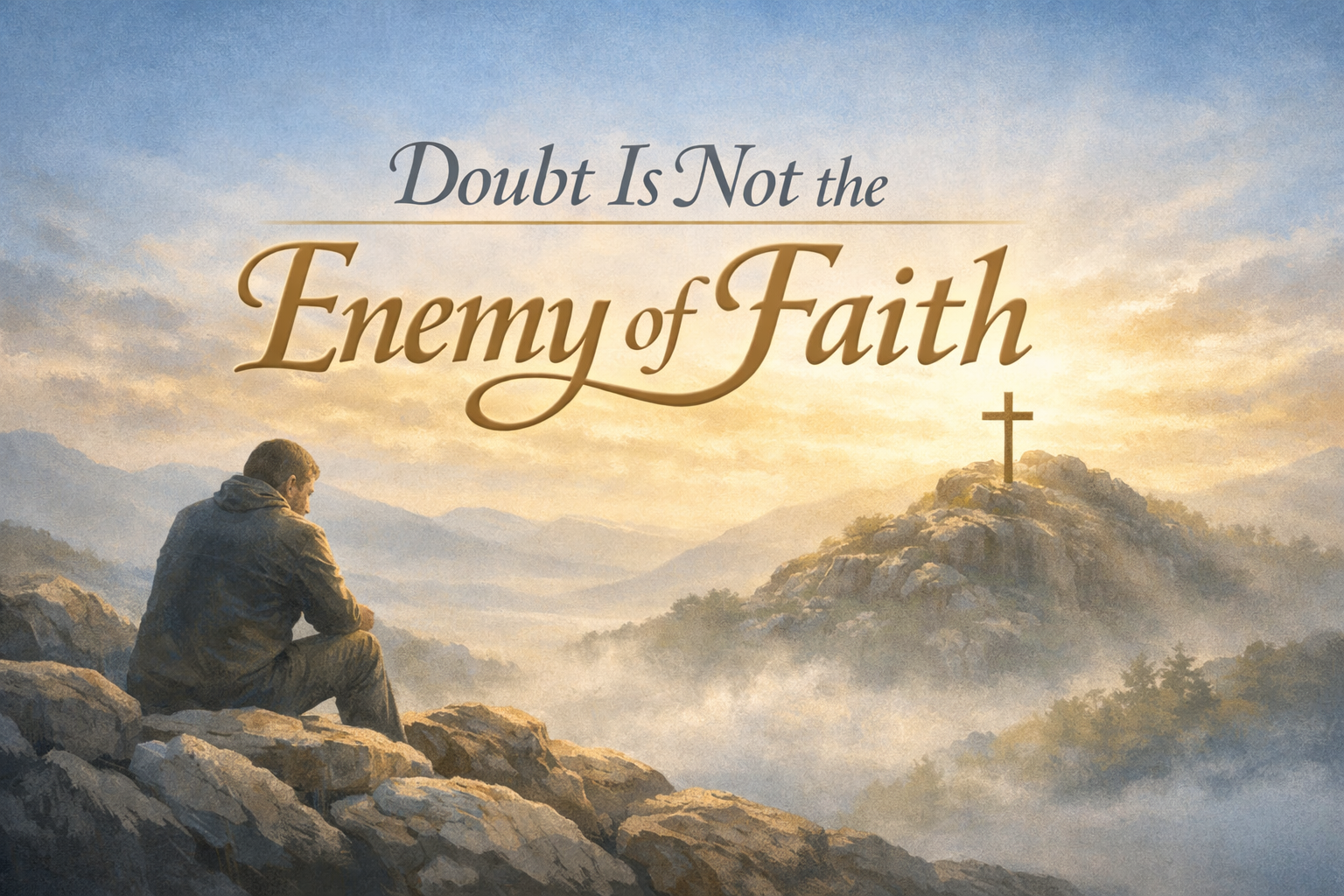
Doubt Is Not the Enemy of Faith
The church has often treated doubt like a disease to be cured rather than a doorway to be walked through. But the Bible tells a different story. From Abraham to Thomas to John the Baptist, the men and women God used most were often the ones who brought their hardest questions directly to Him — and found Him big enough to handle them.
Scripture is full of doubters God refused to discard. Maybe it’s time the church followed His lead.
Somewhere along the way, a lot of Christians got the idea that doubt is the opposite of faith. That if you’re really trusting God, you don’t ask hard questions. You don’t wrestle. You don’t lie awake at three in the morning wondering if any of this is actually true. You just believe — cleanly, quietly, without turbulence.
That’s a nice idea. It also has almost nothing to do with the Bible.
The faith heroes of Scripture were not a group of serene, untroubled believers who never wobbled. They were wrestlers. Argurers. People who pushed back, demanded answers, sat in confusion, and sometimes said things to God that would make a lot of Sunday school teachers reach for the smelling salts. And God — remarkably — did not strike them down for it. He engaged them. He answered them. In several cases, He honored them for it.
If your doubt is driving you away from God, that’s worth paying attention to. But if your doubt is the thing making you wrestle harder, ask deeper, and refuse to settle for easy answers — you might be in better company than you think.
What Doubt Actually Is
Before we go further, it’s worth getting clear on what we mean by doubt — because the word covers a lot of ground, and not all of it is the same thing.
There is doubt that is intellectual: genuine uncertainty about whether the claims of Christianity are true. Did Jesus really rise from the dead? Is the Bible reliable? Can a good God allow this much suffering? These are real questions, and they deserve real answers — not dismissal, not shame, not a pat on the head and a redirect to the worship team.
There is doubt that is emotional: the felt absence of God during a painful season. The prayer that bounces off the ceiling. The worship service that feels mechanical when everything inside you is numb. This isn’t intellectual skepticism — it’s the experience of a person whose heart is outrunning their theology, or whose theology hasn’t caught up to their circumstances yet.
And there is doubt that is volitional: the slow drift of a person who is not so much questioning God as choosing, day by day, to live as if He weren’t there. This one is more dangerous — not because God can’t reach it, but because it tends to disguise itself as the other two.
Most of what the Bible addresses — and most of what we’ll address here — is the first two kinds. Honest intellectual and emotional doubt, brought to God in the context of an ongoing relationship. The kind that says, “I believe — help my unbelief,” which is one of the most honest prayers in Scripture (Mark 9:24).
The Doubters God Didn’t Fire
Let’s look at the record. Because if you survey the biblical text for how God actually responds to doubt, the pattern is pretty consistent — and it is not what most of us were taught to expect.
Abraham: The Father of Faith Who Laughed at God
We call Abraham the father of faith. Romans 4 holds him up as the model of the man who trusted God against all odds. And that’s all true. But it skips the part where Abraham, upon hearing God’s promise that Sarah would bear a son, fell on his face and laughed. Genesis 17:17 — “Abraham fell on his face and laughed and said to himself, ‘Shall a child be born to a man who is a hundred years old? Shall Sarah, who is ninety years old, bear a child?'”
That’s not reverent acceptance. That’s incredulity. That’s a man hearing a promise so improbable that his body’s involuntary response was laughter. And God’s response was not to revoke the promise or rebuke Abraham’s faithlessness. He repeated the promise and told Abraham to name the child Isaac — which means “laughter.” God memorialized Abraham’s doubt in the name of the miracle.
Moses: The Called Man Who Argued Back
When God appeared to Moses in the burning bush and commissioned him to lead Israel out of Egypt, Moses didn’t say “Yes, Lord.” He said, essentially, “You’ve got the wrong guy.” He offered five separate objections — who am I, they won’t believe me, I’m not eloquent, please send someone else. Exodus 3–4 is a sustained negotiation between a man who doubted his own calling and a God who refused to take no for an answer.
God answered each objection. He didn’t rebuke Moses for asking. He didn’t revoke the commission because Moses pushed back. He met every doubt with a response — signs, a companion, a promise of presence. Moses’s doubt didn’t disqualify him. It started a conversation.
Gideon: Asking for Proof. Twice.
When the angel of the Lord appeared to Gideon and told him he was a mighty warrior called to deliver Israel, Gideon’s first response was essentially: if God is with us, why is everything a disaster? — Judges 6:13. Then, even after a sign, Gideon put out the famous fleece — not once, but twice. He asked for confirmation, received it, and asked again with the conditions reversed just to be sure.
God did not strike Gideon down for demanding a second confirmation. He gave it to him. The man who needed two fleeces and an angelic encounter to believe he was called became one of Israel’s greatest judges. God worked with the doubt rather than around it.
John the Baptist: Doubting From Prison
This one hits hard. John the Baptist — the one Jesus called the greatest man born of women — was sitting in Herod’s prison when he sent messengers to ask Jesus: “Are you the one who is to come, or shall we look for another?” — Matthew 11:3. The man who had baptized Jesus, who had heard the voice from heaven, who had said “Behold the Lamb of God” — was now wondering if he’d gotten it wrong.
Jesus did not rebuke John. He didn’t say “tell him his faith is deficient.” He sent back evidence — the blind see, the lame walk, the dead are raised — and then turned to the crowd and said that among those born of women, no one was greater than John. Jesus honored the man in the same breath that He answered the doubt.
Thomas: The Patron Saint of Honest Doubt
We have labeled Thomas the doubter as if it’s a scarlet letter. But consider what Thomas actually said: “Unless I see in his hands the mark of the nails, and place my finger into the mark of the nails, and place my hand into his side, I will never believe.” — John 20:25. That is not the statement of a man walking away from faith. That is the statement of a man whose standards for extraordinary claims are appropriately high.
And what did Jesus do? He showed up specifically for Thomas. He offered His hands. He offered His side. He said, “Do not disbelieve, but believe.” And Thomas’s response — “My Lord and my God!” — is one of the most exalted confessions of Christ’s divinity in the entire New Testament. The doubt was the doorway to the deepest declaration in the room.
Doubt, honestly held and honestly brought to God, has a way of producing faith that is deeper and more durable than the faith that never had to wrestle for it.
What Doubt Is Not
Being clear about what doubt isn’t helps us hold it rightly.
Doubt is not unbelief. Unbelief, in the biblical sense, is a settled refusal to trust God — not a season of uncertainty, but a hardened posture of rejection. The writer of Hebrews warns against the “evil, unbelieving heart” that leads to falling away (Hebrews 3:12) — but the context is deliberate departure, not honest wrestling. The doubter is still in the room. The unbeliever has left the building.
Doubt is not sin. There is no commandment in Scripture that reads “thou shalt not wonder.” The Psalms of lament — half the Psalter, roughly — are God’s own Spirit-inspired provision for the experience of felt uncertainty. Psalm 88 ends in darkness with no resolution. That’s in the Bible. God put it there. He knows His people need language for the hard seasons, and He gave it to them.
Doubt is not a reason to pretend. One of the most corrosive habits in the American church is the expectation of performed confidence — the handshake in the lobby, the smile in the pew, the “doing great, God is good” when everything inside you is falling apart. That performance doesn’t serve God. It doesn’t serve the person doing it. And it doesn’t serve the brother or sister sitting next to them who is in the same boat and desperately needs to know they’re not alone.
What to Do With Your Doubt
Honest doubt deserves an honest response — not platitudes, not pressure to perform certainty you don’t have. Here’s what Scripture and the long tradition of the church actually commend.
Bring It to God Directly
The pattern in Scripture is not “suppress your doubt and hope it goes away.” The pattern is to bring it — loudly, honestly, persistently — to God. Habakkuk opened his entire book with a complaint: “O Lord, how long shall I cry for help, and you will not hear?” — Habakkuk 1:2. God answered him. Two chapters later, Habakkuk was standing on the watchtower with one of the most extraordinary statements of faith in the Old Testament.
The move from doubt to faith in Scripture almost never happens through suppression. It happens through engagement. Bring the question to the One who has the answer.
Follow the Evidence
Intellectual doubt deserves intellectual engagement. The Christian faith is not a blind leap — it is a historically grounded, evidentially supported, philosophically coherent tradition that has been examined by some of the finest minds in human history and found to be credible. The resurrection of Jesus, in particular, is one of the most well-attested events of the ancient world, argued for by historians, philosophers, and legal scholars across centuries.
If your doubt is intellectual, read. Engage. Ask your pastor hard questions. Study apologetics. Look at the evidence honestly and follow it where it leads. Faith that has survived examination is worth more than faith that has never been tested.
Stay in the Community of Faith
Doubt processed in isolation tends to calcify. The questions echo off the walls of your own skull and grow louder without the friction of other believers’ experience and wisdom. Stay in the church. Stay in the small group. Find one trusted person — a pastor, an elder, a mature believer — and tell them what’s actually going on inside.
You will almost certainly find that they have been there. The doubt you’re carrying is not unique to you, and the person you’re confessing it to has probably already walked that road. Let them walk with you.
Act on What You Do Believe
This is the move that surprises people: you don’t have to resolve every question before you act on the faith you have. In fact, acting on partial faith is often what moves you further along. Thomas didn’t get clarity by sitting at home. He was in the room with the other disciples. He was present. And Jesus met him there.
Keep praying, even when it feels hollow. Keep coming to worship, even when it feels mechanical. Keep reading the Word, even when it feels dry. The spiritual disciplines are not premiums for people who have it figured out — they are the means of grace through which God continues to work in people who are still figuring it out. Which, if we’re honest, is all of us.
The Faith That Comes Out the Other Side
There is a kind of faith you can only get by walking through doubt. Not around it — through it. A faith that has asked the hard questions and found that the foundation held. A faith that has stood in the darkness of uncertainty and discovered that God was present in the dark. A faith that is not brittle because it has been tested and knows what it’s made of.
That is what the doubters of Scripture were building when they wrestled with God. Abraham’s laughter became Isaac. Moses’s five objections became the Exodus. Gideon’s two fleeces became the defeat of Midian. John’s prison question became Jesus’s public commendation. Thomas’s demand for evidence became “My Lord and my God.”
The doubt was not the end of the story. It was the beginning of the deepest part of it.
If you are in a season of doubt right now, you are not outside the faith. You are in very good biblical company. Bring your questions to God. Stay in the community. Follow the evidence. Act on what you believe. And trust that the God who met Abraham in his laughter, Moses in his arguments, Gideon in his fleece requests, John in his prison, and Thomas in his demand for proof — is more than capable of meeting you exactly where you are.
He’s handled tougher questions than yours. And He’s still in the room.
You Don’t Have to Pretend
At Mountain Veteran Ministries, we believe honest faith is stronger than performed faith. If you’re wrestling with doubt — about God’s existence, about His goodness, about whether any of this is real — we’d rather you bring it into the open than carry it alone.
A good place to start: read through Psalm 88 and Habakkuk 1–3 back to back. One is a lament that ends with no resolution. The other is a complaint that becomes one of the most breathtaking confessions of faith in the Old Testament. Both are in the Bible. Both are honest. And both are the word of God to people in exactly the place you might be right now.
“I believe; help my unbelief.” — Mark 9:24
Key Takeaways
- Doubt and unbelief are not the same thing. Unbelief is a hardened refusal to trust God. Doubt is honest uncertainty held within an ongoing relationship with Him. Scripture treats them very differently — and so should we.
- The biblical record is full of doubters God honored. Abraham laughed at God’s promise. Moses argued his commission. Gideon demanded two signs. John the Baptist questioned from prison. Thomas required evidence. None of them were discarded. All of them were met.
- Suppressing doubt is not the same as overcoming it. Honest doubt brought to God starts a conversation. Suppressed doubt festers in isolation and tends to harden into something more dangerous over time.
- Intellectual doubt deserves intellectual engagement. The Christian faith is historically grounded and evidentially supported. Hard questions deserve real answers — not shame, not deflection, not performance of certainty you don’t have.
- Faith forged through doubt is more durable than faith that was never tested. The doubters of Scripture came out the other side with some of the deepest and most enduring expressions of trust in God found anywhere in the biblical text.
Mountain Veteran Ministries
Find Your Next Bearing
Every journey needs a direction. If you're wondering where to go from here, choose the path that best fits where you are today.
⚒️ I Want to Live Faithfully
Discover practical wisdom for following Christ in today's world.
→ Living as a Christian Today✝️ I Want to Understand the Gospel
Learn what salvation means and why Jesus came.
→ Understanding Salvation📖 I Want to Understand the Bible
Explore why Christians trust Scripture and how to read it well.
→ Understanding the Bible❓ I Still Have Questions
Explore thoughtful answers to some of Christianity's hardest questions.
→ Hard Questions