Understanding the Return of Christ: What Scripture Says
The return of Christ is not a footnote to Christian theology. It is the event every other doctrine points toward. Jesus didn’t ascend into heaven with a vague promise to “be with us in spirit.” He left with a guaranteed return date — unscheduled, but certain. What that day looks like, and what it demands of us now, is worth understanding before it arrives.
He Left With a Promise — and Promises Have Consequences
There is a moment in Acts 1 that doesn’t get enough attention. Jesus has just ascended into heaven. The disciples are standing there staring up into the sky — understandably, because they just watched him go. Two angels appear and ask what is probably the most gently pointed question in the New Testament: “Men of Galilee, why do you stand looking into heaven?” (Acts 1:11). Then the answer: “This Jesus, who was taken up from you into heaven, will come in the same way as you saw him go.”
The return of Christ is baked into the foundation of Christian theology. It shows up in the Apostles’ Creed. It saturates the letters of Paul. It dominates the book of Revelation. Jesus himself devoted significant teaching to it — not to satisfy curiosity, but to shape how his people live in the meantime.
So what does Scripture actually say about it? And more importantly — what does it mean for how we’re supposed to live right now?
What the Return Will Look Like
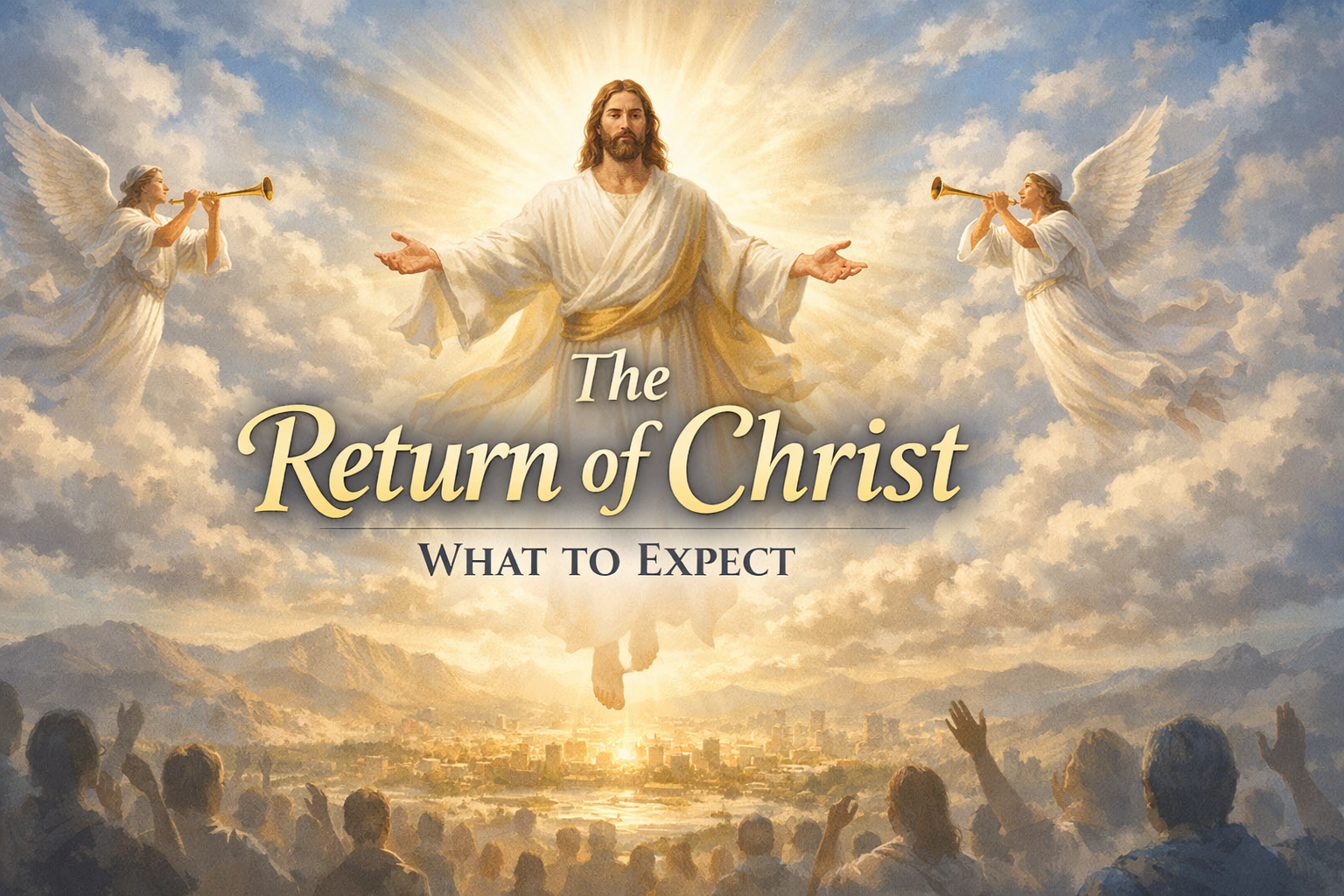
One thing Scripture is clear about: this will not be a quiet event. The popular image of Jesus slipping back in — a private spiritual return, a second coming that already happened in some metaphorical sense — has no grounding in the text. Every description of the second coming in the New Testament is loud, visible, and universal.
Matthew 24:27: “For as the lightning comes from the east and shines as far as the west, so will be the coming of the Son of Man.” Not subtle. Not hidden. Not available only to those with spiritual sensitivity. Lightning. Everywhere at once.
1 Thessalonians 4:16–17: “For the Lord himself will descend from heaven with a cry of command, with the voice of an archangel, and with the sound of the trumpet of God.” Three auditory signals. A shout, an archangel’s voice, and a trumpet — the same trumpet imagery that signals the presence of God throughout the Old Testament (Exodus 19:16, Isaiah 27:13). The dead in Christ rise first, then those alive are caught up together with them to meet the Lord.
Revelation 1:7: “Behold, he is coming with the clouds, and every eye will see him, even those who pierced him, and all tribes of the earth will wail on account of him.” Every eye. Every tribe. The return of Christ will be the most witnessed event in human history.
He came the first time in obscurity — born in a stable, announced to shepherds, missed by most of Jerusalem. The second coming reverses all of that. No one will miss it.
Nobody Knows the Day or the Hour
If Scripture is clear that the return will be unmistakable, it is equally clear that it will be unscheduled — at least from our vantage point. Matthew 24:36: “But concerning that day and hour no one knows, not even the angels of heaven, nor the Son, but the Father only.”
This has not stopped people from trying. Date-setting has a long and consistently embarrassing history in the church. The Millerites predicted 1844. Countless preachers have pointed to specific world events as the trigger. Every generation has had its confident voices declaring the end imminent — and every one of them has been wrong about the timing while correctly identifying that history is moving somewhere.
Jesus used two images to describe the nature of his return. The first is a thief in the night — not malicious, but unexpected (Matthew 24:43–44). The second is labor pains — not random, but intensifying, with signs that something is coming even if the exact moment is unknown (Matthew 24:4–8). Both images push toward the same posture: watchful readiness rather than calendar calculation.
“God didn’t hide the timing to frustrate us. He hid it to free us — from the temptation to coast until the last minute, and from the paralysis of thinking we know more than we do.”
Signs of the Times — What Jesus Actually Said
Jesus does give signs in the Olivet Discourse (Matthew 24, Mark 13, Luke 21). He mentions wars and rumors of wars, famines and earthquakes, persecution of believers, the spread of the gospel to all nations, and a period of great tribulation. He also mentions “the abomination of desolation” spoken of by Daniel (Matthew 24:15), which has generated enormous interpretive debate.
A word of caution is warranted here. Sincere, biblically serious Christians have landed in very different places on the details of end-times chronology. The major positions — premillennialism, amillennialism, postmillennialism, and the various views on a rapture — each have thoughtful defenders who take Scripture seriously. The debates over the millennium, the tribulation, and the sequence of events are real and worth engaging, but they have also consumed enormous energy that could be spent on the things all views agree on.
What all orthodox views share: Christ is coming back bodily and visibly. The dead will be raised. There will be a final judgment. The present age will end and be replaced by something new. Those anchors hold regardless of where you land on the detailed sequencing.
Paul’s word to the Thessalonians is instructive. They were anxious about the return — some had apparently stopped working because they thought it was imminent. Paul doesn’t give them a timeline. He gives them a posture: “be sober-minded” (1 Thessalonians 5:6), “encourage one another” (1 Thessalonians 5:11), and keep doing the work.
The Resurrection of the Dead
The return of Christ is inseparable from the resurrection. This is not a minor subplot — it is the whole point of 1 Corinthians 15, the most extended treatment of resurrection in the New Testament. Paul argues that if there is no resurrection of the dead, then Christ himself was not raised, and the Christian faith collapses entirely.
But Christ was raised — as Paul calls him, “the firstfruits of those who have fallen asleep” (1 Corinthians 15:20). His resurrection is the prototype and guarantee of ours. At his return, those who have died in Christ will be raised first, bodily, in transformed and imperishable bodies (1 Corinthians 15:42–44). Then those still living will be transformed as well.
This matters because the Christian hope is not escape from the physical world — it is its redemption. We are not waiting to leave the body behind and float off into a spiritual realm. We are waiting for a new creation in which resurrection bodies inhabit a renewed earth, and God dwells with his people without the barrier of sin (Revelation 21:3–4). The return of Christ inaugurates not the end of the story but its next and permanent chapter.
The Final Judgment
Every biblical account of the return includes judgment. This is not a popular topic, but avoiding it distorts the whole picture. 2 Corinthians 5:10: “For we must all appear before the judgment seat of Christ, so that each one may receive what is due for what he has done in the body, whether good or evil.” Revelation 20:11–15 describes a great white throne before which the dead stand, and the books are opened.
For those in Christ, judgment does not mean condemnation. Romans 8:1 is unambiguous: “There is therefore now no condemnation for those who are in Christ Jesus.” The judgment seat of Christ for believers is an accounting, not a sentencing — a revealing of what was done in faith, what endures, and what does not (1 Corinthians 3:12–15). The fire tests the work; the worker is saved.
For those outside of Christ, Scripture speaks plainly about a second death, eternal separation from God, and consequences that do not diminish. Jesus himself used stronger language about hell than anyone else in the New Testament. The return of Christ is good news for those who belong to him — and the most solemn warning in history for those who don’t.
“The return of Christ is not primarily a threat. It is a rescue. But every rescue has a flipside — those who won’t be rescued because they wouldn’t be found.”
What the New Creation Looks Like
The destination matters. Scripture doesn’t leave us guessing about what the return of Christ ushers in. Revelation 21:1–5 describes a new heaven and a new earth — the old order passing away, God himself dwelling with his people, every tear wiped away, death and mourning and pain gone. Romans 8:19–21 says the whole creation is groaning in labor pains, waiting to be set free from its bondage to decay.
This is not a vague spiritual existence. It is a renewed material world, populated by resurrected people, ruled by the returned King, with no sin, no death, no corruption, and no distance between God and his image-bearers. Everything broken in Genesis 3 is healed. Everything the cross purchased is fully applied. The prayer Jesus taught — “Your kingdom come, your will be done, on earth as it is in heaven” (Matthew 6:10) — is finally and completely answered.
What This Demands of Us Now
This is where the rubber meets the road. Jesus and the apostles consistently tied the doctrine of his return not to prophetic speculation but to practical behavior. The second coming is not raw material for argument — it is fuel for faithfulness.
Stay alert. The parable of the ten virgins (Matthew 25:1–13) is brutal in its simplicity. Five had oil. Five didn’t. When the bridegroom came, five went in. Five were shut out. The difference was readiness. Not theological correctness about the timing. Readiness.
Stay faithful in the work. The parable of the talents (Matthew 25:14–30) follows immediately. The servants who invested what the master gave them were rewarded. The one who buried it out of fear was rebuked. Between now and the return, we are stewards — of gifts, of the gospel, of relationships, of time. Faithful use of what we’ve been given is the expected posture.
Stay oriented toward others. Matthew 25:31–46 — the sheep and the goats — ties the return of Christ directly to how we treated the hungry, the stranger, the sick, the prisoner. The coming King is already present in the needs of the people around you. How you respond to them is how you respond to him.
Don’t set dates — but don’t get comfortable either. 2 Peter 3:8–14 handles the skeptics who mock the return because it hasn’t happened yet. Peter’s answer: God’s patience is not delay — it is mercy, giving more time for repentance. But the day will come like a thief. The right response is not calculation but holy living and godliness.
The early church ended its gatherings with a single Aramaic word: Maranatha — “Come, Lord Jesus” (1 Corinthians 16:22, Revelation 22:20). It was a prayer, a greeting, and a posture all in one. They lived with the return in mind — not in anxiety, but in anticipation. That’s the note the New Testament ends on, and it’s the note Christians are still called to live by.
Key Takeaways
- The return will be bodily, visible, and unmistakable. Every New Testament description of the second coming rules out a spiritual or metaphorical interpretation. Every eye will see him — no one will need it explained after the fact.
- Nobody knows the timing — and that’s intentional. God hid the day and hour not to frustrate us but to keep us in a posture of ongoing readiness rather than last-minute scrambling or calendar obsession.
- The return is inseparable from the resurrection. Christ’s return inaugurates the resurrection of the dead — bodily, real, and transformative. The Christian hope is not escape from creation but its renewal.
- Judgment follows — with different outcomes for different people. For those in Christ, no condemnation — but an accounting. For those outside Christ, Scripture speaks plainly about consequences that are eternal and serious.
- The new creation is the goal, not just the ending. The return of Christ doesn’t close the story — it opens the permanent chapter: God dwelling with his people in a renewed creation, every tear wiped away, every wrong made right.
- The doctrine is meant to produce faithfulness, not fascination. Jesus tied the second coming to parables about readiness, stewardship, and care for others — not to prophetic speculation. The right response is holy living, not chart-making.
Key Scriptures: Acts 1:11 · Matthew 24:27, 36 · 1 Thessalonians 4:16–17 · Revelation 1:7 · 1 Corinthians 15:20–22 · 2 Corinthians 5:10 · Revelation 21:1–4 · Matthew 25:13 · 2 Peter 3:10–12
Mountain Veteran Ministries
Find Your Next Bearing
Every journey needs a direction. If you're wondering where to go from here, choose the path that best fits where you are today.
⚒️ I Want to Live Faithfully
Discover practical wisdom for following Christ in today's world.
→ Living as a Christian Today✝️ I Want to Understand the Gospel
Learn what salvation means and why Jesus came.
→ Understanding Salvation📖 I Want to Understand the Bible
Explore why Christians trust Scripture and how to read it well.
→ Understanding the Bible❓ I Still Have Questions
Explore thoughtful answers to some of Christianity's hardest questions.
→ Hard Questions