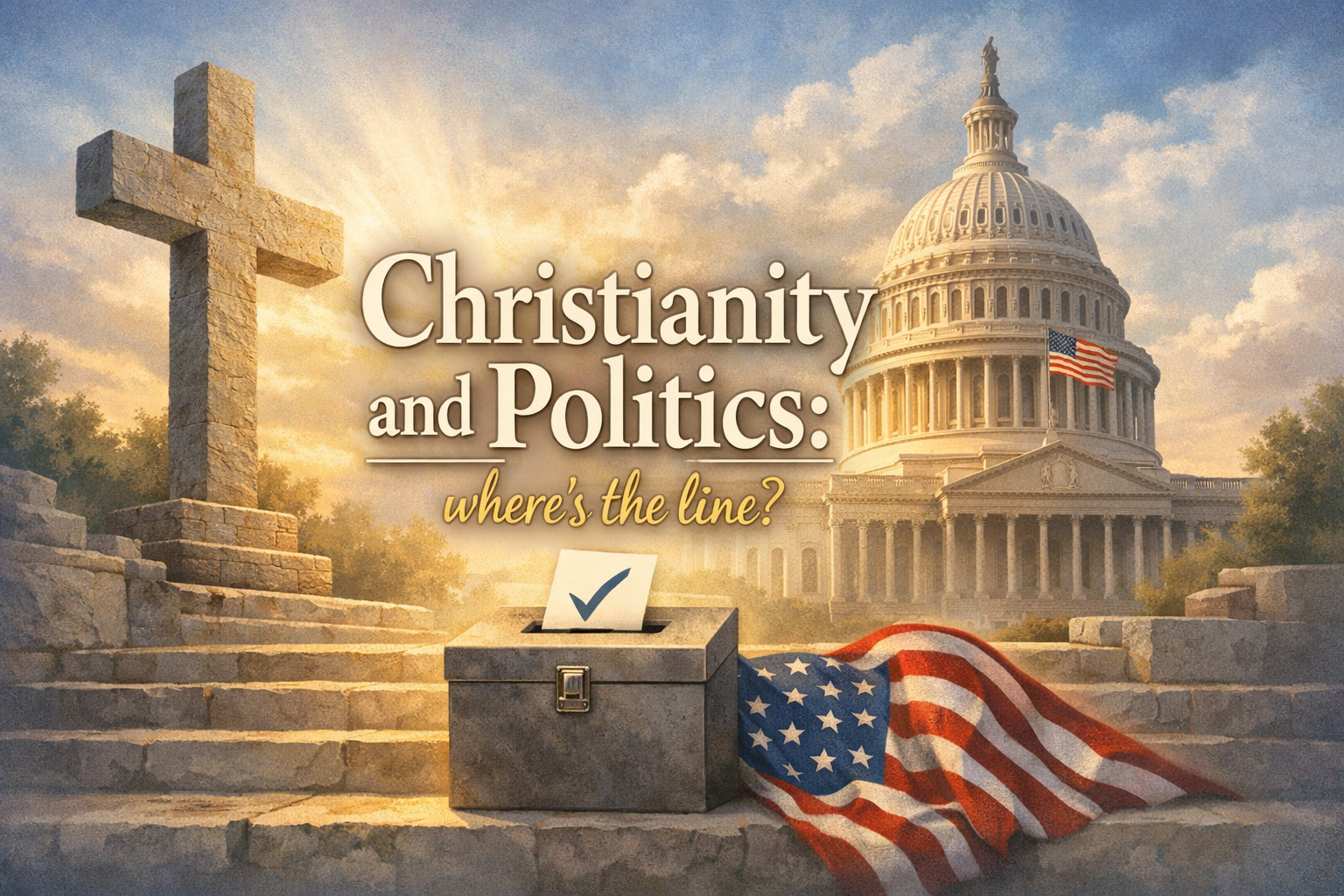
Christianity and politics: where’s the line?
The church has always lived inside political systems it did not create and cannot fully control. The question was never whether Christians engage the political world — they must, because they live in it. The question is how: with what priorities, what limits, what loyalties, and what expectations. Getting that wrong in either direction has cost the church dearly. Getting it right starts with knowing who you actually serve.
Two Kingdoms, One Loyalty, and the Perennial Temptation to Confuse Them
Few topics generate more heat inside the church right now than politics. On one side, Christians who believe the church has a prophetic responsibility to engage the political order — that silence is complicity, that the gospel has public implications, that justice requires political action. On the other side, Christians who believe the church has been seduced by partisan politics, that the pulpit is being co-opted by ideological agendas, that mixing Jesus with political platforms is a category error that corrupts both.
Both sides have a point. And both sides, when they run their instinct all the way out without a check, end up somewhere the New Testament does not support.
This is not a post that will tell you how to vote. It is not going to endorse a party, a candidate, or a policy platform. What it will do is give you a biblical framework for thinking about the relationship between Christian faith and political life — one that takes both seriously without confusing them.
The Question Underneath the Question
Before getting to the framework, it helps to name what is actually being asked when Christians argue about politics. Usually it is one of three questions — and they require different answers.
Question one: Should Christians care about justice and public life? Yes. Unambiguously. The prophets spoke truth to kings. Jesus announced a kingdom that makes claims on every area of human life. The command to love your neighbor does not stop at the voting booth. Christians who retreat entirely from public life in the name of spiritual purity are not being more faithful — they are abdicating a responsibility that comes with being human beings made in God’s image, living in communities with other human beings.
Question two: Should the institutional church function as a political organization? No. The church has a specific mission — proclaiming the gospel, making disciples, administering the sacraments, forming people in the image of Christ. When the institutional church subordinates that mission to a political agenda, it has traded its birthright for a mess of political potage. It gains influence in the short term and loses its prophetic credibility in the long term.
Question three: Should Christians bring their faith to bear on how they engage the political world? Yes — inevitably, unavoidably, and as a matter of integrity. The question is never whether your worldview shapes your politics. Everyone’s does. The question is whether your worldview is honest about what it is and whether it is genuinely accountable to something higher than the party platform.
Most of the arguments inside the church are not actually about these three questions. They are about which political conclusions flow from Christian premises — and on that, the church has never achieved consensus, because Scripture does not hand you a party platform. It hands you a set of convictions, a set of obligations, and a set of limits on what political systems can accomplish. What you do with those is where the honest work begins.
What Scripture Actually Establishes
Government Is Legitimate and Has Real Authority
The New Testament does not treat government as inherently evil. Romans 13:1–7 is unambiguous: “Let every person be subject to the governing authorities. For there is no authority except from God, and those that exist have been instituted by God.” Paul wrote that under Nero — not exactly a model ruler. The point is not that every government is good. It is that governmental authority as such is a provision of God for human order — part of what theologians call common grace, the restraint of chaos that allows human life and society to function.
Government’s legitimate role in Scripture is primarily to restrain evil and promote justice — to punish the wrongdoer and protect the innocent (Romans 13:3–4, 1 Peter 2:13–14). It is not the church. It cannot regenerate hearts or produce the kingdom of God. But it can and should produce ordered society in which human beings can live, work, worship, and raise families. That is no small thing.
1 Timothy 2:1–2 tells Christians to pray for kings and all in high positions — “that we may lead a peaceful and quiet life, godly and dignified in every way.” The goal of good government, from a Christian perspective, is not utopia. It is the kind of stable, ordered environment in which the church can do its work and ordinary people can flourish. That is a modest but serious mandate.
Government Is Not Ultimate and Has Real Limits
The same New Testament that affirms governmental authority also sets firm limits on it. When the Sanhedrin commanded the apostles to stop preaching in Jesus’ name, Peter answered without hesitation: “We must obey God rather than men” (Acts 5:29). When government commands what God forbids, or forbids what God commands, the obligation to obey God overrides the obligation to obey the state.
The book of Revelation, written to churches under Roman persecution, uses vivid imagery to describe the Roman Empire as Babylon the Great — a system of idolatrous power demanding the worship that belongs only to God (Revelation 17–18). The Christians to whom John wrote were not being asked to overthrow Rome. They were being called to refuse to worship Caesar — to maintain their primary allegiance to the Lamb, even at the cost of their lives. That refusal, quiet and costly, is one of the most politically significant acts in human history.
The line is clear: government has legitimate authority in its proper sphere. It does not have ultimate authority. It does not define truth, it does not determine morality, and it does not have the right to demand what belongs to God alone. “Render to Caesar the things that are Caesar’s, and to God the things that are God’s” (Matthew 22:21) — the coin belongs to Caesar. You do not.
“The Roman emperors demanded total loyalty. The early Christians gave them taxes, prayers, and honest work — and reserved their worship for someone else. That distinction between civil obedience and ultimate allegiance is not a fine theological point. It is what got Christians killed.”
Christians Are Exiles, Not Residents
Peter addresses his letters to “elect exiles” (1 Peter 1:1). Paul tells the Philippians that their citizenship is in heaven (Philippians 3:20). The author of Hebrews describes the patriarchs as people who acknowledged they were “strangers and exiles on the earth,” seeking a better, heavenly country (Hebrews 11:13–16).
This exile identity is not an excuse for political disengagement. The same Peter who calls believers exiles tells them to “be subject to every human institution” and to “honor the emperor” (1 Peter 2:13–17). Jeremiah told the exiles in Babylon to build houses, plant gardens, marry, and — remarkably — to “seek the welfare of the city” where they were sent, because in its welfare they would find their welfare (Jeremiah 29:5–7).
Exile is not withdrawal. It is a particular kind of presence — engaged, contributing, seeking the common good — but without the illusion that the city you’re building is your permanent home or the political system you’re working within is the kingdom of God. Exiles don’t confuse Babylon with Jerusalem. They serve in Babylon while keeping their eyes on Jerusalem.
The Two Ditches
Church history is littered with examples of what happens when Christians lose the tension and fall into one of two ditches.
Ditch One: Theocracy and the Confusion of Kingdoms
The temptation to build the kingdom of God through political power is ancient and recurring. Constantine’s conversion in 312 AD changed Christianity’s relationship to empire overnight — and within a generation, coercion of religious conscience was being practiced by the formerly persecuted church. The medieval papacy at its worst claimed authority over kings and emperors, excommunicating rulers and placing nations under interdict as political weapons. Calvin’s Geneva executed heretics. The 16th-century Reformers, for all their theological recovery, were slow to develop robust doctrines of religious liberty.
In more recent history, the merging of Christian identity with nationalist political projects — Christian nationalism in its various forms — repeats the same error in a democratic key. When the flag and the cross are treated as interchangeable symbols, when political victory is framed as spiritual victory, when the church’s mission becomes winning elections rather than making disciples, something has gone badly wrong. The kingdom of God does not arrive on Air Force One. It arrives in the hearts of people transformed by the gospel.
When a church or Christian leader speaks about a political party or candidate with the same certainty and urgency as the gospel — when electoral defeat feels like spiritual catastrophe — the kingdoms have been confused. Political outcomes matter. They do not matter that much.
Ditch Two: Quietism and the Abandonment of Responsibility
The opposite error is to treat Christian faith as purely private and interior — a set of personal convictions that have nothing to say about public life. This position sounds humble and non-partisan. It is actually a form of irresponsibility dressed up as piety.
Wilberforce didn’t abolish the slave trade by keeping his Christianity private. The Confessing Church didn’t resist Hitler by staying out of politics. The civil rights movement — shaped profoundly by Black Christian theology and the black church’s prophetic tradition — was not apolitical. The prophets of Israel were not quietists. Amos thundered against economic injustice. Isaiah confronted kings. Jeremiah was arrested for what he preached. The prophetic tradition within Scripture is explicitly, unavoidably political in the sense that it makes claims about how power should and should not be used.
When Christians say “I don’t want to talk about politics in church,” they sometimes mean something legitimate — they are resisting the partisan capture of the pulpit. But if they mean that the gospel has no implications for how society is ordered, how the vulnerable are treated, or how power is exercised — that is not biblical Christianity. That is gnosticism wearing a political disguise.
When a church never addresses any public moral question because it might be “political,” ask what is actually driving that silence. Is it principled distinction between the church’s mission and partisan politics — or is it conflict avoidance dressed up as theological principle?
What the Church Can and Should Say
The church has legitimate prophetic authority on a range of public questions — and genuine humility is required on others. The distinction matters.
On matters where Scripture speaks with clarity — the dignity of every human being made in God’s image, the protection of the vulnerable, the wrongness of idolatry, the obligation of justice, the sanctity of human life — the church can and should speak. Not with partisan framing, but with the authority of the Word. These are not political opinions. They are biblical convictions that have political implications.
On matters of prudential judgment — the best policy to achieve a just outcome, the right tax rate, the correct immigration framework, the optimal foreign policy — the church should be far more cautious. Christians who share the same biblical convictions about human dignity will reach different conclusions about which policies best serve human dignity. The church that tells its members exactly how to vote on a complex policy question has exceeded its authority and is probably baptizing one political tribe’s preferences as divine revelation.
The line runs between moral principle and policy application. Scripture establishes that the poor must be cared for. It does not establish whether the best mechanism is a government program, a private charity network, or some combination. Scripture establishes that human life has dignity from conception. It does not write the precise legal framework for how that dignity is protected in a pluralistic democracy. Christians of genuine faith and serious biblical engagement will land in different places on those applications — and the church should make room for that without pretending the biblical principles themselves are negotiable.
The Particular Danger of Partisan Capture
The most acute danger facing American Christianity in this moment is not political disengagement. It is partisan capture — the absorption of the church’s identity, mission, and credibility into one side of the partisan divide.
When the church becomes functionally identified with a political party, several things happen. The gospel gets associated with a political brand — and people who are repelled by the brand never get close enough to hear the gospel. The church’s prophetic voice is silenced on every issue where its political allies are on the wrong side, because loyalty to the tribe overrides loyalty to truth. Members of the congregation who belong to the other political tribe feel unwelcome — not because the gospel is offensive to them, but because the church’s political monoculture is. And the leaders of the political movement the church has aligned with gain enormous leverage over the church’s message, priorities, and silence.
This danger is real on both sides of the aisle. A church that has become an auxiliary of the Republican Party and a church that has become an auxiliary of the Democratic Party have both made the same error. They have given away their independence — which is the source of their prophetic authority — in exchange for political relevance. The deal always costs more than it pays.
“The church that is most politically useful to the kingdom of God is not the one most aligned with a political party. It is the one that both parties know they cannot fully control — because it serves a King they don’t.”
Dual Citizenship Done Right
The Christian is a citizen of two realms simultaneously — and that dual citizenship is not a burden to manage but a calling to live out faithfully. Augustine described it as the City of God and the City of Man existing in overlap throughout history, citizens of each intermingled until the end. Luther developed the Two Kingdoms doctrine — God governing the earthly realm through law and government, and the heavenly realm through gospel and Spirit — not to separate them into watertight compartments but to clarify how each operates.
Living dual citizenship well looks like this: Vote. Pay taxes. Serve on juries. Advocate for just laws. Speak up for the vulnerable. Hold leaders accountable. Serve your community. Be an honest, contributing participant in public life — because that is what it means to love your neighbor and seek the welfare of the city.
And simultaneously: hold your political convictions loosely enough that you can still hear the Word when it cuts against them. Refuse to let your party identity override your Christian identity. Remember that the person across the aisle is made in God’s image too. Do not treat political victory as the primary measure of faithfulness. Keep the main thing the main thing — which is not a political platform but a person, Jesus Christ, crucified and risen, Lord of every king and president and prime minister who has ever drawn breath.
Micah 6:8 gives the summary that crosses every era and every political system: “He has told you, O man, what is good; and what does the LORD require of you but to do justice, and to love kindness, and to walk humbly with your God?” Do justice. Love kindness. Walk humbly. That agenda is bigger than any party platform and smaller than any political movement can contain. It belongs to the King whose kingdom has no end.
Key Takeaways
- Government is legitimate but not ultimate. Romans 13 establishes real governmental authority as a provision of God for human order. Acts 5:29 establishes its limit: when Caesar commands what God forbids, God wins. Christians owe their government civil obedience and their God ultimate allegiance — and they must never confuse the two.
- Christians are exiles called to seek the welfare of the city. Exile is not withdrawal. The Jeremiah 29 pattern — build, plant, marry, seek the city’s welfare — describes engaged presence without the illusion that Babylon is Jerusalem. Christians participate in political life without expecting political systems to deliver what only the gospel can.
- The church should speak on moral principle and be humble about policy application. Scripture establishes that the poor must be cared for and human life has dignity. It does not write tax codes or immigration frameworks. The church has authority on the principle; it should hold its policy applications loosely and make room for Christians of genuine faith to land differently.
- Both ditches are real — theocracy and quietism. Confusing the kingdom of God with a political project has repeatedly cost the church its gospel credibility. Treating Christian faith as purely private abandons a responsibility that comes with being image-bearers living in community. The narrow road runs between them.
- Partisan capture is the acute danger of this moment. A church absorbed into either political party has traded its prophetic independence — the source of its authority — for political relevance. The price is always higher than it looks going in. The church that neither party can fully control is the one with something worth saying.
- Dual citizenship is a calling, not a burden. Vote, serve, advocate, and contribute as full participants in public life — and hold your political convictions accountable to a King who transcends every party platform. Do justice, love kindness, walk humbly. That is the Christian political program, and no party has a monopoly on it.
Key Scriptures: Romans 13:1–4 · Acts 5:29 · Matthew 22:21 · Jeremiah 29:7 · 1 Peter 1:1 · Philippians 3:20 · Micah 6:8 · Amos 5:24 · Revelation 13:4
Mountain Veteran Ministries
Find Your Next Bearing
Every journey needs a direction. If you're wondering where to go from here, choose the path that best fits where you are today.
⚒️ I Want to Live Faithfully
Discover practical wisdom for following Christ in today's world.
→ Living as a Christian Today✝️ I Want to Understand the Gospel
Learn what salvation means and why Jesus came.
→ Understanding Salvation📖 I Want to Understand the Bible
Explore why Christians trust Scripture and how to read it well.
→ Understanding the Bible❓ I Still Have Questions
Explore thoughtful answers to some of Christianity's hardest questions.
→ Hard Questions