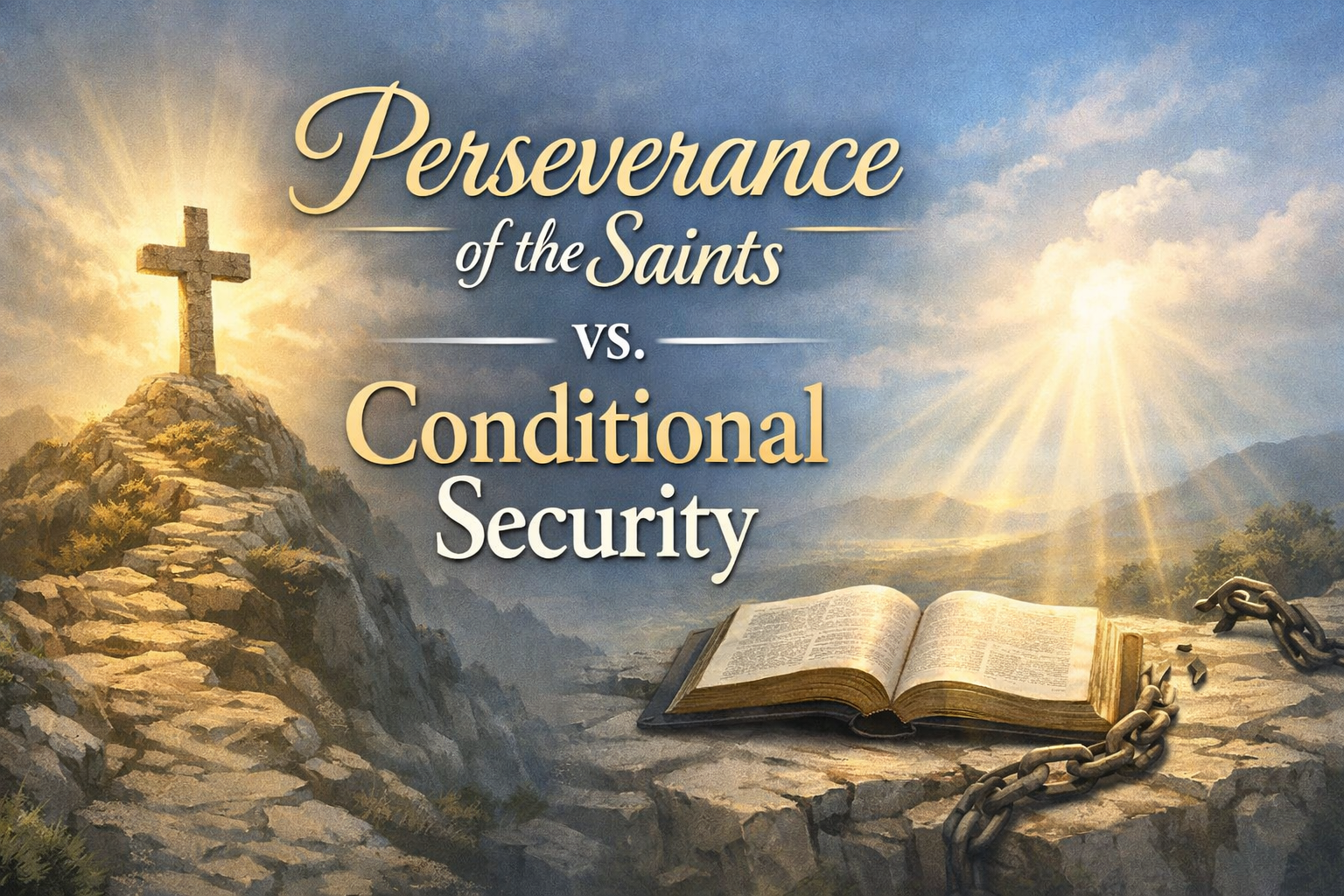
Perseverance of the saints vs. conditional security
Can a true Christian lose their salvation? Few questions in Christian theology are more personal or more contested. Your answer determines where you go when you’ve sinned badly, how you read the warning passages in Hebrews, what you say to a believer who has walked away from the faith, and whether you go to sleep at night resting in God’s grip or gripping your own faith hard enough to stay in. This is not a debate about peripheral matters. It is a debate about the nature of grace, the character of God, and the security of the soul.
The debate over eternal security is one of the oldest and most emotionally loaded in Protestant theology. It is also one of the most personally consequential. Ask someone whether they believe a Christian can lose their salvation and you will learn a great deal — not just about their theology, but about where they locate their confidence, what they think God’s promises actually guarantee, and how they read the hard passages in Hebrews that seem to warn of exactly that possibility.
Two major positions have been staked out across centuries of careful biblical interpretation. The Reformed doctrine of the perseverance of the saints holds that all who are truly regenerate will persevere in faith to the end — not because they are strong enough to hold on, but because God is faithful enough to hold them. The Arminian doctrine of conditional security holds that salvation, genuinely received, can be genuinely lost through unbelief or willful apostasy. Both positions have serious biblical scholars in their corner. Both deserve honest engagement.
Naming the Positions Carefully
Before the arguments, a pair of clarifications that will save confusion.
“Once saved, always saved” is not quite the same as perseverance of the saints. The popular slogan, as it circulates in Baptist and broadly evangelical culture, often carries the implication that a person who prayed a prayer at some point is eternally secure regardless of how they subsequently live — regardless of whether any evidence of regeneration ever appeared. That is not the Reformed doctrine. The Reformed doctrine of perseverance insists that those who are truly saved will persevere — which means that a person showing no fruit of the Spirit, making no progress in holiness, and exhibiting no meaningful evidence of the new birth is not, on that basis, guaranteed heaven simply because they once raised their hand at a revival meeting. The doctrine of perseverance and the doctrine of assurance are related but distinct. Perseverance describes what God does. Assurance is the believer’s confidence that they are among those in whom he is doing it.
Conditional security is not the same as salvation by works. Arminians do not believe you earn salvation by good behavior or lose it through isolated acts of sin. They believe that saving faith is the condition of justification, and that apostasy — the complete and final abandonment of saving faith — results in the loss of justification. The distinction between stumbling (which all believers do) and apostatizing (which a true believer, on the Arminian view, can do) is important. Conditional security is not a merit system. It is a claim about the nature and stability of the faith that receives salvation.
The Perseverance Case
The case for the perseverance of the saints is built on several converging lines of biblical argument, each of which is strong on its own and formidable in combination.
The golden chain of Romans 8. As covered in the ordo salutis post, Romans 8:29–30 presents an unbroken sequence: foreknown, predestined, called, justified, glorified. The same people appear at every link. No one who enters the chain drops out before glory. Paul writes glorification in the past tense — “those whom he justified he also glorified” — because from God’s perspective, the outcome is as certain as if it had already occurred. The chain holds because God forged it, not because the individual links are strong enough on their own.
The explicit promises of Christ. John 6:37–40 is one of the most direct passages in the New Testament on this question. Jesus says: “All that the Father gives me will come to me, and whoever comes to me I will never cast out. For I have come down from heaven, not to do my own will but the will of him who sent me. And this is the will of him who sent me, that I should lose nothing of all that he has given me, but raise it up on the last day.” Jesus does not say he will do his best to keep what the Father has given him. He says he will lose nothing. The will of the Father — that the Son lose nothing — is the ground of the promise. John 10:28–29 doubles down: “I give them eternal life, and they will never perish, and no one will snatch them out of my hand. My Father, who has given them to me, is greater than all, and no one is able to snatch them out of the Father’s hand.”
The nature of the new covenant. Jeremiah 31:31–34 promises a new covenant in which God will write his law on the hearts of his people, be their God, forgive their sin, and — crucially — ensure that they know him. The new covenant does not merely make obedience possible. It guarantees it for those who are truly within it. Ezekiel 36:27 adds: “I will put my Spirit within you, and cause you to walk in my statutes.” The divine causation here is not a nudge toward obedience — it is the assurance that the covenant community will be kept in covenant faithfulness by the Spirit’s indwelling presence.
The intercessory work of Christ. Romans 8:34 asks: “Who is to condemn? Christ Jesus is the one who died — more than that, who was raised — who is at the right hand of God, who indeed is interceding for us.” The risen Christ is presently interceding for his people. In John 17:11, Jesus prays: “Holy Father, keep them in your name, which you have given me, that they may be one, even as we are one.” The question that frames the perseverance debate is this: does Christ’s intercession for his people fail? Can he pray for their keeping and have that prayer go unanswered? Hebrews 7:25 answers: “He is able to save to the uttermost those who draw near to God through him, since he always lives to make intercession for them.” To the uttermost — completely, finally, all the way to glory.
The sealing of the Spirit. Ephesians 1:13–14: “In him you also, when you heard the word of truth, the gospel of your salvation, and believed in him, were sealed with the promised Holy Spirit, who is the guarantee of our inheritance until we acquire possession of it.” A seal in the ancient world was a mark of ownership and protection — the guarantee that what was sealed would be delivered. The Spirit is God’s seal on the believer, his down payment guaranteeing the full inheritance. The question this raises for the conditional security position is whether God’s guarantee can be forfeited by the one he has sealed.
The Conditional Security Case
The Arminian and broader Wesleyan tradition reads the same Bible and reaches a different conclusion. Their arguments also deserve careful engagement.
The warning passages of Hebrews. The most challenging texts for the perseverance position are concentrated in Hebrews, and they are genuinely difficult. Hebrews 6:4–6: “For it is impossible, in the case of those who have once been enlightened, who have tasted the heavenly gift, and have shared in the Holy Spirit, and have tasted the goodness of the word of God and the powers of the age to come, and then have fallen away, to restore them again to repentance, since they are crucifying once again the Son of God to their open shame.” The description of those who fall away is not superficial — enlightened, sharing in the Holy Spirit, tasting the heavenly gift. If these describe genuine believers, then the passage is describing genuine believers apostatizing. And if it is warning against something impossible, why warn against it?
Hebrews 10:26–27 adds: “For if we go on sinning deliberately after receiving the knowledge of the truth, there no longer remains a sacrifice for sins, but a fearful expectation of judgment.” Hebrews 10:38–39 quotes Habakkuk: “But my righteous one shall live by faith, and if he shrinks back, my soul has no pleasure in him.” The shrinking back is a real possibility being warned against — not a hypothetical for those who were never truly saved.
Paul’s own anxiety about his standing. 1 Corinthians 9:27: “But I discipline my body and keep it under control, lest after preaching to others I myself should be disqualified.” Paul speaks as though the possibility of disqualification is real and motivates serious self-discipline. Conditional security proponents argue this is not the language of a man who regards his final standing as unconditionally secure.
The “if” clauses of perseverance. Several New Testament texts frame the assurance of final salvation with conditional language. Colossians 1:22–23: “He has now reconciled you in his body of flesh by his death, in order to present you holy and blameless and above reproach before him, if indeed you continue in the faith.” Hebrews 3:14: “For we have come to share in Christ, if indeed we hold our original confidence firm to the end.” These “if” clauses are not, on the Arminian reading, merely tests of genuine faith. They are genuine conditions — continuation in faith is what the final standing depends on.
The real examples of falling away. In 1 Timothy 1:18–20, Paul names Hymenaeus and Alexander as those who “have made shipwreck of their faith” and whom he has “handed over to Satan.” In 2 Timothy 2:17–18, Hymenaeus reappears, described as having “swerved from the truth.” These are not described as people who were never really saved. They are described as people who once held the faith and abandoned it. Whether their initial faith was genuine is the crux — but the conditional security position reads these as real examples of real apostasy.
How the Reformed Position Handles the Hard Texts
The warning passages of Hebrews are the most serious exegetical challenge for the perseverance position, and Reformed interpreters have offered several responses — not evasions but genuine engagements with the text.
The warnings are the means of preservation. This is perhaps the most pastorally rich Reformed response. God preserves his people through the warnings — the warnings themselves are part of his keeping work. A parent who warns a child away from a cliff is not implying the child will fall; the warning is what prevents the fall. The Hebrews warnings function the same way: God uses them to produce the perseverance he has guaranteed. The warning is real. The danger it describes is real to the one being warned. But the elect, confronted with the warning, take it seriously and therefore do not apostatize. The fact that God warns does not imply that those he has chosen will ultimately fail to heed.
The descriptions in Hebrews 6 may describe covenant participation, not regeneration. Some Reformed interpreters argue that “enlightened,” “tasting the heavenly gift,” and “sharing in the Holy Spirit” can describe those who have been closely associated with the covenant community — experiencing the corporate benefits of the Spirit’s presence, receiving the word, participating in the life of the church — without being truly regenerate. On this reading, Hebrews 6 is warning the community that some among them who appear to be participants in Christ may prove, by falling away, never to have been truly united to him. 1 John 2:19 supports this framework: “They went out from us, but they were not of us; for if they had been of us, they would have continued with us. But they went out, that it might become plain that they all are not of us.”
The “if” clauses are tests of genuine faith, not conditions of ongoing justification. When Colossians 1:23 says “if indeed you continue in the faith,” Reformed interpreters read this as: continuation in faith is the evidence that your reconciliation is real, not the condition that makes it real. The conditional is epistemic — it tells you how to know whether your standing is genuine — not ontological. God does not preserve people in their reconciliation only so long as they continue to cooperate. He preserves them, and their continuation is the fruit of his preservation. But because continuation is what real faith looks like, the warning to continue is the warning to examine whether your faith is real.
The Pastoral Weight of Each Position
Where you land on this question has real-world consequences for pastoral care and for your own soul.
The perseverance position grounds assurance in the character and promises of God rather than in the consistency of the believer. On a bad day — a day of doubt, of serious sin, of spiritual coldness — the persevering believer is not thrown back onto their own performance to determine whether they are still saved. They are thrown back onto the promises of Christ, the intercession of the Son, the sealing of the Spirit, and the electing love of the Father. That anchor holds when feelings do not.
The conditional security position argues that genuine perseverance requires genuine engagement — and that the assurance of false security is worse than no assurance at all. A person who believes they are eternally secure regardless of how they live may be emboldened in sin by that belief. The warnings of Hebrews exist precisely to prevent that. Conditional security keeps the believer awake, attentive, and engaged with the serious business of following Christ.
Both concerns are legitimate. The Reformed answer to the second is that genuine regeneration produces genuine sanctification — that a person truly united to Christ will not, finally, live as though the gospel makes no claim on them. The warning passages serve not to threaten the genuinely regenerate with loss but to expose those whose profession was never matched by the reality of new birth. But the Reformed position also acknowledges that assurance must be calibrated to evidence — a person showing no fruit of the Spirit over a long period has reason to examine the genuineness of their faith, not merely to rest in a past decision.
A Pastoral Word on Assurance
Whatever position you hold, two things are true at the same time. First, the grounds of assurance are the promises of God and the evidence of new birth — both matter, and neither should be separated from the other. Second, the pastoral response to a struggling believer is never to question their salvation as the first move. It is to point them to Christ, who does not cast out those who come to him (John 6:37), whose love cannot be separated from his own (Romans 8:38–39), and whose intercession for them has never ceased.
The person in genuine repentance who fears they have lost their salvation is not the primary audience for the warning passages of Hebrews. The person in hardened unbelief who has abandoned any meaningful engagement with Christ — that person needs to hear the warning. The person in genuine struggle who fears their own weakness — they need to hear the promise.
“He who calls you is faithful; he will surely do it.” — 1 Thessalonians 5:24
“Now to him who is able to keep you from stumbling and to present you blameless before the presence of his glory with great joy, to the only God, our Savior, through Jesus Christ our Lord, be glory, majesty, dominion, and authority, before all time and now and forever. Amen.” — Jude 24–25
The one who keeps you from stumbling is not you. The one who presents you blameless is not you. The doxology at the end of Jude is not addressed to the persevering believer. It is addressed to the God who keeps.
Rest in that. And examine yourself to see that your rest is in him — not in a prayer prayed decades ago, not in a decision made under emotional pressure, but in a living faith in a living Savior who has never lost what the Father has given him.
Key Takeaways
- Perseverance of the saints is not the same as “once saved, always saved.” The Reformed doctrine does not guarantee heaven to everyone who has ever made a profession of faith. It guarantees that those who are truly regenerate will persevere — and treats the absence of perseverance as evidence that regeneration was not genuine.
- The case for perseverance rests on the character and promises of God. The golden chain of Romans 8, the explicit promises of John 6 and 10, the intercessory work of Christ, the sealing of the Spirit, and the new covenant guarantee all ground eternal security in divine faithfulness — not human consistency.
- The warning passages of Hebrews are the strongest evidence for conditional security. Hebrews 6 and 10 describe those who fall away in terms that sound like genuine believers. Reformed interpreters respond that the warnings are God’s means of preserving his people, and that the descriptions may indicate covenant participation rather than true regeneration.
- The “if” clauses of perseverance texts are interpreted differently by each position. Conditional security reads them as genuine conditions of ongoing justification. Reformed interpreters read them as epistemic markers — tests of whether faith is genuine — not ontological conditions that God’s keeping power depends on.
- Assurance should be grounded in God’s promises and the evidence of new birth — together. Neither bare profession nor the feeling of security is an adequate ground. The believer looks outward to the promises of Christ and inward to the fruit of regeneration — and finds in both the same Spirit bearing witness that they belong to God.
Key Scriptures: John 6:37–40 · John 10:28–29 · Romans 8:29–30, 38–39 · Hebrews 6:4–6 · Hebrews 7:25 · Ephesians 1:13–14 · 1 John 2:19 · Jude 24–25
Mountain Veteran Ministries
Find Your Next Bearing
Every journey needs a direction. If you're wondering where to go from here, choose the path that best fits where you are today.
⚒️ I Want to Live Faithfully
Discover practical wisdom for following Christ in today's world.
→ Living as a Christian Today✝️ I Want to Understand the Gospel
Learn what salvation means and why Jesus came.
→ Understanding Salvation📖 I Want to Understand the Bible
Explore why Christians trust Scripture and how to read it well.
→ Understanding the Bible❓ I Still Have Questions
Explore thoughtful answers to some of Christianity's hardest questions.
→ Hard Questions