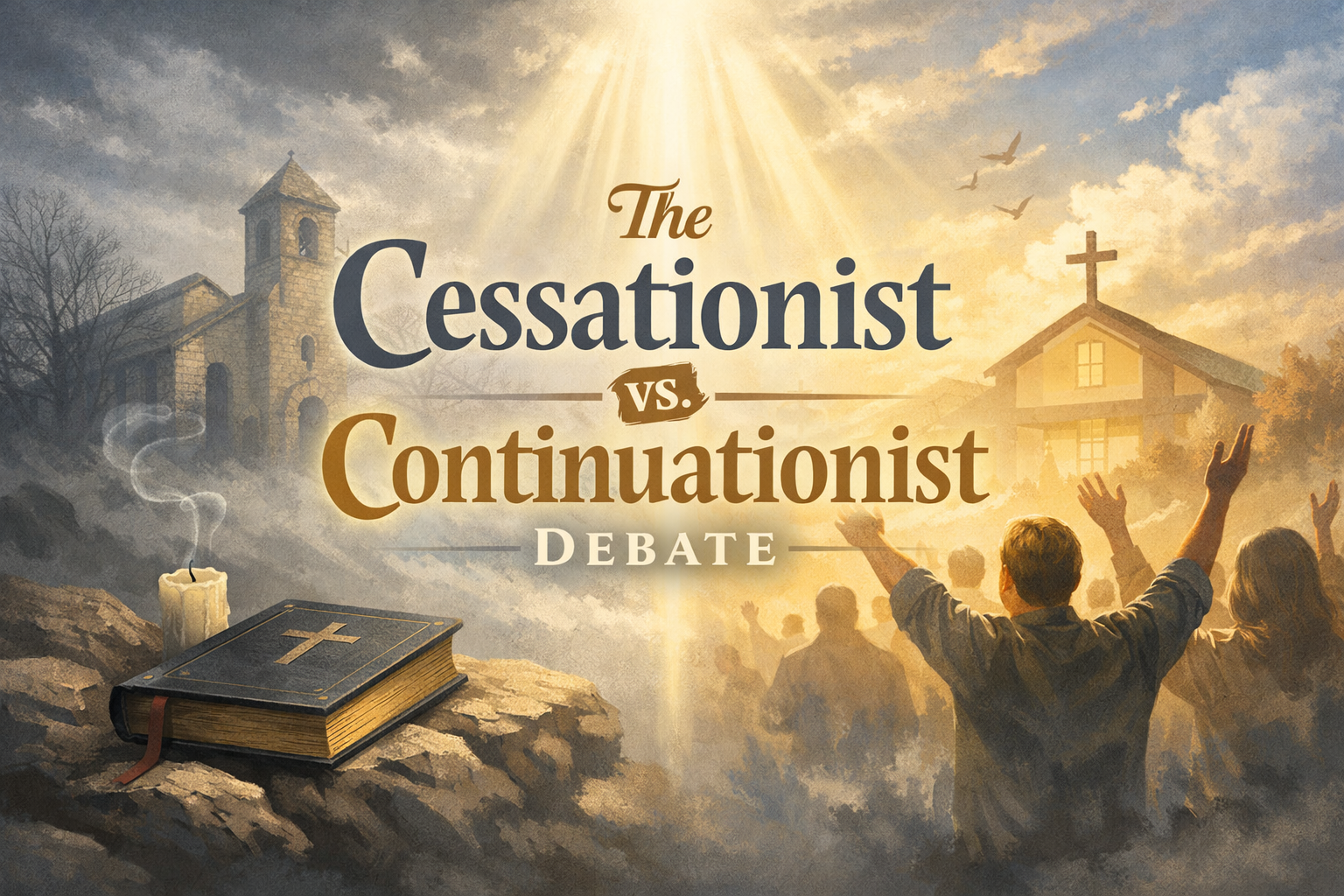
The cessationist vs. continuationist debate
Few debates in contemporary Christianity generate more heat with less light than the question of spiritual gifts. Do the miraculous gifts of the Spirit — tongues, prophecy, healing, miracles — continue today? Or did they cease with the apostolic age? Cessationists say they ended. Continuationists say they didn’t. And both sides have serious biblical scholars, long church histories, and pastoral convictions behind them. Before you pick a team, it’s worth understanding what’s actually at stake.
A fair-handed look at one of evangelicalism’s most contested internal debates — what each side actually argues, where the real difficulties lie, and what both get right.
Walk into a Southern Baptist church and a Pentecostal church on the same Sunday morning and you will hear the same gospel, sing overlapping songs, and affirm the same creeds. But ask both congregations what they think about speaking in tongues, and you will get answers so different you’d wonder if they’re reading the same Bible.
They are. That’s precisely what makes this debate hard.
The cessationist vs. continuationist question is one of those intra-evangelical disputes where both sides have serious exegetical arguments, genuine church-historical evidence, and real pastoral concerns. It’s also one where the popular versions of each position are often caricatures of the best versions. Cessationists get accused of quenching the Spirit. Continuationists get accused of chasing experience over Scripture. Neither caricature is fair, and neither helps anyone think clearly.
Let’s do better than that.
Defining the Terms
Before anything else, we need to be precise about what is being debated — because both labels cover more ground than most people realize.
Cessationism is the view that certain supernatural gifts of the Holy Spirit — specifically the “sign gifts” including tongues, prophecy, healing, and miracles — ceased at or near the close of the apostolic age (roughly the end of the first century, coinciding with the completion of the New Testament canon and the death of the last apostle). These gifts served a specific foundational purpose: to authenticate the apostles’ message and establish the Church. Once the foundation was laid and the canon was closed, the need for these authenticating signs passed. The Spirit continues to work powerfully in the Church — through the Word, through sanctification, through common grace — but not through the same miraculous gifts active in Acts.
Continuationism is the view that all the spiritual gifts described in the New Testament — including tongues, prophecy, healing, and miracles — remain available and active in the Church today. The Spirit distributes gifts as He wills (1 Corinthians 12:11), and nothing in Scripture explicitly teaches that He stopped willing to distribute them. Continuationists range from classical Pentecostals (who often treat tongues as the initial evidence of Spirit baptism) to charismatic evangelicals (who affirm the gifts but don’t require tongues) to “open but cautious” evangelicals who are persuaded the gifts continue but are wary of excesses.
Already you can see that neither camp is monolithic. There are hard cessationists who think any claim to miraculous gifts today is at best self-deception and at worst demonic. There are soft cessationists who think the gifts have largely ceased but wouldn’t rule out sovereign exceptions. There are wildly enthusiastic continuationists and deeply careful, Word-centered continuationists. The labels are starting points, not finishing lines.
The Cessationist Case
Core Argument: Gifts Served a Foundational, Unrepeatable Purpose
The strongest cessationist argument is not primarily about what Scripture says will happen at the end of the apostolic age — it’s about what Scripture says the sign gifts were for. In Hebrews 2:3–4, the writer explains that “this salvation… was declared at first by the Lord, and it was attested to us by those who heard, while God also bore witness by signs and wonders and various miracles and by gifts of the Holy Spirit distributed according to his will.” The language is past tense and historically anchored — the signs confirmed the apostolic proclamation at a specific moment in redemptive history.
Paul’s language in Ephesians 2:20 describes the Church as “built on the foundation of the apostles and prophets, with Christ Jesus himself as the cornerstone.” Foundations are laid once. The extraordinary gifts clustered around the apostolic office — including the ability to confer gifts through the laying on of hands (Acts 8:17–18, 2 Timothy 1:6) — belonged to that unrepeatable foundational era.
The canon argument. Many cessationists argue that the completion of the New Testament canon made ongoing revelatory gifts redundant — and potentially dangerous. If prophecy is a channel through which God delivers fresh revelation, and if the canon is now closed (Revelation 22:18–19, Jude 3), then present-day “prophecy” is either (a) genuine Scripture-level revelation that should be added to the canon, which no responsible continuationist wants to claim, or (b) something significantly less than what prophecy was in the New Testament — in which case, is it really the same gift?
The church history argument. Cessationists note that the miraculous gifts appear to have faded dramatically after the apostolic era. The early church fathers — Chrysostom, Augustine — acknowledged this. The widespread recurrence of tongues and prophecy doesn’t emerge again until the Montanist movement of the second and third centuries, which the mainstream Church largely condemned as aberrant. The next major wave doesn’t appear until the early twentieth century with the Azusa Street revival. For cessationists, this long historical gap is significant: if the gifts were meant to be normative throughout Church history, why the near-silence for eighteen centuries?
Key proponents: B.B. Warfield (who coined much of the modern cessationist argument in Counterfeit Miracles), John MacArthur, Thomas Schreiner, and much of the confessional Reformed tradition.
The Continuationist Case
Core Argument: Scripture Does Not Teach Cessation
The continuationist’s strongest point is straightforward: nowhere does the New Testament explicitly say the miraculous gifts will cease before Christ’s return. The burden of proof lies with those claiming cessation. The gifts were given to the Church by the Spirit (1 Corinthians 12); to claim they have been revoked requires positive biblical evidence for that revocation — and continuationists argue no such evidence exists. Commands like “earnestly desire the spiritual gifts, especially that you may prophesy” (1 Corinthians 14:1) are addressed to the whole Corinthian church, not uniquely to an apostolic-era audience.
The clearest candidate for a cessationist proof-text — 1 Corinthians 13:8–12, where Paul says tongues “will cease” and prophecy “will pass away” when “the perfect comes” — turns out, on careful exegesis, to describe the eschaton (the final state at Christ’s return), not the close of the canon. “Now we see in a mirror dimly, but then face to face” describes the beatific vision, not the completed Scripture. If “the perfect” is the canon, the passage would mean we now know fully even as we are fully known — which no cessationist actually believes.
The Pentecost argument. Peter’s citation of Joel 2 at Pentecost is programmatic: “In the last days, God says, I will pour out my Spirit on all people. Your sons and daughters will prophesy… Even on my servants, both men and women, I will pour out my Spirit in those days, and they will prophesy” (Acts 2:17–18). If we are in “the last days” — which began at Pentecost and continue until Christ returns — then Spirit-given prophecy belongs to the entire last-days era, not just its opening decades.
The global church argument. Continuationists point to the rapid growth of Christianity in the Global South — Africa, Asia, Latin America — where reports of healings, miracles, and prophetic experiences are widespread and closely linked to evangelistic advance. The argument isn’t that every reported miracle is genuine, but that dismissing all of it as either fraud or demonic deception requires more confidence than the evidence warrants. God works where and how He wills.
The theological consistency argument. If the Spirit still indwells believers, still intercedes through believers’ prayers (Romans 8:26), still gifts the Church for ministry — why would He arbitrarily withdraw certain gifts but not others? The Spirit is not a diminished Spirit. He is the same Spirit who fell at Pentecost, and He distributes gifts “as He wills.”
Key proponents: Gordon Fee, D.A. Carson, Wayne Grudem, Sam Storms, and the broader charismatic-evangelical and Pentecostal traditions. Notably, Reformed continuationists like Grudem and Storms hold a high view of Scripture and do not equate present-day prophecy with canonical revelation.
Where the Real Difficulties Lie
Both positions face genuine exegetical and experiential difficulties that their best advocates acknowledge honestly.
Cessationism’s hardest problem is the argument from silence. The New Testament nowhere says “these gifts will end when the last apostle dies” or “when the canon is complete.” The cessationist case is built on inference from the purpose of the gifts — a reasonable inference, but an inference nonetheless. The canon-closure argument also carries a circularity risk: if the gifts ceased because the canon is sufficient, and we know the canon is sufficient partly because the gifts ceased, the argument risks begging the question.
The church history argument cuts less cleanly than it appears. The patristic evidence shows both that some fathers acknowledged the gifts had diminished and that others — including Irenaeus, Tertullian (pre-Montanist), and Augustine (late in his life, in the City of God) — reported or affirmed miraculous gifts in their own contexts. The picture is more complex than “gifts ended in AD 100.”
Continuationism’s hardest problem is accountability. If prophecy continues, what does it mean, and how do we evaluate it? New Testament prophecy in the apostolic era carried real authority — Paul could say “what I am writing to you is the Lord’s command” (1 Corinthians 14:37). If present-day prophecy is genuinely the same gift, it carries the same weight. But no responsible continuationist wants to say that a word from a modern prophet carries canonical authority. Grudem’s solution — that New Testament congregational prophecy was already a lesser gift than apostolic revelation, capable of being tested and corrected — is exegetically plausible but contested.
The experiential evidence also demands scrutiny. The prosperity-gospel excesses, manipulative healing ministries, and theologically bankrupt “prophetic” movements associated with charismatic Christianity are real and damaging. Responsible continuationists rightly condemn these — but the association is not simply unfair. The absence of robust cessationist instincts in many charismatic contexts has opened the door to serious pastoral and theological harm.
Where Does This Leave a Thinking Believer?
Here is an honest assessment: this is a secondary issue on which godly, biblically serious, Spirit-filled Christians have disagreed for generations — and will likely continue to disagree until Christ returns.
It is not a gospel issue. Cessationists and continuationists are brothers and sisters in Christ. The gospel — justification by grace through faith in the atoning work of Christ — is not at stake in this debate. Church fellowship, cooperative mission, and mutual respect should not be sacrificed on this altar.
It is, however, a significant ecclesiological and pneumatological issue that affects how a church worships, how it evaluates spiritual experience, and how it forms its members. Churches need to have a thoughtful position, teach it clearly, and apply it with pastoral wisdom.
What is not acceptable on either side: cessationists dismissing all reported miraculous gifts as fraud or demonic deception without careful examination; continuationists abandoning biblical discernment in pursuit of spiritual experience. The Spirit is not opposed to the Word — He inspired it. And the Word is not opposed to the Spirit — it is His instrument.
What Both Sides Must Hold
Regardless of where you land on cessationism or continuationism, several convictions belong to all of orthodox Christianity and should not be casualties of this debate.
The Holy Spirit is fully active in the Church today. This is non-negotiable. Whatever cessationists say about the sign gifts, they do not — should not — believe in a functionally absent Spirit. The Spirit regenerates, sanctifies, illuminates Scripture, convicts of sin, produces fruit, intercedes in prayer, gifts believers for ministry, and empowers witness. A cessationist who treats the Christian life as essentially Spirit-less has overcorrected badly.
All spiritual experience must be tested by Scripture. This is the continuationist’s necessary guardrail. 1 John 4:1: “Dear friends, do not believe every spirit, but test the spirits to see whether they are from God.” 1 Thessalonians 5:19–22: “Do not quench the Spirit. Do not despise prophecies, but test everything; hold fast what is good.” The command to test is not optional. A prophetic word, a reported healing, a claimed tongue — all of it goes through the filter of Scripture and sound doctrine. What contradicts Scripture is false, full stop.
God is sovereign over His own gifts. He gives as He wills. Neither cessationism nor continuationism should presume to box God in. The cessationist should be careful not to say God cannot heal miraculously today — only that He has not promised to do so through a permanent gift of healing distributed through individuals. The continuationist should be careful not to demand miraculous gifts as proof of spiritual vitality — the fruit of the Spirit (Galatians 5:22–23) is the consistent biblical marker of Spirit-filled life, not spectacular manifestations.
The glory belongs to Christ, not to the gift. The Spirit’s own ministry is self-effacing — He glorifies Christ (John 16:14). Any exercise of spiritual gifts that draws attention to the gift or the gifted person rather than to Christ has already gone wrong, regardless of whether the gift is real.
A Word on Discernment
Whatever your position on this debate, you will encounter the phenomenon it addresses. You will meet sincere believers who speak in tongues and whose lives bear genuine fruit. You will encounter “prophetic ministries” that are manipulative and theologically bankrupt. You will find cessationist churches that are spiritually dry and others that are alive with Scripture-saturated, prayer-soaked vitality. You will find charismatic churches that are biblically serious and others that are a pastoral disaster.
The gifts debate, in other words, is not ultimately about who has the better exegetical argument in a seminar room. It is about how the Spirit of God actually works in the lives of real people — and that requires discernment that goes beyond any single theological category.
The ancient criterion still holds: by their fruit you will know them (Matthew 7:16). Whatever gifts are or aren’t operating, look for the fruit: love, joy, peace, patience, kindness, goodness, faithfulness, gentleness, self-control. That fruit is promised. That fruit is permanent. And that fruit is available to every believer in every tradition — cessationist and continuationist alike.
Key Takeaways
- Both positions have serious biblical and historical support. Cessationism and continuationism are not a contest between scholarship and emotionalism — both sides have rigorous theologians, careful exegetes, and deep pastoral convictions. Engage the best versions of each.
- Cessationism argues from the purpose and function of sign gifts. The miraculous gifts authenticated apostolic ministry during the foundational era of the Church; once the foundation was laid and the canon was closed, their specific role was fulfilled.
- Continuationism argues from the absence of explicit biblical cessation. The New Testament never says the gifts will end before Christ’s return; the Spirit distributes gifts as He wills, and nothing in Scripture revokes that promise for the post-apostolic Church.
- The key exegetical battlegrounds are 1 Corinthians 13:8–12 and Acts 2:17–18. “The perfect” in 1 Corinthians 13 most naturally refers to the eschaton, not the canon. Joel’s promise of Spirit-given prophecy in “the last days” covers the entire period from Pentecost to Christ’s return.
- This is a secondary, not a primary, issue. The gospel is not at stake. Cessationists and continuationists are brothers and sisters in Christ who can cooperate in mission, worship together, and respect each other’s convictions.
- All spiritual experience must be tested by Scripture. 1 John 4:1 and 1 Thessalonians 5:19–22 apply regardless of your position. Claims of prophecy, healing, or tongues are not self-authenticating — they must be evaluated against the Word.
- The consistent biblical marker of the Spirit-filled life is fruit, not gifts. Love, joy, peace, patience, kindness, goodness, faithfulness, gentleness, self-control — these are promised to every believer and are not subject to the cessationist debate.
Mountain Veteran Ministries
Find Your Next Bearing
Every journey needs a direction. If you're wondering where to go from here, choose the path that best fits where you are today.
⚒️ I Want to Live Faithfully
Discover practical wisdom for following Christ in today's world.
→ Living as a Christian Today✝️ I Want to Understand the Gospel
Learn what salvation means and why Jesus came.
→ Understanding Salvation📖 I Want to Understand the Bible
Explore why Christians trust Scripture and how to read it well.
→ Understanding the Bible❓ I Still Have Questions
Explore thoughtful answers to some of Christianity's hardest questions.
→ Hard Questions