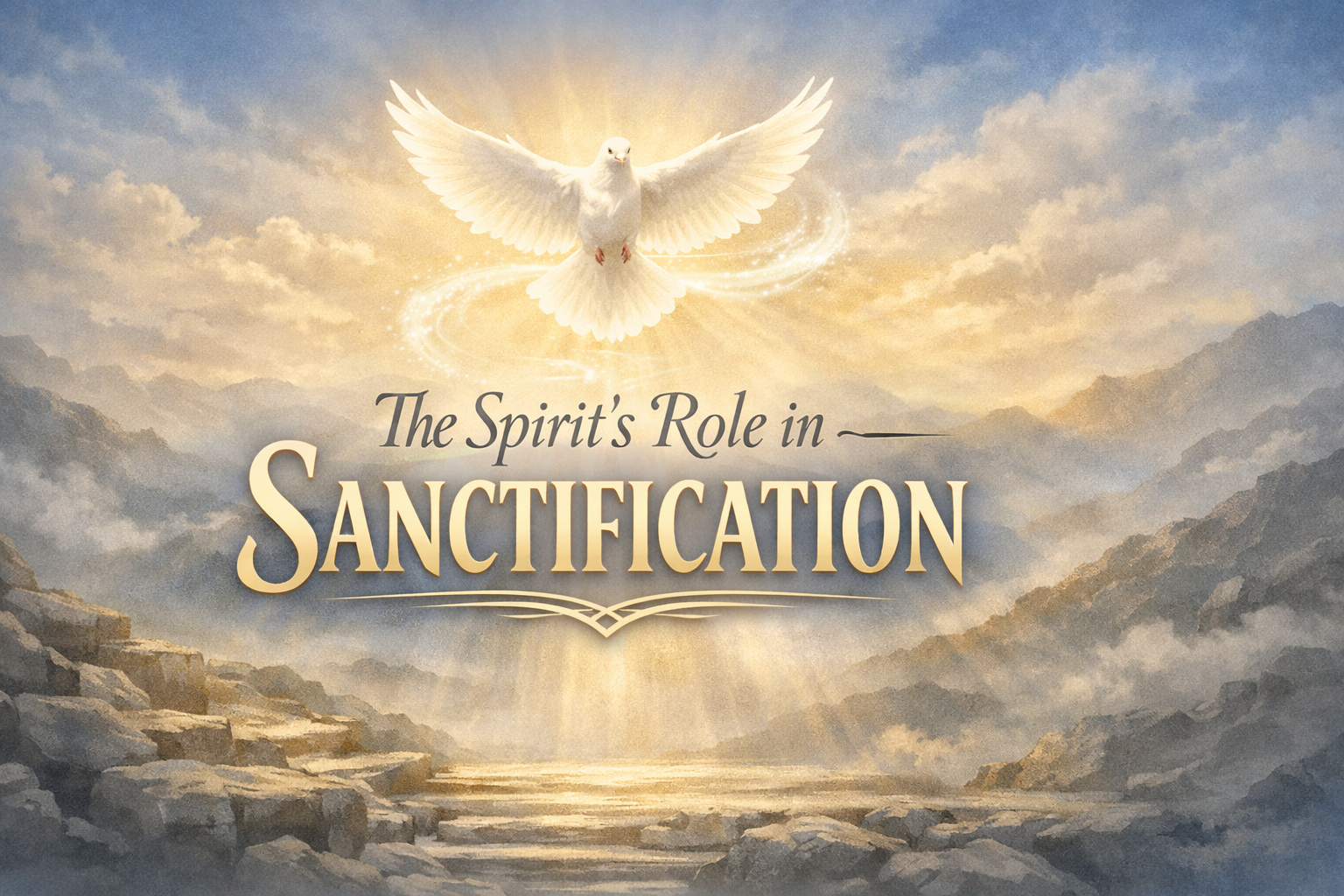
The Spirit’s Role in Sanctification
Every Christian knows they’re supposed to be growing. The problem is figuring out how. Try harder? Pray more? White-knuckle the sin you keep falling into? The New Testament has a different answer than most people expect — and it runs straight through the person of the Holy Spirit. Sanctification is not a self-improvement project with religious vocabulary. It is the Spirit of God transforming a person from the inside out, from one degree of glory to another. Understanding His role changes everything about how you pursue holiness.
Sanctification is not willpower dressed in religious clothing. It is the Spirit of the living God at work in the believer — and understanding His specific roles changes how you pursue holiness from the ground up.
There is a version of the Christian life that looks like this: you know you’re forgiven, you know where you’re going when you die, but the stretch between justification and glory is essentially a grind. You try to be good. You fail. You feel guilty. You try again. You hear sermons about sin and resolve to do better. You don’t. Repeat.
If that description is familiar, the problem may not be a lack of willpower. The problem may be a missing doctrine — specifically, a working understanding of what the Holy Spirit is actually doing in the life of a believer between conversion and death.
Sanctification — the process by which a Christian is progressively conformed to the image of Christ — is not a human project that God watches from a distance and grades. It is the Spirit of God doing something in and through a person that the person could never accomplish alone. The New Testament is emphatic on this point, and getting it right has enormous practical consequences.
What Sanctification Actually Is
Before we get to the Spirit’s role, a brief definition. Sanctification in the New Testament carries three distinct but related meanings that are worth holding separately.
Definitive sanctification is the once-for-all act by which a believer is set apart — made holy in their standing before God — at the moment of conversion. Paul can address the Corinthian believers as those who “were washed, sanctified, and justified” (1 Corinthians 6:11), using the past tense for all three. They have been sanctified, definitively, in Christ. This is not a description of their moral progress — the Corinthians had plenty of moral problems — but of their status. They belong to God; they are set apart as His.
Progressive sanctification is the ongoing process of transformation — the actual work of becoming, in experience and practice, what one already is in status. This is what most people mean when they talk about sanctification: growing in holiness, putting sin to death, bearing more fruit, being more conformed to Christ. It is real, it involves effort, and it takes a lifetime.
Final sanctification (or glorification) is the ultimate completion of the process at death or at Christ’s return, when the believer is fully and permanently conformed to Christ’s image — no more indwelling sin, no more remaining corruption, the project complete.
The Holy Spirit is active in all three. But it is progressive sanctification where His role is most often misunderstood — either ignored entirely (leaving the believer to fight alone) or overemphasized in a way that eliminates human responsibility (waiting passively for God to do everything). The New Testament navigates between both errors with precision.
The Spirit’s Specific Roles in Progressive Sanctification
1. The Spirit Indwells — He Is the Power Source
The Foundation: God Has Moved In
Everything else the Spirit does in sanctification flows from this foundational reality: He indwells the believer permanently. 1 Corinthians 6:19: “Do you not know that your body is a temple of the Holy Spirit within you, whom you have from God?” Romans 8:11: “If the Spirit of him who raised Jesus from the dead dwells in you, he who raised Christ Jesus from the dead will also give life to your mortal bodies through his Spirit who dwells in you.”
The power that raised Christ from the dead is not available to the believer as an external resource to be drawn upon under certain conditions. It dwells in the believer. The temple imagery in 1 Corinthians 6 is not decorative — in the Old Testament, the temple was where God’s presence resided. The believer’s body is now that dwelling place. Sanctification is not the believer climbing toward a distant God. It is the believer learning to live in conscious cooperation with a God who has already moved in.
This is the foundation that makes everything else possible and everything else make sense. You are not fighting sin from a position of neutral strength while occasionally receiving divine assistance. You are fighting from a position of indwelt power. The Spirit who regenerated you, who united you to Christ, who sealed you for the day of redemption — He is in you, right now, and His presence is not contingent on your performance.
2. The Spirit Convicts — He Exposes What Needs to Change
Before transformation can happen, a person has to see what is wrong. The Spirit is the one who opens that sight. Jesus describes the Spirit’s convicting work in John 16:8: “When he comes, he will convict the world concerning sin and righteousness and judgment.” That convicting work doesn’t stop at conversion. The Spirit continues, throughout the believer’s life, to illumine — to show sin for what it is, to surface idolatries that have gone unexamined, to press on areas of comfortable compromise.
This is why the reading of Scripture and the hearing of preaching so often has a cutting quality. It is not merely the force of good arguments. The Spirit is using the Word as His instrument — the “sword of the Spirit” (Ephesians 6:17) — to pierce through the self-deceptions that sin generates. Hebrews 4:12: “The word of God is living and active, sharper than any two-edged sword, piercing to the division of soul and spirit, of joints and of marrow, and discerning the thoughts and intentions of the heart.”
The practical implication is that the discipline of regular, attentive Scripture reading is not just about acquiring theological information. It is positioning yourself to be convicted — to let the Spirit, through the Word, do the diagnostic work that sanctification requires. A believer who avoids the Word avoids the Spirit’s primary convicting instrument and should not be surprised when sin goes unexamined.
3. The Spirit Illuminates — He Makes the Word Transformative
The Spirit’s relationship to Scripture in sanctification goes deeper than conviction. He is also the one who makes the Word genuinely comprehensible and personally transformative — not merely intellectually decoded but spiritually received. 1 Corinthians 2:12–14: “Now we have received not the spirit of the world, but the Spirit who is from God, that we might understand the things freely given us by God… The natural person does not accept the things of the Spirit of God, for they are folly to him, and he is not able to understand them because they are spiritually discerned.”
This means that Bible study without dependence on the Spirit is not merely less effective — it is categorically different in kind from Spirit-illumined reading. The believer has access to a Teacher who inspired the text, who knows every nuance of its meaning, and who has a specific interest in applying it to the reader’s exact situation. Prayer before and during Scripture reading is not a warm-up ritual. It is an acknowledgment that without the Spirit’s illumination, the words remain external to the reader rather than penetrating and transforming.
4. The Spirit Mortifies — He Puts Sin to Death
This is where the New Testament’s language becomes most direct and most demanding. Romans 8:13: “For if you live according to the flesh you will die, but if by the Spirit you put to death the deeds of the body, you will live.” The Greek verb is thanatoō — to put to death, to kill. Paul is not talking about managing sin or reducing its frequency. He is talking about mortification: the ongoing, deliberate killing of sinful desires and patterns.
Notice the agency in this verse carefully: “if by the Spirit you put to death.” The Spirit does not do it without you. You do not do it without the Spirit. The verse is explicitly both-and: Spirit-empowered human effort. John Owen’s formulation in his classic work on mortification says it precisely: “Be killing sin, or sin will be killing you.” But Owen is equally clear that this killing is done by the Spirit — the believer’s effort is real, but it is the Spirit who supplies the power that makes the effort effective.
This rules out two errors simultaneously. The first error is the passive “let go and let God” approach — waiting for the Spirit to remove sinful desires without engaging the spiritual disciplines, the hard work of repentance, the deliberate avoidance of temptation. The Spirit does not mortify sin in a believer who is not striving. The second error is the self-reliant approach — engaging in all the right disciplines through sheer willpower, grinding against sin through clenched-teeth determination, with no actual dependence on the Spirit’s power. That approach produces either pride when it temporarily succeeds or despair when it fails. Neither is sanctification.
5. The Spirit Produces Fruit — He Grows What Cannot Be Manufactured
The most well-known passage on the Spirit and sanctification is probably Galatians 5:22–23: “But the fruit of the Spirit is love, joy, peace, patience, kindness, goodness, faithfulness, gentleness, self-control; against such things there is no law.” Notice the singular: fruit, not fruits. This is one integrated cluster of character qualities, not a checklist of achievements. And they are called fruit — not accomplishments, not products of effort, not résumé entries. They grow.
The agricultural metaphor is deliberate and instructive. Fruit is the natural output of a living, healthy plant that is properly rooted and nourished. A farmer cannot manufacture fruit by attaching artificial apples to a dead tree. What a farmer can do is cultivate the conditions in which fruit naturally grows — clearing away what chokes it, ensuring adequate nourishment, removing what harms the plant. The Spirit produces the fruit. The believer’s responsibility is to remain connected to the vine (John 15:4–5) and to cultivate the conditions — through the means of grace — in which the Spirit’s work can flourish.
This is why legalism always fails as a sanctification strategy. You cannot produce love, genuine joy, real peace, or authentic patience through rule-following and self-discipline alone. These are Spirit-generated realities. What you can do — what Scripture repeatedly calls you to do — is walk by the Spirit, keep in step with the Spirit (Galatians 5:16, 25), which means remaining consciously dependent, removing hindrances, and using the means by which the Spirit works.
6. The Spirit Renews the Mind — He Transforms from the Inside
Romans 12:2 calls believers not to be conformed to the world but to “be transformed by the renewal of your mind.” The word translated “transformed” is metamorphoō — the same root as metamorphosis. This is not surface-level behavior modification. It is a deep, inside-out renovation of the way a person thinks, perceives, values, and responds to the world.
The Spirit is the agent of this renewal. Titus 3:5 speaks of “the renewing of the Holy Spirit” as part of the work of new birth — and that renewing continues throughout the believer’s life. 2 Corinthians 3:18 captures the process with precision: “And we all, with unveiled face, beholding the glory of the Lord, are being transformed into the same image from one degree of glory to another. For this comes from the Lord who is the Spirit.”
The mechanism described here is beholding — sustained, attentive contemplation of Christ as revealed in the gospel. The Spirit uses the content of the gospel, repeatedly absorbed and meditated upon, to progressively reshape the believer into the image of Christ. This is why preaching, Scripture memory, meditation on the Word, and the Lord’s Supper are not incidental to sanctification. They are the Spirit’s primary instruments of mind-renewal. He transforms through truth.
7. The Spirit Intercedes — He Prays When We Cannot
Help in the Hard Moments
There is a dimension of the Spirit’s sanctifying work that is easy to overlook because it happens outside the believer’s direct awareness: intercession. Romans 8:26–27: “Likewise the Spirit helps us in our weakness. For we do not know what to pray for as we ought, but the Spirit himself intercedes for us with groanings too deep for words. And he who searches hearts knows what the mind of the Spirit is, because the Spirit intercedes for the saints according to the will of God.”
The word “helps” here is a compound Greek word that means to take hold of something alongside another — the image is of the Spirit coming alongside and bearing part of the weight with you. In the specific moments of spiritual weakness, confusion, grief, and disorientation where you don’t even know how to pray, the Spirit is not absent. He is interceding with a depth and accuracy that your own prayer cannot achieve. He prays according to the will of God — which means His intercession for your sanctification is perfectly calibrated to what you actually need.
This is pastoral gold for the Christian in a hard season. When you feel spiritually dry, when sin has beaten you down and you don’t know how to pray your way back, when your words feel hollow and your heart feels distant — the Spirit is not waiting for you to get your prayer life together before He engages on your behalf. He is already interceding. You are not alone in the fight even when the fight feels utterly lonely.
The Human Side — Why Effort Still Matters
A right understanding of the Spirit’s role in sanctification does not lead to passivity. The New Testament makes this unmistakably clear. The same Paul who says the Spirit mortifies the deeds of the body also commands believers to “put to death therefore what is earthly in you” (Colossians 3:5). The same Spirit who produces fruit is the Spirit by whom believers are commanded to “walk” and “keep in step” (Galatians 5:16, 25). The same God who works in believers is the ground for the command to “work out your own salvation with fear and trembling” — because “it is God who works in you, both to will and to work for his good pleasure” (Philippians 2:12–13).
The grammar of Philippians 2:12–13 is worth pausing on. God’s working does not replace human working — it is the basis for it. The indicative (“God works in you”) grounds the imperative (“work out your salvation”). Divine sovereignty and human effort are not in tension here; they are nested. The Spirit’s power is the engine; the believer’s effort is the engaged transmission that puts that power to use.
The means of grace — Scripture reading, prayer, corporate worship, the Lord’s Supper, preaching, Christian fellowship, fasting, giving — are not optional accessories for those who want to be especially devout. They are the channels through which the Spirit ordinarily works in sanctification. A believer who neglects them is not being more Spirit-dependent; they are being less so. They are cutting themselves off from the Spirit’s primary instruments.
Practical Reorientation: How This Changes the Daily Battle
If the Spirit is the agent of sanctification and you are the dependent cooperator, then the daily battle against sin and the daily pursuit of holiness looks different from what many Christians assume.
You fight from victory, not toward it. The Spirit who indwells you has already conquered sin and death in Christ. You are not trying to achieve a position of strength — you already occupy one. The fight is real, but the outcome of the war is not in doubt.
Repentance replaces self-condemnation. When you sin, the Spirit’s role is to convict — not to condemn. Condemnation loops you back into yourself. Repentance, empowered by the Spirit, moves you back toward Christ. 1 John 1:9 is not a begrudging concession; it is a door the Spirit holds open.
The means of grace are not duty — they are oxygen. Bible reading, prayer, gathered worship, the Lord’s Supper — you don’t do these things to earn standing with God. You do them because they are where the Spirit most reliably meets you. Miss them consistently and you will feel it, not because God has moved, but because you have stepped away from the channels He uses.
Slow growth is still growth. The Spirit’s work in sanctification is, for most believers in most seasons, gradual. It is not always dramatic. The fruit metaphor implies a process invisible to the naked eye most of the time. Trust the process. Engage the means. The Spirit is not absent in the quiet seasons.
The Goal: Conformity to Christ
The end toward which the Spirit is working in every believer’s sanctification is not vague moral improvement. It is a specific person: Jesus Christ. Romans 8:29: “For those whom he foreknew he also predestined to be conformed to the image of his Son, in order that he might be the firstborn among many brothers.” 2 Corinthians 3:18: “We… are being transformed into the same image from one degree of glory to another.”
The Spirit knows exactly what He is building toward. He has a perfect template — Christ Himself — and He works with patience and precision toward that end in every believer He indwells. This means that every Spirit-driven act of repentance, every mortified sin, every moment of renewed thinking, every increment of fruit is not a random achievement. It is one more mark of conformity to Christ.
It also means the process will not stop short of completion. The Spirit who began the good work will bring it to completion at the day of Jesus Christ (Philippians 1:6). Sanctification is not a project you might abandon halfway through. It is the Spirit’s project, and He finishes what He starts.
Key Takeaways
- Sanctification has three phases — definitive, progressive, and final. The Spirit is active in all three. Progressive sanctification — the ongoing work of becoming holy — is where His role is most often misunderstood or ignored in daily Christian life.
- The Spirit indwells the believer permanently. The resurrection power that raised Christ from the dead dwells in the believer (Romans 8:11). Sanctification begins from a position of indwelt strength, not neutral effort hoping for occasional divine assistance.
- The Spirit convicts and illuminates through the Word. He uses Scripture as His primary instrument — both to expose sin and to make the Word transformative rather than merely informational. Regular, dependent engagement with Scripture is not optional for sanctification.
- The Spirit mortifies sin — but not without the believer. Romans 8:13 presents Spirit-empowered human effort: “by the Spirit you put to death.” Both passivity (waiting for God to do it all) and self-reliance (fighting sin through willpower alone) are equally wrong and equally ineffective.
- The Spirit produces fruit that cannot be manufactured. Love, joy, peace, patience, and the rest of Galatians 5:22–23 are Spirit-generated realities, not achievements of religious effort. The believer’s role is to remain connected to the vine and cultivate the conditions for the Spirit’s work.
- The Spirit renews the mind through sustained beholding of Christ. 2 Corinthians 3:18 describes the mechanism: transformation comes from beholding the glory of Christ. Preaching, Scripture meditation, and the ordinances are the Spirit’s instruments of inside-out renovation.
- The Spirit intercedes in weakness. Romans 8:26–27 means you are never fighting alone, even when you feel spiritually depleted. The Spirit is praying for your sanctification according to the will of God — perfectly, accurately, on your behalf.
Mountain Veteran Ministries
Find Your Next Bearing
Every journey needs a direction. If you're wondering where to go from here, choose the path that best fits where you are today.
⚒️ I Want to Live Faithfully
Discover practical wisdom for following Christ in today's world.
→ Living as a Christian Today✝️ I Want to Understand the Gospel
Learn what salvation means and why Jesus came.
→ Understanding Salvation📖 I Want to Understand the Bible
Explore why Christians trust Scripture and how to read it well.
→ Understanding the Bible❓ I Still Have Questions
Explore thoughtful answers to some of Christianity's hardest questions.
→ Hard Questions