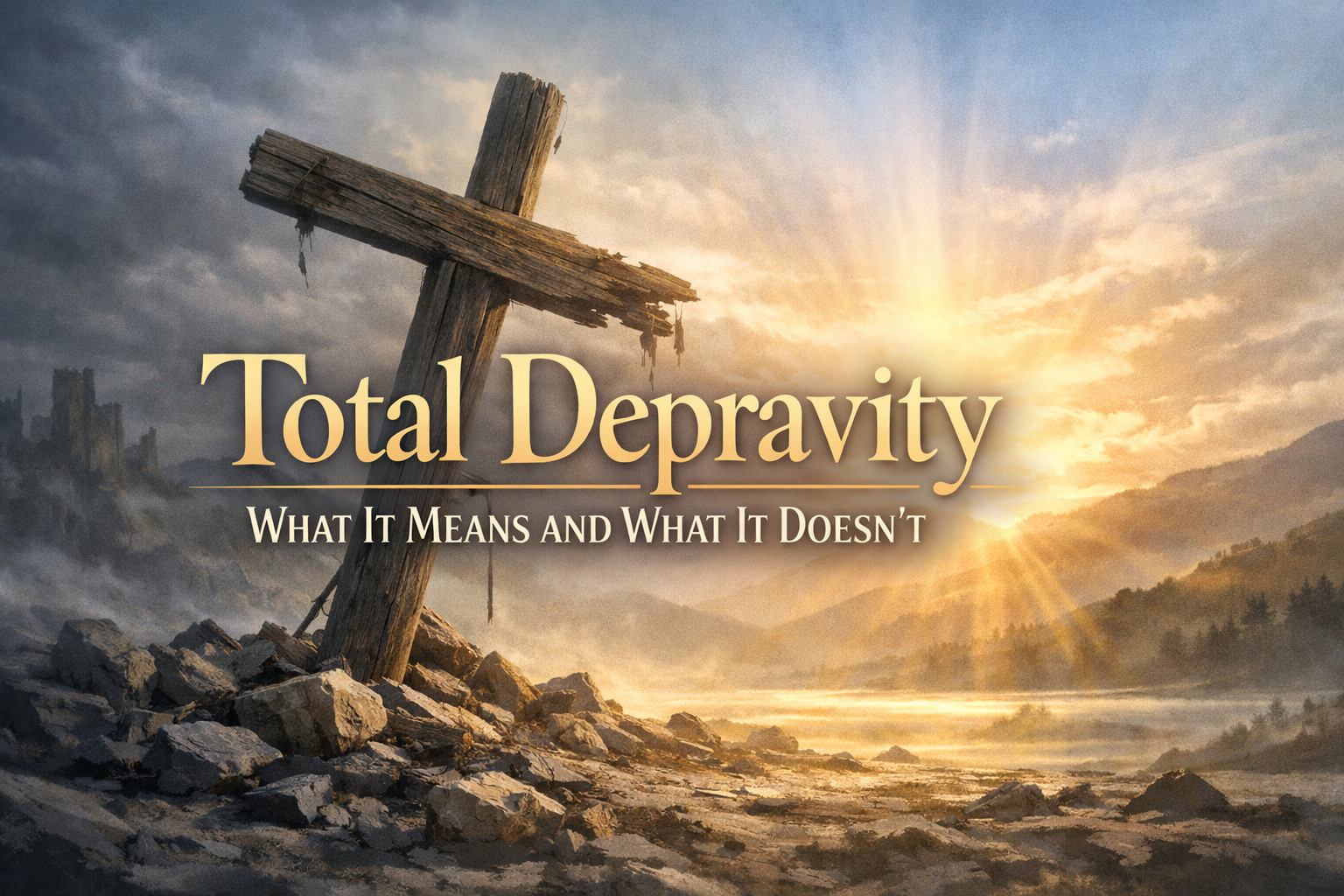
Total Depravity — What It Means and What It Doesn’t
A man will never prize the cure if he does not understand the illness. If we think sin is only a few bad habits on an otherwise healthy soul, then grace becomes little more than moral coaching — and Jesus becomes a helper rather than a Savior. Total depravity tells the truth about the human condition so that the gospel can be seen for what it truly is.
The short plain answer: total depravity means sin has affected every part of our human nature, so that apart from God’s grace no part of us is untouched by the fall and no sinner can come to God on his own. It does not mean every person is as wicked as possible, nor that unbelievers can do nothing externally kind or useful. In plain country terms, the problem is not just on the surface. The whole well is bad. The whole tree is diseased at the root. Sin is not a scratch on human nature. It is a deep corruption running through the whole man.
What Total Depravity Actually Means
Total depravity means the fall affected the whole person. It does not mean every human faculty ceased to exist. People still think, choose, feel, love, reason, build, work, laugh, and care for children. But every faculty is now touched by sin — the mind darkened, the heart deceitful, the will bent away from God, the affections disordered, the conscience damaged, the body subject to corruption and death.
Ephesians 2:1 — “And you hath he quickened, who were dead in trespasses and sins.”
Dead in sin does not mean people are as active in evil as they could be every moment. It means they are spiritually dead toward God — unable to love Him rightly, submit to Him gladly, or come to Him savingly apart from grace.
Romans 3:10–11 — “There is none righteous, no, not one: There is none that understandeth, there is none that seeketh after God.”
Paul is not saying nobody ever searches for meaning, religion, or spiritual experience. He is saying that in ourselves, left to ourselves, nobody seeks the true God in the right way, from the right heart, for the right end. That is total depravity.
The word total does not mean total in degree — as if every person is as vile as possible. It means total in extent. Sin reaches the whole man. A cracked foundation affects the whole house even if not every wall has fallen down yet.
Sin Reaches Every Part of Who We Are
The mind is darkened, “alienated from the life of God through the ignorance that is in them” (Ephesians 4:18). A man can be brilliant in business, farming, or engineering — and still be blind to the beauty of Christ. He can know how to fix a tractor and still not know his own heart.
“The heart is deceitful above all things, and desperately wicked” (Jeremiah 17:9). The heart in Scripture is the inner control center of the person. That center is corrupted — our loves are crooked, loving wrong things too much and right things too little, loving self-rule more than submission to God.
Jesus said, “Ye will not come to me, that ye might have life” (John 5:40). The problem is not lack of opportunity — it is resistance. Apart from grace, the will is enslaved to sin. “No man can come to me, except the Father which hath sent me draw him” (John 6:44).
We do not merely do wrong things — we desire wrong things. We hunger for what we should resist and resist what we should hunger for. As Augustine put it, the problem is not that we do not love, but that we love wrongly. The affections are bent toward self and away from God.
Total depravity is not only inward. The fall reaches bodily life — sickness, weakness, pain, decay, and death are all part of living as fallen people in a fallen world. The body is not evil in itself (God made it good), but it now lives under the shadow of corruption.
Even the moral compass within is damaged. The conscience can be seared, dulled, or educated to call evil good and good evil. It still functions — God restrains sin partly through it — but it is no longer the reliable guide it was created to be apart from the renewing work of the Spirit.
What Total Depravity Does Not Mean
It does not mean every person is as bad as possible. Total depravity is about the reach of sin, not its maximum expression. There is a real difference between an unbelieving neighbor who loves his family and a violent tyrant who delights in cruelty. Scripture itself recognizes degrees of wickedness. A field can be overrun with weeds without every square foot having the exact same weed growth — the whole field is affected, though some patches look cleaner than others.
It does not mean unbelievers can do nothing outwardly good. Unbelievers can love their children, help neighbors, build hospitals, fight fires, and act with real kindness on a human level. Jesus Himself said even sinners know how to give good gifts to their children (Luke 11:13). Civil goodness, social usefulness, and natural affection exist. What total depravity denies is that fallen man can produce works spiritually pure and pleasing to God in the fullest sense apart from faith — “without faith it is impossible to please him” (Hebrews 11:6).
It does not mean the image of God has been destroyed. Man is fallen, but man is still made in God’s image. That image is marred, not erased. That is why human life still has dignity, why murder is serious, and why every person should be treated with basic honor as a creature made by God. Total depravity should never be used to justify treating people like trash.
It does not mean sin always erupts in its fullest visible form. God restrains sin in the world through common grace — conscience, family, law, government, shame, consequences, and social order. If God removed all restraint, the world would be far worse than it is. Total depravity means the corruption is there, not that it always runs to its full visible extent.
Historic Reformed theology teaches total depravity, not utter depravity. Total depravity means every part of man is touched by sin. Utter depravity would mean every person is as bad as possible in every way. Only the first is the actual doctrine.
What the Bible Says
Why We Resist This Doctrine
We resist it because it offends human pride. Most people are willing to admit they are imperfect. Fewer are willing to admit they are guilty. Fewer still are willing to admit they are powerless to fix themselves before God.
The natural heart likes a gospel where man keeps at least one hand on the steering wheel. Total depravity says the steering wheel is not merely hard to manage. The whole engine is dead. And that is exactly why grace is so glorious.
If man were only wounded, grace would be medicine. If man were only misled, grace would be instruction. If man were only weak, grace would be assistance. But if man is dead in sin, blind to God, unwilling to come, and corrupt in every faculty — then grace is resurrection, sight, liberation, cleansing, and new creation.
Total Depravity and the Need for New Birth
If sin has affected the whole person, then salvation must reach the whole person too. That is why Jesus told Nicodemus not “you need a few adjustments” or “you need a better religious routine” — but
John 3:7 — “Ye must be born again.”
The problem is radical, and the remedy must be radical. The dead must be made alive. The blind must be given sight. The hard heart must be replaced. The rebel will must be renewed. The sinner must be brought from darkness to light. That is what God does in grace.
And total depravity does not cancel human responsibility. Our inability is not the inability of a man chained against his will who desperately wants God but cannot reach Him. It is the inability of a sinner who loves darkness rather than light. “Men loved darkness rather than light” (John 3:19). Sinners are responsible because they sin willingly. Their bondage is real, but it is a bondage they love — until grace sets them free.
What This Does to Us
It humbles us. If we came to Christ, it is because God had mercy. If our eyes were opened, God opened them. If our hearts were softened, God softened them. A right grasp of total depravity takes the swagger out of religion. It also makes us patient with other sinners — if we understand what we were apart from grace, we will be less shocked by human sin and more amazed by divine patience.
It makes us pray more earnestly for the lost. If people are spiritually dead, conversion is not finally a sales job. It is a miracle. We preach, witness, invite, and plead — but we also cry out for God to open blind eyes, because we know that is the only way they will be opened.
It makes us preach the gospel more plainly. Because the real need is deep, our message must be deeper than self-help. People do not need vague encouragement only. They need Christ crucified and risen.
It makes grace breathtaking. God did not set His love on lovely people who needed a nudge. He loved enemies, rebels, and the spiritually dead. A right view of depravity does not make grace smaller — it makes grace staggering.
A Rural Illustration
Picture an old apple tree in an orchard. One limb may still leaf out better than another. One side may look healthier from the road. There may even be a little fruit hanging here and there. But if the disease is down in the root system, the problem is not confined to one branch — the whole tree is affected.
That is total depravity. It does not mean every limb is equally rotten, or every apple equally shriveled. It means the corruption has reached the root, and therefore the whole tree is under the sickness. The answer is not trimming one branch or tying up another. The answer must go deeper than that.
So it is with man. We do not just need better habits. We need new life from the root up.
Total depravity is not the doctrine that man is always as wicked as possible. It is the doctrine that sin has touched everything in us, so that apart from grace we cannot make ourselves right with God. It tells the truth about the depth of the disease so that we will not settle for shallow remedies. And once we understand that, the grace of God in Christ stops looking like a little help for decent folks — and starts looking like what it truly is: resurrection for the dead. Do not stop at depravity. Follow the doctrine all the way to Christ.
Key Takeaways
- Total depravity means sin has affected the whole person — in extent, not necessarily in maximum degree. Mind, will, heart, affections, conscience, and body all bear the mark of the fall. The word “total” speaks to the reach of sin across every faculty, not to the maximum possible wickedness in every individual.
- It does not mean every person is as wicked as possible, or that unbelievers can do no external good. God restrains sin through common grace. Unbelievers can love families, serve communities, and act with real kindness. What total depravity denies is that any of this constitutes spiritually pure, God-pleasing works apart from faith.
- The image of God is marred, not erased. Human beings remain creatures made by God and bearing His image, which is why human life retains dignity even in fallenness. The doctrine should produce humility before God — never contempt for people.
- The biblical evidence is broad and clear. Genesis 6, Psalm 51, Jeremiah 17, Romans 3, and Ephesians 2 together form a consistent portrait: sin runs deep, universal, and inward — not only behavioral but reaching the root of who we are before God.
- Total depravity is the necessary foundation for understanding grace. A man who thinks sin is shallow will think grace is small. A man who sees how deep the corruption runs will begin to see why the gospel had to be as radical as it is — new birth, resurrection, new creation.
- The doctrine should produce humility, intercession, bold preaching, and wonder. If we came to Christ, it was mercy. If others have not, they need a miracle — not merely a better argument. And the God who raises the dead is still in the business of doing exactly that.
Key Scriptures: Genesis 3; 6:5 · Psalm 51:5 · Jeremiah 17:9 · Ezekiel 36:25–27 · John 3:3–8 · John 5:40 · John 6:44 · Romans 3:10–18 · Ephesians 2:1–3 · Hebrews 11:6 · Titus 3:3–7
Mountain Veteran Ministries
Find Your Next Bearing
Every journey needs a direction. If you're wondering where to go from here, choose the path that best fits where you are today.
⚒️ I Want to Live Faithfully
Discover practical wisdom for following Christ in today's world.
→ Living as a Christian Today✝️ I Want to Understand the Gospel
Learn what salvation means and why Jesus came.
→ Understanding Salvation📖 I Want to Understand the Bible
Explore why Christians trust Scripture and how to read it well.
→ Understanding the Bible❓ I Still Have Questions
Explore thoughtful answers to some of Christianity's hardest questions.
→ Hard Questions