Do the sacraments convey grace or signify it?
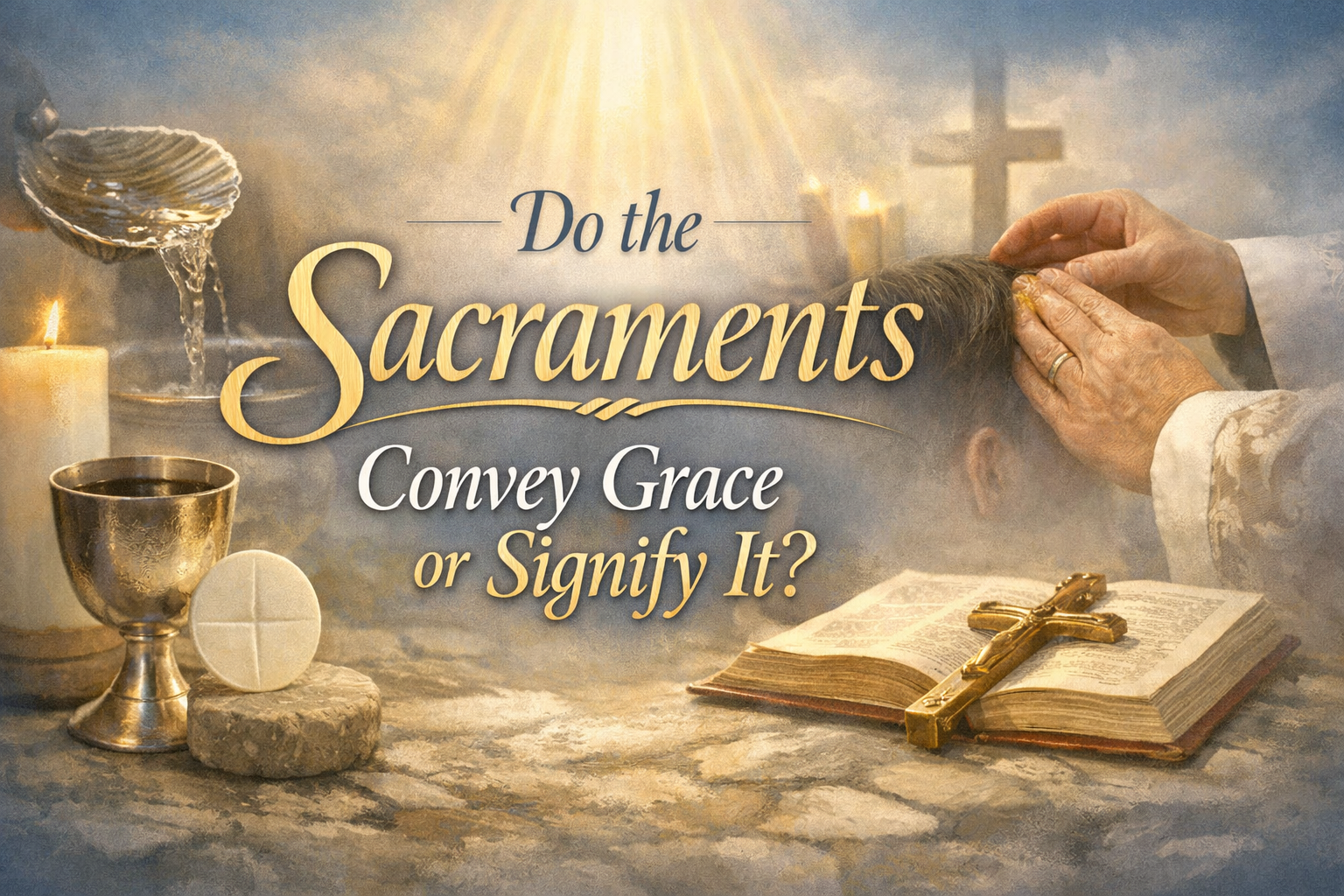
Do the sacraments convey grace, or do they merely signify it? That question has been argued for centuries — not just in seminary classrooms, but in churches, at the Table, and in the hearts of believers trying to understand what exactly Christ is doing when His people come to the water, the bread, and the cup. The answer matters more than people often realize, because getting it wrong in either direction leads to real spiritual damage.
On one side are Christians who speak of the sacraments chiefly as signs — visible sermons pointing us toward Christ and His promises. On the other side are Christians who speak of the sacraments as not only signs, but also as means of grace — ways God truly strengthens, nourishes, and confirms believers through what He has appointed. Both sides have something right. Both sides, pressed too hard, go somewhere wrong.
The best biblical answer is that the sacraments do indeed signify grace — and in a true, God-appointed way, they also serve as means by which He communicates grace to His people. But that has to be said carefully. Say it carelessly and you end up with superstition on one side or empty symbolism on the other. In plain talk: the sacraments are not magic, and they do not save by the bare outward act. But neither are they mere props. They are Christ-given signs through which He truly ministers to His people when received in faith.
Why This Question Matters
Two Ditches, One Narrow Road
This is not a word game. Get it wrong in either direction and the church suffers real spiritual damage.
If the sacraments automatically convey grace just by being performed, then the outward act itself does the saving work — whether faith is present or not. That breeds false assurance and formalism. People trust in rites instead of Christ.
If the sacraments only signify grace and nothing more, they become thin. Baptism is a nice ceremony. The Supper is a memory aid. The whole thing starts to feel decorative — and the ordinances Christ gave are treated with the casualness they do not deserve.
The Bible will not let us settle comfortably in either ditch. And a church that drifts into one or the other will eventually show it — either in people resting in rituals they have never believed through, or in a congregation that treats what Christ appointed as barely worth taking seriously.
God Has Always Used Visible Signs
Before getting to the sacraments specifically, it helps to step back and notice a consistent pattern across all of Scripture: God often uses visible, physical signs to confirm His promises to His people.
The rainbow after the flood. Circumcision in the covenant with Abraham. The Passover as a sign of redemption from Egypt. Sacrifices, washings, and ritual acts throughout the Old Testament — all pointing to deeper spiritual realities. God did not need visible signs because His Word was weak. He gave visible signs because we are weak. We are embodied people. We learn not only by hearing, but also by seeing and touching.
That is the foundation for understanding the sacraments. They are not unnecessary extras bolted onto the gospel. They are part of God’s fatherly kindness to slow-learning creatures. He does not merely speak the promise — He sets it before our eyes in visible form. In plain country terms: the Lord knows we are slow learners, so He not only speaks the promise, He lets us see it acted out.
The Sacraments Clearly Signify Grace
There is little dispute on this much: the sacraments are signs, and they signify grace richly.
Baptism signifies cleansing from sin, union with Christ in His death and resurrection, and entrance into the visible covenant people of God. Romans 6:3–4 speaks of being baptized into Christ’s death and raised with Him. Galatians 3:27 speaks of being baptized into Christ. Acts 2:38 connects baptism with repentance and the forgiveness of sins. The sign is rich with meaning — the water is not the blood of Christ, but it points to cleansing by Christ.
The Lord’s Supper signifies Christ’s body and blood given for sinners. Every time the church comes to the Table, the gospel is being shown again in visible form: Christ died. His body was given. His blood was shed. Our life is in Him. Jesus said, “This do in remembrance of me” (Luke 22:19), and that remembrance is a genuine, formative act of faith — not passive nostalgia.
So yes, the sacraments signify grace. That is clear and undeniable. The real question is whether that is all they do.
Why “Only Signify” Is Too Thin
If the sacraments were nothing more than visual reminders — visual sermons with no spiritual transaction taking place — some of the Bible’s language about them would seem unusually strong.
1 Corinthians 10:16 — “The cup of blessing which we bless, is it not the communion of the blood of Christ? The bread which we break, is it not the communion of the body of Christ?”
That is stronger language than “this helps us remember.” The Greek word is koinōnia — participation, sharing, genuine fellowship. Then in 1 Corinthians 11:27–29, Paul warns that eating and drinking unworthily makes a person “guilty of the body and blood of the Lord” and invites judgment. Why such solemnity if the Supper is only a symbolic exercise with no real spiritual weight?
With baptism, 1 Peter 3:21 calls it “the answer of a good conscience toward God” — a pledge, not merely an illustration. Romans 4:11 calls circumcision a “sign and seal” of the righteousness of faith — and the same language applies to baptism as circumcision’s New Covenant counterpart (Colossians 2:11–12). Signs and seals are more than visual aids. A seal confirms and ratifies; it is not mere decoration.
So the biblical witness pushes us beyond bare signifying. The sacraments are signs — but they are signs that belong to God’s active dealings with His people, not illustrations that stand at a distance from His work.
The Better Category: Means of Grace
The phrase means of grace has served the church well here. It refers to the ordinary ways God has appointed to strengthen, nourish, confirm, and bless His people — the Word preached, prayer, baptism, and the Lord’s Supper.
But the phrase needs to be handled carefully, because it is easy to misread.
To say the sacraments are means of grace does not mean the water saves by itself, or the bread and cup save by themselves, or the act works automatically, or that everyone who receives the sacrament receives saving benefit regardless of faith. That would be exactly the superstition ditch.
To say the sacraments are means of grace does mean that God truly uses these Christ-appointed signs to confirm His promises, strengthen faith, nourish believers, and communicate spiritual blessing to His people when received in faith.
In plain talk: the sacraments are not magic pipes that pump grace into anybody who gets wet or takes a bite. But they are real instruments in the hand of God. Christ uses them. The Spirit works through them. Believing people are genuinely helped by them. That is a far richer and more biblical picture than the “mere symbol” account.
How They Convey Grace — and How They Do Not
They do not convey grace mechanically. The old Latin phrase ex opere operato — the idea that the sacrament works by the mere performance of the act — has been rightly rejected by Protestants when understood in a mechanical sense. A man can be baptized and still be lost. A man can take the Lord’s Supper and eat and drink judgment upon himself (1 Corinthians 11:29). Acts 8 gives us a sober warning in Simon Magus — he was baptized, yet Peter’s rebuke showed his heart was not right before God. The bare outward act, apart from faith and the Spirit’s work, guarantees nothing.
They do convey grace instrumentally. When the sacraments are joined to the Word of God and received in faith, God truly uses them. Baptism confirms the promises of the gospel. The Supper nourishes believers spiritually as they partake with faith and self-examination. The grace communicated may include strengthened assurance, deeper repentance, greater gratitude, richer communion with Christ, and stronger unity with His people. The sacraments do not convey grace automatically — but they do convey grace instrumentally, as appointed means in the hand of God.
The Role of Faith
Faith is one of the biggest keys in this whole discussion, and it cannot be overstated.
The same ordinance that strengthens a believing soul may bring judgment on a hypocrite who comes carelessly. The same sun that softens wax hardens clay. Faith does not create the sacrament’s meaning — Christ gave the sacrament its meaning. But faith is the hand that receives what Christ offers through it. Without faith, the sacrament is not saving medicine. With faith, it becomes a precious means of spiritual strengthening.
This is why preaching and sacrament belong together. The Word explains the promise; the sacrament confirms it. The Word awakens faith; the sacrament nourishes it. Pull them apart and both suffer. A sacrament without the Word becomes a mute ceremony. The Word without the sacrament loses its visible, embodied confirmation.
What the Reformers Were Trying to Protect
This debate came to a head at the Reformation, and both sides were protecting something real.
Rome’s concern was to preserve the objectivity of God’s action in the sacraments. The sacrament was not merely man doing something for God — it was God doing something for man. That instinct is worth preserving. The sacraments are divine gifts, not human performances.
The Reformers’ concern was to protect the gospel — to ensure that justification rested on faith alone in Christ alone, not on ritual performance. They fought against any view that made salvation depend on mechanical sacramental administration. But the better Reformers did not reduce the sacraments to bare symbolism. Luther, Calvin, and the Reformed confessions all treated baptism and the Supper as real means of grace — just not automatic ones.
The best Protestant instinct is not: “These are just symbols, and nothing really happens.” The best Protestant instinct is: “These are signs appointed by Christ, and through them He truly blesses His people when received by faith.”
That is a far richer and more biblical position — and it is the one the strongest Protestant theologians actually held.
A Plain Illustration
Think of the sacraments like a signed deed held out by a trustworthy father. The paper is not the land. The ink is not the inheritance. But the document is not empty either — it is a real, appointed instrument confirming a real promise. The man who receives it by faith has something more than a memory and more than a symbol. He has a binding pledge from someone whose word can be trusted.
Or put it even plainer: the sacraments are not just fence posts pointing toward grace in the distance. In God’s hand, they are also feeding troughs for the flock. They are not empty jars sitting on a shelf, and they are not miracle tools that work regardless of the condition of the heart. They are Christ’s appointed signs and channels of blessing — and when received with faith, they become rich comforts to the soul.
The Balanced Conclusion
The sacraments are signs. Jesus said “Do this in remembrance of me,” and the signifying function of the sacraments is clear and irreducible.
They are not empty signs. The biblical language of communion, participation, sealing, and solemn warning points to something with more weight than a visual illustration.
They are not magical acts. Grace does not flow through them mechanically regardless of faith, heart condition, or the Spirit’s work.
They are real instruments in the hand of Christ. When joined to the Word and received by faith, God truly uses them to confirm His promises, strengthen His people, and nourish them in grace.
The blessing is received by faith, and grounded in Christ alone. The sacraments do not replace Christ — they direct us to Him, and through them He ministers to those who come in faith.
A church that gets this right will approach baptism with reverence and genuine expectation. It will come to the Lord’s Table with self-examination, gratitude, and faith — not casual routine, not superstitious magic, but faithful reception of what Christ appointed for the nourishment of His people. The ordinances become what they were always meant to be: visible words of promise, holy means of grace, and signs with substance.
Key Takeaways
- The sacraments both signify grace and serve as means of grace. They are signs — but not empty signs. When joined to the Word and received by faith, God truly uses them to confirm His promises and strengthen His people.
- Two ditches must be avoided: superstition and reductionism. Treating the sacraments as automatic grace-dispensers breeds false assurance. Treating them as mere visual reminders hollows them out. The Bible will not let us rest comfortably in either extreme.
- God has always used visible signs to confirm His promises. The sacraments fit a pattern that runs through the whole Bible — from the rainbow to circumcision to Passover. They are part of God’s fatherly kindness to embodied, slow-learning people.
- The sacraments do not convey grace mechanically, but they do convey it instrumentally. A man can be baptized and still be lost. A man can take the Supper and eat judgment. The grace is not in the act itself, but in Christ working through the appointed means to those who receive it by faith.
- Faith is the hand that receives what Christ offers through the sacraments. The Word and sacrament belong together — the Word explains and awakens faith; the sacrament confirms and nourishes it. Pull them apart and both suffer.
Key Scriptures: Romans 4:9–12 · Romans 6:3–4 · Acts 8:9–24 · 1 Corinthians 10:1–22 · 1 Corinthians 11:23–32 · Galatians 3:27 · Colossians 2:11–12 · 1 Peter 3:21 · Ephesians 2:8–9