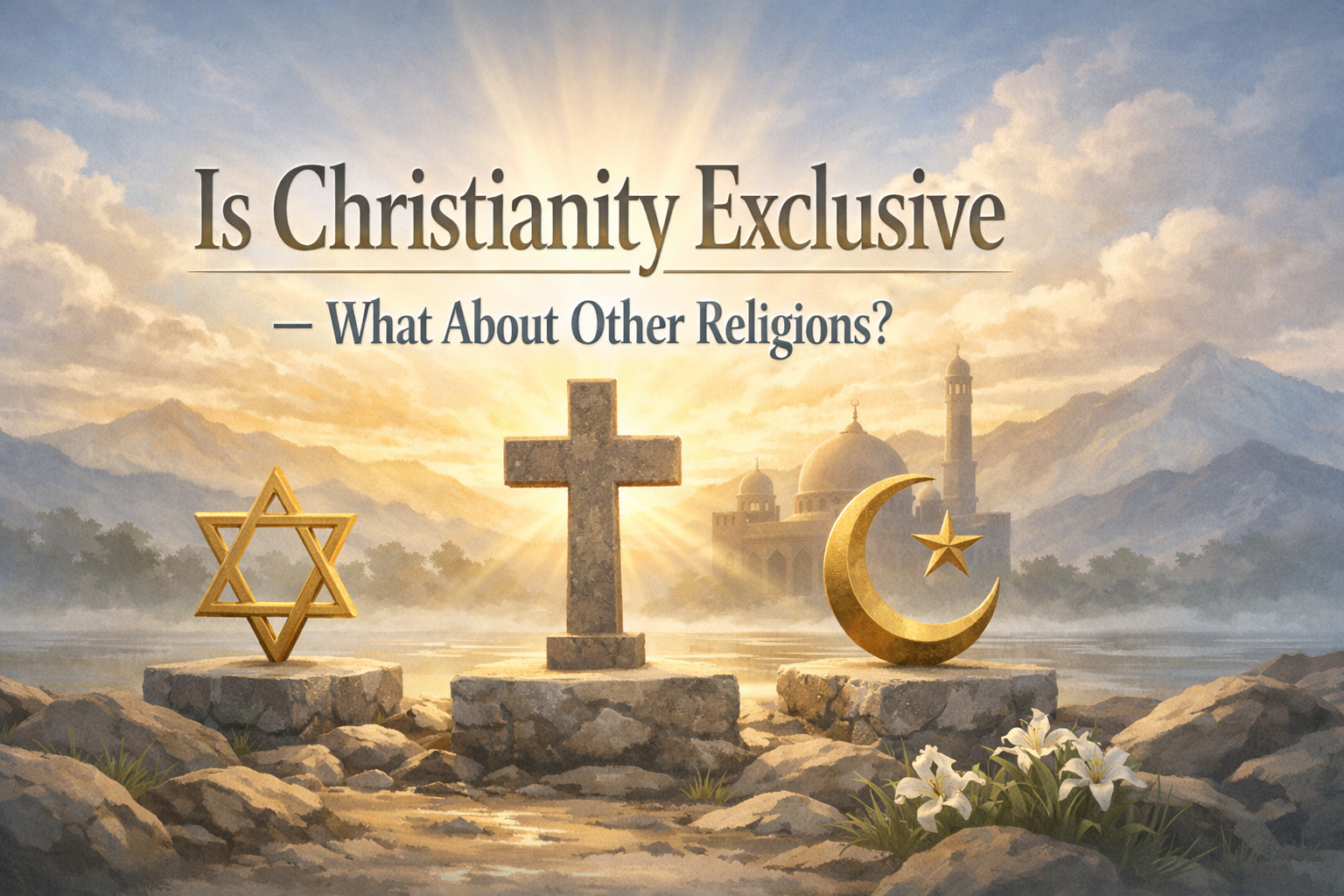
Is Christianity exclusive — what about other religions?
Christianity makes a claim that cuts against the grain of everything the modern world values about tolerance and inclusion: that Jesus is the only way to God. That claim is either the most important truth a man can encounter or an act of breathtaking arrogance. Here’s how to think about it honestly.
Jesus said, “I am the way, the truth, and the life. No one comes to the Father except through me.” That’s either the most important sentence ever spoken or an act of breathtaking arrogance. The modern world finds it embarrassing. The question worth asking is whether the embarrassment is a reason to dismiss it — or whether the claim, if true, changes everything.
A man I know spent three years in Southeast Asia before his first deployment. He’d seen Buddhism up close — the temples, the monks, the discipline, the obvious sincerity of the people practicing it. He’d sat with a Buddhist monk for two hours once in a village outside Chiang Mai and come away genuinely moved. When he came back to faith later in life, one question followed him everywhere he went: what happens to that monk?
It’s a serious question. It’s the question that makes a lot of men hesitate at the door of Christianity — not because they want to keep sinning, not because they can’t accept the resurrection, but because the exclusivity of the Christian claim feels like it requires writing off most of the human race, including people they’ve met who seemed more spiritually alive than half the Christians they know.
This post is going to take that question seriously. We’re going to look at what the Christian exclusive claim actually is, why every major religion makes some version of it, what the three main positions are within Christianity itself, and what the honest answer looks like for a man trying to decide whether the claim is arrogance or truth.
First: Every Religion Is Exclusive
The most important thing to establish up front: the charge that Christianity is uniquely arrogant for claiming to be true is itself based on a misunderstanding of how religious truth claims work.
Every major religion makes exclusive claims. Not in the same way, not with the same content — but every tradition holds that some things are true about ultimate reality and some things are false, and that the difference matters. The idea that all religions are basically the same and all paths lead to the same destination is itself a specific religious claim — the claim of a relativistic universalism that none of the major traditions actually hold.
Islam explicitly denies the Trinity, the divine sonship of Jesus, and the Christian account of the crucifixion (the Quran says Jesus was not crucified). It holds that the biblical texts have been corrupted and that the Quran is the final and complete revelation. These are exclusive claims that directly contradict Christian ones.
Classical Buddhism is either atheistic or non-theistic — the question of a personal Creator God is considered irrelevant or unanswerable, and some Buddhist schools explicitly deny it. The Buddhist account of the self, of suffering, and of liberation directly contradicts the Christian account of a personal God, a created soul, and redemption through Christ.
In its Advaita (non-dual) form — the most philosophically developed strain — Hinduism holds that the personal God of Christianity is a lower-level reality, a manifestation of the impersonal absolute rather than the ultimate itself. This is not compatible with Christian theism and is itself an exclusive metaphysical claim.
Judaism explicitly rejects the central Christian claim — that Jesus is the Messiah and the Son of God. This is not a minor disagreement. It is the decisive point of divergence, and Jewish tradition has been clear about it for two thousand years.
The point is not to score points against other religions. The point is that the objection “Christianity is arrogant for claiming to be true” applies with equal force to every tradition that makes truth claims — which is all of them. The question is not whether a religion makes exclusive claims. The question is whether its exclusive claims are actually true.
What the Christian Claim Actually Is
Before evaluating the Christian exclusive claim, it helps to state it precisely — because it is often either overstated or understated.
The claim, in its New Testament form, has three parts:
- Jesus is the unique incarnation of God. Not one teacher among many, not one manifestation of the divine among many, but the one in whom “the whole fullness of deity dwells bodily” (Colossians 2:9). This is a claim about who Jesus is — unique, unrepeatable, definitive.
- Salvation is through Jesus Christ specifically. Acts 4:12: “Salvation is found in no one else, for there is no other name under heaven given to mankind by which we must be saved.” John 14:6: “I am the way, the truth, and the life. No one comes to the Father except through me.” These are Jesus’s own words — not a later church invention.
- This salvation is offered to all people without ethnic, national, or cultural restriction. The Great Commission (Matthew 28:18–20) sends the message to all nations. Revelation 7:9 envisions the redeemed as a multitude “from every nation, tribe, people and language.” The claim is exclusive in its content but universal in its reach.
The Christian claim is not that God has hidden himself from most of the world and only revealed himself to Western Europeans. It is that God has revealed himself definitively in a specific historical person — available in principle to anyone, anywhere, in any culture — and that this revelation is the only basis on which the broken relationship between God and humanity can be repaired.
The Three Main Christian Positions
Within Christianity, theologians have identified three main positions on the question of other religions and salvation. It’s worth knowing what they are, because the conversation often assumes there’s only one Christian view.
Salvation requires explicit conscious faith in Jesus Christ. Those who have not heard or have rejected the gospel are not saved. This is the traditional and most historically held position, grounded in the direct reading of Acts 4:12 and John 14:6.
Christ is the only Savior, but his saving work may be applied to those who never heard the gospel explicitly — those who respond in faith and humility to whatever light they have received. Associated with C.S. Lewis, John Stott, and many evangelical thinkers. Maintains the uniqueness of Christ while allowing for the mystery of God’s justice toward the unevangelized.
All religions are essentially different paths to the same ultimate reality. Jesus is one valid path among many equally valid paths. This position, associated with theologian John Hick, requires abandoning the New Testament’s explicit claims about Jesus — and is generally considered outside the bounds of orthodox Christianity.
Most of the serious theological action happens in the space between exclusivism and inclusivism. Both positions affirm that Christ is the only Savior. They differ on whether explicit conscious faith is necessary for salvation or whether God’s grace can operate through Christ beyond the explicit proclamation of the gospel.
Pluralism — the idea that all religions are equally valid paths — is not a defensible Christian position without abandoning what the New Testament actually says. It also faces a logical problem: if all paths lead to the same destination, they can’t all be right about where they’re going, because they describe incompatible destinations.
The Hardest Questions — Answered Honestly
“What about people who never heard the gospel — the person born in a remote village two thousand years ago who had no access to Christianity?”
This is the most serious challenge, and the Christian tradition has wrestled with it honestly rather than dismissing it. Several responses deserve consideration together. First, Romans 1:19–20 affirms that general revelation — creation itself — provides enough knowledge of God that every human being has genuine moral and spiritual accountability. Second, Romans 2:14–16 suggests that those without the written law are judged by the law written on their hearts — that God judges according to available light, not according to unavailable light. Third, the inclusivist position holds that Christ’s atonement covers those who respond in genuine faith and humility to whatever revelation they have, even if they never heard the name of Jesus. None of these is a complete resolution. The honest answer is that Scripture gives us enough to know that God is just and that no one will be condemned for failing to respond to a gospel they never heard — but it does not give us a detailed account of every case. What it does give us is enough confidence in God’s justice and mercy to trust him with the cases we can’t fully resolve.
“Isn’t it arrogant for Christians to say their religion is right and everyone else is wrong?”
Arrogance is about attitude and motivation, not about making truth claims. A doctor who tells a patient “you have cancer and need treatment” is not being arrogant — he’s being honest about a diagnosis that matters. The question is whether the claim is true and whether it’s being communicated with appropriate humility and respect. Christians who are arrogant about exclusivity are sinning against the spirit of the gospel they’re proclaiming. But the solution to arrogance is not to abandon true claims — it’s to hold them with the humility appropriate to people who are themselves only saved by grace. A man who has been rescued from drowning doesn’t brag about his swimming. He tells others where the life preserver is.
“What about the sincere Buddhist monk or devout Muslim — surely their sincerity counts for something?”
Sincerity is not the measure of truth. A man can be sincerely wrong about a medical diagnosis, a map coordinate, or the structural integrity of a bridge — and sincerity will not change the outcome. That said, the question of sincerity and spiritual posture is theologically relevant in a different way: the inclusivist tradition holds that God can work in ways we don’t fully understand with people who genuinely seek him, even outside explicit Christian proclamation. What can be said with confidence is that the moral seriousness, spiritual depth, and genuine seeking found in other traditions are not nothing — they reflect the image of God in human beings, the light of general revelation, and God’s common grace to all people. What they cannot do is constitute the basis for salvation, because salvation requires dealing with the problem of sin — and that dealing happened at the cross, not in the accumulation of spiritual sincerity.
“If Christianity is true, what was God doing for the 200,000 years of human history before Jesus?”
The Bible’s answer to this is the concept of progressive revelation — God revealing himself progressively throughout human history, culminating in Jesus. Before the Mosaic law there was the covenant with Noah and Abraham. Before Abraham there was the general revelation available to all humanity through creation and conscience (Romans 1–2). The Christian claim is not that God was absent before the Incarnation but that the Incarnation is the definitive and final revelation toward which all prior revelation was pointing. The question also contains an assumption worth examining: that the timing of the Incarnation was arbitrary or unfair. Paul’s answer in Galatians 4:4 is that Jesus came “in the fullness of time” — a specific historical moment chosen by God, in a context where the Roman road system, the Greek language, and the Jewish prophetic tradition had uniquely prepared the world to receive and transmit the message.
“Don’t all religions teach basically the same thing — love, kindness, treat others as you want to be treated?”
They share some moral overlap — and Christian theology has an explanation for that: general revelation and common grace mean that moral truth echoes through all cultures, because all human beings are made in God’s image and all have the moral law written on their hearts (Romans 2:15). But the religions are not saying the same thing. They disagree at exactly the most important points: Who is God? What is wrong with the human condition? How is it fixed? What happens when you die? On every one of these questions, the major traditions give incompatible answers. To say they teach the same thing is to not have read them. A Buddhist does not believe in a personal Creator God. A Muslim does not believe Jesus died on the cross. A Hindu does not believe in the resurrection of the body. A Christian does not believe that enlightenment or righteous deeds achieve liberation from karma. These are not minor differences in emphasis — they are fundamental disagreements about the nature of reality.
The Distinction That Changes the Conversation
The exclusivity of the gospel is not a claim about the limits of God’s grace. It is a claim about the source of it.
Christianity does not say that God’s saving grace is limited to people who have sat in a church pew and said a specific prayer. It says that whatever saving grace exists, wherever it reaches, flows from the person and work of Jesus Christ — from his life, death, and resurrection — as the one act in history that dealt with the human problem of sin.
The width of salvation’s reach is a question the New Testament leaves with genuine mystery and appropriate humility. The source of salvation — the exclusive sufficiency of Christ’s atoning work — is not mysterious at all. It is stated plainly, repeatedly, and without hedging.
A man can hold both: that Christ alone saves, and that the scope of those Christ saves is known fully only to God. That is not a dodge. It is the honest position of a man who takes the New Testament seriously and does not presume to sit in the seat of divine judgment about every case he cannot resolve.
What Genuine Respect for Other Traditions Looks Like
The Christian exclusive claim, rightly understood, does not require contempt for other religions or the people who practice them. It requires taking them seriously enough to engage their actual claims honestly.
Genuine respect means treating a Buddhist or Muslim or Hindu as a person capable of reasoning, capable of examining evidence, capable of changing their mind — not as someone too fragile to hear a different view. Condescension masquerades as tolerance when it says: “I believe something different from you, but your tradition is equally valid and I won’t challenge it.” That’s not respect. That’s dismissal dressed up in kind language.
Genuine respect also means intellectual honesty. If a Christian believes that Jesus rose from the dead — that this is a historical fact with evidence behind it — then the stakes of that belief extend to everyone, not just to people who were already inclined toward Christianity. The Christian is not doing a Buddhist any favors by keeping the resurrection to himself out of politeness.
Paul’s approach at the Areopagus in Acts 17 is the model: he engages Greek philosophy and poetry on their own terms, acknowledges the truth and genuine seeking present in Greek religious culture (“I see that you are very religious”), and then presents Jesus and the resurrection as the answer to what they were already reaching for. Not contempt. Not capitulation. Engagement with the genuine conviction that truth, wherever it leads, is worth pursuing.
“The person who is open to all religions equally has probably never taken any of them seriously enough to actually believe any of them.”
— Adapted from the tradition of G.K. Chesterton
Why the Exclusive Claim Is Actually Good News
Here’s a reframe that most people miss: the exclusivity of Christianity is not a feature of its narrowness. It’s a feature of its specificity — and specificity is what makes it good news rather than just good intentions.
A gospel that says “try your best, be sincere, and hope God grades on a curve” is not good news. It’s anxiety with a theological veneer. It leaves every person wondering whether they’ve been sincere enough, tried hard enough, accumulated enough spiritual credit. Most religious traditions, at their core, are systems of effort — moral, ritual, or meditational. They tell you what to do to close the gap between yourself and the divine.
The Christian gospel says the gap has already been closed — from God’s side, at God’s cost, through a specific act in history. The exclusivity is not that only certain people can receive it. The exclusivity is that only one thing closed the gap. And that thing is done.
That means the Buddhist monk in Chiang Mai is not disqualified by his culture, his geography, or his tradition. He is in the same position as every other human being — in need of what God has already provided, and capable of receiving it if he turns toward the God who made him. Whether and how that happens in his specific case is between him and God, and the Christian tradition is appropriately humble about the details of that answer.
What the Christian is not humble about is this: the cross happened. The tomb is empty. The question is not whether salvation is available — it is. The question is what a man does with the one who provides it.
Key Takeaways
- Every religion is exclusive. Islam, Buddhism, Hinduism, and Judaism all make truth claims that exclude competing claims. The objection “Christianity is arrogant for claiming to be true” applies equally to every tradition that takes its own beliefs seriously — which is all of them.
- The Christian claim has three parts. Jesus is the unique incarnation of God. Salvation is found in no one else. This salvation is universally offered — to all people, in all cultures, without ethnic or geographic restriction.
- Three positions exist within Christianity. Exclusivism (explicit faith required), inclusivism (Christ saves beyond explicit proclamation through his atoning work), and pluralism (all paths valid). The first two are within orthodoxy and represent genuine theological debate. Pluralism requires abandoning the New Testament’s explicit claims.
- The hardest question — those who never heard — has serious responses. Romans 1–2 establishes universal accountability through general revelation. The inclusivist tradition allows for the mystery of God’s justice toward the unevangelized without abandoning Christ’s uniqueness. Scripture gives enough to trust God’s justice without providing a case-by-case account.
- The key distinction: Christ is the exclusive source, not the exclusive limit. Christianity claims that whatever saving grace exists flows from Christ’s atoning work. The scope of whom that grace reaches is held with appropriate humility. The source is held with full conviction.
- Genuine respect for other traditions means taking them seriously, not patronizing them. Treating other religions as equally valid without examining their truth claims is not respect — it’s condescension. Genuine engagement follows Paul’s Areopagus model: acknowledge what is true and genuinely seeking, then present Christ as the answer to what is being reached for.
- The exclusivity is what makes it good news. A gospel that requires enough sincerity or effort is anxiety, not grace. The exclusive claim is that the gap between humanity and God has been closed — from God’s side, at God’s cost — once, for all. That’s not narrow. That’s sufficient.
Still Wrestling With It?
The question of other religions is one of the most honest questions a man can bring to Christianity — and it deserves an honest answer, not a pat on the head. If you’ve got a specific person in mind — a friend from a different tradition, a family member, someone you served with — and you’re trying to figure out what Christianity says about them, that’s worth a real conversation.
Mountain Veteran Ministries is here for exactly that. We’re not interested in easy answers or cultural Christianity. We’re interested in the truth — wherever it leads and whatever it costs. Reach out if you want to keep going with this.
Key Scriptures: John 14:6 · Acts 4:12 · Acts 17:22–31 · Romans 1:19–20 · Romans 2:14–16 · Colossians 2:9 · Matthew 28:18–20 · Revelation 7:9 · Galatians 4:4 · Galatians 3:28 · Matthew 8:10