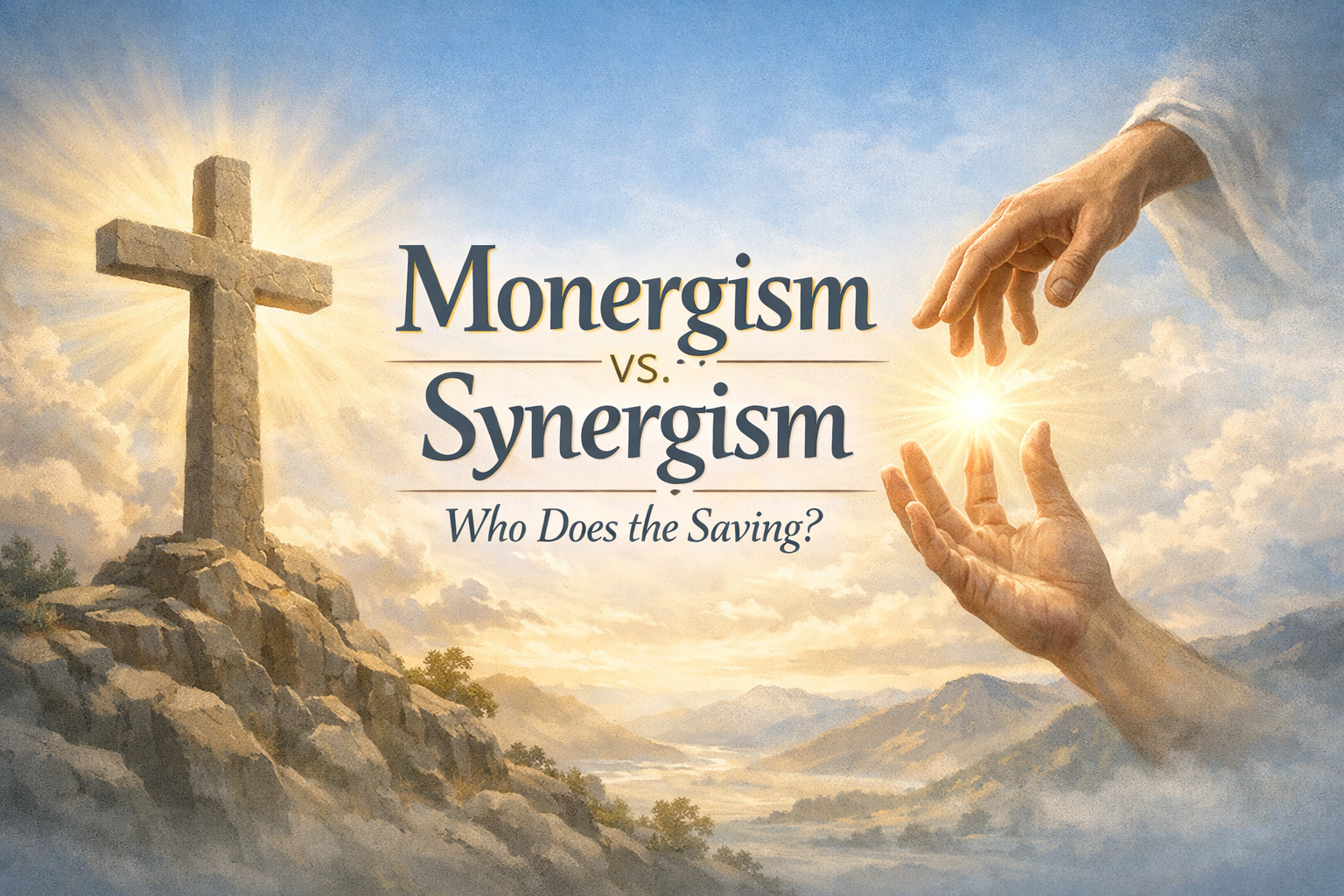
Monergism vs. synergism — who does the saving?
When you became a Christian, who made that happen? Most people, if they’re honest, will say something like: “Well, God did his part and I did mine.” That sounds humble. It might not be. The question of who does the saving is not a secondary debate for theologians with too much time on their hands. It goes straight to the heart of what grace actually means, what the human will actually can do, and whether salvation is ultimately secure. Get this wrong in one direction and you end up with a God who tries but can’t quite close the deal. Get it wrong in the other direction and you lose the reality of genuine human response. The stakes are higher than the vocabulary suggests.
Monergism. Synergism. They’re Greek-derived technical terms, and they sound like something you’d find in a seminary textbook buried under three layers of footnotes. But the question they represent is one every honest Christian eventually has to face: when a person comes to faith in Christ, what exactly is happening? Is God doing all of it? Is the person contributing something essential? Is it a partnership?
How you answer that question determines your entire doctrine of grace — and it has real consequences for how you pray, how you evangelize, how you counsel struggling believers, and whether you go to sleep at night trusting God or trusting yourself.
The Words, Defined
Monergism comes from two Greek words: monos (alone) and ergon (work). Monergism says that in the act of regeneration — the new birth — God alone works. He does not merely assist, enable, or provide the conditions. He acts unilaterally on a spiritually dead person and brings them to life. The human being contributes nothing to that initial act of divine grace. Faith and repentance follow from the new birth; they do not produce it.
Synergism comes from syn (together) and ergon (work). Synergism says that in conversion, God and the human being work together. God provides grace — prevenient grace, in the Arminian tradition — that restores the human will’s ability to respond. The person then must cooperate with that grace, choosing to believe and repent. Salvation requires both divine initiative and human response as a genuine contributing cause.
Put simply: monergism says God saves. Synergism says God saves and the sinner cooperates in being saved.
Both positions affirm that faith is necessary. Both affirm that grace is prior. The dispute is over whether human cooperation is a contributing cause of the new birth, or a consequence of it.
The Diagnosis Both Sides Are Answering
To understand why this debate matters, you have to start with the doctrine of sin — specifically, what the fall did to the human will. Both sides agree that sin is serious. They disagree on exactly how serious.
The monergist position, associated historically with Augustine, the Reformers, and Reformed theology, holds that the fall left human beings spiritually dead — not sick, not weakened, but dead. The language Paul uses in Ephesians 2:1 is not metaphorical decoration: “you were dead in your trespasses and sins.” A dead person does not assist in their own resurrection. They do not contribute to the process. They receive it.
Furthermore, Paul argues in Romans 8:7–8 that the natural mind “is hostile to God, for it does not submit to God’s law; indeed, it cannot. Those who are in the flesh cannot please God.” The inability is not circumstantial. It is structural. The unregenerate person is not merely disinclined toward God — they are constitutionally incapable of genuine submission to him. This is what Reformed theology means by total depravity: not that fallen people are as bad as they could possibly be, but that every faculty — including the will — is corrupted and inclined away from God.
The synergist position, associated with Arminius, Wesley, and much of evangelical Protestantism, takes the fall seriously but draws back from the conclusion that the will is completely unable. They typically introduce the concept of prevenient grace — a grace given universally or sufficiently to all people that restores enough of the will’s freedom to make genuine response possible. On this view, total depravity is real, but prevenient grace lifts it sufficiently so that the person can choose or reject God. The final determining cause of salvation is the person’s free response to that grace.
The Monergist Case
The monergist argument rests on several convergent lines of biblical evidence.
Regeneration precedes faith. John 1:12–13 says that those who believed were “born not of blood nor of the will of the flesh nor of the will of man, but of God.” The new birth is explicitly not of human will. In John 3:3, Jesus tells Nicodemus that no one can even see the kingdom of God unless they are born again — vision of the kingdom requires the new birth, not the other way around. Ezekiel 36:26–27 gives the prophetic picture: God removes the heart of stone and gives a heart of flesh, then places his Spirit within, causing his people to walk in his statutes. The new heart comes first. The walking follows.
Election is unconditional. Romans 9:10–16 addresses this directly in the case of Jacob and Esau. Before either had done good or evil, God chose Jacob — “so that God’s purpose of election might continue, not because of works but because of him who calls.” Paul drives the point home: “So then it depends not on human will or exertion, but on God, who has mercy.” Paul anticipates the objection — isn’t this unfair? — and does not resolve it by limiting God’s sovereignty. He expands it, citing Pharaoh as the counterexample. Election is not based on foreseen faith. It is the ground of faith.
The new birth is an act of sovereign creation. 2 Corinthians 4:6 draws the analogy explicitly: “For God, who said, ‘Let light shine out of darkness,’ has shone in our hearts to give the light of the knowledge of the glory of God in the face of Jesus Christ.” The original creation involved no cooperation from the darkness. The new creation involves no cooperation from the spiritually dead. God speaks. Light appears. The dead heart becomes alive. This is not collaboration — it is resurrection.
The drawing of the Father is effectual. In John 6:37, 44, Jesus says: “All that the Father gives me will come to me” and “No one can come to me unless the Father who sent me draws him.” The drawing is the precondition of coming. And the scope of verse 37 is total: all that the Father gives will come — not might come, not are given the opportunity to come. The giving and the coming are locked together by divine purpose.
The Synergist Case
The synergist position is not without its own serious biblical warrant, and it deserves honest engagement rather than caricature.
Universal gospel calls imply genuine ability to respond. Scripture repeatedly calls all people to repent and believe (Acts 17:30, Mark 1:15). If people are genuinely commanded to respond, the argument goes, they must have a genuine ability to do so. A command issued to those who are constitutionally incapable of obeying would be a kind of divine deception. Prevenient grace is the synergist’s mechanism for preserving the integrity of these universal calls.
God’s expressed desire that all be saved. 1 Timothy 2:4 says God “desires all people to be saved and to come to the knowledge of the truth.” 2 Peter 3:9 says God is “not wishing that any should perish, but that all should reach repentance.” If God monergistically saves, and some perish, then either God’s desire is frustrated or “all” doesn’t mean all. Synergists argue that God’s universal saving will is genuine, and human freedom is what accounts for why not all are saved.
Genuine human responsibility throughout Scripture. The Bible consistently addresses people as responsible moral agents: “Choose this day whom you will serve” (Joshua 24:15). “Repent and turn from all your transgressions” (Ezekiel 18:30). If human response is merely the effect of a prior divine act rather than a genuine contributing cause, synergists worry that the reality of human agency — and thus the reality of human guilt — is undermined.
The resistance of grace. Acts 7:51 has Stephen accuse his hearers of “always resisting the Holy Spirit.” Matthew 23:37 has Jesus lamenting: “How often would I have gathered your children together as a hen gathers her brood under her wings, and you were not willing!” Synergists see in these texts evidence that God’s saving intentions can be genuinely resisted — implying that the will retains a real determining role.
Where the Debate Turns
The core issue comes down to one question: what kind of inability did the fall produce?
Monergists distinguish between natural ability and moral ability. Every human being has the natural faculties — intellect, will, affections — to respond to God. What they lack is the moral inclination to use those faculties in submission to God. They can think, choose, and desire — but those capacities are comprehensively oriented away from God. Prevenient grace, on this view, is not a coherent solution because the problem is not one of capacity but of nature. You don’t fix a heart that hates God by giving it a little more ability. You replace it.
Synergists reply that a genuine command requires genuine ability, and that the monergist God ends up with a theater of responsibility — holding people accountable for what they truly cannot do. They also argue that monergism makes evangelism perfunctory: if God has already determined who will be saved, why the urgency of proclamation?
The monergist response on evangelism is worth quoting. Spurgeon, asked how he reconciled election with evangelism, reportedly said he had no trouble at all: “The elect are those who will believe, and the non-elect are those who won’t. Since I don’t know which is which, I preach to everyone.” The decree and the means are not in competition. God has ordained the preaching of the gospel as the means by which his elect are gathered. The urgency of proclamation is not undermined by divine sovereignty — it is grounded in it.
What This Means Practically
This is not abstract. The question of who does the saving shapes real life in concrete ways.
Assurance of salvation. If your conversion ultimately rested on your decision — your contribution to the cooperative act of being saved — then your assurance rests on the reliability of that decision. Decisions waver. Feelings change. Circumstances erode confidence. The monergist has a different anchor: God chose, God called, God regenerated, God will keep. The security of salvation is as firm as the character of God. John 10:28–29: “I give them eternal life, and they will never perish, and no one will snatch them out of my hand. My Father, who has given them to me, is greater than all, and no one is able to snatch them out of the Father’s hand.”
The nature of prayer for the lost. If conversion ultimately turns on human decision, prayer for the lost is asking God to make the conditions favorable. If conversion turns on divine regeneration, prayer for the lost is asking God to do what only he can do — open blind eyes, raise dead hearts, draw those he has given to the Son. The second kind of prayer has a different weight and a different expectation.
Gratitude and humility. If you contributed something essential to your own salvation — if your faith was the decisive factor that God’s grace depended on — then you have something to credit yourself for. Not much, perhaps, but something. The monergist position strips that away entirely. The only honest response to “why are you a Christian and your neighbor isn’t?” is: grace. Not better judgment. Not more openness. Not a wiser decision. Grace alone, all the way down.
“For who sees anything different in you? What do you have that you did not receive? If then you received it, why do you boast as if you did not receive it?” — 1 Corinthians 4:7
A Word on Holding This Humbly
Christians who hold monergism and Christians who hold synergism worship the same Lord, trust the same gospel, and are going to the same place. This is an intra-evangelical debate with serious stakes, but it is not a first-order salvation issue. Arminian brothers and sisters are not denying the gospel — they are affirming it through a different account of how divine sovereignty and human freedom relate.
That said, the differences are real and worth taking seriously. Sloppy thinking here produces sloppy worship, sloppy assurance, and sloppy evangelism. Precision in doctrine is not the enemy of pastoral warmth — it is what makes pastoral warmth durable when the hard questions hit.
Know what you believe. Know why. Hold it with conviction and with charity. And whatever conclusion you reach, let it drive you to the same place: worship of a God whose grace is inexhaustibly generous and whose purposes cannot be undone.
“Oh, the depth of the riches and wisdom and knowledge of God! How unsearchable are his judgments and how inscrutable his ways! For who has known the mind of the Lord, or who has been his counselor? Or who has given a gift to him that he might be repaid? For from him and through him and to him are all things. To him be glory forever. Amen.” — Romans 11:33–36
Key Takeaways
- Monergism says God alone does the work of regeneration. The new birth is an act of sovereign divine grace on a spiritually dead person, not a cooperative act. Faith and repentance are the result of the new birth, not contributing causes of it.
- Synergism says God and the sinner cooperate in salvation. Prevenient grace restores sufficient freedom to the will so that the person’s genuine response is a determining cause of their conversion. God initiates; the person must cooperate.
- The debate hinges on the nature of the fall’s effect on the will. Monergists hold that the will is morally unable to choose God without prior regeneration. Synergists hold that prevenient grace restores enough freedom to make genuine response possible.
- Both positions have serious biblical warrant and represent genuine Christian traditions. This is an important intra-evangelical debate, not a first-order salvation issue — but the implications for assurance, prayer, and the nature of grace are real and significant.
- Monergism grounds assurance in God’s character rather than human decision. If God sovereignly regenerates and keeps those he has chosen, the security of salvation depends on his faithfulness — not on the consistency of a human decision made under the pressure of strong emotion at a revival meeting.
Key Scriptures: Ephesians 2:1–5 · John 6:37, 44 · Romans 9:15–16 · John 1:12–13 · Ezekiel 36:26–27 · 1 Corinthians 4:7 · Romans 11:33–36