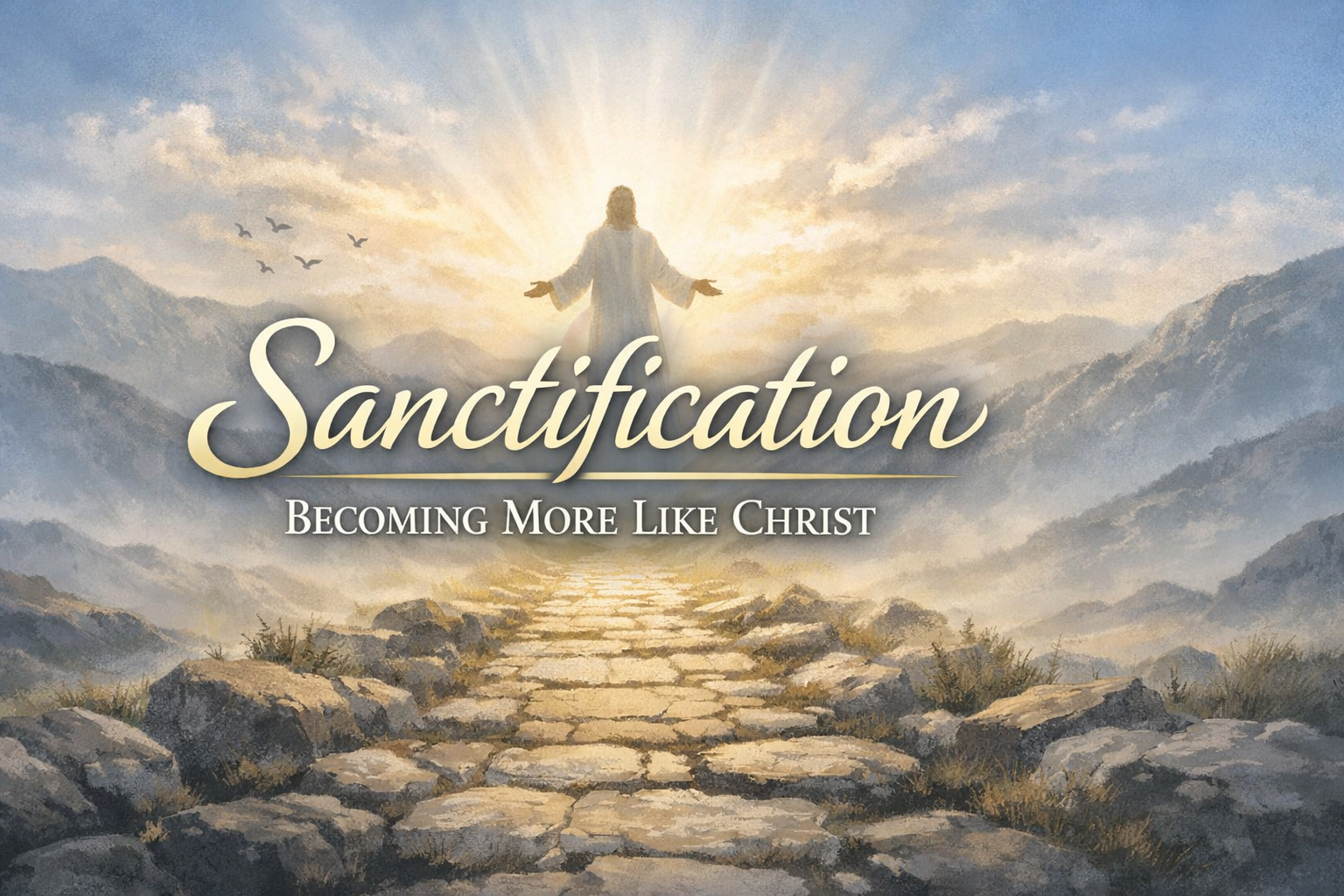
Sanctification: Becoming More Like Christ
A Christian Perspective on Holiness, Growth, and the Grace That Never Gives Up
If you’ve been around church folks for any length of time, you’ve probably heard the word sanctification. It sounds a bit lofty — maybe even intimidating. But it’s one of the most encouraging and hopeful truths in the whole Bible.
In plain terms: sanctification means becoming more like Jesus. It’s not just about cleaning up your act. It’s the ongoing work of the Holy Spirit transforming your desires, your habits, and your character to reflect the Son of God who saved you.
“For this is the will of God, your sanctification…” — 1 Thessalonians 4:3
The word comes from the Greek hagiazō — “to make holy” or “to set apart.” God is setting you apart from sin and for Himself. That’s a holy calling and a holy transformation — and it’s God’s will for every believer, not just the spiritually advanced.
Three Stages of Sanctification
Sanctification isn’t a single moment — it unfolds across the entire Christian life. Scripture presents it in three distinct movements:
Positional
What God Declares
At salvation, God declares the believer holy in Christ. This is your identity — not earned, but given by grace.
1 Corinthians 1:2 — “to those sanctified in Christ Jesus, called to be saints…”
Progressive
What God Does and We Do
The everyday journey of growth in holiness, battling sin, and becoming more like Christ — slow, real, and Spirit-powered.
2 Corinthians 3:18 — “being transformed…from glory to glory…”
Ultimate
What God Will Finish
At Christ’s return, believers will be perfectly sanctified — no more sin, no more struggle. Glorification is the final stage.
1 John 3:2 — “we shall be like Him, for we shall see Him as He is.”
The Holy Spirit — The Power Behind It All
Sanctification is not about trying harder in your own strength. It is about yielding to the Holy Spirit, who works within you to change your desires, your habits, and your heart from the inside out.
The fruit of the Spirit in Galatians 5:22–23 — love, joy, peace, patience, kindness, goodness, faithfulness, gentleness, self-control — aren’t things you will into existence by discipline alone. They grow in your life as the Spirit works through your obedience, your prayer, your immersion in the Word.
“Walk by the Spirit, and you will not gratify the desires of the flesh.” — Galatians 5:16
Your Role — Cooperation, Not Passivity
Sanctification is God’s work — but He doesn’t do it without you. Scripture calls believers to actively pursue holiness, not to wait passively for transformation to happen.
“Work out your own salvation with fear and trembling, for it is God who works in you, both to will and to work for his good pleasure.” — Philippians 2:12–13
God supplies the power. You walk in obedience. That cooperation looks like:
The Means of Grace
Practices That Open Your Life to the Spirit’s Work
- Confession and repentance — keep short accounts with God; don’t let sin compound
- Immersion in God’s Word — Scripture is the Spirit’s primary instrument for transformation
- Prayer and worship — abiding in the vine is the condition for bearing fruit
- Christian fellowship — you cannot be sanctified in isolation; the Body exists for this
- The spiritual disciplines — fasting, solitude, service, and generosity train the soul
Holiness doesn’t just happen. It is pursued with intention — and the intention is possible because the Spirit is already at work.
What Different Traditions Teach
Reformed / Calvinist
Sanctification as the Fruit of Sovereign Grace
In Reformed theology, sanctification is the necessary and inevitable result of God’s sovereign work in the believer. The Spirit works through the Word, the sacraments, and the community of the church. Good works are the fruit of salvation — not its cause, and not an optional addition to it.
Wesleyan / Arminian
Entire Sanctification and Christian Perfection
John Wesley emphasized what he called “entire sanctification” or “Christian perfection” — the possibility that a believer may come to a place of complete love for God and neighbor, with sin no longer reigning. This doesn’t mean sinless perfection, but a significant and real victory over the dominion of sin, available in this life through the work of the Spirit.
Catholic and Orthodox
Theosis — Participation in God’s Life
In Catholic and Orthodox traditions, sanctification is closely tied to participation in the sacraments, the life of the Church, and the ancient practice of theosis — progressively sharing in God’s divine nature (2 Peter 1:4). The journey of becoming holy is lifelong, involving both God’s grace and human cooperation, extending through purgation in Catholic theology even beyond death.
Why Sanctification Matters for Daily Life
🌱 It Changes Who You Are
You’re not just “a sinner saved by grace” — you’re a saint being shaped by grace. Your identity is rooted in Christ, not in your past. You are being renewed every day, even as the outer self fades.
2 Corinthians 4:16 — “Though our outer self is wasting away, our inner self is being renewed day by day.”
🧰 It Shapes How You Live
Holiness is not restriction — it’s freedom. As sanctification works, you break free from the bondage of sin, treat others with grace and patience, and become a living witness of the gospel. The holier you become, the more human you become — more what God designed you to be.
Romans 6:14 — “Sin will have no dominion over you, since you are not under law but under grace.”
💪 It Equips You for Battle
Sanctification is part of spiritual warfare. As you grow in holiness, you’re better equipped to resist temptation, rely on God’s Word and prayer, and fight not in fear but with confidence — because the victory belongs to Christ, not to your own resolve.
Ephesians 6:10–11 — “Be strong in the Lord and in the strength of his might. Put on the whole armor of God…”
The Process Is Messy — But It’s Worth It
Sanctification is not smooth sailing. It’s often two steps forward, one step back. Dry seasons come. Persistent temptations return. Failures leave you discouraged. This is normal, not exceptional. The question is never whether you fall — it’s whether you get back up.
“He who began a good work in you will carry it on to completion at the day of Jesus Christ.” — Philippians 1:6
Signs that sanctification is happening — even when it’s hard to see:
- You’re more aware of your sin — not less. Holiness sharpens your conscience, it doesn’t dull it.
- You desire to obey God, even when it’s costly.
- You grow in love for God and for the people He’s placed in your life.
- You recover faster from spiritual setbacks — not because you’re tougher, but because repentance flows more quickly.
- You find genuine joy in spiritual things — prayer, the Word, worship — that once felt like duty.
It’s not about perfection. It’s about progress. And the direction of travel matters more than the speed.
🌳 The Oak Tree
Think of a young oak tree. A seed is planted — that’s salvation. Over time, the tree grows tall and strong. The roots go deep before the trunk rises. The crown spreads slowly, season by season.
That’s sanctification. Slow, steady growth over decades — anchored by grace, watered by the Spirit, nourished by God’s Word. It may not look impressive overnight. But given time, you’ll see the fruit. And the oak doesn’t doubt the process — it simply keeps growing toward the light.
“They are like trees planted by streams of water, that yield their fruit in its season.” — Psalm 1:3
Voices from the Church
John Stott
“Sanctification is the process by which God is actually changing us — remaking us from the inside out.”
J.I. Packer
“Holiness means belonging to God, and being shaped by God’s moral character.”
Charles Spurgeon
“I believe the holier a man becomes, the more he mourns over the unholiness which remains in him.”
R.C. Sproul
“Sanctification is a lifelong process that God uses to conform us to the image of His Son.”
Sanctification is not about earning God’s love — it’s about living in response to it. It’s the beautiful, patient work of God remaking His people to reflect His Son. It calls for humility, obedience, and patience. But it brings joy, freedom, and purpose that nothing in the world can match.
You’re not walking this path alone. The same Spirit who raised Christ from the dead lives in you — and He is not finished with you yet.
Keep pressing on. Keep surrendering. Keep abiding. Because sanctification is not just about becoming better. It’s about becoming His.
“May the God of peace Himself sanctify you completely, and may your whole spirit and soul and body be kept blameless at the coming of our Lord Jesus Christ. He who calls you is faithful; He will surely do it.” — 1 Thessalonians 5:23–24
Key Scriptures: 1 Thessalonians 4:3; 5:23–24 · 1 Corinthians 1:2 · 2 Corinthians 3:18; 4:16 · Galatians 5:16–23 · Philippians 1:6; 2:12–13 · Romans 6:14 · 1 John 3:2 · Ephesians 6:10–11 · Psalm 1:3 · Hebrews 12:14
Want to Go Deeper?
Sanctification sits at the heart of the Christian life. If this post stirred something, here are a few next steps:
- Read J.I. Packer’s Rediscovering Holiness — the clearest modern treatment of what sanctification actually looks like in practice.
- Read John Owen’s The Mortification of Sin — the Puritan classic on the daily work of killing sin; more accessible than it sounds.
- Read the companion MVM posts on Reformed theology, Arminianism, and the doctrine of regeneration — sanctification connects directly to all three traditions covered there.
- Subscribe to get new posts delivered straight to your inbox — gospel-rooted, plain-spoken truth for the week ahead.
“For this is the will of God, your sanctification.” — 1 Thessalonians 4:3