
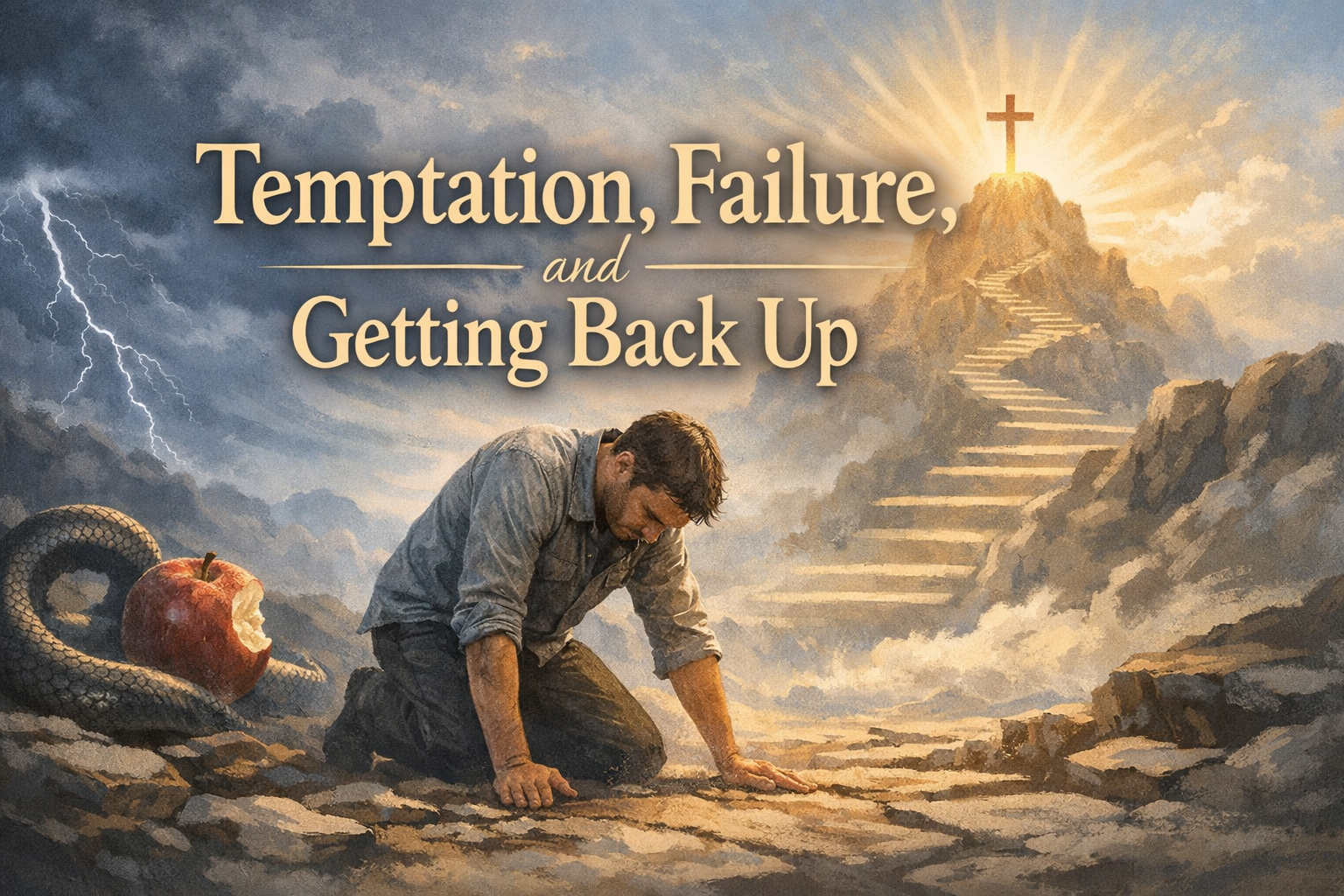
Temptation, Failure, and Getting Back Up
Every man fails. Scripture doesn’t flinch from that. What it does — consistently, relentlessly — is point back toward the One who doesn’t, and show us the path from the ground back to our feet.
Temptation is not proof you’re broken. Failure is not the end of the story. And getting back up is not something you earn — it’s something you receive.
Let’s start with what most men actually believe, even if they’d never say it out loud: that real spiritual maturity means eventually reaching a point where temptation loses its grip. Where the struggle fades. Where the patterns that have beaten you in the past finally stop showing up.
That belief is understandable. It’s also not what Scripture teaches.
Paul, who wrote more of the New Testament than anyone else and described himself as having “learned, in whatever situation I am, to be content” (Philippians 4:11), also wrote Romans 7 — where he describes an ongoing war with sin in language so raw and honest it reads like a confession: “I do not do what I want, but I do the very thing I hate” (Romans 7:15). This is not a man writing about his pre-conversion struggles. Scholars debate the exact interpretation, but the weight of the passage is a man describing the real, present tension of trying to live rightly and failing.
If that’s where Paul lands, the rest of us are in reasonable company.
The question isn’t whether you’ll face temptation or whether you’ll fail at some point. You will. The question is what you do with the temptation before it becomes failure, and what you do with the failure when it comes. That’s what this post is about.
What Temptation Actually Is
There’s a confusion that does serious damage in the lives of a lot of believers: the assumption that being tempted is itself a sin. That if you were really walking with God, the pull toward the wrong thing wouldn’t be there. That feeling the draw means you’ve already failed.
Scripture doesn’t support that. Hebrews 4:15 is clear: Jesus was “tempted in every way, just as we are — yet he did not sin.” The temptation was real. The pull was real. The desert experience in Matthew 4 wasn’t a formality — the enemy brought his best material to that encounter, and the text doesn’t suggest it was easy. Jesus sweated. Jesus fasted forty days. The hunger was real, the offer was real, the pressure was real. And he did not sin.
That distinction — between temptation and sin — is not a technicality. It’s load-bearing. Because if temptation itself is failure, then the moment you feel the pull you’ve already lost, which means there’s no point resisting. But if temptation is the moment of decision — the place where the choice actually happens — then it’s the arena where faithfulness is possible. You haven’t fallen yet. You’re standing at the edge. And there’s a path that doesn’t go over it.
James is careful about the origin of temptation in James 1:13–15: “God cannot be tempted with evil, and he himself tempts no one. But each person is tempted when he is lured and enticed by his own desire. Then desire when it has conceived gives birth to sin, and sin when it is fully grown brings forth death.” The sequence matters. External opportunity meets internal desire. The two together create the pull. Sin happens when desire crosses into choice and action.
That doesn’t make temptation safe or harmless. It means you need to understand what’s actually driving it — not just the external trigger, but the internal desire that the trigger is feeding. The man who only manages the external environment and never asks what the desire underneath is really reaching for will keep getting flanked. He blocks one door; the enemy finds another. The desire hasn’t been addressed, just frustrated.
Temptation is not proof that you’re broken beyond repair. It’s proof that you’re human, living in a world with real spiritual opposition, carrying desires that were made for good things and have been bent toward destructive ones. That’s not a reason to despair. It’s a reason to understand what you’re actually dealing with.
The Way Out That’s Always There
1 Corinthians 10:13 is one of the most quoted verses on temptation, and it’s worth looking at closely: “No temptation has overtaken you that is not common to man. God is faithful, and he will not let you be tempted beyond your ability, but with the temptation he will also provide the way of escape, that you may be able to endure it.”
Three things in that verse deserve attention.
First: “common to man.” Whatever you’re dealing with — the specific shape of the temptation, the particular pull, the thing you’ve been ashamed to name — it is not unique to you. This isn’t minimizing. It’s isolating a lie the enemy loves to tell: that your struggle is so specific, so strange, so severe that no one would understand it and no one else is dealing with anything like it. That lie keeps you silent and alone with something that festers in the dark. The truth is that the shape of temptation changes across people and eras, but the fundamental dynamics don’t. You are not the first man to stand where you’re standing.
Second: God is faithful. Not “God might come through if you’re good enough” — faithful. Reliable. Consistent. The escape route is not conditional on your performance. It’s provided by a God whose character doesn’t vary based on whether you’ve been impressive lately.
Third: “the way of escape.” Not the removal of the temptation. Not the sudden disappearance of the desire. A way out — which implies a door you have to actually walk through. Paul is not promising that God will eliminate the pull. He’s promising that there is always a path that doesn’t lead to the sin. Finding it and taking it is still a choice you have to make.
For most men, that path looks less dramatic than they’d expect. It’s not usually a supernatural intervention that takes the temptation away. It’s a door that was always there — the conversation you could have instead of isolating, the person you could call, the place you could go, the action that redirects before the decision point arrives. The escape route is often ordinary. The question is whether you’ve thought about it before you’re standing at the edge, because at the edge is the worst time to start looking for the door.
When You Fail
This is the part most spiritual warfare content skips or handles too quickly. But for the man who has already fallen — who isn’t standing at the edge of temptation but is already sitting in the wreckage of a choice he wishes he could undo — what comes next matters enormously.
The enemy has a specific play he runs at this moment. He’s been doing it since the garden. Adam and Eve sin, and the first thing that happens is they hide (Genesis 3:8). Not because God chased them into the bushes. Because shame, when it lands, drives toward concealment. The instinct is to cover, to manage the fallout privately, to hope it doesn’t come to light, to convince yourself that you can handle the consequences on your own. That instinct is where so much additional damage gets done — not from the original failure, but from the hiding that follows it.
Shame and guilt are not the same thing, and the distinction is more important than it sounds. Guilt says: I did something wrong. Shame says: I am something wrong. Guilt is accurate — you did something wrong. Guilt can move toward confession, repair, and restoration. Shame gets stuck on identity — it tries to make the failure the defining fact about who you are. And when shame takes root, the hiding gets deeper, because bringing the thing into light would mean letting people see the real you, and the real you is apparently irredeemable.
That’s the lie. And it’s a lie with serious staying power.
1 John 1:9 cuts directly through it: “If we confess our sins, he is faithful and just to forgive us our sins and to cleanse us from all unrighteousness.” Notice that the faithfulness and justice are God’s — not yours. You don’t confess in order to earn the forgiveness. You confess because the forgiveness is already secured and confession is how you receive it. The cleansing is from “all unrighteousness” — not the manageable sins, not the socially acceptable ones, not the ones you’re not too embarrassed to bring up. All of it.
The posture of confession is not groveling. It’s not endless self-flagellation, replaying the failure on loop until you’ve suffered enough to feel like you’ve paid something. That’s not repentance — that’s penance, and it doesn’t work. Genuine repentance is a turning: honest acknowledgment of what happened, real agreement with God about its nature, and a genuine orientation of the will toward a different direction. The suffering over the sin is real, but it’s not the mechanism of forgiveness. Christ’s work is the mechanism. You’re not paying anything. You’re receiving what was already paid.
The man who confesses and receives forgiveness and gets back up is not the man who fell the least. He’s the man who understood what to do when he hit the ground.
Peter and the Shape of Restoration
If you want a biblical case study in failure and restoration, you don’t have to look far. Peter is right there in all four Gospels, and he fails in the most public, most documented way possible.
He doesn’t just stumble into a quiet failure no one notices. He denies Jesus — three times, to servants and bystanders, in the hours when it cost something to stand with Christ. And this is the same man who had, just hours earlier, told Jesus he would die before he denied him (Matthew 26:35). The gap between what Peter said and what Peter did is not a small one.
What happens next matters. After the resurrection, Jesus doesn’t avoid Peter. He seeks him out. In John 21, after breakfast on the beach, Jesus asks him the same question three times — once for each denial — “Do you love me?” Each time Peter says yes. Each time Jesus gives him a commission: feed my lambs, tend my sheep, feed my sheep. The restoration is deliberate, structured, and complete. Peter isn’t put back on probation. He isn’t given a diminished role. He’s given the same commission he had before — with the failure accounted for and the relationship fully restored.
That’s not a soft moment. It’s a picture of how God handles failure in the life of someone he’s called. The failure doesn’t end the story. It doesn’t disqualify the person. It becomes part of the story — the thing that shapes the humility and the gratitude and the compassion that the restored person carries into the rest of their life.
Peter’s failure shows up in almost every credible tradition about his later life and ministry. He’s not a man who pretended it didn’t happen. He’s a man who carried it honestly, understood what it cost, and served with a kind of sober faithfulness that failure tends to produce in men who actually get back up.
The Difference Between Falling and Staying Down
Proverbs 24:16 puts it in the simplest possible terms: “for the righteous falls seven times and rises again, but the wicked are brought down by calamity.” The distinguishing mark of the righteous man in this verse is not that he doesn’t fall. It’s that he gets back up. Every time.
That sounds simple. It is not easy. Because every time you fall, the enemy is right there with a reason to stay down. You’ve tried before and it didn’t stick. You’ve promised before and broken it. How many times are you going to drag the same failure back to God like it means anything? Doesn’t the pattern prove something permanent about who you are?
Those questions have the feel of realism. They’re not. They’re accusation dressed up as self-awareness. The man who has fallen six times and is lying there calculating whether a seventh attempt is statistically likely to succeed has been deceived about the nature of what’s happening. The grace doesn’t run out at some number. The faithfulness of God described in 1 Corinthians 10:13 and 1 John 1:9 is not conditional on your track record. It is conditional on his character, which doesn’t change.
There is, however, a real question worth asking on the ground after a fall: not “should I get up?” — the answer to that is always yes — but “what needs to change?” Because the man who falls at the same point repeatedly without examining why is not taking the fall seriously. He’s treating forgiveness as a reset button that restores the situation to exactly what it was before, so the next cycle can play out identically. That’s not repentance; it’s a loop.
Real restoration looks outward after it looks upward. Confession before God, yes — and then the practical question of what changes. What accountability needs to be added? What needs to be removed from the environment? What underlying wound or unmet need is the temptation actually targeting? What honest conversation has been avoided that needs to happen? Getting back up is not just a spiritual act. It’s a strategic one.
The Role of Community in All of This
James 5:16 says something that makes most men uncomfortable: “Therefore, confess your sins to one another and pray for one another, that you may be healed.” Not just to God in private. To one another. Out loud. To actual people who know you.
The discomfort is understandable. Most men have been burned by misplaced vulnerability — have told someone something real and had it used against them, or watched it change how someone looked at them, or learned that not every person who claims to be safe actually is. The instinct to keep the hard things private is not paranoia. It’s often earned.
But the alternative — managing every failure alone, in private, with no outside witness and no accountability — has a well-documented failure rate. The enemy knows that isolation is where he does his best work. The thing you can’t say out loud to anyone has a power over you that the same thing brought into the light loses. That’s not psychology — it’s the mechanism James is describing. Healing follows confession, and the confession James has in mind involves another person.
This doesn’t mean broadcasting your failures to everyone. It means having at least one person — ideally a small number — who knows you well enough to hear the real version, who has enough integrity to keep it, and who has enough spiritual groundedness to help you think about it clearly rather than just validating whatever you want to hear. That’s not easy to find. It’s worth finding.
The man who has been through serious failure and gotten back up with the help of even one person who knew the truth and stayed — that man knows something about grace that the man who’s only ever known private religion hasn’t experienced in the same way. There is something about being known fully and not abandoned that touches the soul at a depth that private confession alone can’t reach.
Grace Is Not an Excuse — It’s the Engine
There’s a worry that runs underneath a lot of conversations about grace and failure: that if you make grace too available, too unconditional, too undemanding, men will use it as a license to keep sinning and call it covered. Paul anticipates exactly that concern in Romans 6:1–2: “What shall we say then? Are we to continue in sin that grace may abound? By no means! How can we who died to sin still live in it?”
The answer to the concern about cheap grace is not to restrict grace. It’s to understand what grace actually does in the life of a person who receives it. Genuine grace doesn’t produce indifference to sin. It produces an increasingly acute awareness of what sin costs, a deepening gratitude for the forgiveness that wasn’t owed, and a genuine desire to live differently — not to earn what’s already been given, but because the person you’re becoming doesn’t want to go back.
The man who treats forgiveness as a license has not actually received grace. He’s received a conceptual understanding of a transaction that hasn’t touched his heart. The man who has genuinely stood in the full weight of what his failure cost and received forgiveness anyway — that man does not typically walk away indifferent. He walks away changed, or at least pointed in the direction of change.
Grace is not the thing that makes failure less serious. It’s the thing that makes getting up possible even when the weight of the failure says you have no right to stand. That’s not a loophole. That’s the entire point.
Getting Back Up
If you’re reading this from the ground — if the failure is recent, the shame is fresh, and the distance between where you are and where you want to be feels like it’s grown too large to cross — then here is what Scripture says with remarkable consistency:
Get up.
Not when you feel like you’ve suffered enough. Not when you’ve figured out a plan to make sure it never happens again. Not after you’ve proven to yourself and God and everyone else that you’re serious this time. Now. In the state you’re in. With the record you have. With the doubt about whether it will stick.
The father in the parable of the prodigal son (Luke 15:11–32) doesn’t wait for his son to make it all the way home before he moves. He sees him “while he was still a long way off” and runs. He doesn’t make the son finish the speech he’d rehearsed. He doesn’t put him on a probationary status to see how serious he is. He puts the robe on him and calls for the celebration before the son has done a single thing to demonstrate he deserves it.
That’s not the way we would run it. It’s the way God runs it.
The path back is shorter than the shame says it is. The welcome is larger than the failure says it deserves. And the God who is faithful to provide the way of escape when you’re standing at the edge is the same God who is faithful to restore you when you didn’t take it.
Get up. Turn around. Start walking. He’s already running toward you.
Key Takeaways
- Temptation is not the same as sin. Being tempted means you’re human and the enemy is doing his job. Jesus was tempted in every way we are and did not sin. The pull doesn’t mean you’ve already fallen — it means you’re at a decision point, and there’s still a path that doesn’t go over the edge.
- There is always a way out. 1 Corinthians 10:13 promises not the removal of temptation but the provision of an escape route. Finding it usually requires thinking about it before you’re standing at the edge — because that’s the worst time to start looking for the door.
- Shame and guilt are not the same. Guilt says you did something wrong and can move toward confession and repair. Shame says you are something wrong and drives toward hiding — which is where so much additional damage gets done. The enemy runs this play every time.
- The distinguishing mark of the righteous man is not that he doesn’t fall — it’s that he gets back up. Every time. The grace doesn’t run out. What changes after the fall is not whether to get up but what needs to be different so the same cycle doesn’t run again.
- Community is not optional in recovery. James 5:16 connects healing to confession before other people. The thing you can’t say out loud to anyone has a power over you that the same thing brought into the light loses. Find the one or two people who can hold it safely.
- Grace is the engine, not the excuse. The man who genuinely receives forgiveness doesn’t walk away indifferent to sin — he walks away changed. Cheap grace is a conceptual transaction that hasn’t touched the heart. Real grace produces both the capacity to get up and the desire to walk differently.
You Don’t Have to Figure This Out Alone
Mountain Veteran Ministries exists for men who are carrying things they were never meant to carry solo — including the weight of past failure and the hard work of getting back up. If this post hit close to home, we’d be glad to talk. Reach out through our contact page, or explore more in the Christian Life category.
Key Scriptures: Hebrews 4:15 · James 1:13–15 · 1 Corinthians 10:13 · 1 John 1:9 · Romans 7:15 · John 21:15–19 · Proverbs 24:16 · James 5:16 · Romans 6:1–2 · Luke 15:11–32 · Genesis 3:8