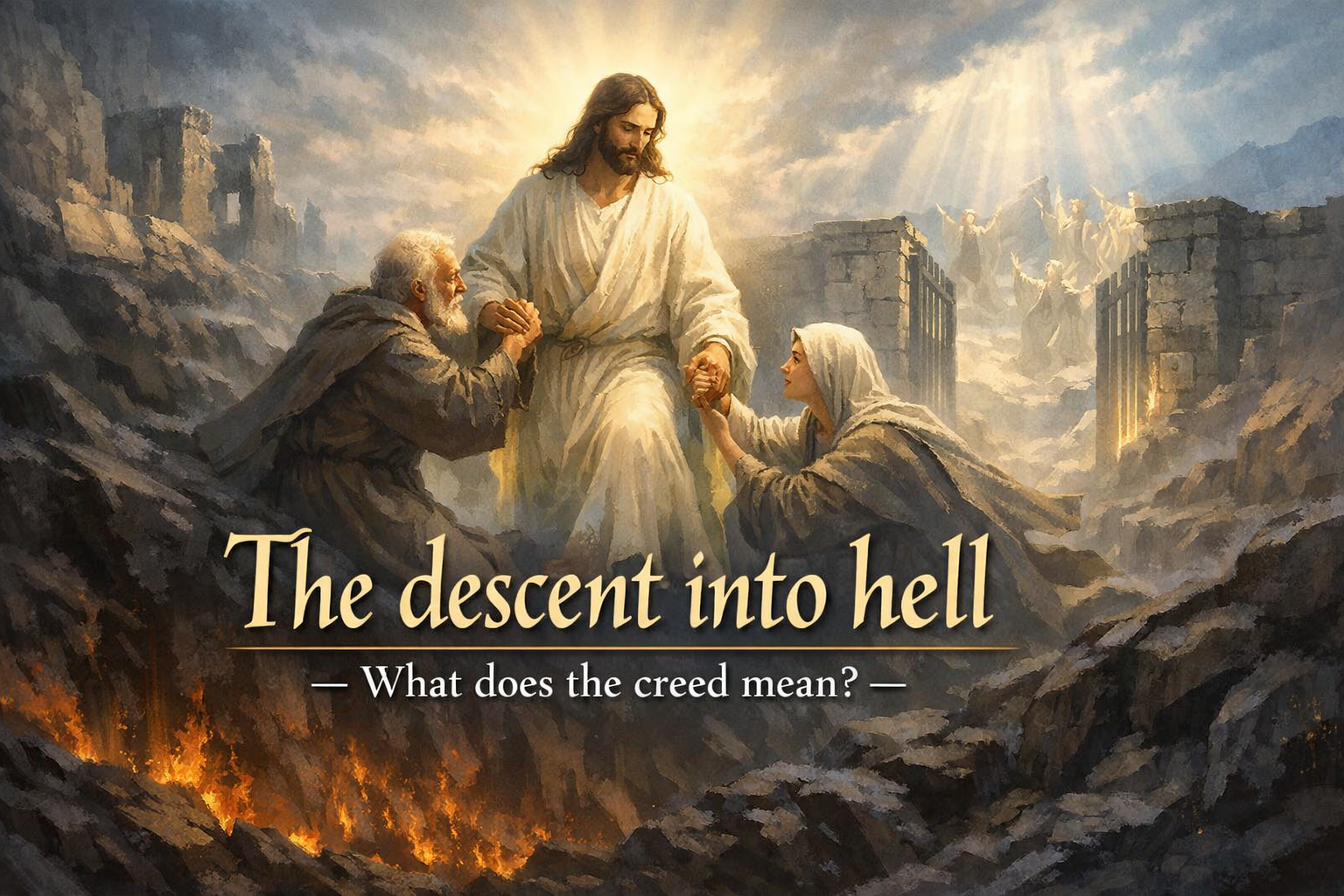
The descent into hell — what does the creed mean?
Every Sunday, millions of Christians recite the Apostles’ Creed — and then stumble on the same five words: “He descended into hell.” What does that actually mean? Did Jesus go to the place of the damned? Did He suffer there? Did He preach to the lost? The short answer is that the Church has never fully agreed. But working through the options is worth your time — because what you believe about those five words has everything to do with what you believe about what Christ actually accomplished.
Five words in the Apostles’ Creed that have puzzled, divided, and — when handled carefully — clarified the full weight of Christ’s saving work.
It happens every Sunday in churches all over the world. Congregation rises, opens the bulletin, and together recites the Apostles’ Creed. Born of the Virgin Mary. Suffered under Pontius Pilate. Crucified, dead, and buried. Then — right there between the burial and the resurrection — He descended into hell.
For most people in the pew, those five words pass by like a speed bump. They say them and move on. But anyone who stops long enough to think about them runs into some hard questions. Did Jesus actually go to hell — the place of eternal punishment? What was He doing there? Does this mean He suffered something beyond the cross? And if we’re not sure what it means, should we even be saying it?
These aren’t idle theological puzzles. How you understand the descent touches everything from the completeness of Christ’s atonement to the fate of the unevangelized to the nature of Christ’s human suffering. Let’s work through it carefully.
The Line Wasn’t Always There
First, a historical reality check: the descent clause is a late addition to the Creed. The earliest versions of the Apostles’ Creed — traceable back to Roman baptismal formulas of the second and third centuries — simply move from “buried” to “rose again on the third day.” The phrase descendit ad inferna (He descended to the lower regions) doesn’t appear reliably in creedal texts until the fourth century, and doesn’t become universal in Western Christianity until well into the sixth and seventh centuries.
This means the descent clause entered the Creed after the Church had been reflecting on the relevant biblical texts for centuries — which also means that centuries of theological debate preceded and shaped its inclusion. We are not dealing with an obvious, self-evident affirmation. We are dealing with a hard-won doctrinal statement whose meaning the Church has continued to debate ever since.
The Relevant Texts — and Why They’re Difficult
The scriptural case for some form of Christ’s post-death activity in the realm of the dead rests on a handful of passages, none of which is easy.
Acts 2:27 and Psalm 16:10 — Not Abandoned to Hades
In his Pentecost sermon, Peter quotes Psalm 16:10: “You will not abandon my soul to Hades, or let your Holy One see corruption.” Peter’s argument is that David couldn’t have been speaking of himself — David died and was buried and his tomb is still here. He was speaking prophetically of Christ, whose soul was not abandoned to Hades and whose body did not see decay because He rose.
This text establishes that Christ’s soul went to Hades — the realm of the dead — between death and resurrection. What it doesn’t tell us is what happened there. The point of the psalm, as Peter uses it, is simply that Christ was not left there.
Ephesians 4:8–10 — He Descended to the Lower Parts
Paul quotes Psalm 68:18 and adds: “In saying, ‘He ascended,’ what does it mean but that He also descended into the lower regions of the earth? He who descended is the one who also ascended far above all the heavens, that He might fill all things.”
This is a disputed text. “Lower regions of the earth” could mean the realm of the dead (as early church fathers like Irenaeus read it), or it could simply mean the earth itself — that the Incarnation was the descent, and the Ascension was the corresponding exaltation. Both readings have substantial scholarly support. The text alone doesn’t settle the question.
1 Peter 3:18–20 — Preaching to Spirits in Prison
This is the most contested passage in the entire discussion. Peter writes that Christ, “being put to death in the flesh but made alive in the spirit, in which He went and proclaimed to the spirits in prison, because they formerly did not obey, when God’s patience waited in the days of Noah.”
The interpretive possibilities here are numerous. Who are these “spirits in prison”? When did this proclamation happen? What was proclaimed?
Options include: (1) Christ, through the pre-incarnate Spirit, preached through Noah to the disobedient people of that generation — they are “spirits in prison” now because they died in unbelief; (2) Between His death and resurrection, Christ descended and proclaimed His victory to fallen angels bound in Tartarus since the days of Noah (2 Peter 2:4, Jude 6); (3) Between death and resurrection, Christ proclaimed His victory to the souls of all the dead, offering them a post-mortem opportunity for salvation.
Option three has been a minority position throughout church history and cuts against the consistent biblical testimony that death is followed by judgment (Hebrews 9:27). Option one and option two both have serious defenders. The honest assessment is that 1 Peter 3 is among the most exegetically difficult passages in the New Testament, and no consensus exists.
1 Peter 4:6 — The Gospel Preached to the Dead
“For this is why the gospel was preached even to those who are dead, that though judged in the flesh the way people are, they might live in the spirit the way God does.” This is sometimes linked to the previous passage, but most commentators take “those who are dead” to refer to people who were alive when they heard the gospel but have since died — not to post-mortem preaching in the realm of the dead.
The Major Interpretive Traditions
Given that the texts are genuinely difficult, it shouldn’t surprise us that Christian tradition has landed in several different places on what the descent means. Here are the four most significant positions.
1. The Victory Proclamation View
Associated strongly with the early church fathers and carried forward by many in the Reformed tradition, this view holds that between His death and resurrection, Christ descended to the realm of the dead and proclaimed His victory over death, sin, and Satan. This was not an offer of salvation to the damned but a declaration of conquest — the cosmic announcement that the war was won. The “spirits in prison” in 1 Peter 3 are fallen angels or the souls of the disobedient, and Christ’s word to them was not a second chance but a herald’s proclamation.
This view takes seriously the idea that Christ’s victory was total and cosmic — not just effective for those who hear the gospel above ground, but proclaimed throughout every realm of existence.
2. Paradise / Bosom of Abraham View
Many in the Reformed and evangelical traditions — including Calvin himself — argued that the descent clause refers not to a literal geographic descent but to Christ’s full experience of death. The “hell” in question is not Gehenna (the place of the damned) but sheol/hades (the realm of the dead generally). On this reading, the clause is a summary statement that Christ truly died — He was not merely apparently dead, He fully entered the state of death. The creed moves from burial to descent as two ways of affirming the same reality.
Calvin actually went further, arguing that the descent refers to Christ’s suffering of the full weight of God’s wrath — not during a post-mortem journey but on the cross itself. The “descent into hell” was the agony of forsakenness: “My God, my God, why have you forsaken me?” (Matthew 27:46). For Calvin, the clause belongs logically with the crucifixion, not after the burial.
3. The Intermediate State / Comfort View
A number of Lutheran and Anglican theologians have held that between death and resurrection, Christ descended to the intermediate state — to the realm where the righteous dead awaited His coming — and proclaimed their liberation. On some versions of this view (influenced by Luke 23:43 and Luke 16:22–26), there was a compartment of sheol called “Abraham’s bosom” or “paradise” where the faithful dead of the Old Testament waited. Christ’s descent was the fulfillment of their hope: He announced that the atoning work was complete, and led these saints into the fullness of heaven at His ascension (Ephesians 4:8).
This view has strong ancient roots — it is reflected in patristic writers from Ignatius through Irenaeus to Clement of Alexandria and Origen — and it preserves the continuity of God’s saving purposes across both testaments.
4. The Second-Chance / Universal Proclamation View
Some theologians — particularly in more liberal or universalist frameworks — have taken 1 Peter 3–4 to mean that Christ offered post-mortem salvation to those who had never heard the gospel or who died before the Incarnation. This is a minority position in historic Christianity and runs into serious exegetical and theological headwinds. The consistent testimony of Scripture is that the decisions made in this life are final (Hebrews 9:27, Luke 16:26, 2 Corinthians 5:10). This view tends to be driven more by modern pastoral concerns about fairness than by the weight of biblical evidence.
What the Reformed Tradition Has Emphasized
It’s worth pausing on what Reformed theology — broadly speaking — has found most important in this discussion, since that tradition is the theological home base for much of what we do at Mountain Veteran Ministries.
Calvin’s instinct was to interpret the descent as Christ’s endurance of divine wrath, because he was concerned that placing the suffering after the death would suggest the cross was insufficient. The atonement had to be complete at the cross — “It is finished” (John 19:30) could not mean “mostly finished.” For Calvin, the descent clause is not an afterthought; it is a way of saying that what Christ experienced in His human soul — the full, crushing weight of God’s judgment against sin — was real, not symbolic.
The Heidelberg Catechism follows Calvin on this point. Question 44 asks why the creed adds “He descended into hell,” and the answer is: “That in my greatest temptations I may be assured that Christ my Lord has redeemed me from hellish anxieties and torment by the unspeakable anguish, pains, and terrors which He suffered in His soul both on the cross and before.”
This is pastorally rich. The descent is not a geographical curiosity — it is a guarantee. Whatever hell-ward anxiety, whatever experience of desolation, whatever God-forsaken darkness a believer walks through, Christ has already been there. He did not merely observe suffering from outside; He entered it.
What We Can Say With Confidence
Across the diversity of interpretive traditions, several things can be said with genuine confidence.
Christ truly died. He did not swoon. His death was not apparent or incomplete. The creed’s movement from crucified to dead to buried to descended is a cumulative insistence on the reality of His death. Whatever else the descent means, it means that. The Word made flesh tasted death in its fullness (Hebrews 2:9).
Christ’s work was comprehensive. The New Testament insists that Christ’s victory is cosmic in scope — over sin, over death, over the principalities and powers, over every realm of existence (Colossians 2:15, Philippians 2:9–11, Revelation 1:18). The descent, however we interpret it, is one way the creed registers that there is no territory Christ has not claimed.
Christ holds the keys of Death and Hades. Revelation 1:18 is explicit: “I have the keys of Death and Hades.” Whatever happened between Good Friday and Easter Sunday, Christ came out of it as Lord — not as victim. The realm of the dead is not independent of His authority.
The atonement is complete. Whatever the descent involved, it adds nothing to the sufficiency of the cross. Christ’s sacrifice was the once-for-all payment for sin (Hebrews 10:10–14). The descent does not supplement the cross; it may proclaim its completion, but it does not extend it.
Should We Still Say It?
Some churches have quietly dropped the descent clause from their creedal recitations — or substituted “He descended to the dead” (as in some modern liturgical revisions) to avoid implying Christ suffered in the place of eternal punishment. That substitution has the virtue of using the more neutral biblical language of sheol/hades rather than Gehenna.
But there’s a strong argument for keeping the traditional language and doing the hard theological work. The clause has done genuine service in the Church across sixteen centuries. It guards against a merely apparent death. It proclaims the cosmic scope of Christ’s victory. And in its Calvinist reading, it offers pastoral comfort that Christ has plumbed the depths of human desolation.
Say it. And know what you’re saying.
A Word on What It Doesn’t Mean
Given the interpretive range, it’s worth being clear about what the descent clause almost certainly does not mean.
It does not mean Christ suffered ongoing punishment in hell after the cross. The atonement was accomplished on the cross. “It is finished” was a declaration of completion, not an interim status report. Any interpretation that places Christ in a position of active suffering or defeat after the resurrection is incompatible with the New Testament’s testimony that He was “raised for our justification” (Romans 4:25).
It does not mean there is a second chance for salvation after death. The weight of Scripture is against post-mortem opportunity for the repentance of those who heard and rejected the gospel in this life (Hebrews 9:27). Those who take 1 Peter 3 to support this reading are working against the grain of the broader biblical testimony.
And it does not mean hell is a temporary state from which Christ will eventually empty it — the universalist reading. Christ’s descent was particular and purposeful, not a general liberation of all who have ever died.
Why It Matters
Theology always has pastoral application — and this topic is no exception.
If the Reformed reading is right — that the descent describes Christ’s bearing of divine wrath in His soul — then the darkest human experience of God-forsakenness has been entered and redeemed from the inside. When a believer sits in a season of spiritual desolation, when prayer feels like shouting into a void, when the sense of God’s presence has dried up entirely — they are not in territory that Christ has not mapped. He went there. He came back. And He says: I am the resurrection and the life (John 11:25).
If the proclamation view is right — that Christ announced His victory to the powers of death and darkness — then believers can rest in the knowledge that there is no spiritual power, no principality, no force in any realm of existence that has not already heard the verdict. The war is over. The announcement has been made. We live in the aftermath of a victory already won.
If the intermediate-state view is right — that Christ liberated the righteous dead who waited for His coming — then God’s faithfulness to every generation of His people is affirmed. Abraham, Moses, David, Isaiah — they waited. Christ did not forget them.
All three of these emphases are worth holding. And none of them requires that you have resolved every exegetical puzzle in 1 Peter 3.
Key Takeaways
- The descent clause is historically late but theologically significant. It entered the Creed gradually and has carried genuine doctrinal weight for sixteen centuries — worth understanding, not skipping.
- The biblical texts are genuinely difficult. Acts 2, Ephesians 4, and especially 1 Peter 3 have sustained multiple serious interpretations among faithful scholars. Humility is appropriate.
- Christ truly and fully died. Whatever else the descent means, it insists on the complete reality of Christ’s death — no docetism, no apparent death, no half-measure.
- The atonement is complete at the cross. No interpretation of the descent should add to or supplement what Christ accomplished in His crucifixion. “It is finished” means finished.
- Christ’s victory is cosmic in scope. Revelation 1:18 says He holds the keys of Death and Hades. There is no domain over which He is not Lord.
- The Reformed reading offers deep pastoral comfort. If Christ bore the full weight of hell’s weight of divine wrath in His soul, then no experience of desolation is beyond His understanding or His redemption.
- Post-mortem salvation is not supported. The consistent biblical witness holds that death is followed by judgment — not a second chance. Interpretations that require otherwise are working against the grain of Scripture.