The Donkey, the Prophecy, and the King Who Kept His Word
The crowd was right to shout. They had the right king, the right prophecy, and the right city. What they got wrong was everything they expected to happen next.
The palms were right. The prophecy was right. The city was right. And before the week was over, the crowd would be screaming for his execution. Palm Sunday is not a feel-good prelude to Easter — it is a collision between what we want God to do and what God actually came to do.
The Most Anticipated Entry in History
It is the spring of roughly 30 AD. Jerusalem’s population, normally around 50,000, has swollen to well over 100,000 pilgrims flooding in for Passover — the annual feast celebrating Israel’s deliverance from Egypt. The Roman governor Pontius Pilate has ridden in from Caesarea Maritima with reinforcements. The tension is coiled. Messianic expectation is running high. Every Passover, the question hangs in the air: Is this the year God finally acts?
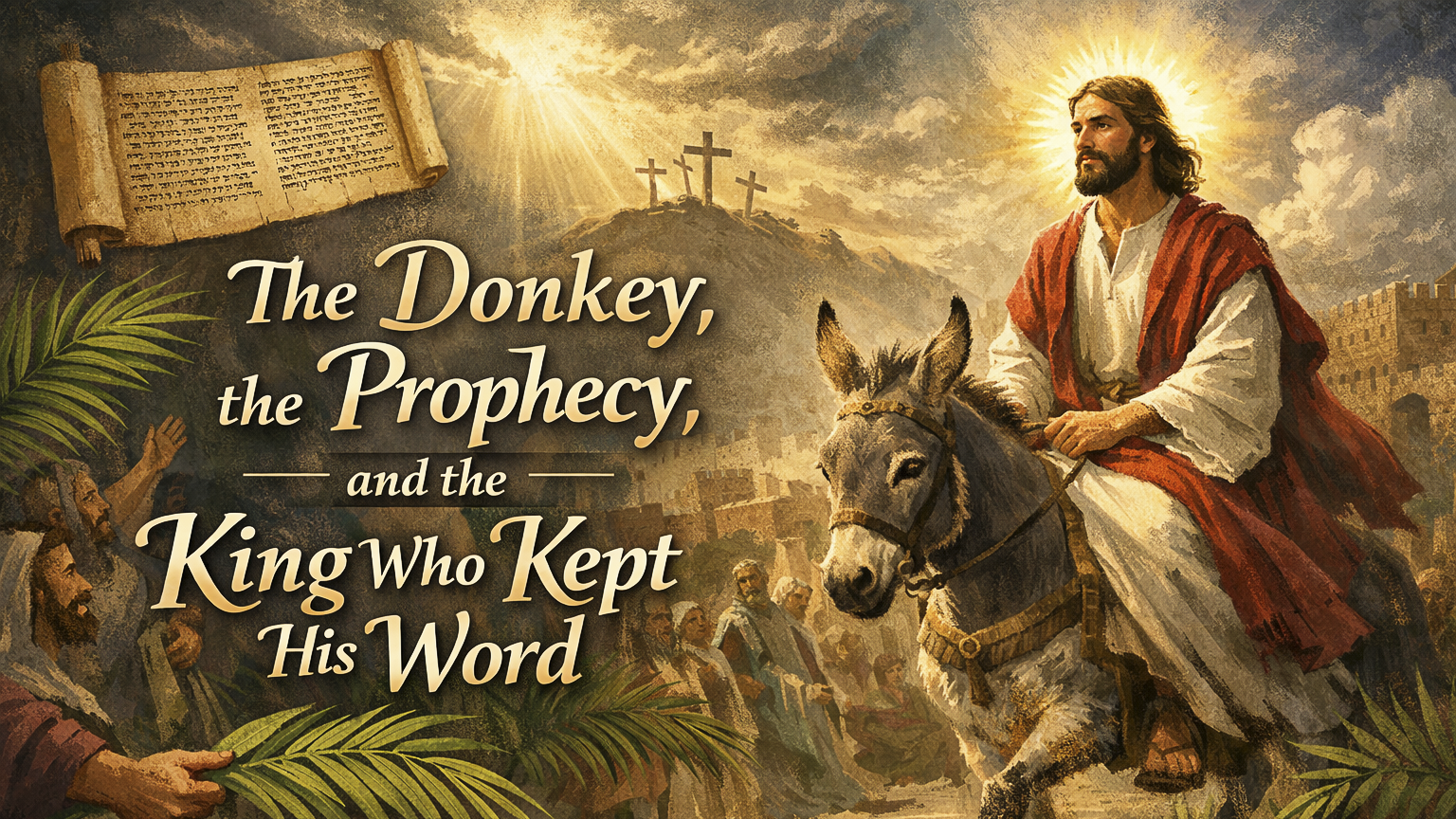
Into this atmosphere, Jesus of Nazareth descends the Mount of Olives on a young donkey, surrounded by a crowd spreading cloaks and palm branches in his path, shouting words pulled directly from Psalm 118: “Hosanna! Blessed is he who comes in the name of the Lord! Blessed is the coming kingdom of our father David!” (Mark 11:9–10).
What looks like a spontaneous outburst of popular enthusiasm is, on closer examination, a carefully constructed act of royal theater — one loaded with prophetic meaning that the crowd grasped, even if they misread its implications. To understand Palm Sunday is to understand that Jesus was not swept along by events. He was orchestrating them.
The Prophecy Hidden in Plain Sight
The apologetics case for Palm Sunday begins with a prophecy written roughly five centuries before Jesus rode into Jerusalem. The prophet Zechariah, writing during the post-exilic period, declared:
“Rejoice greatly, Daughter Zion! Shout, Daughter Jerusalem! See, your king comes to you, righteous and victorious, lowly and riding on a donkey, on a colt, the foal of a donkey.” — Zechariah 9:9
Matthew’s Gospel is the most explicit in connecting the entry to this prophecy (Matthew 21:4–5), but the other Gospel writers assume their readers know it. What is remarkable is not just that the prophecy was fulfilled, but how specifically it was fulfilled — and how deliberately.
Jesus did not simply happen to find a donkey. According to all four Gospel accounts, he sent two disciples ahead with precise instructions: they would find a specific animal tied in a specific village, and if anyone questioned them, they were to say, “The Lord needs it” (Mark 11:2–3). This is not improvisation. Jesus knew exactly what he was enacting and why. He was announcing his identity in the language Israel’s Scripture had provided — not through a declaration, but through a living fulfillment of the text.
N.T. Wright, in his landmark work on the historical Jesus, argues that this moment must be understood as a deliberate prophetic action — what Wright calls an “enacted parable.” Jesus was not merely fulfilling a prediction the way an actor hits a mark. He was claiming, in the symbolic vocabulary that every literate Jew in that crowd would have recognized, to be the one Zechariah had described. The King of Israel, arriving not on a warhorse but on a donkey — not in conquest but in deliberate, costly humility.
What the Crowd Understood — and Got Wrong
The crowd’s response tells us they grasped the claim. Palms were not decoration. In the century and a half before Jesus, palm branches had been a symbol of Jewish national resurgence — they appeared on coins minted during the Maccabean revolt, when Jewish fighters drove out the Seleucid Greeks and rededicated the temple. To wave palms was to invoke that memory. It was the equivalent of flying a flag.
The Hosanna cry from Psalm 118:25–26 was the traditional pilgrim hymn sung approaching Jerusalem for the feasts, but its meaning runs deeper than liturgy. Hosanna is a Hebrew plea: Hoshia na — “Save now!” The crowd was not just singing. They were petitioning. They wanted deliverance — from Rome, from corruption, from oppression. They had a king in front of them and they wanted him to act like one.
Tim Keller observed that the tragedy of Palm Sunday is not that the crowd was insincere. It is that they were sincere about the wrong thing. They wanted a king who would do what kings do — consolidate power, defeat enemies, restore national glory. What Jesus came to do was infinitely larger and infinitely more costly: to defeat the enemies that no army can touch — sin, death, and the corruption at the root of every human heart.
Luke’s account adds a detail the other Gospels omit, and it is devastating: as Jesus crests the Mount of Olives and Jerusalem comes into view, he weeps over the city (Luke 19:41–44). The Greek word Luke uses — eklaisen — is the same word used for deep, audible weeping, not quiet tears. Here is the king arriving to his capital, surrounded by celebration, and he is mourning. He says: “If you, even you, had known on this day what would bring you peace — but now it is hidden from your eyes.”
This is the moment that exposes the gap between the crowd’s expectations and the reality Jesus was walking toward. He was not confused about what lay ahead. He wept because they were.
The Apologetics Case: Multiple Independent Witnesses
One of the most compelling aspects of the Palm Sunday account from an apologetics standpoint is the convergence of four independent Gospel witnesses, each writing for different audiences and preserving distinct details — yet all agreeing on the core event.
Matthew writes for a Jewish audience and emphasizes the prophetic fulfillment most explicitly. Mark, writing the earliest and most compressed account, preserves the raw detail of Jesus surveying the temple and quietly departing — the kind of understated, eyewitness-feeling detail that fabricated stories tend not to include. Luke adds the weeping over Jerusalem, which serves no triumphalist purpose and would have been an awkward detail to invent. John, writing latest, notes something remarkable: the disciples did not understand the significance of the event until after the resurrection (John 12:16). This admission of the disciples’ incomprehension is a mark of historical honesty, not theological spin.
The criteria historians use to evaluate ancient sources cut in favor of these accounts. The criterion of multiple attestation — independent sources reporting the same event — is clearly met. The criterion of embarrassment — details that the authors would have had no motive to invent — is met by the disciples’ confusion and by Jesus weeping when he should, by any narrative logic, be triumphant. The criterion of coherence — does the event fit what we otherwise know about the time, place, and figure? — is met by the Passover context, the Roman political tensions, and the well-documented messianic expectations of first-century Judaism.
John’s account adds one more detail worth noting: the Pharisees, watching the crowd, say to one another, “Look how the whole world has gone after him!” (John 12:19). Enemies do not typically invent scenes that make their rival look dangerously popular. The hostility of the religious establishment toward Jesus is one of the most historically secure facts about his ministry — and Palm Sunday is the moment that hostility reaches the breaking point.
The King Who Chose the Donkey
Here is what the fulfilled prophecy of Zechariah 9:9 is actually claiming about the nature of this king. The verse does not say the king will be weak. Zechariah says he will be righteous and victorious — the Hebrew word is nosha, which carries the sense of one who has been saved or delivered, with the implication that this salvation came at cost. The king wins, but not the way kings usually win.
Spurgeon, preaching on this text, pressed his congregation on the word lowly. He argued that the donkey was not incidental — it was the entire point. A Roman general entering a conquered city rode a warhorse. Jesus arrived on a beast of burden. Spurgeon called this “the meekness of omnipotence” — not weakness pretending to be strong, but genuine power choosing a different posture. The one who could have called twelve legions of angels (Matthew 26:53) chose the slow road into a city that would kill him before the week was out.
N.T. Wright takes this further. He argues that in riding into Jerusalem this way, Jesus was enacting the broader narrative sweep of Israel’s Scripture — the return of YHWH to Zion, the coming of God himself to his temple to set things right. In the prophets, especially Ezekiel 43 and Malachi 3, the Lord’s return to the temple is not a gentle homecoming. It is a moment of judgment and purification. The temple action immediately following the entry (Mark 11:15–17) is inseparable from it. Jesus is not throwing over tables in a moment of hot emotion. He is a king arriving at his capital and finding it corrupt — and acting accordingly.
The prophecy, in other words, is not merely a set of data points to be checked off a list. It is a theological statement about what kind of salvation God was going to accomplish — and how it would come.
What the Stones Would Have Said
Luke’s account includes an exchange that is easy to miss. When the Pharisees demand that Jesus silence the crowd, he replies: “I tell you, if they keep quiet, the stones will cry out” (Luke 19:40).
This is not hyperbole for effect. Jesus is making a claim about the nature of the moment: what is happening cannot be suppressed because it is not merely a human demonstration. It is the culmination of centuries of prophetic trajectory. The whole creation, as Paul would later put it, has been groaning in anticipation of this (Romans 8:22). The entry of the Son of God into Jerusalem is the hinge of history. Even inanimate stones would bear witness to it if the crowd fell silent.
Keller draws a pastoral observation from this that cuts deep: the crowd shouting Hosanna was doing the right thing for mixed reasons. They wanted deliverance, but they wanted it on their terms. Jesus accepted their worship anyway, because the worship was true even when the worshipers were confused. He did not correct them in that moment. He wept, and he kept riding. The plan had been set in motion long before the crowd gathered on the Jericho road, and nothing — not Roman soldiers, not hostile Pharisees, not the fickle enthusiasm of a Passover crowd — was going to stop it.
For Us, Now
The fulfilled prophecy of Palm Sunday is not just an apologetics argument, though it is a powerful one. It is a window into the character of God. What these texts show us, across five centuries from Zechariah to the Gospels, is a God who keeps his word — specifically, precisely, at cost to himself.
The king arrived exactly as promised. He came to exactly the right city, at exactly the right time in redemptive history, in exactly the manner the prophet had described. And then he kept going — past the shouts, past the palms, past the temple courts — all the way to a cross on the other side of the week.
For anyone who wonders whether they can trust the Scriptures, Palm Sunday is an exhibit worth sitting with. The prophecy did not predict a vague spiritual event. It named a city, described a posture, and pointed to a king. And the king showed up.
And if you already believe — then Palm Sunday is a call to examine what kind of king you are actually following. The crowd on the Jericho road wanted a deliverer. They got one. They just didn’t recognize what deliverance would cost, or what it would look like, until it was finished.
Key Takeaways
- The entry was deliberate, not accidental. Jesus orchestrated every detail of his arrival — the colt, the timing, the route — as a conscious enactment of Zechariah 9:9, a prophecy written five centuries earlier. This was not coincidence.
- The crowd understood the claim, even if they misread the mission. Palms, Hosanna, and the descent from the Mount of Olives were loaded with messianic symbolism that first-century Jews recognized immediately. Their enthusiasm was not misplaced — only their expectations were.
- Four independent Gospel witnesses corroborate the event. Matthew, Mark, Luke, and John preserve distinct details that collectively pass the standard historical criteria used to evaluate ancient sources — including the embarrassing admission that the disciples didn’t understand it until later.
- The weeping king reveals God’s heart. Luke’s account of Jesus weeping over Jerusalem shows that the arrival of the King was not triumphalism — it was grief-saturated love for a people about to reject him. The prophecy fulfilled was personal, not mechanical.
- Palm Sunday is a test of what we want from God. Every person in that crowd wanted something from Jesus. What they received was more than they asked for and different from what they expected. The same question faces every reader of these texts: what are you actually asking for when you call him Lord?
Key Scriptures: Zechariah 9:9 • Psalm 118:25–26 • Matthew 21:1–17 • Mark 11:1–11 • Luke 19:28–44 • John 12:12–19 • Isaiah 53:1–9