
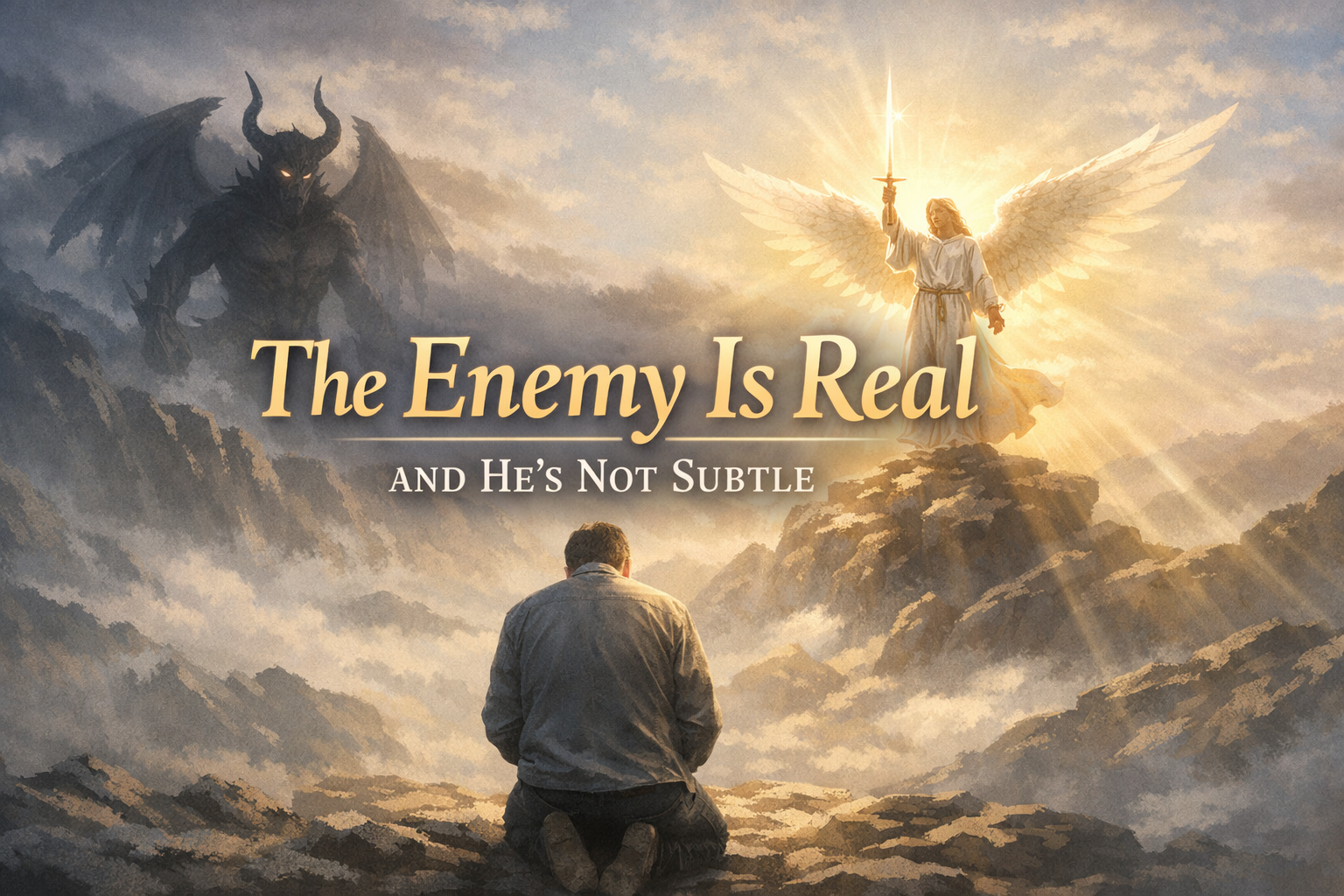
The Enemy Is Real and He’s Not Subtle
Scripture doesn’t talk about the devil as a distant threat or a theological abstraction. It describes him as an active enemy — scheming, roaring, deceiving — and it calls us to stand firm. That’s not a metaphor. That’s a mission briefing.
He’s not hiding. He’s not subtle. And Scripture says stand firm — not because we’re strong, but because the battle has already been decided.
A lot of guys I talk to either don’t think much about the devil or they’re obsessed with him. Neither one serves you well in the field. The man who ignores enemy activity gets flanked. The man who sees the enemy behind every rock starts shooting at friendlies. What you need is a clear-eyed assessment of who you’re dealing with, what he’s capable of, and why the fight isn’t actually as uncertain as it feels some days.
That’s what Scripture gives us. Not a horror story about Satan, and not a dismissive wave of the hand. An honest operational picture.
He’s Not a Cartoon
Modern culture has done one of two things with the devil: turned him into a Halloween costume or turned him into a punchline. Neither gets the job done. The red suit and pitchfork version is easy to dismiss, and that’s exactly the problem. When your enemy looks ridiculous, you stop taking him seriously.
But Scripture doesn’t treat him as a cartoon. 1 Peter 5:8 says he “prowls around like a roaring lion, seeking someone to devour.” That’s not imagery meant to entertain. That’s a threat assessment. A lion doesn’t announce himself. He studies his target, waits for the moment of vulnerability, and then moves fast. Anyone who has served knows what that kind of patience and precision looks like. It’s not random. It’s deliberate.
Paul calls him “the god of this age” (2 Corinthians 4:4) — not because he actually owns anything, but because he holds enormous influence over how this world thinks and operates. The systems, the values, the noise that tells you money is the point, comfort is the goal, and weakness is something to be ashamed of — that’s his operating environment. He’s not working against the grain of this world. He’s riding it.
“The greatest trick the devil ever pulled was convincing the world he didn’t exist.” That line is from a movie, not Scripture — but it captures something real. An enemy who can convince you he’s fictional has already won half the fight.
So the first thing to get straight: he’s real, he’s active, and he’s been doing this a long time.
What He Actually Does
Scripture gives us a fairly detailed portrait of his tactics. He’s not just a vague spiritual force — he operates in specific, traceable ways.
He Lies
Jesus said of the devil in John 8:44, “He was a murderer from the beginning, and does not stand in the truth, because there is no truth in him. When he lies, he speaks out of his own character, for he is a liar and the father of lies.” That’s not a secondary characteristic. Deception is his native language. He’s not occasionally dishonest — dishonesty is what he is.
And he’s good at it. The lies he tells are rarely obvious. They’re the half-truths that are harder to catch: You’re not really worth much. God can’t use someone with your history. That craving is just who you are — might as well stop fighting it. No one would really miss you. These aren’t random. They’re targeted. They go after whatever the man in front of them is most likely to believe about himself.
This is why Paul tells us in 2 Corinthians 10:5 to “take every thought captive to obey Christ.” Because the battlefield starts in your own head. If your enemy can get inside your thinking, he doesn’t need to do much else.
He Accuses
Revelation 12:10 calls him “the accuser of our brothers” — the one who stands before God and brings charges against believers, day and night. That language has a legal weight to it. He’s not just criticizing; he’s prosecuting. He wants you found guilty.
Here’s how this plays out practically: you fail, you sin, you do something you know you shouldn’t — and the weight of it doesn’t go away the way it should. You confess. You repent. But the condemnation stays. That’s accusation. The Spirit convicts and then releases when the confession is genuine. The accuser convicts and then keeps piling on, hoping to bury you under enough shame that you stop believing grace could possibly apply to someone like you.
If you’ve ever felt like you were too far gone for God — and I mean genuinely believed it, not just thought it — that’s worth examining. Romans 8:1 says there is “no condemnation for those who are in Christ Jesus.” That’s a legal statement, made over against the accusation. The verdict has already been rendered.
He Schemes
Ephesians 6:11 tells us to “stand against the schemes of the devil.” The word in Greek is methodeia — method, strategy, calculated approach. He doesn’t just wing it. He studies you. He knows your weak points. He knows what triggers you, what isolates you, what you’re most likely to reach for when the pressure gets high.
For a lot of veterans, the schemes look like this: isolation (convince you that no one wants to hear what you’re carrying), pride (convince you that asking for help is weakness), or numbing (give you something that takes the edge off just enough that you never deal with the underlying wound). None of those are accidental. They’re patient, methodical, and they work — unless you can see them for what they are.
What He Can’t Do
Here’s where the picture gets brighter, and this part matters just as much as everything above.
The devil is not God’s equal and opposite. That’s a heresy called dualism, and it’s not what Scripture teaches. He is a created being — a fallen angel — operating under constraints he cannot overcome. He cannot be everywhere at once. He cannot read your mind. He cannot force you to do anything. And he cannot touch what God has sealed.
Job 1 is instructive here. Satan cannot even touch Job without explicit divine permission. He has to go before God and make his case. He operates within a leash. That doesn’t make him harmless, but it means every move he makes has already been accounted for in the sovereignty of God.
James 4:7 gives us the simplest summary of the power dynamics at play: “Submit yourselves therefore to God. Resist the devil, and he will flee from you.” Flee. Not stand his ground, not escalate — flee. There is something about a man who is genuinely submitted to God and standing in that authority that the enemy cannot press through. He’s not brave. He’s a predator, and predators avoid prey that fights back on the right ground.
The enemy can tempt. He can accuse. He can scheme. What he cannot do is reach past the blood of Christ and pull you out of the Father’s hand. John 10:28–29 is a locked door, and he doesn’t have the key.
This is not an invitation to be casual about spiritual warfare. It’s an invitation to fight from a position of confidence rather than fear. There’s a difference between a soldier who doesn’t know how strong his position is and a soldier who does. The latter fights differently.
The Armor Is Not Optional
Paul’s famous passage in Ephesians 6:10–18 is probably the most direct piece of operational doctrine on spiritual warfare in all of Scripture. And it’s worth reading slowly, because every piece of the armor is active and intentional.
The belt of truth. The breastplate of righteousness. Shoes fitted with the readiness of the gospel of peace. The shield of faith. The helmet of salvation. The sword of the Spirit, which is the word of God.
Notice that nearly everything on that list is defensive. The sword is the one offensive weapon. This tells us something about the posture we’re supposed to hold: we’re not hunting the enemy down. We’re holding the ground we’ve been given. We stand. Paul uses that word four times in this passage. Stand. Not advance on your own initiative, not retreat, not run — stand.
For men who’ve been trained to move and engage, standing can feel passive. It’s not. Standing under fire when everything in you wants to break and run is one of the hardest things a man can do. It requires knowing what ground you’re standing on and being willing to absorb the assault.
The armor works because each piece corresponds to something real. Truth holds you together when the lies start landing. Righteousness — the imputed righteousness of Christ — protects your heart from the accusation. Faith stops the burning arrows of doubt before they can wound you. The word of God is the one thing you can push back with. Not arguments, not willpower, not confidence in yourself — the word. Jesus himself, when tempted in the wilderness, answered every assault with “It is written.” That’s the model.
You Are Not Fighting Alone
One of the enemy’s most effective tactics is convincing men that they’re in this alone. That the struggle is private. That no one else would understand, and bringing it to light would cost too much.
That’s a lie with a strategy behind it. An isolated soldier is a vulnerable soldier. The enemy knows this. The early church knew this too — which is why the New Testament is relentlessly communal. Bear one another’s burdens. Confess to one another. Pray for one another. Iron sharpens iron.
The man who is embedded in real community — where he can say “I’m struggling with this” without it blowing up his life — is significantly harder to pick off than the man who is going it alone with the weight of unspoken warfare pressing down on him.
Revelation 12:11 describes how the brothers in the heavenly scene overcome the accuser: “by the blood of the Lamb and by the word of their testimony.” The blood of the Lamb is what Christ accomplished. The word of their testimony is what you bring into the open. There’s power in speaking the truth about what God has done — especially when the enemy wants it buried.
The Outcome Is Not in Question
Whatever else you take from this, take this: the war is already decided. Colossians 2:15 says Christ “disarmed the rulers and authorities and put them to open shame, by triumphing over them in him.” Past tense. It’s done. The cross and the resurrection were the decisive engagement. Everything since is a mopping-up operation by an enemy who knows he’s lost but hasn’t stopped fighting.
That’s actually a strange kind of enemy to face. He’s not fighting toward victory anymore — he’s fighting toward damage. He knows he can’t win the war. He’s trying to take as many casualties as possible before the final word is spoken. That means the fight is real, the wounds are real, the danger is real — but the outcome is settled.
You fight from the position of a man whose side has already won. That doesn’t mean the current engagement isn’t hard. It means you fight with something underneath you that doesn’t move — a foundation of finished work that no scheme of the enemy can undo.
So stand. Put the armor on. Stay in the word. Stay in community. Stop pretending the enemy doesn’t exist, and stop giving him more credit than Scripture does. He’s real, he’s dangerous, and he’s already beaten.
That’s the mission briefing. Now you know who you’re dealing with.
Key Takeaways
- The enemy is real and strategic. Scripture describes Satan as a prowling lion with calculated schemes — not a cartoon villain. Ignoring him is as dangerous as being obsessed with him.
- His core tactics are deception, accusation, and isolation. He lies to your mind, prosecutes your failures, and works to cut you off from the community and truth that would expose him.
- He is not God’s equal. He is a created being on a leash. He cannot force you, read your mind, or reach past what God has sealed. His power has real limits.
- The armor in Ephesians 6 is operational, not decorative. Each piece corresponds to a real attack. Wearing it means actively grounding yourself in truth, righteousness, faith, and the word of God every day.
- The war is already won. The cross was the decisive engagement. You are not fighting for victory — you are fighting from it. Stand firm on finished ground.
You Don’t Have to Fight This Alone
Mountain Veteran Ministries exists for men who are carrying things they were never meant to carry solo. If what you read here stirred something, we’d be glad to talk — or just listen. Reach out through our contact page, or explore more posts in the Christian Life category.
Key Scriptures: 1 Peter 5:8 · John 8:44 · 2 Corinthians 4:4 · 2 Corinthians 10:5 · Revelation 12:10–11 · Ephesians 6:10–18 · James 4:7 · Colossians 2:15 · Romans 8:1 · John 10:28–29