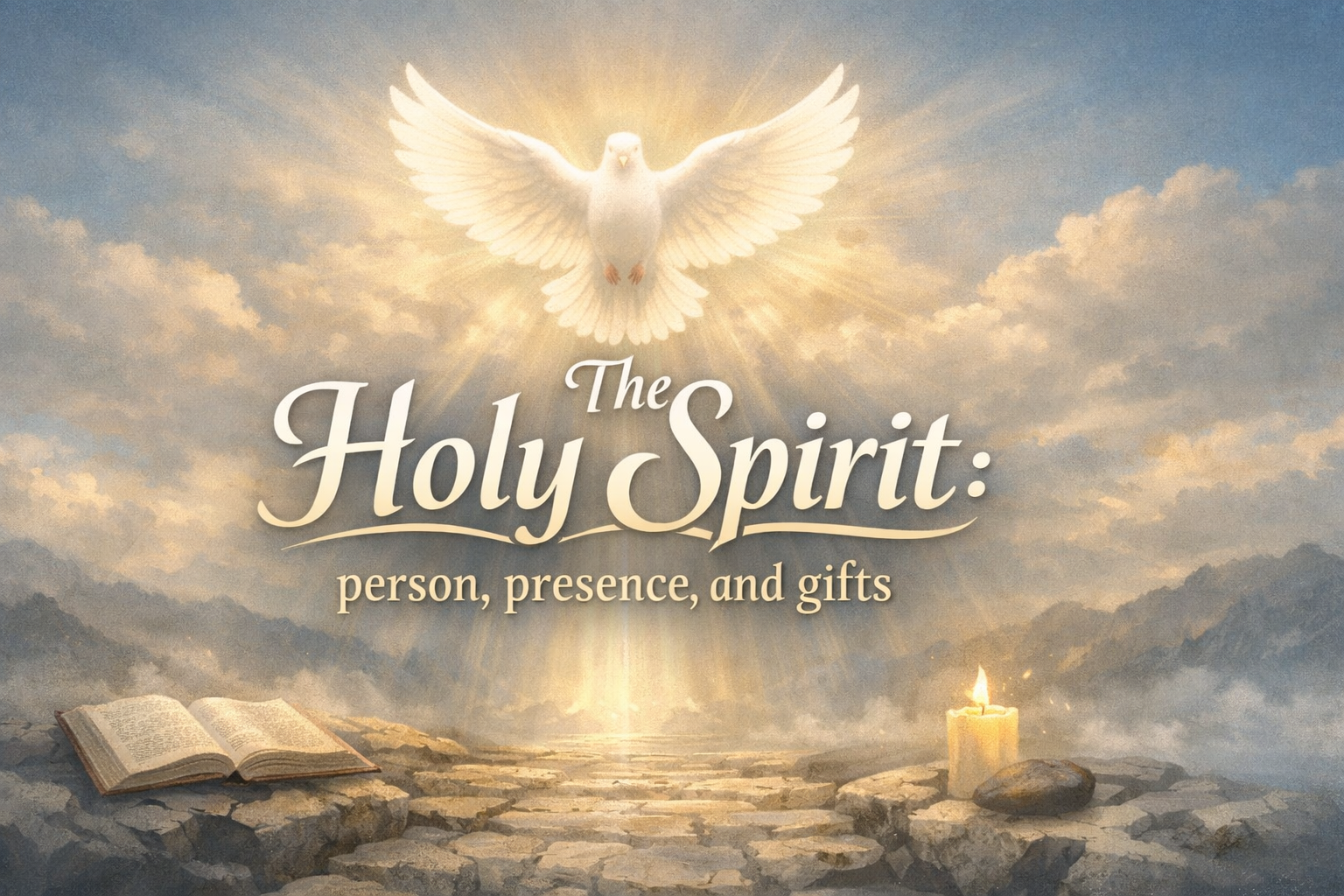
The Holy Spirit: person, presence, and gifts
The Holy Spirit is the most neglected person of the Trinity in most evangelical churches, and the most misrepresented person of the Trinity in charismatic ones. Both errors cost us something real. When the Spirit gets ignored, the Christian life becomes a project of human willpower dressed up in religious language. When the Spirit gets distorted, He becomes a vehicle for personal experience that ends up producing more confusion than clarity. What the New Testament actually teaches about the Spirit is more grounding and more powerful than either version.
Before you can understand what the Spirit does, you need to know who the Spirit is — and that answer is more important than the gifts debate that usually dominates the conversation.
Mention the Holy Spirit in a room of Christians and you’ll get different reactions depending on who’s in the room. In some churches the mention triggers images of speaking in tongues, falling under the power, and emotional services that prioritize experience over order. In others, the Spirit gets a brief theological acknowledgment — yes, He’s the third person of the Trinity — and then effectively disappears from practical conversation, replaced by Bible study methods and personal discipline as the primary drivers of the Christian life.
Neither of those is faithful to what the New Testament actually teaches. The Spirit is not a secondary subject to be handled briefly and moved past, and He is not primarily a source of ecstatic experiences to be pursued as ends in themselves. He is a Person — fully divine, fully distinct, irreplaceable in the life of every believer — who does specific work that cannot be replicated by human effort, religious practice, or doctrinal knowledge alone.
Understanding who the Spirit is comes first. Understanding what He does follows from that. The gifts debate — which tends to dominate the conversation — comes last, because starting with the gifts without establishing the personhood and work of the Spirit is like arguing about the tools before you understand the tradesman.
The Spirit Is a Person, Not a Force
This is the foundational claim, and it is worth establishing carefully because the alternative — treating the Spirit as a divine influence, an energy, or an impersonal power — is both historically widespread and practically consequential.
The New Testament ascribes to the Spirit everything that belongs to personhood. He speaks (Acts 13:2, 1 Timothy 4:1). He teaches (John 14:26). He testifies (John 15:26). He guides (John 16:13). He intercedes — praying on behalf of believers with groanings too deep for words (Romans 8:26). He commands (Acts 8:29). He sends (Acts 13:4). He can be grieved (Ephesians 4:30), quenched (1 Thessalonians 5:19), lied to (Acts 5:3), and blasphemed (Matthew 12:31). You cannot grieve an impersonal force. You cannot lie to an energy field. You cannot blaspheme a principle. All of these responses presuppose a Person — one with a will, an intelligence, and moral standing.
Jesus uses the masculine personal pronoun for the Spirit in John 16:13–14 even though pneuma (spirit) is grammatically neuter in Greek. The grammar argues against personhood; Jesus overrides the grammar. He calls the Spirit the Paraclete — a word that means advocate, helper, counselor, one called alongside. It is a relational term. You call a Paraclete the way you call a lawyer or a friend. It is not a word for an impersonal resource.
The practical consequence of this is significant. You do not merely access the Spirit as a resource or channel a power. You relate to a Person. You walk with Him, grieve Him or please Him, yield to Him or resist Him, pray in Him and through Him. That relational frame changes everything about how the Christian life is approached.
The Spirit Is Fully God
The New Testament is equally clear that the Spirit is not merely a divine agent or an emanation of God — He is God. When Peter confronts Ananias in Acts 5:3–4, he says in consecutive sentences that Ananias has lied to the Holy Spirit and that he has lied to God. The identification is direct and unreserved.
Paul describes the Spirit’s knowledge of God in terms that only belong to God: “The Spirit searches everything, even the depths of God. For who knows a person’s thoughts except the spirit of that person which is in him? So also no one comprehends the thoughts of God except the Spirit of God” (1 Corinthians 2:10–11). Only God knows the depths of God. The Spirit knows the depths of God. The conclusion follows.
The Nicene Creed — forged in the fourth century by the church working through exactly these questions — confesses the Spirit as “the Lord and giver of life, who proceeds from the Father and the Son, who with the Father and the Son together is worshipped and glorified.” The equal dignity of worship and glorification is not language applied to creatures or subordinate agents. It is Trinitarian language — three persons, one God, each fully divine, none reducible to the others.
This matters pastorally because it means the Spirit’s work in you is God’s work in you. When the Spirit convicts you of sin, God is convicting you. When the Spirit comforts you in grief, God is comforting you. When the Spirit illuminates Scripture so that a passage you’ve read a dozen times suddenly breaks open with meaning, God is teaching you. The presence of the Spirit is the presence of God — not a representative, not a delegate, but the living God dwelling within His people.
The Spirit’s Work in the Believer
The New Testament describes a wide range of things the Spirit does in and for the believer. These are not optional upgrades for the spiritually advanced — they are the normal operating conditions of the Christian life.
Regeneration. The new birth is the Spirit’s work. Jesus tells Nicodemus that what is born of the Spirit is spirit — the new nature is not generated by human decision or religious sincerity but by the sovereign, creative act of the Spirit who “blows where he wishes” (John 3:8). No Spirit, no new birth. No new birth, no genuine Christian life.
Assurance. Paul says the Spirit Himself bears witness with our spirit that we are children of God (Romans 8:16). He is the one who produces in us the cry of Abba, Father — the intimate address that would be presumptuous without the Spirit’s testimony confirming it. Assurance of salvation is not primarily a matter of theological deduction — it is a gift of the Spirit’s witness, and the absence of it may sometimes indicate a need to seek the Spirit more than to study the doctrine more.
Sanctification. The fruit of the Spirit in Galatians 5:22–23 — love, joy, peace, patience, kindness, goodness, faithfulness, gentleness, self-control — is not a checklist for moral self-improvement. It is the character of Christ being produced in the believer by the Spirit who is making that believer more like Jesus. Paul’s contrast with the works of the flesh is sharp: the flesh produces its characteristic fruit by default. The Spirit’s fruit requires walking with the Spirit, yielding to the Spirit, not quenching the Spirit. The process is not passive — it requires genuine engagement — but the power is entirely the Spirit’s.
Prayer. The Spirit helps us in our weakness, Paul says in Romans 8:26, because we do not know what to pray for as we ought. He intercedes for us with groanings too deep for words. Christian prayer is not a human monologue directed at God — it is the Spirit praying through the believer, aligning the believer’s desires with God’s will, translating inarticulate need into the intercession the Father hears. You are never praying alone.
Illumination. The natural person does not accept the things of the Spirit of God, Paul writes in 1 Corinthians 2:14, because they are spiritually discerned. Scripture is not a text that yields its meaning to sufficiently clever readers. The Spirit who inspired it is the same Spirit who must illuminate it. Bible study without the Spirit is not impossible — secular scholars can produce impressive historical-grammatical work — but it will not produce the kind of understanding that transforms the life. That transformation requires the Spirit who makes the Word alive.
The Gifts: What They Are and What They’re For
The New Testament describes spiritual gifts — charismata — as specific capacities given by the Spirit to believers for the benefit of the body of Christ. Three primary gift lists appear: Romans 12:6–8, 1 Corinthians 12:8–10, and Ephesians 4:11–12. They overlap but are not identical, which suggests that the lists are illustrative rather than exhaustive.
The governing principle Paul establishes is clear: gifts are given “for the common good” (1 Corinthians 12:7), not for personal spiritual development or individual status. The person who uses a gift to draw attention to themselves has misunderstood the gift. The person who hoards a gift rather than deploying it in the community has failed the one who gave it. Gifts are the Spirit’s provision for the body’s health and mission — they are tools, not trophies.
The most theologically contested gifts are the ones sometimes called the sign gifts or extraordinary gifts: tongues, interpretation, prophecy, healing, and miracles. The debate between cessationists — who hold that these gifts ceased with the apostolic age — and continuationists — who hold that they continue today — is genuine, long-standing, and not settled by a single proof text.
The cessationist argument draws primarily on the function of these gifts in the apostolic period — authenticating the apostles and the emerging canon of Scripture — and on texts like 1 Corinthians 13:8–12, which speaks of tongues ceasing and prophecy passing away “when the perfect comes.” If “the perfect” refers to the completed canon, the argument runs, the authenticating gifts have served their purpose and been withdrawn. The continuationist reads “the perfect” as the return of Christ, noting that Paul’s argument is about the incompleteness of present knowledge, not the incompleteness of the canon — and points to the absence of any explicit biblical statement that the gifts would be withdrawn before the end.
Both positions are held by serious, biblically careful Christians. What is not debatable is the purpose of the gifts: they serve the body, not the individual. Whatever gifts the Spirit distributes, they are to be exercised in love — which is why Paul places his famous hymn to love in 1 Corinthians 13 directly between his two chapters on gifts. The gifts without love are noise. Love without gifts is incomplete. Both together, properly ordered, is what the Spirit intends.
The Spirit and the Word
One of the most important relationships in a healthy theology of the Spirit is the relationship between the Spirit and Scripture. These two are never properly separated, and the errors that result from separating them go in opposite directions.
The Spirit-without-Word error elevates personal experience, impressions, and subjective sense of leading above the objective standard of Scripture. When someone says “The Spirit told me” in a way that cannot be tested against Scripture — or worse, in a way that contradicts Scripture — the Spirit is being invoked to authorize what the Spirit inspired Scripture to forbid. The Spirit does not contradict Himself. He inspired the Word; He does not lead His people away from it.
The Word-without-Spirit error treats Scripture as a text to be mastered by the right interpretive methods, with the Spirit’s role reduced to a historical footnote about inspiration. The result is technically competent Bible study that produces no transformation — knowledge that puffs up rather than the love that builds up. Paul’s point in 2 Corinthians 3:6 is sharp: “the letter kills, but the Spirit gives life.” The written Word, absent the Spirit’s illuminating and applying work, is capable of being used to deadly effect.
The healthy position is what the Westminster Confession calls the “inward work of the Holy Spirit bearing witness by and with the Word in our hearts.” Not the Spirit apart from the Word. Not the Word apart from the Spirit. The Spirit working through the Word, illuminating it, applying it, producing faith and repentance and obedience through it — that is normal Christian experience.
Walking in the Spirit
Paul’s command in Galatians 5:25 is succinct: “If we live by the Spirit, let us also keep in step with the Spirit.” The military cadence image is apt — keeping in step requires both attention to the one setting the pace and active movement in response. It is neither passive waiting nor autonomous marching. It is sustained, attentive, responsive movement with a Person who is leading.
What does that look like practically? It looks like regular, honest engagement with Scripture — not merely reading to check a box, but reading with expectation that the Spirit will use it. It looks like prayer that is more than a performance — actual conversation with a Person who hears and responds. It looks like quick repentance when the Spirit convicts, rather than negotiating with the conviction or suppressing it. It looks like deploying your gifts in the community rather than sitting on them. It looks like being alert to the needs of people around you, because the Spirit often speaks through the circumstances He arranges.
None of this is extraordinary. All of it is available to every believer, regardless of background, maturity level, or emotional temperament. The Spirit is not rationed. He is not reserved for the spiritually elite. He is the inheritance of every person in whom Christ dwells — the seal of the promise, the down payment on glory, the presence of God himself in the ordinary days of an ordinary Christian life.
And I will ask the Father, and he will give you another Helper, to be with you forever, even the Spirit of truth, whom the world cannot receive, because it neither sees him nor knows him. You know him, for he dwells with you and will be in you.
— John 14:16–17
With you. In you. Forever. That is not a secondary doctrine. It is the promise that makes everything else possible.
A Word to Veterans
In the military, you don’t go into the field without your equipment. Every piece of gear has a function — it keeps you alive, enables the mission, extends your capability beyond what you could do unequipped. The person who goes into combat without their kit because they think they can handle it alone is not brave. They’re a liability.
The Holy Spirit is not optional spiritual gear. He is the equipment without which the Christian life cannot function as designed. The regeneration, assurance, sanctification, prayer, illumination, and gifts He provides are not upgrades for advanced Christians. They are the standard-issue provision for every believer, without which the mission — loving God, making disciples, bearing witness to the resurrection — cannot be accomplished.
Veterans who have operated in environments where the right equipment was the difference between mission success and catastrophic failure understand this instinctively. You don’t improvise what was designed to be provided. You learn what your equipment is, how to use it, and how to maintain your relationship with the One who issued it. That is what walking in the Spirit looks like. Not a mystical add-on. Essential kit for the assignment.
Key Takeaways
- The Spirit is a Person, not a force. He speaks, teaches, guides, intercedes, grieves, and can be lied to. You do not access the Spirit as a resource — you relate to Him as a Person, yielding to or resisting a divine will that is fully engaged with yours.
- The Spirit is fully God. Acts 5:3–4 identifies lying to the Spirit with lying to God directly. His presence in the believer is God’s presence — not a representative or delegate, but the living God dwelling within His people through the third person of the Trinity.
- The Spirit’s work in the believer is the normal operating condition of the Christian life. Regeneration, assurance, sanctification, prayer, and illumination are all Spirit-dependent — not optional upgrades but the standard provision without which genuine Christian life cannot function.
- Gifts are given for the common good of the body, not for individual status or experience. Whatever position you hold on the cessation question, the purpose of gifts is unambiguous: they serve the community of Christ, exercised in love, for the building up of the body toward maturity.
- The Spirit and the Word belong together. Spirit without Word produces unanchored subjectivism. Word without Spirit produces dead orthodoxy. The Spirit works through Scripture — illuminating, applying, and producing transformation that information alone cannot generate.
- Keeping in step with the Spirit is active and attentive, not passive. Regular Scripture engagement with expectation, honest prayer, quick repentance, deployed gifts, and alertness to others — these are the practical rhythms of a life led by the Spirit in ordinary time.
Key Scriptures: John 14:16–17 · John 16:13 · Romans 8:16 · Romans 8:26 · Acts 5:3–4 · 1 Corinthians 2:10–11 · 1 Corinthians 12:7 · Galatians 5:22–25 · Ephesians 4:30 · 2 Corinthians 3:6