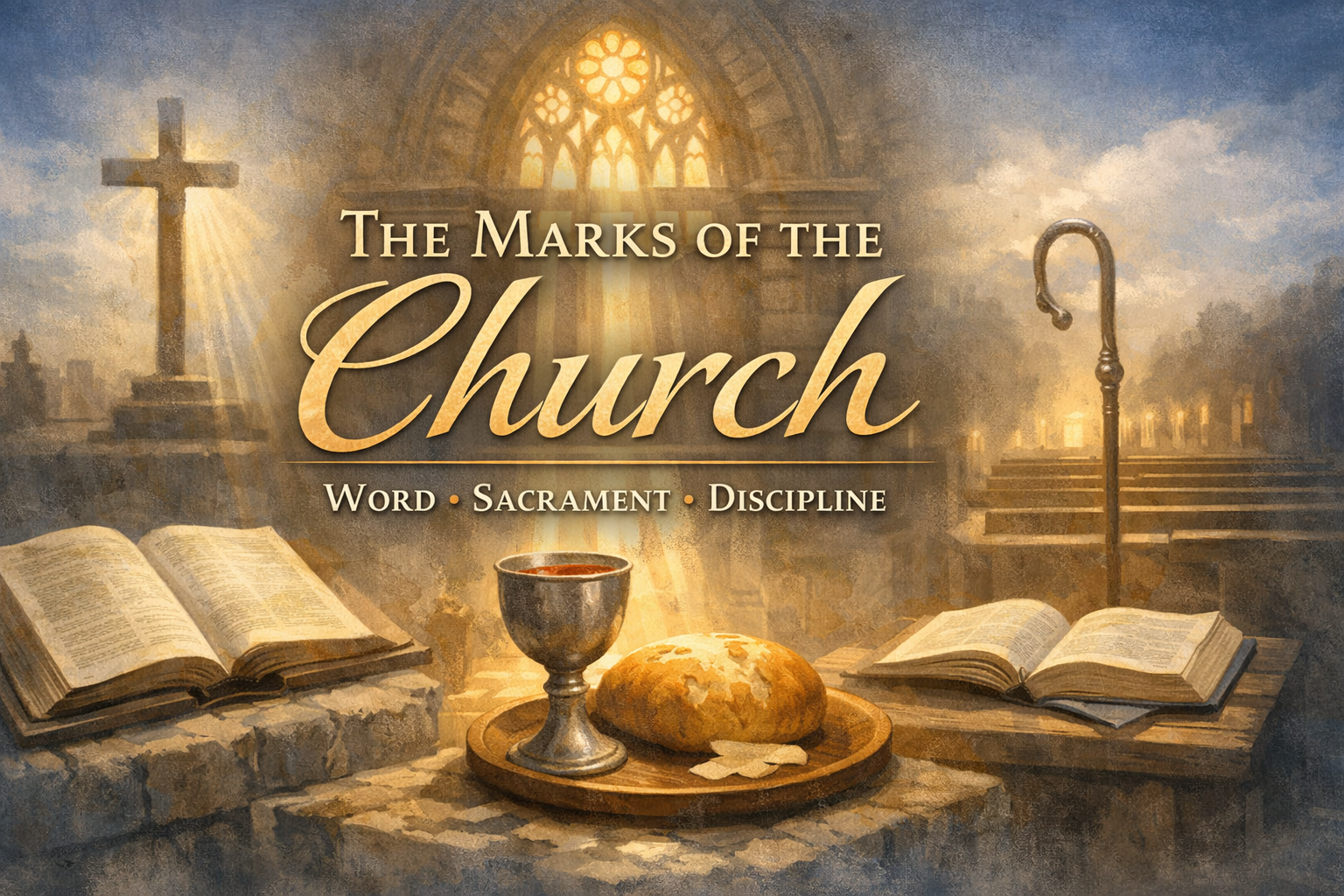
The marks of the church — word, sacrament, discipline
When Christians ask “What makes a true church?” they are not asking about buildings, music styles, or attendance numbers. The Reformation tradition points to three marks that have stood the test of time: the right preaching of the Word, the faithful administration of the sacraments, and the exercise of loving discipline. Together, they answer the question with precision — and they still matter today.
Churches today are evaluated by the wrong standards. Size. Popularity. Music quality. Production value. Preacher charisma. Political alignment. Emotional atmosphere. None of those are the biblical marks of the church. A congregation can score high on every one of them and still be spiritually thin. A congregation can score low on all of them and still be exactly what Christ intended.
So what are the actual marks? The Reformation tradition, drawing from the New Testament, has named three:
- The right preaching of the Word
- The right administration of the sacraments
- The faithful exercise of discipline
These are not decorations. They are not optional features for especially serious churches. Think of them like the main beams in a barn frame. If they are sound, the structure can stand. If they are rotten, the whole thing is in trouble — no matter how good the paint looks on the outside.
Mark One: The Word
The Church Is Created and Ruled by God’s Truth
The first mark comes first for a reason: the church is born by the gospel. People do not become the church by joining a social club or inheriting a family tradition. They are gathered by the call of God through His Word.
Romans 10:17 — “Faith cometh by hearing, and hearing by the word of God.”
The church begins with revelation, not invention. That means a true church is a place where Scripture is not pushed to the sidelines. The Bible is not used as a garnish for human opinions. It is opened, explained, believed, and obeyed. Preaching does not merely entertain or stir emotions. It brings people face to face with God’s truth, God’s holiness, man’s sin, Christ’s saving work, and the call to repentance and faith.
Why is this the first mark? Because without the Word:
- The gospel becomes blurred
- Christ becomes secondary
- Human ideas fill the vacuum
- The people are spiritually starved
The Word is what gives the church its message, its authority, and its shape. A church may have warm fellowship and beautiful music, but if it neglects the Word, it begins to drift like a boat untied from the dock. In plain terms: if a church stops listening to God, it stops acting like Christ’s church.
Mark Two: The Sacraments
The Church Visibly Proclaims the Gospel
The second mark is the right administration of the sacraments — in many Protestant and Reformed settings, baptism and the Lord’s Supper, though some traditions use the word ordinances to make clear these are acts commanded by Christ, not church-invented ceremonies. The point is the same: Christ gave visible signs to His church, and a true church handles them faithfully.
These signs matter because God knows we are not just minds with ears. We are embodied people. So He gave the church visible, tangible acts that proclaim the gospel in physical form.
Baptism marks entrance into the visible covenant community. It points to cleansing from sin, union with Christ, and identification with His death and resurrection. A true church does not treat baptism as empty custom or family ritual. It teaches what it means and administers it according to Christ’s command.
The Lord’s Supper continually brings the church back to the center — Christ’s body given and His blood shed for sinners. It is a meal of remembrance, proclamation, communion, and hope.
1 Corinthians 11:26 — “For as often as ye eat this bread, and drink this cup, ye do shew the Lord’s death till he come.”
If the Word is like the spoken promise, the sacraments are like the promise acted out before the eyes. They visibly preach the same gospel the Word proclaims audibly. A church that neglects or distorts them begins to lose clarity about the gospel itself. The visible witness gets muddied. The congregation may still gather, but it is no longer faithfully doing what Christ told His people to do.
Mark Three: Discipline
The Church Guards Holiness and Truth
This is the mark modern people often like the least. But biblically, discipline is not cruelty. It is one of the ways the church shows that holiness matters, truth matters, and love tells the truth.
Church discipline covers more than formal correction. At its broadest, it means the church is a community where believers are taught, corrected, warned, restored, and shepherded — an ongoing reality of life together. At its narrower focus, it means the church confronts open, serious, unrepentant sin rather than pretending nothing is wrong.
Why is this a mark of the church? Because the church is called to be holy. Not perfect — but holy. Set apart. If there is no discipline at all, the church is saying with its silence that doctrine does not matter and conduct does not matter. Discipline, done rightly, protects at least four things:
- The honor of Christ’s name
- The purity of the church
- The spiritual health of the sinner being corrected
- The witness of the gospel before the watching world
Matthew 18:15–17 and 1 Corinthians 5 make clear that discipline is meant to be restorative when possible. The goal is not humiliation but repentance — not casting people aside, but calling them back.
Think of it as fence-mending work. If the fence falls down and nobody repairs it, sooner or later the whole pasture is in disorder. A church without discipline may look peaceful, but often it is only avoiding hard obedience. Love without truth becomes softness. Truth without love becomes harshness. Biblical discipline is where love and truth meet.
Why These Three Belong Together
These marks are not isolated pieces. They function as a system, and they weaken one another when separated.
The Word defines truth. The sacraments display truth. Discipline protects truth. Or put another way:
- The Word tells us what the gospel is.
- The sacraments show us the gospel in visible form.
- Discipline keeps the church from openly denying the gospel by its life and conduct.
Pull one out and the others weaken. A church with Word but no discipline may know truth and tolerate open contradiction to it. A church with sacraments but little Word may keep its rituals while losing their meaning. A church with discipline but weak gospel preaching can become hard, legalistic, and joyless. The three marks, taken together, help a church stay faithful in doctrine, worship, and life.
What This Framework Does — and Doesn’t — Mean
One strength of this “marks of the church” approach is that it prevents two opposite errors. It keeps us from saying, “Any gathering with religious language counts as a church.” But it also keeps us from saying, “A church must be flawless to be real.” The marks are about faithfulness, not perfection.
A true church may be weak in places. It may have immature members, a struggling pastor, a tired congregation, and plenty of room to grow. But if these marks are present in a real and biblical way, it is still Christ’s church. That is a comforting truth — especially for small, ordinary congregations that do not look impressive by modern standards.
At the same time, these marks should not be treated like a cold checklist. A church can talk about Word, sacrament, and discipline in a rigid, mechanical way and still become spiritually dry. These marks are meant to serve the life of the church, not replace it. Where they are healthy, they should produce love for Christ, repentance, humility, worship, holiness, unity, perseverance, and genuine care for souls.
The marks are not mechanical. They are living signs that Christ is shepherding His people through the means He appointed.
A Word for Churches Today
This old language still matters because so much of what drives church evaluation today has nothing to do with what Christ actually asked of His people. A church can be small, plain, and unimpressive by every worldly measure — yet be a true church if the Word is preached, the sacraments are faithfully practiced, and discipline is lovingly upheld. A church can be polished, crowded, and culturally impressive — and still be spiritually thin if these marks are absent.
The framework helps us look deeper than appearances. And in a day when appearances are everything, that is no small thing.
In plain talk, a true church is where the Lord’s truth is heard, the Lord’s promises are seen, and the Lord’s people are lovingly kept in the faith.
Key Takeaways
- The three marks are the right preaching of the Word, the faithful administration of the sacraments, and the exercise of loving discipline. These are not optional features — they are the main structural beams of a true church.
- The Word comes first because the church is born by the gospel. Without Scripture rightly preached and taught, the church loses its message, its authority, and its shape.
- The sacraments visibly preach what the Word audibly proclaims. Baptism and the Lord’s Supper are Christ-given signs, not church-invented ceremonies — and neglecting them muddies the church’s gospel witness.
- Discipline is not cruelty — it is where love and truth meet. A church without discipline is not more gracious; it is less faithful. Done biblically, discipline protects Christ’s name, the church’s purity, and the soul of the sinner.
- The marks are about faithfulness, not perfection. A true church may be small, struggling, and unimpressive — but if these marks are genuinely present, it is still Christ’s church.
Key Scriptures: Romans 10:17 · Romans 6:1–11 · 1 Corinthians 5:1–13 · 1 Corinthians 11:23–32 · Matthew 18:15–20 · 2 Timothy 4:1–5 · Ephesians 4:11–16