The new creation — restoration or replacement?
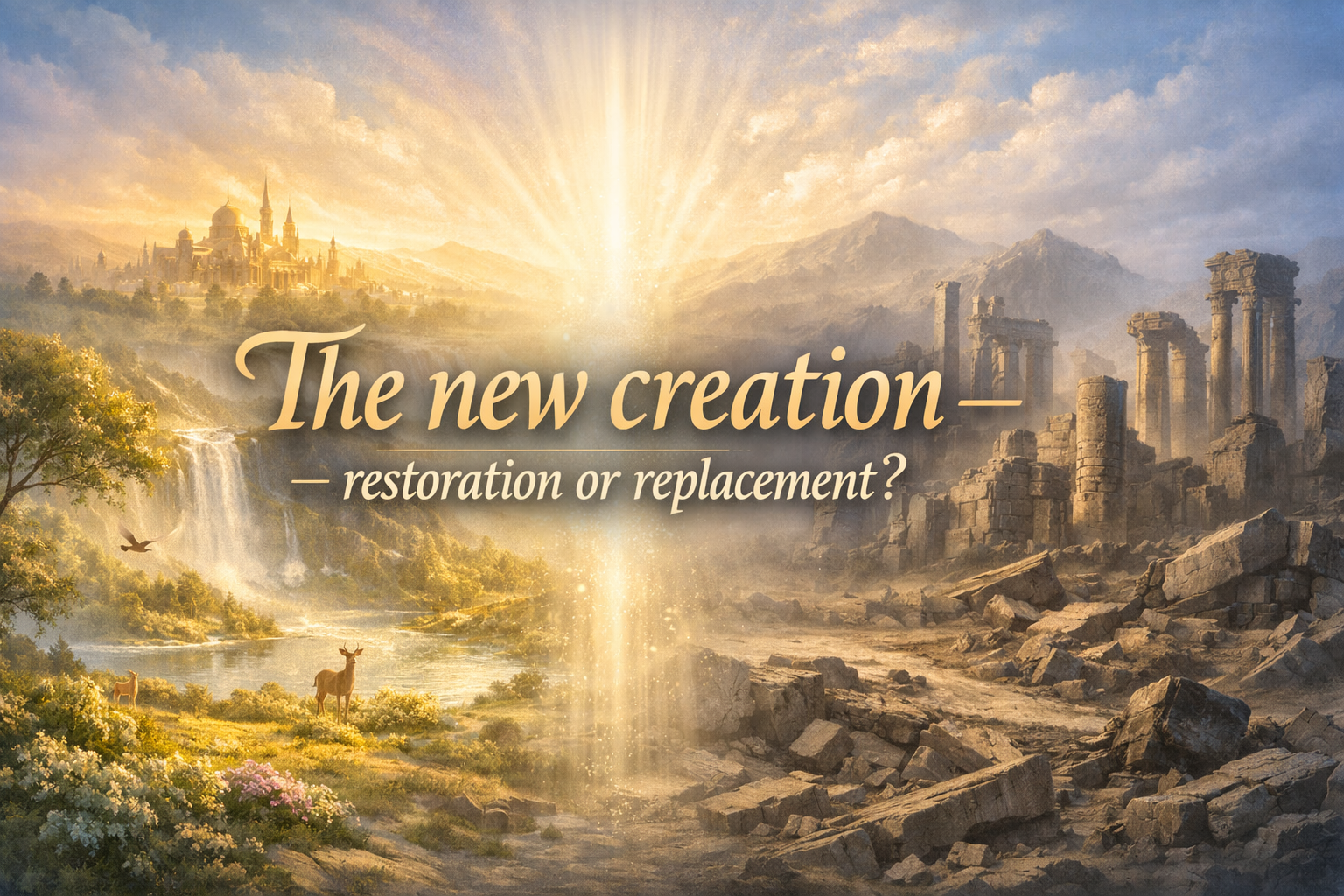
When God makes all things new, He is not scrapping His creation and starting over. He is redeeming it. Scripture points us not to the annihilation of creation but to its renewal — purified from the curse, liberated from corruption, and brought into its intended glory under the reign of Christ. The new creation is not replacement born of defeat. It is restoration accomplished by victory.
There is a question tucked inside a lot of Christian thinking about the future, and it goes like this: When God makes all things new, is He restoring this world, or replacing it with another one altogether? Will the new creation be the old creation healed and renewed, or will God scrap the whole thing and start over from nothing?
That is not just a question for theologians sitting around a table with big books open. It reaches right into ordinary Christian life. It shapes how we think about the body, the earth, work, beauty, suffering, hope, death, and the final victory of Jesus Christ. It changes how we read Romans 8. It affects how we hear Revelation 21. It even changes the way we look at a field, a mountain, a sunrise, or an old churchyard.
The short Christian answer is this: the new creation is not mere replacement, but restoration through radical renewal. God does not abandon His creation as though He made a mistake. He redeems it. He purifies it. He liberates it from the curse. He brings it into its intended glory under the reign of Christ.
Now, to be plain, the new creation will be so transformed that it will feel almost beyond imagination. The old order of sin, death, decay, and sorrow will be gone. Yet Scripture points us not to the annihilation of creation, but to its renewal. The God who made heaven and earth is also the God who purposes to redeem heaven and earth. The final state is not God giving up on creation. It is God finishing what sin tried to ruin.
Why This Question Matters
A lot of Christians have grown up with the idea that the end of the story is this world burning up, disappearing completely, and believers going off to some entirely other place called heaven. There is a grain of truth in that way of speaking — judgment is real and the future glory is beyond this fallen age. But if we are not careful, we can end up thinking of salvation as escape from creation rather than the redemption of creation.
The Bible gives us something better than escape. It gives us renewal.
God made the world good. Not partly good, but good. He made man from the dust of the ground and breathed into him the breath of life. He made rivers, trees, stars, beasts, birds, fruit, light, land, and sea. He placed man in a garden, not in a cloud. Sin entered, and with sin came curse, futility, thorns, sweat, pain, corruption, and death. But the answer to sin is not that God tosses the world aside in disgust. The answer is that Christ comes as Redeemer and King.
That means redemption reaches as far as the curse is found.
The Bible Begins and Ends With Creation
One of the clearest ways to see this is to notice how the Bible opens and closes. It opens in Genesis with the creation of heaven and earth. It closes in Revelation with a new heaven and a new earth.
“And I saw a new heaven and a new earth: for the first heaven and the first earth were passed away.” — Revelation 21:1 (KJV)
At first glance, some folks take that to mean total replacement, as if the first creation is thrown away and a completely unrelated one is made. But that reading does not fit the larger pattern of Scripture, where God’s habit is not to discard what sin has damaged, but to redeem it.
Think of the resurrection of the body. The Christian hope is not that God throws away the body and gives us some unrelated existence. He raises the body and transforms it. There is continuity and change. It is really you, and yet glorified. In much the same way, the new creation is really creation — and yet glorified.
The same God who raises the body also renews the cosmos.
Romans 8: Creation Is Groaning for Liberation
If you want one of the strongest passages in the Bible on this subject, go to Romans 8. Paul writes:
“For the creature was made subject to vanity, not willingly, but by reason of him who hath subjected the same in hope, Because the creature itself also shall be delivered from the bondage of corruption into the glorious liberty of the children of God.” — Romans 8:20–21 (KJV)
That language is important. Paul does not say creation will be discarded. He says creation will be delivered. He says it is in bondage to corruption now, but it will be set free. That sounds a whole lot more like restoration than replacement.
Creation is pictured as groaning, like a woman in travail, waiting for the day of liberation. That is not the groan of something about to be tossed in the dump. That is the groan of something about to be brought through pain into glory. And notice this: creation’s future is tied to the resurrection and glorification of God’s people.
“For we know that the whole creation groaneth and travaileth in pain together until now.” — Romans 8:22 (KJV)
The whole creation is bound up with man’s fall, and it will be bound up with man’s redemption. When Christ completes His saving work in His people, creation itself will share in that freedom from corruption. That is restoration language.
Revelation 21: “Behold, I Make All Things New”
Now look again at Revelation.
“And he that sat upon the throne said, Behold, I make all things new.” — Revelation 21:5 (KJV)
Notice carefully what the Lord says. He does not say, “Behold, I make all new things.” He says, “I make all things new.” That may seem like a small difference, but it is not small at all. “All new things” sounds like replacement. “All things new” sounds like renewal. The emphasis falls on transformation. God takes what has been devastated by sin and makes it new. He does not surrender the field to the devil. He does not hand creation over as a permanent loss. He reclaims it as the rightful King.
The new Jerusalem comes down out of heaven from God. The direction is downward, not upward only. The story ends not with redeemed humanity permanently escaping earth, but with God dwelling with man in a renewed creation.
“Behold, the tabernacle of God is with men, and he will dwell with them.” — Revelation 21:3 (KJV)
That is not abandonment of creation. That is the marriage of heaven and earth under God’s final reign.
What About 2 Peter 3? Doesn’t It Say Everything Burns Up?
This is one of the main passages people point to when they argue for replacement rather than restoration. Peter writes:
“But the day of the Lord will come as a thief in the night; in the which the heavens shall pass away with a great noise, and the elements shall melt with fervent heat, the earth also and the works that are therein shall be burned up.” — 2 Peter 3:10 (KJV)
Now that is strong language, and we should not soften it. Judgment is real. Fire is real. The present order as we know it will not continue unchanged. But destruction by fire in Scripture does not always mean annihilation. Often it means purification, exposure, judgment, and transformation. Fire burns away impurity. Fire tests. Fire refines. The same Bible that speaks of creation being delivered in Romans 8 and all things made new in Revelation 21 should help us read 2 Peter in a fuller biblical frame.
Peter goes on to say:
“Nevertheless we, according to his promise, look for new heavens and a new earth, wherein dwelleth righteousness.” — 2 Peter 3:13 (KJV)
So yes, there is cataclysmic judgment. Yes, the old sinful order passes away. Yes, this world in its present cursed form comes to an end. But the end is not sheer nonexistence. The end is a righteous new creation. A good way to say it is this: the new creation comes through judgment and purification, not through divine abandonment.
Noah’s Flood as a Pattern
There is another clue in 2 Peter. Peter compares the final judgment to the days of Noah. The world of Noah’s day was judged by water. But the flood did not mean the planet ceased to exist and another one was created from nothing. It was the world judged, cleansed, and brought through catastrophe into a new order.
The same earth passed through the flood. It was not an altogether different planet afterward. In a similar way, the present creation will pass through God’s final judgment and emerge as the new creation, fully cleansed from every trace of sin and curse.
Judgment can transform without annihilating identity. That is a strong case for restoration through radical transformation.
The Resurrection of Jesus Is the Pattern
If you want the deepest Christian pattern for this whole question, look to Jesus Himself. The resurrection of Christ is not replacement. It is restoration and transformation. The body that was laid in the tomb is the body that was raised in glory. The tomb was empty. Christ was not replaced by another Christ. He was raised and glorified.
“It is I myself.” — Luke 24:39 (KJV)
And yet He was transformed beyond mortal weakness and beyond death. That pattern matters because Christ is not only the Savior of souls. He is the firstfruits of resurrection and the head of the new creation. What God did in Christ’s resurrection gives us a window into what He intends for all things. Just as the body is not discarded but glorified, so creation is not abandoned but renewed.
Colossians 1: Christ Reconciles All Things
Paul says something mighty in Colossians:
“And, having made peace through the blood of his cross, by him to reconcile all things unto himself… whether they be things in earth, or things in heaven.” — Colossians 1:20 (KJV)
That does not mean every individual is saved regardless of faith — Scripture clearly rejects that idea. But it does mean Christ’s reconciling work is cosmic in scope. His redemptive reign reaches beyond the private inner life. It reaches to the whole created order.
Christ is not a small-town fixer patching up one room in a collapsing house. He is the reigning Lord through whom, for whom, and by whom all things were made, and He is bringing all things under His righteous peace. That points again toward restoration, not replacement.
Not a Return to Eden Only, but Better Than Eden
Sometimes people say the new creation is simply a return to Eden. That is partly true, but not enough. Yes, there are Eden echoes in Revelation. There is a river. There is the tree of life. There is no curse. God dwells with man. But the end is not merely a reset to Genesis 2. It is something greater. It is Eden fulfilled.
In Eden, there was innocence, but not yet tested glory. There was goodness, but not yet redemption. There was fellowship, but not yet the triumph of the slain and risen Lamb. The new creation is better than Eden because it is creation brought through fall, redemption, judgment, and victory into everlasting security. Adam could fall. The saints in glory will never fall.
Eden was the beginning of man’s probation. The new creation is the completion of God’s redemptive plan in Christ. So yes, it is restoration. But it is restoration lifted higher than the original beginning. Not less than the first creation — more.
A Word for Veterans
In the service, you learn something about ruined places. You have seen what war does to land — to towns, to buildings, to fields. You know what it looks like when something that was built for life gets torn apart. And you know the difference between a place that was given up on and a place someone fought to get back.
The new creation is not God giving up on the battlefield. It is God taking it back.
The whole created order has been under enemy occupation since the fall. Decay, death, corruption — these are not what God designed it for. But the reigning Christ is not standing on the sidelines. He already planted His flag in the enemy’s strongest hold when He rose from the dead. The final liberation of all creation is the completion of what that victory secured.
And for the man or woman who carries their own ruins — a body marked by injury, a mind carrying weight from years of hard service, a life that has seen more than its share of what’s broken — this doctrine says something personal. God is not done with what is worn down. He is a Redeemer. He does not write off what He made. He restores it. He renews it. He brings it through the fire into something better than it was before.
That is not just theology. That is hope with boots on.
A Rural Illustration
Think about an old farmhouse that has been battered by decades of neglect. The roof leaks. The porch sags. The paint peels. The windows rattle. A stranger drives by and says, “Tear it down. It’s done.”
But then the rightful owner comes. He knows the foundation is sound. He knows the house was built for something good. So he strips it down, tears out the rot, repairs the frame, replaces what is ruined, strengthens what is weak, and restores it until the place shines better than it ever did before.
Now that restored house is not “the same” in every superficial sense. It has been renewed. Purified. Strengthened. Beautified. Yet it is not a total abandonment of the original. It is the original brought to its intended glory.
That is closer to the biblical picture of new creation than the idea of God tossing the whole world in the junk pile and walking away from it.
What This Means for Everyday Christian Living
This doctrine is not meant to stay locked in an ivory tower. It gets dirt under its fingernails.
It teaches us that creation matters. If God intends to redeem creation, then creation is not meaningless. Christians should not worship nature, but we should receive the world as God’s handiwork. Fields, rivers, trees, mountains, work, meals, music, craftsmanship, and beauty all matter because God made them. This world is fallen, yes. But it is still God’s world.
It teaches us that our labor is not in vain. Paul ends 1 Corinthians 15, the great resurrection chapter, by saying:
“Therefore, my beloved brethren, be ye stedfast, unmoveable, always abounding in the work of the Lord… forasmuch as ye know that your labour is not in vain in the Lord.” — 1 Corinthians 15:58 (KJV)
Because resurrection is coming and renewal is coming, what is done in Christ matters. The kindness you show, the gospel you speak, the prayers you pray, the faithfulness you carry into hard days — none of it is meaningless.
It teaches us to resist despair. This world is broken. You do not need a seminary degree to know that. But the gospel does not lead us to fatalism. It leads us to hope. God is not wringing His hands. He is not improvising. In Christ, He is reconciling all things to Himself, and one day He will bring that work to full completion.
It teaches us not to confuse heaven with the final state. When a believer dies, he is with Christ, and that is far better. But the Bible’s final hope is not merely “going to heaven.” The final hope is resurrection and new creation. The intermediate state is blessed, but the last word is fuller still: body and soul reunited, creation renewed, God dwelling with His people forever. That is sturdier hope than a vague spiritual afterlife.
Key Takeaways
- The new creation is restoration through radical transformation, not outright replacement. God’s habit throughout Scripture is to redeem what sin has ruined — not to discard it.
- Romans 8 uses liberation language, not disposal language. Creation will be delivered from bondage to corruption, not thrown away. That is restoration from start to finish.
- “I make all things new” is different from “I make all new things.” The emphasis in Revelation 21 falls on transformation, not substitution.
- The resurrection of Christ is the pattern for the new creation. Just as Christ’s body was raised and glorified — not replaced — so God’s creation will be renewed and glorified, not abandoned.
- This doctrine changes how Christians live now. If God is restoring creation, then our bodies, our work, our faithfulness, and our stewardship of this world all carry lasting weight. None of it is wasted in Christ.
Final Encouragement
So then, is the new creation restoration or replacement? The best biblical answer is this: it is restoration through judgment, purification, and glorious transformation. Not a mere patch job. Not a polished-up version of the old fallen order. And not a total abandonment of creation either.
It is this world made new. Heaven and earth brought into their proper union under the reign of Christ. The curse removed, righteousness established, God dwelling openly with His people. Eden surpassed. Creation redeemed.
And that means Christian hope is bigger than “someday I leave this world behind.” Christian hope is this: Jesus Christ will raise the dead, judge evil, remove the curse, and renew all things.
That is why the believer can look at even a weary world and say, “This is not the end of the story.” The fields may still groan. The body may still weaken. Nations may still rage. Graves may still fill. But the risen Christ has already secured the future.
And that future is not ashes only.
It is renewal.
It is glory.
It is the new creation.
Key Scriptures:
Genesis 1–3 | Isaiah 65:17–25 | Romans 8:18–25 | Colossians 1:15–20
2 Peter 3:10–13 | Revelation 21:1–5 | Revelation 22:1–5 | 1 Corinthians 15:20–28, 42–58