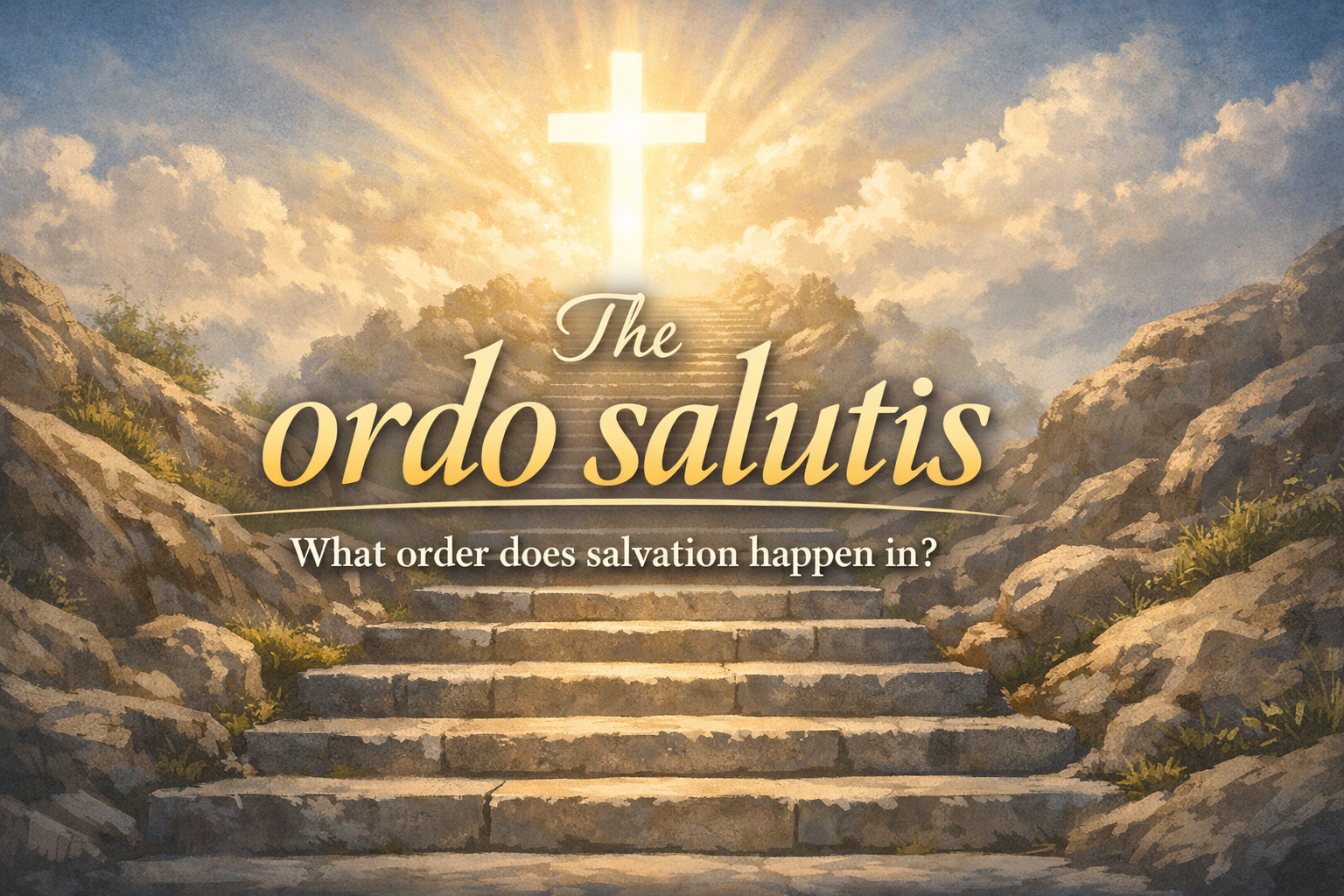
The ordo salutis — what order does salvation happen in?
Most Christians know they’ve been saved. Fewer have thought carefully about what that word actually contains. Salvation is not a single event — it’s a complex of divine acts that work together to bring a person from death to glory. The ordo salutis is theology’s attempt to map that sequence. It’s not just academic architecture. It’s a way of seeing how each part of what God does connects to every other part — and why getting the order wrong can quietly undermine the whole thing.
The Latin phrase ordo salutis means “order of salvation.” It’s the theological term for the sequence of acts by which God brings a sinner from spiritual death to eternal glory. Not every tradition orders the steps identically — Reformed, Lutheran, Arminian, and Catholic theologies produce different maps. But the exercise of mapping it is itself valuable, because it forces you to think about how the pieces connect.
This is not theology for its own sake. Every step in the ordo salutis has a pastoral payoff. Get the sequence wrong and you’ll misplace your assurance, misunderstand your ongoing struggle with sin, or miscommunicate the gospel to someone who needs to hear it clearly. Get it right and you have a coherent picture of what God has done, is doing, and will do — from eternity past to eternity future.
The Anchor Text
The biblical foundation for any ordo salutis begins in Romans 8:29–30, where Paul gives the most compressed account of the salvation sequence anywhere in Scripture:
“For those whom he foreknew he also predestined to be conformed to the image of his Son, in order that he might be the firstborn among many brothers. And those whom he predestined he also called, and those whom he called he also justified, and those whom he also justified he also glorified.”
Five links in the chain: foreknowledge, predestination, calling, justification, glorification. Theologians call this the “golden chain” because every link is connected to the same people — those foreknown are predestined, those predestined are called, those called are justified, those justified are glorified. No one enters the chain who doesn’t complete it. No one drops out between justification and glorification. The chain holds because God holds it.
Paul’s chain is not exhaustive — it doesn’t mention regeneration, faith, repentance, adoption, or sanctification, all of which belong to the full picture. But it provides the backbone. Everything else in the ordo salutis hangs on this structure.
Election and Foreknowledge
Before time, before creation, before you drew a breath: God chose. Election is God’s sovereign act of selecting particular individuals to be the recipients of saving grace. It is the fountainhead of the ordo salutis — not chronologically first in your experience, but logically prior to everything else.
The word “foreknew” in Romans 8:29 is important and often misread. It does not mean God looked down the corridor of time, saw who would believe, and then chose them on that basis. If it did, the text would say God chose people because they would believe — but that makes election conditional on foreseen faith and reduces it to a divine rubber stamp on human decisions. The New Testament usage of “foreknow” consistently carries a relational weight: to foreknow is to set one’s affection on, to know intimately in advance. It is covenantal knowledge, not mere cognitive prediction. Compare Amos 3:2, where God says to Israel: “You only have I known of all the families of the earth” — he didn’t mean he was ignorant of other nations. He meant Israel alone was the object of his intimate covenantal attention.
Predestination follows directly: God not only chose who would be saved, he determined the goal — conformity to the image of his Son. Election is not arbitrary rescue. It is purposeful shaping toward a specific end: a redeemed humanity bearing the family likeness of the firstborn Son.
Effectual Calling
The “calling” in Romans 8:30 is not the general call of the gospel that goes out to all hearers. It is the effectual or internal call — the sovereign work of God by which he applies the external gospel proclamation to specific individuals in a way that infallibly produces response. Everyone who is called in this sense comes. That is why Paul can say those called are justified — not merely invited, not given the opportunity, but called in a way that accomplishes its purpose.
The distinction between general call and effectual call is important. Jesus says in Matthew 22:14: “Many are called, but few are chosen.” The many-called refers to the broad gospel invitation. The few-chosen refers to those who are effectually drawn. Not everyone who hears the gospel preached is effectually called. But everyone who is effectually called responds — because the calling itself is the work of the Spirit who regenerates the heart to receive what is offered.
This is why Acts 13:48 can say with no apparent tension: “And as many as were appointed to eternal life believed.” The appointment and the believing are not in competition. The appointment is what produces the believing.
Regeneration
Regeneration is the new birth — the divine act by which God imparts spiritual life to a person who was spiritually dead. In the Reformed ordo salutis, regeneration logically precedes faith. As we discussed in the post on monergism and synergism, dead people do not assist in their own resurrection. God must first make the heart alive before that heart can exercise saving faith.
John 3:3 is the anchor: “Unless one is born again he cannot see the kingdom of God.” The new birth is the precondition of seeing — of perceiving the kingdom as real and desirable. Ezekiel 36:26 gives the Old Testament picture: God removes the heart of stone and gives a heart of flesh. The removal and replacement happen before the new obedience follows.
Regeneration is entirely the work of God. It is not something a person does or decides. It is something done to them — the sovereign implantation of new life by the Spirit of God. The person is passive in regeneration in the same way Lazarus was passive in his resurrection: he didn’t cooperate with coming out of the tomb. He came out because Jesus commanded it and life obeyed.
Faith and Repentance
With the new heart given by regeneration, the person now exercises saving faith and genuine repentance. These are not contributions to salvation in the sense of adding something to Christ’s work. Faith is the instrument by which the person receives what Christ has already accomplished. Repentance is the turning of the whole person — mind, will, affections — away from sin and toward God.
Both are genuine human acts. The monergist does not deny that the person truly believes and truly repents. What monergism insists is that the capacity and inclination to do so flows from the new birth, not from autonomous human will. God gives the faith he requires. Ephesians 2:8–9: “For by grace you have been saved through faith. And this is not your own doing; it is the gift of God, not a result of works, so that no one may boast.” The phrase “this is not your own doing” in context most naturally refers to the entire package — the grace-through-faith salvation — as the gift. You believed. But the believing was itself given.
Repentance and faith are inseparable. They are not two sequential events. They are two aspects of the single movement of a reborn soul toward its Savior. You cannot genuinely trust Christ without turning from what you were trusting before. You cannot genuinely turn from sin without turning to someone.
Justification
Justification is the forensic declaration by which God pronounces the believing sinner righteous. It is the pivotal doctrine of the Reformation — the article, as Luther said, by which the church stands or falls. And it is important to be precise about what it is and what it is not.
Justification is not the same as sanctification. Justification is a legal declaration. Sanctification is a moral transformation. Justification happens at a point in time, is complete, and never changes. Sanctification is a process, ongoing, and not complete until glorification. Justification is what God declares about your status before him. Sanctification is what God works in your character over time. Conflating the two — the error of Rome, and the error of much contemporary evangelical preaching — produces either self-righteous moralism or despairing perfectionism.
The basis of justification is the righteousness of Christ, imputed to the believer. 2 Corinthians 5:21 gives the exchange in its starkest form: “For our sake he made him to be sin who knew no sin, so that in him we might become the righteousness of God.” Your sin was credited to Christ’s account at the cross. His righteousness is credited to your account at the moment of faith. This is the great exchange — and it is the only ground on which a holy God can declare a sinner just without compromising his own justice.
The instrument of justification is faith alone — sola fide. Not faith plus works, not faith plus sacraments, not faith plus sufficient moral improvement. Faith alone receives the imputed righteousness of Christ. Romans 4:5: “And to the one who does not work but believes in him who justifies the ungodly, his faith is counted as righteousness.”
Adoption
Alongside justification — and often treated as its companion — is adoption. Where justification addresses the believer’s legal standing before God as judge, adoption addresses the believer’s relational standing before God as Father. Both happen at the same moment; they are distinguishable aspects of the single act of being received into God’s family through faith.
John 1:12: “But to all who did receive him, who believed in his name, he gave the right to become children of God.” Galatians 4:4–5: “God sent forth his Son, born of woman, born under the law, to redeem those who were under the law, so that we might receive adoption as sons.” The Spirit himself confirms this standing: Romans 8:15–16: “You have received the Spirit of adoption as sons, by whom we cry, ‘Abba! Father!’ The Spirit himself bears witness with our spirit that we are children of God.”
Adoption is enormously important for the Christian life and is probably the most underemphasized element of the ordo salutis in ordinary evangelical preaching. You are not merely a pardoned criminal. You are a welcomed child. The difference between those two positions is the difference between cautious relief and full-throated belonging — and far too many Christians are living in the first when they have every right to the second.
Sanctification
Sanctification is the ongoing process by which the Holy Spirit conforms the believer to the image of Christ — producing in them, over time, the character that justification has declared them to possess. Where justification is a verdict, sanctification is a renovation. Where justification is instantaneous and complete, sanctification is progressive and incomplete until glory.
Sanctification is both God’s work and the believer’s active participation. Philippians 2:12–13 holds both together in a single sentence: “Work out your own salvation with fear and trembling, for it is God who works in you, both to will and to work for his good pleasure.” Work it out — genuine human effort and moral striving are required. But the energy behind that effort, the desire that fuels it, the will that drives it: those are God’s work in you. Sanctification is not self-improvement by religious effort. It is the Spirit producing in you what the flesh cannot produce on its own, through the means of Scripture, prayer, community, and suffering.
Sanctification also involves the ongoing struggle with indwelling sin — what theologians call the flesh or the old man. The Christian life is not a straight line of moral progress. It is a fought battle, with real defeats and real recoveries, all within the security of a justification that never wavers and an adoption that never expires. Romans 7 is not a description of the pre-Christian Paul. It is Paul’s honest account of the ongoing conflict that marks the Christian life until glory.
Perseverance
The Reformed tradition includes perseverance — the preservation of the saints — as a component of the ordo salutis. Those whom God regenerates, justifies, and adopts, he also keeps. Perseverance is not the claim that a true Christian will live a perfect life or never experience serious doubt or sin. It is the claim that a true Christian will not finally and completely fall away from faith.
John 10:28–29: “I give them eternal life, and they will never perish, and no one will snatch them out of my hand.” Philippians 1:6: “I am sure of this, that he who began a good work in you will bring it to completion at the day of Jesus Christ.” The one who starts the work finishes it. The guarantee is not in the consistency of the believer. It is in the faithfulness of God.
This doctrine is a deep well of pastoral comfort for struggling believers. The person who is genuinely in Christ is not white-knuckling their way to glory hoping they don’t fall off. They are being carried — and the carrier has never lost a passenger.
Glorification
The final link in Paul’s golden chain is glorification — the completion of salvation at the resurrection of the body and the full renewal of creation. This is the goal toward which the entire ordo salutis has been moving. Election was “to be conformed to the image of his Son” (Romans 8:29). Sanctification is progressive conformity to that image. Glorification is the completion — the total transformation of the believer into the likeness of Christ, body and soul, in the new creation.
1 Corinthians 15:42–44 describes the resurrection body: sown in dishonor, raised in glory; sown in weakness, raised in power; sown a natural body, raised a spiritual body. 1 John 3:2: “Beloved, we are God’s children now, and what we will be has not yet appeared; but we know that when he appears we shall be like him, because we shall see him as he is.”
Notice that Paul writes the golden chain in Romans 8:30 with glorification in the past tense: “those whom he justified he also glorified.” It has not happened yet in time. But from God’s perspective, it is as certain as if it had already occurred. The end of the story is not in doubt. The chain holds.
Why the Order Matters
The sequence of the ordo salutis is not theological furniture arrangement. Each ordering decision carries weight.
If regeneration follows faith rather than precedes it, the new birth becomes a reward for believing rather than the divine act that makes believing possible — and you are back to the problem of spiritual death making a saving decision. If justification is confused with sanctification, assurance becomes hostage to your moral performance. If adoption is skipped entirely, believers live as pardoned strangers rather than welcomed children. If glorification is treated as uncertain, the whole chain loses its anchor.
The ordo salutis is the grammar of salvation. You can speak the gospel without it, but understanding it lets you speak the gospel precisely — and precision matters when someone’s eternal life is the subject.
More than that: when the chain is clear, gratitude becomes total. Every link was forged by God. You did not foreknow yourself. You did not predestine yourself. You did not effectually call yourself. You did not regenerate yourself. You did not justify yourself. You will not glorify yourself. You received a salvation planned in eternity, executed in history, applied by the Spirit, and guaranteed to completion by the one who cannot fail.
“He who calls you is faithful; he will surely do it.” — 1 Thessalonians 5:24
Key Takeaways
- The ordo salutis is the ordered sequence of God’s saving acts. Romans 8:29–30 provides the backbone — foreknowledge, predestination, effectual calling, justification, glorification — to which regeneration, faith, repentance, adoption, sanctification, and perseverance are added for the full picture.
- Regeneration precedes faith in the Reformed ordo. The new birth is the divine act that makes saving faith possible, not the reward for it. Spiritually dead people do not contribute to their own resurrection — they receive it.
- Justification and sanctification must be carefully distinguished. Justification is a complete forensic declaration that never changes. Sanctification is an ongoing moral transformation. Confusing them produces either moralism or despair — and neither is the gospel.
- Adoption gives the believer a relational standing, not merely a legal one. You are not just a pardoned criminal; you are a welcomed child. The Spirit himself witnesses to this, and far too many believers are living below the privilege it carries.
- The chain holds because God holds it. Election, effectual calling, regeneration, justification, perseverance, and glorification form an unbroken sequence driven entirely by divine faithfulness. The security of salvation rests on the character of God, not the consistency of the believer.
Key Scriptures: Romans 8:29–30 · John 3:3 · Ephesians 2:8–9 · 2 Corinthians 5:21 · Romans 8:15–16 · Philippians 2:12–13 · John 10:28–29 · 1 Corinthians 15:42–44