
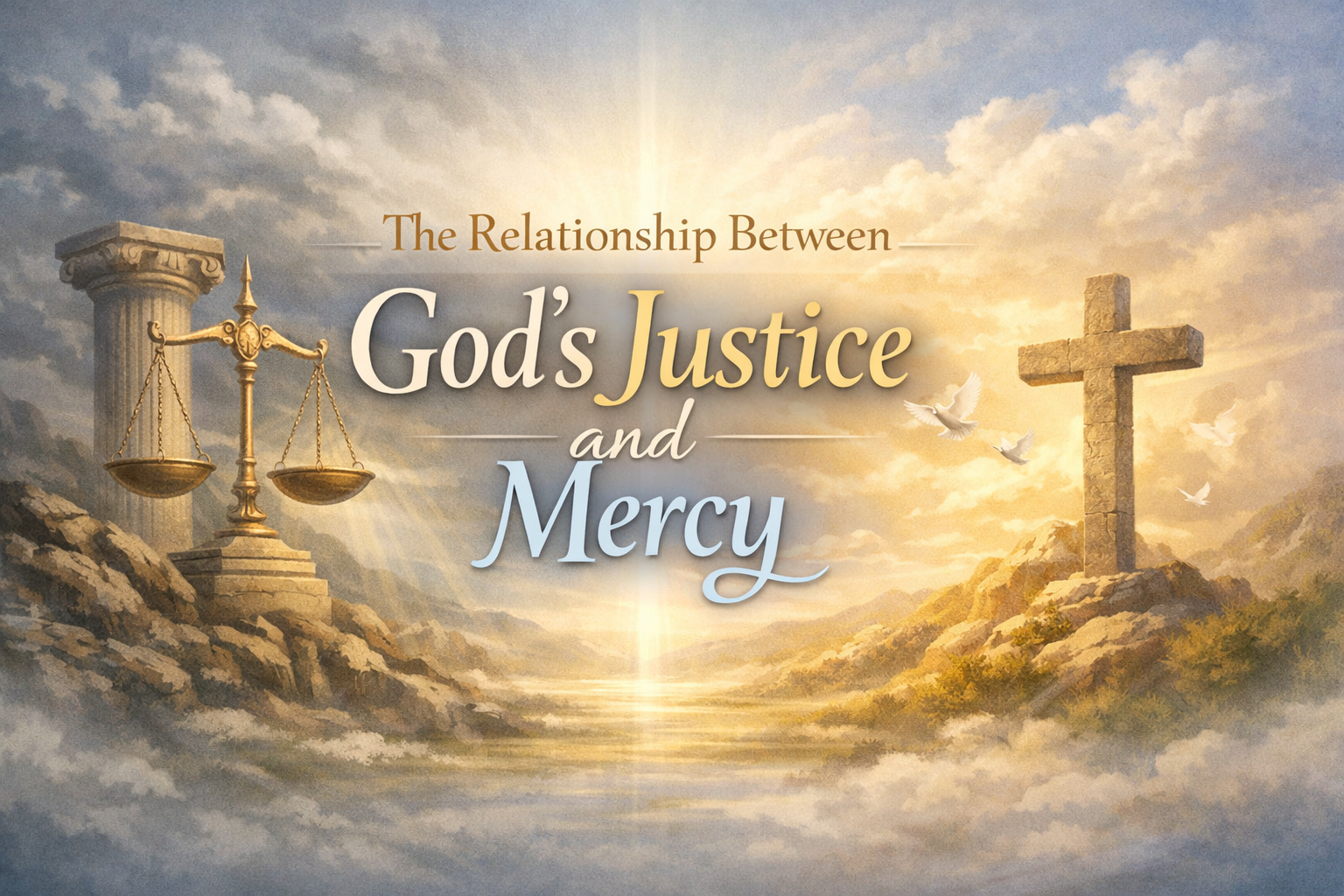
The relationship between God’s justice and mercy
Most people assume that God’s mercy and God’s justice are in tension — that mercy is what happens when justice gets overruled, that forgiveness is God looking the other way, that grace is God deciding not to enforce the rules this time. That assumption is wrong, and it matters more than you might think. A God whose mercy overrides His justice is not a trustworthy God. And a God whose justice exists in permanent standoff with His mercy is not a unified God. The cross is where that knot gets cut — not by eliminating either attribute, but by revealing that they were never actually opposed.
Here’s how most people imagine it: on one side of a cosmic scale sits Justice, demanding payment for every sin. On the other side sits Mercy, lobbying for leniency. God looks back and forth between them and makes a call — sometimes mercy wins, sometimes justice does. The cross, on this reading, is the moment mercy finally won a decisive victory over justice by finding a legal workaround: make someone else pay the debt so justice is technically satisfied and mercy can get what it wanted.
That picture is wrong from top to bottom. And the wrongness isn’t a minor theological footnote. It produces a God who is internally divided, a salvation that is essentially a legal fiction, and a mercy that is always a little bit unjust and a justice that is always a little bit merciless.
The actual relationship between God’s justice and mercy is not a competition. It’s a unity. And working out what that means requires going back to the beginning — to what justice and mercy actually are in the character of the God who possesses them both.
Justice Is Not Simply Punishment
The first move is to correct a common distortion. When most people think of God’s justice, they think punishment. Justice is the attribute that demands someone gets what they deserve, preferably in a painful way. On that reading, mercy is what happens when the punishment is waived — so justice and mercy are definitionally in tension, because mercy is always a reduction of justice.
But justice in Scripture is far richer than punishment. The Hebrew word most commonly translated “justice” — mishpat — encompasses the full range of what it means to set things right. It includes punishing the guilty, yes. But it also includes vindicating the innocent, defending the oppressed, restoring the wronged, and ordering society so that the vulnerable are protected. Mishpat is fundamentally about rightness — the condition in which things are as they ought to be.
This is why the prophets can speak of justice and mercy in the same breath without contradiction. Micah 6:8 — “do justice, love kindness, and walk humbly with your God” — presents justice and kindness (hesed, steadfast covenant love) as companion obligations, not competing ones. The person who truly does justice is also the person who loves kindness. They’re pulling in the same direction.
And this is why Psalm 85:10 can produce one of the most beautiful lines in the Psalter without irony: “Steadfast love and faithfulness meet; righteousness and peace kiss each other.” Righteousness — justice — and peace, the fruit of mercy, don’t just coexist. They embrace. They are made for each other.
Mercy Is Not Simply Leniency
The same correction applies to mercy. When mercy gets flattened into leniency — God deciding not to enforce the rules this time — it becomes something much smaller than what Scripture describes. Leniency is morally arbitrary. It means the rules don’t really apply. It means the guilty walk free not because anything was resolved but because the judge didn’t feel like pursuing it.
The primary Hebrew word for mercy — hesed — carries an entirely different weight. It is covenant faithfulness. It is the loyal, persistent, determined love of a God who has committed Himself to His people and will not abandon that commitment regardless of what they do. Hesed is not God going soft. It is God being relentlessly, indestructibly true to what He has said He is and what He has promised to do.
Lamentations 3:22–23 — “The steadfast love of the Lord never ceases; his mercies never come to an end; they are new every morning; great is your faithfulness.” The hesed of God is not a momentary softening. It is the permanent, inexhaustible, morning-by-morning commitment of God to His own. That is not leniency. That is love of an entirely different order.
Similarly, the New Testament Greek word eleos — mercy — carries the sense of active compassion that moves toward need. It’s not passive permission. It’s the father running toward the prodigal while he is still a great way off (Luke 15:20). The mercy of God is not God failing to act. It’s God acting decisively and at great cost toward those who deserve nothing from Him.
The Unity Behind the Distinction
If justice is fundamentally about setting things right, and mercy is fundamentally about loyal, active love toward the undeserving — then the question becomes: are these really opposed? Or are they two aspects of a single divine character that always operates as a whole?
The doctrine of divine simplicity — explored in depth in our earlier post — says God has no parts. His attributes are not separate components that can be pitted against each other. God’s justice is His mercy, and His mercy is His justice, in the sense that both are the one, undivided being of God meeting human need and human sin. When we speak of them separately, we’re using different lenses to look at the same infinite reality, not describing different departments in God’s personality.
This means the frame of “justice vs. mercy” is already asking the wrong question. The right question is: how does the one God — who is perfectly just and perfectly merciful because He is perfectly holy and perfectly loving — deal with a world of sinners?
“God’s mercy is not a relaxation of His justice, but rather an expression of His justice toward those who cannot meet its demands on their own.” — Herman Bavinck, Reformed Dogmatics, Vol. 2
Bavinck’s formulation is precise. Mercy is not justice taking a break. Mercy is justice — the full weight of God’s commitment to what is right — directed toward those who have no resources to meet that standard. The goal is not to relax the standard. The goal is to fulfill it in a way that opens the door for the unworthy to enter.
The Old Testament Pattern
The Old Testament does not present justice and mercy as opposites struggling for dominance. It presents them as twin facets of the covenant character of God, both of which are always fully in play.
The self-revelation of God in Exodus 34:6–7 is the most concentrated statement of divine character in the entire Old Testament, and Jesus, Paul, and the psalmists all draw on it: “The Lord, the Lord, a God merciful and gracious, slow to anger, and abounding in steadfast love and faithfulness, keeping steadfast love for thousands, forgiving iniquity and transgression and sin, but who will by no means clear the guilty.”
Read that carefully. In a single declaration God is merciful, gracious, abounding in steadfast love, forgiving — and will by no means clear the guilty. Both. Simultaneously. With no sense of internal contradiction. The God who forgives is the same God who will not clear the guilty. These are not two moods in tension. They are the full-orbed character of the one holy God.
This pattern runs through the entire Old Testament sacrificial system. The sacrifices were not a legal fiction that allowed God to pretend the sin didn’t happen. They were a real provision — ordained by God’s mercy — through which sin was genuinely addressed, guilt was genuinely transferred, and atonement was genuinely made. The mercy of God provided the means by which the justice of God was satisfied. They worked together from the beginning.
Romans 3 and the Cross as the Resolution
No passage in Scripture brings the justice-mercy relationship into sharper focus than Romans 3:21–26. Paul’s argument here is so dense and precise that it repays slow reading.
He writes that God “put forward” Christ Jesus “as a propitiation by his blood, to be received by faith.” And then the key phrase: “This was to show God’s righteousness, because in his divine forbearance he had passed over former sins. It was to show his righteousness at the present time, so that he might be just and the justifier of the one who has faith in Jesus.”
The cross, on Paul’s account, is not primarily the moment mercy overruled justice. It is the moment God demonstrated His righteousness — His justice — precisely by showing how He could be just and the justifier simultaneously. The problem Paul is solving is not “how can God be merciful?” God has always been merciful. The problem is: how can a just God justify the ungodly without compromising His own justice?
The answer is propitiation — the bearing of the full weight of divine wrath against sin by the Son, in the place of those who deserved it. This is not a legal fiction. Something real happened. Sin was genuinely punished. The penalty was genuinely paid. Justice was genuinely satisfied — not bypassed, not overruled, not deferred. And because justice was genuinely satisfied, mercy could flow without remainder.
“The cross is not the place where mercy triumphed over justice. It is the place where justice and mercy triumphed together — where the righteousness of God was fully demonstrated in the act by which sinners are freely justified.” — John Stott, The Cross of Christ
This is why Paul can say in Romans 8:1 — “There is therefore now no condemnation for those who are in Christ Jesus” — without any qualification. Not “there is less condemnation” or “the condemnation has been delayed.” None. The justice of God against sin has been fully executed in Christ, which means it cannot be executed again against those who are in Him. The mercy that flows from the cross is not a mercy that looks away from sin. It is a mercy that looked directly at sin, dealt with it completely, and then declared the forgiven sinner fully righteous.
Why This Is Not Penal Substitution vs. Moral Influence
The view of the atonement sketched above is broadly penal substitutionary — Christ bore the penalty for sin in the place of sinners, satisfying the justice of God and opening the way for mercy. This view has been the majority position across Christian traditions and deserves its standing.
But it’s worth being honest about the challenges that have been raised. Moral influence theories — associated with Abelard and, in various forms, with liberal theology since the 19th century — object that a God who needs a payment before He can forgive is less morally admirable than a God who simply forgives freely. If a human father demanded that someone be punished before he could forgive his child, we’d call that a moral defect, not a virtue.
The response to that objection has several layers. First, the analogy between human forgiveness and divine forgiveness is not straightforward. A human father’s forgiveness is a personal, relational act between individuals. God’s justice involves the moral order of all creation — what it means for the universe to be rightly ordered, for evil to be taken seriously, for the claim that sin actually matters to be vindicated. A God who forgives by simply deciding to overlook sin has implicitly declared that sin is not serious — which is not good news for the oppressed, the abused, and the wronged who need justice, not sentimentality.
Second, the penal substitution framework, rightly understood, does not picture the Father demanding payment from an unwilling Son. The Trinitarian act of atonement is a single, undivided divine act in which Father, Son, and Spirit are fully united. The Son was not coerced. He laid down His life willingly (John 10:18). The mercy and the justice are both the act of the one God — which is exactly what divine simplicity would lead us to expect.
Implications for How We Live
This isn’t just abstract theology. The right understanding of justice and mercy shapes the life of faith in concrete ways.
It shapes how we receive forgiveness. If you think God’s mercy overrides His justice, then forgiveness always carries a low-grade guilt — the sense that you got away with something, that justice wasn’t really served, that maybe God will eventually come back to collect. The cross says otherwise. There is no unpaid tab. Justice was served — fully, finally, in Christ. The forgiveness you receive is not a pardon that bypasses guilt. It is a declaration that the penalty has been paid and righteousness has been imputed. You are not getting away with anything. You are fully and finally justified.
It shapes how we extend forgiveness. Micah 6:8 — “do justice, love kindness.” These are not alternatives. People who have received a mercy that fully honored justice are people who can pursue justice and show mercy simultaneously — who care about the wronged and the wrongdoer, who demand accountability and practice forgiveness, who don’t flatten either because they’ve seen how both operate in God.
It shapes how we read God’s wrath. The wrath of God is not the opposite of His love. It is the expression of His love — His holy, determined opposition to everything that destroys what He loves. A God without wrath is a God who doesn’t care about injustice, oppression, or the suffering of the innocent. The wrath and the mercy are both the same God fully committed to what is right and fully committed to the people He has made.
For the Person Who Worries About Deserving Mercy
If you find yourself wondering whether you’ve sinned too much, too recently, or too deliberately to be genuinely forgiven — the cross is the answer. God’s mercy is not indulgence extended to people whose sins are small enough. It is the full satisfaction of divine justice applied to people whose sins are as large as they really are. The size of your sin doesn’t determine whether mercy is available. The cross does. And the cross was sufficient for exactly the sin you’re thinking of right now.
Key Takeaways
- Justice is not simply punishment — it is the full-orbed setting right of all things. The Hebrew mishpat encompasses vindicating the innocent, defending the oppressed, and restoring the wronged alongside holding the guilty accountable.
- Mercy is not simply leniency — it is loyal, active, covenant love. The Hebrew hesed is the persistent, indestructible faithfulness of God to His own — not a momentary softening but a morning-by-morning commitment.
- Divine simplicity means justice and mercy cannot be in competition. God has no parts. Both attributes are the one, undivided God meeting human sin and human need — different lenses on the same infinite reality.
- Exodus 34:6–7 holds both fully and simultaneously. God is merciful, gracious, and abounding in steadfast love — and will by no means clear the guilty. Both, in one breath, with no sense of internal contradiction.
- Romans 3:21–26 is the definitive New Testament statement. The cross demonstrates God’s righteousness precisely by showing how He can be just and the justifier at the same time — through propitiation, not through bypassing justice.
- The cross is not mercy overruling justice — it is both fully satisfied. Sin was genuinely punished in Christ. The penalty was genuinely paid. Which is why the mercy that flows from the cross is a mercy without remainder — and Romans 8:1 can say “no condemnation” without any qualification.
- This shapes the life of faith at every level. Receiving forgiveness without guilt, extending justice and mercy together, reading God’s wrath as the expression of His love — all of these follow from understanding that these attributes were never at war.
Key Scriptures: Exodus 34:6–7 · Psalm 85:10 · Psalm 89:14 · Micah 6:8 · Lamentations 3:22–23 · Luke 15:20 · Romans 3:21–26 · Romans 8:1 · 2 Corinthians 5:21 · Hebrews 9:26