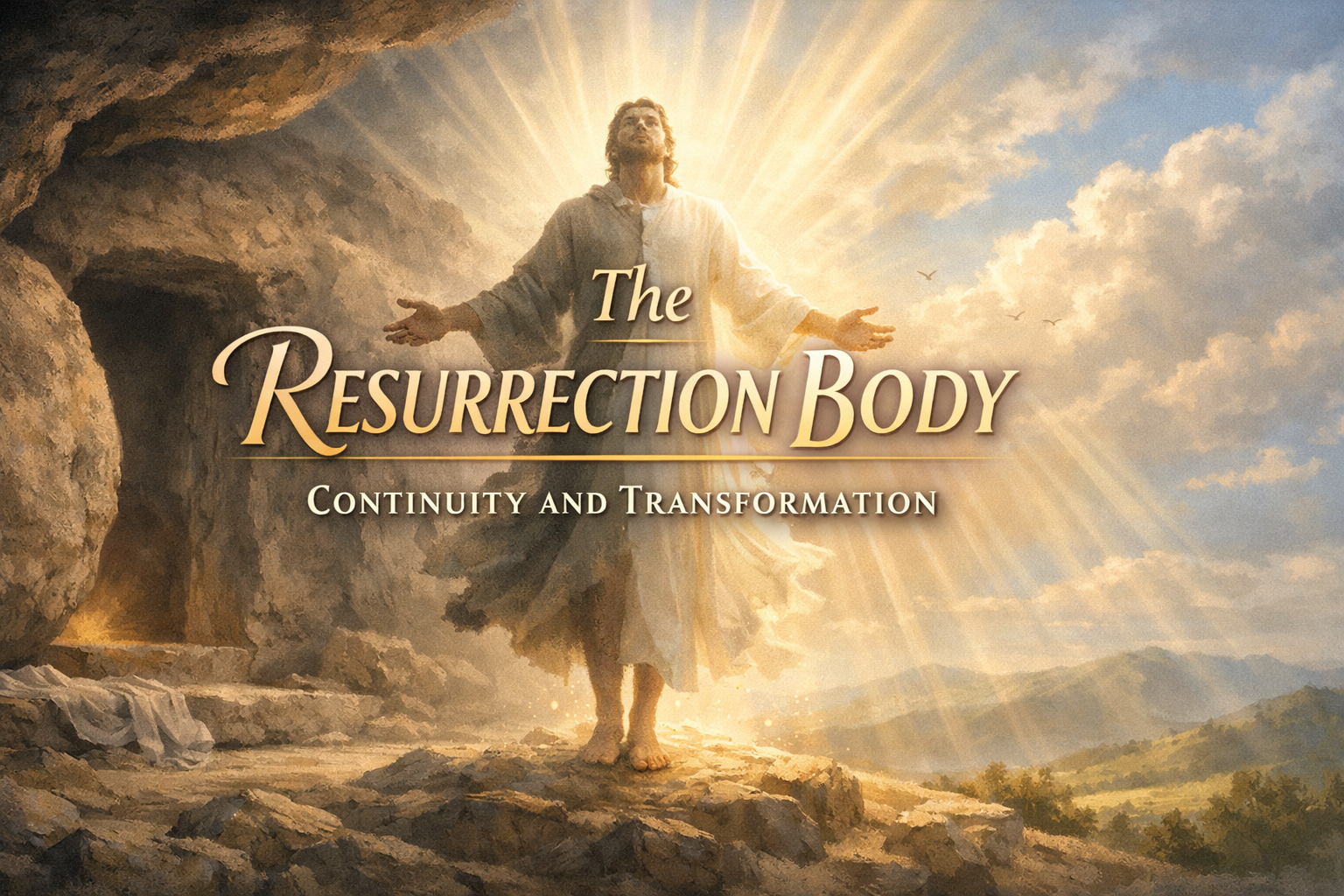
The Resurrection Body — Continuity and Transformation
The resurrection body will be the same body, and yet gloriously transformed. There is continuity, and there is transformation. It is really you, but you renewed. Really your body, but made fit for immortality. Not discarded, but redeemed. That truth stands at the heart of Christian hope — and it changes everything about how we face aging, suffering, and death.
There are some questions that stay with a man. Not because they are strange, but because they are close. Very close.
One of those questions is this: What will our resurrection body be like? When the Lord raises His people, will we still be ourselves? Will there be real continuity between this life and the next? Or will everything be so changed that we become almost unrecognizable?
That is not just a theological puzzle for scholars in libraries. That is a bedside question. A graveside question. A question for the saint who feels age in the bones, pain in the joints, weakness in the flesh, and wonders what God has prepared on the other side of death. It is a question for those who have buried believing parents, spouses, children, and friends and long to know whether the body laid in the ground is the same body God will raise in glory.
The Christian answer is both comforting and staggering: the resurrection body will be the same body, and yet gloriously transformed. There is continuity, and there is transformation. It is really you, but you renewed. Really your body, but made fit for immortality. Not discarded, but redeemed.
That truth stands at the heart of Christian hope.
Why This Matters
A great many people think Christianity is mainly about the soul going to heaven. That is part of the story, but it is not the whole story. The Bible does not teach that our final hope is to float forever in a bodiless spiritual state. The Christian hope is bigger, richer, and more earthy than that. It is the hope of resurrection.
God made man as body and soul. Sin brought death, decay, and separation. But Christ came not merely to rescue a piece of us. He came to redeem the whole person. His saving work reaches as far as the curse is found. That means not only forgiveness of sins, but the future resurrection of the body.
“Who shall change our vile body, that it may be fashioned like unto his glorious body, according to the working whereby he is able even to subdue all things unto himself.” — Philippians 3:21 (KJV)
“For the trumpet shall sound, and the dead shall be raised incorruptible, and we shall be changed.” — 1 Corinthians 15:52 (KJV)
Notice that language carefully. Raised and changed. There is continuity and transformation right there in the text.
The Christian Hope Is Bodily Resurrection
The clearest chapter in the Bible on this subject is 1 Corinthians 15. Paul was dealing with people who had trouble believing in the resurrection of the dead. So he did not soften the matter or turn it into poetry. He planted his feet and declared that if there is no resurrection, then the gospel itself falls apart.
“But now is Christ risen from the dead, and become the firstfruits of them that slept.” — 1 Corinthians 15:20 (KJV)
That word firstfruits matters. It means Christ’s resurrection is not an isolated miracle with no connection to us. It is the beginning of the great harvest. What happened to Him in resurrection glory will happen to His people.
That means the resurrection body is not a side issue. It belongs to the very victory of Christ. He did not merely survive death spiritually. He conquered death bodily. The tomb was empty. The body was raised. And because He lives, His people will be raised also.
Continuity: It Is Really You
The resurrection body has continuity with the body that dies. That matters because Christianity does not teach that God throws away His creation and starts from scratch. He redeems what sin has ruined.
When a farmer plants wheat, he does not expect corn to come up. When an acorn goes into the ground, an oak comes out — not a rock, not a fish, not some unrelated thing. There is change, yes, but there is also identity. Paul uses that very sort of picture:
“And that which thou sowest, thou sowest not that body that shall be, but bare grain… But God giveth it a body as it hath pleased him.” — 1 Corinthians 15:37–38 (KJV)
Some folks read that and think Paul is denying continuity. He is not. He is saying there is both sameness and difference. The seed and the plant are connected. One grows from the other. The thing buried is the thing God raises, but it does not come back in the same condition.
That helps us avoid two errors. The first says the resurrection body is basically unrelated to the present body. The second says the resurrection body is just this present body patched up a bit. Neither one is right. The Bible gives us something better — the same body raised in a new mode of life and power.
Job, speaking in deep suffering, looked forward to this hope:
“And though after my skin worms destroy this body, yet in my flesh shall I see God.” — Job 19:26 (KJV)
He did not say, “I will cease to be bodily.” He said, “In my flesh shall I see God.” That is continuity.
Jesus Is the Pattern
The strongest evidence for continuity and transformation is the risen Christ Himself. After His resurrection, Jesus was not a ghost. He was not a mere spiritual presence. He was bodily raised. He could be seen. He could be touched. He ate with His disciples. He still bore the marks of crucifixion.
“Behold my hands and my feet, that it is I myself: handle me, and see; for a spirit hath not flesh and bones, as ye see me have.” — Luke 24:39 (KJV)
That is continuity in bright daylight. Jesus could say, “It is I myself.” The same Jesus who had been crucified stood alive before them.
And yet there was transformation too. His resurrection body was no longer subject to death. No weakness could overtake Him again. No grave could claim Him again. No shame, curse, or decay rested on Him anymore. He was the same Lord Jesus, but glorified.
That matters because Scripture says our lowly bodies will be made like His glorious body (Philippians 3:21). Christ is not only our Savior from sin; He is the pattern of what redeemed humanity will be.
So when we ask, “Will I still be me?” the answer is yes. And when we ask, “Will I still be weak, frail, tempted, decaying?” the answer is no.
Transformation: Changed for Glory
The resurrection body is not merely a return to present conditions. It is a transformation into glory. Paul says:
“It is sown in corruption; it is raised in incorruption: It is sown in dishonour; it is raised in glory: it is sown in weakness; it is raised in power.” — 1 Corinthians 15:42–43 (KJV)
That is one of the most hope-filled descriptions in all the Bible. Let’s take it piece by piece.
Sown in Corruption, Raised in Incorruption
Every man who has watched age take hold of the body knows what corruption means. Hair grays. Vision dims. Strength slips. The body gets tired easier than it used to. Illness comes. Injury lingers. And finally death claims what dust already hinted at.
But the resurrection body will be incorruptible. No disease. No decay. No wearing down. No slow giving out. What God raises will never perish.
Sown in Dishonor, Raised in Glory
Death is a humiliating thing. The body that once worked, embraced, labored, knelt, and worshiped becomes still. Sin has brought man low. Even the best funeral cannot hide the sorrowful truth that death is an enemy.
But what is buried in dishonor will be raised in glory. The body of the believer will no longer bear the marks of Adam’s fall. It will reflect the triumph of Christ.
Sown in Weakness, Raised in Power
This present body is weak. Sometimes that shows up in dramatic sickness. Sometimes it shows up in the small daily reminders that we are not what we once were. We grow tired. We ache. We struggle. We cannot do all we wish.
But the resurrection body will be raised in power. Not sinful self-assertion, but strength suited to eternal life. Strength that never drains out. Strength that serves, rejoices, worships, and obeys without collapse.
What “Spiritual Body” Actually Means
One phrase in 1 Corinthians 15 sometimes trips people up:
“It is sown a natural body; it is raised a spiritual body.” — 1 Corinthians 15:44 (KJV)
Some take “spiritual body” to mean non-physical — like a ghost. But that cannot be right, because Paul is talking about a body, and because Jesus’ own resurrection was bodily. A “spiritual body” does not mean immaterial. It means a body fully animated, ruled, and empowered by the Spirit of God.
The natural body is fitted for this fallen world. The spiritual body is fitted for the coming age. The natural body is suited to life under Adam; the spiritual body is suited to life under Christ.
So do not think of the resurrection body as less real than this one. It will be more real, not less. More alive, not less. More fully human, because it will be humanity healed and glorified under the reign of Christ.
Not Replacement but Redemption
There is something deeply Christian here. God is not embarrassed by the body. He created it. The Son of God took on flesh. Jesus was born, lived, suffered, died, and rose bodily. And He remains the God-man forever.
That means redemption is not an escape from creatureliness. It is the cleansing and perfecting of creaturely life under God. Sometimes folks talk as if the body is a shell to be thrown off so the “real you” can finally be free. That is not Bible Christianity. The body is not a prison. Sin is the prison. Death is the enemy. Corruption is the problem. And the answer is not bodily abandonment but bodily resurrection.
Romans 8 says creation itself groans, and believers groan too:
“Waiting for the adoption, to wit, the redemption of our body.” — Romans 8:23 (KJV)
There it is plain as day: the redemption of our body. Not the disposal of our body. Not the denial of our body. The redemption of our body.
What Will Remain, and What Will Be Gone?
This is where many people naturally ask practical questions.
Will we recognize one another? Scripture strongly points in that direction. Jesus was recognized after the resurrection. Moses and Elijah were recognizable at the Transfiguration. The saints are consistently spoken of as themselves, not as erased identities. Christian hope includes real personal identity and recognition.
Will we still have our history? Yes, but without sin’s burden, shame, or sorrow owning us. Redemption does not erase your story; it brings your story under the mercy and triumph of God.
What will be gone? Sin, corruption, shame, frailty, sickness, death, and every effect of the fall that now clings to the body. No lust. No exhaustion. No dementia. No cancer. No wheelchairs. No failing eyesight. No trembling hands. No funerals.
That is not sentiment. That is gospel hope worked out in bodily terms.
Continuity Guards Our Identity, Transformation Guards Our Hope
Why does continuity matter so much? Because without it, resurrection starts sounding like replacement. If God simply makes some other being and calls it you, that is not resurrection — that is substitution.
The comfort of the gospel is that you yourself will be raised. The believer who trusted Christ, loved Him imperfectly, suffered here, and died in hope — that very believer will stand in glory.
The Lord is not losing track of His people. He knows exactly whose bones lie in the ground. He knows exactly whose ashes have blown in the wind. He knows exactly how to call His own forth on the last day.
“The hour is coming, in the which all that are in the graves shall hear his voice, And shall come forth…” — John 5:28–29 (KJV)
But transformation matters too. Because if continuity were all we had, we would only come back as we are now — still wounded, still corruptible, still under the shadow of decay. The Christian hope is not resuscitation into the same fallen order. It is resurrection into a glorified order.
Lazarus was raised, but he would die again. Jesus was raised never to die again. And believers will share in that kind of resurrection life. Transformation means the body becomes perfectly suited for the new heavens and new earth — complete wholeness, perfect obedience without inward resistance, joy in worship without distraction, strength without pride, rest without boredom.
“Beloved, now are we the sons of God, and it doth not yet appear what we shall be: but we know that, when he shall appear, we shall be like him; for we shall see him as he is.” — 1 John 3:2 (KJV)
A Word for Veterans
Anyone who has served knows something about what it costs to live in a body. You know about injuries that never quite healed, about pain that became a permanent roommate, about the way combat stress can settle into the body and stay there for decades. You know about watching fellow soldiers go down — young men and women with strong bodies, cut short.
The resurrection has something to say to all of that.
The body you came back with — the one marked by service, by wounds, by what you saw and carried — that is not the final version. Every limitation, every injury, every scar that cost you something: the Lord who conquered death has also conquered all of that. He redeems the whole man. Not just the soul. Not just the mind. The body too.
And the men and women you lost who knew Christ — they are not gone forever. Their bodies may be in the ground, but the day is coming when those graves will not hold. The same Lord who emptied His own tomb will not leave His people in theirs.
In the military, you learn that no man left behind is not just a slogan — it is a commitment. The Lord Jesus operates on a similar principle with His own. Not one of His will be left in the grave on the last day.
A Rural Illustration
Think of an old orchard in winter. The branches look bare, twisted, and dead. The ground is hard. Frost sits on the rows. To a stranger passing by, it may look finished.
But the farmer knows better.
Life is there, though hidden. Spring will come. What looked lifeless will bud. What looked spent will bloom again. Not a different orchard, but this orchard renewed in season.
Now every illustration limps, and resurrection is far greater than an orchard in spring. But it helps make the point. The believer’s body may be laid in the cold ground. It may look final to human eyes. But the Lord of life has not forgotten what He planted there. At His appointed hour, what was sown in weakness will be raised in power.
Not discarded. Not replaced. Raised.
Christ the Firstfruits, Believers Afterward
The whole doctrine stands or falls with Christ. If Jesus did not rise bodily, then there is no Christian hope worth speaking of. Paul says as much. But if He did rise — and He did — then the resurrection of His people is certain.
“For as in Adam all die, even so in Christ shall all be made alive.” — 1 Corinthians 15:22 (KJV)
Adam handed down mortality, corruption, and death. Christ brings life, righteousness, and resurrection. The first man dragged us into the dust. The second Man, the Lord from heaven, will raise His people into glory.
That is why the believer’s future is not uncertain. It is tied to a living Christ who cannot fail.
Key Takeaways
- The Christian hope is bodily resurrection, not merely a spiritual afterlife. God redeems the whole person — body and soul — and the grave is not the end of the story.
- There is real continuity between your present body and your resurrection body. It is truly you who will be raised — not a replacement, but the same person redeemed and renewed.
- There is also real transformation — from corruption to incorruption, from weakness to power, from dishonor to glory. The resurrection body is suited for eternal life in the presence of God.
- Jesus Christ is both the proof and the pattern. His bodily resurrection guarantees ours, and His glorified body shows us what redeemed humanity will be like.
- This doctrine changes how we live now. It gives dignity to the body, courage in aging and suffering, and an anchor for our hope that is sturdier than sentiment — it is grounded in a risen Savior.
Final Encouragement
Christian friend, your future is not a thin little spiritual existence floating somewhere far away. Your future is resurrection life in a redeemed creation under a reigning Christ. The same Lord who saved your soul will also raise your body. The cemetery is not the end of the story. Decay is temporary. Grief has an expiration date. Christ will finish what He started.
And if you are worn down today — by age, by pain, by illness, by sorrow — then take heart. The body you now carry in weakness is not the final edition. The Lord has promised better.
The trumpet will sound.
The dead will be raised.
And we shall be changed.
“O death, where is thy sting? O grave, where is thy victory?” — 1 Corinthians 15:55 (KJV)
Because in Christ, even the grave is only borrowed ground.
Key Scriptures:
1 Corinthians 15:20–58 | Philippians 3:20–21 | Romans 8:18–25 | Luke 24:36–43
John 5:28–29 | 1 John 3:2 | Job 19:25–27 | 2 Corinthians 4:16–5:5