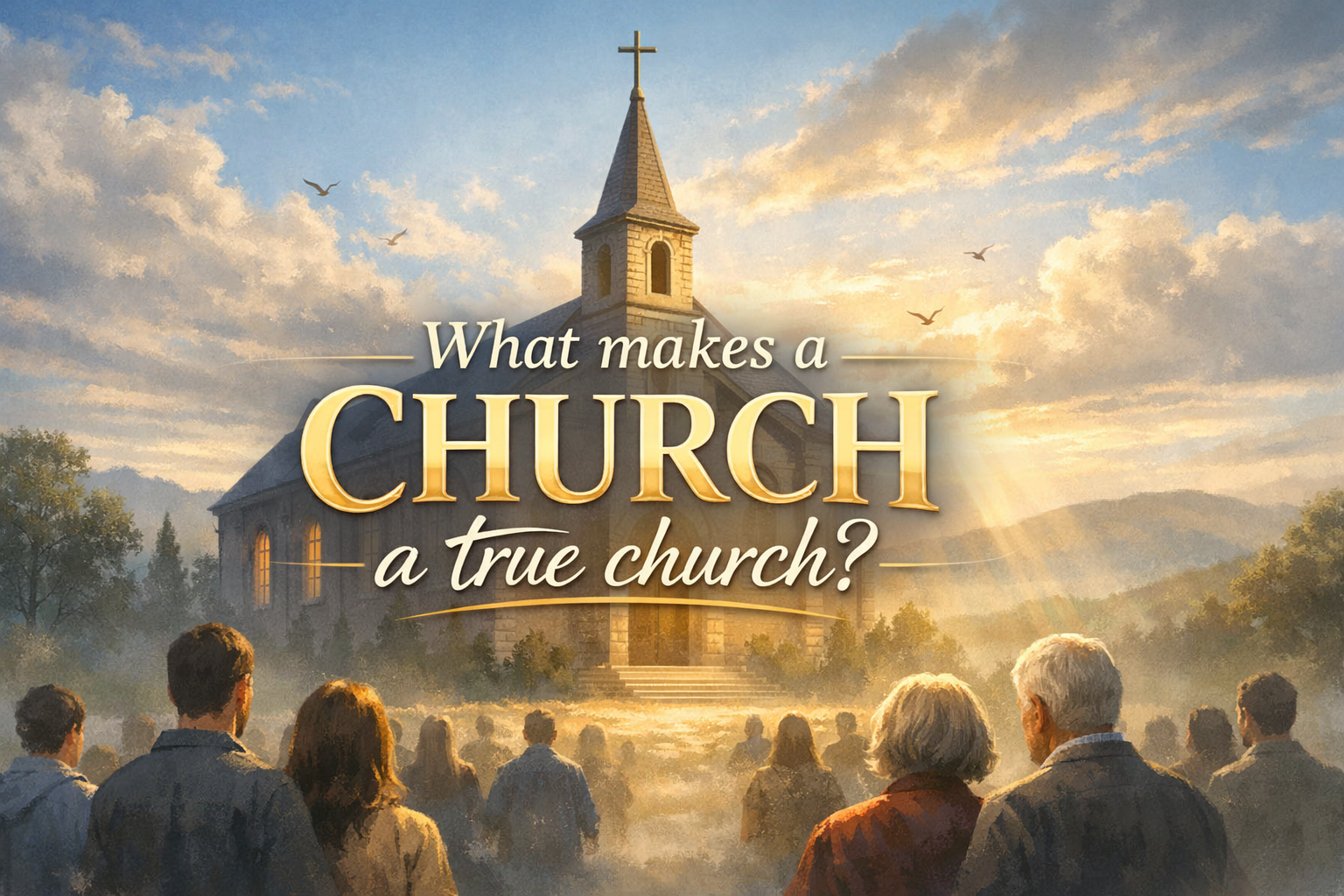
What makes a church a true church?
In an age of religious noise, slick branding, and spiritual confusion, one question cuts through everything else: What actually makes a church a true church? The answer has nothing to do with the building, the style, or the crowd — and everything to do with faithfulness to Jesus Christ, the gospel, and the Word of God.
Some churches meet in brick buildings with steeples. Some gather in school gyms, storefronts, or living rooms. Some have choirs and hymnals. Some have guitars and video screens. Some are large and polished. Some are small and plain. And across that entire spectrum, you can find churches that are faithful — and churches that are adrift.
The building doesn’t settle it. The music style doesn’t settle it. The attendance numbers don’t settle it. The reputation in town doesn’t settle it. What settles it is this: A true church is one that is faithful to Jesus Christ, the gospel, and the Word of God.
That may sound like a simple answer, but it cuts through a lot of fog. Let’s walk through what it actually means.
The Church Belongs to Christ
Before we talk about what a true church does, we need to be clear about whose church it is.
The church does not belong to a pastor. It does not belong to a denomination. It does not belong to the people with the most money, the strongest opinions, or the loudest voices. Jesus said in Matthew 16:18, “I will build my church; and the gates of hell shall not prevail against it.”
Notice that: my church. That changes everything. If the church belongs to Christ, then Christ defines what it is. We do not get to reinvent it according to the spirit of the age. We do not get to treat it like a business, a social club, a motivational center, or a political machine. As Colossians 1:18 says, Christ is “the head of the body, the church.”
A true church lives under the headship of Jesus. It does not merely mention His name. It submits to His lordship. That means a church can have a fine reputation in town and still be unhealthy before God — nice people, good coffee, strong programs, full parking lot, and yet spiritually adrift if Christ is no longer truly central.
A true church asks, in every matter: What does the Lord say? What honors Christ? What is faithful to His Word? That is where truth begins.
A True Church Preaches the True Gospel
If you lose the gospel, you lose the church — no matter what else remains.
The gospel is not religious advice. It is not a call to self-improvement. It is not a pep talk for troubled people. It is not moralism dressed up in church clothes. The gospel is the good news that sinners are saved by the grace of God through faith in Jesus Christ — through His sinless life, His atoning death on the cross, and His bodily resurrection from the grave.
1 Corinthians 15:3–4 — “Christ died for our sins according to the scriptures; and that he was buried, and that he rose again the third day according to the scriptures.”
That is the heart of the Christian faith. A true church does not soft-pedal sin, because without the truth about sin, grace no longer makes sense. It does not hide the cross, because without the cross there is no forgiveness. It does not treat the resurrection like a religious symbol, because without the resurrection there is no living hope.
A true church tells people the truth: We are sinners by nature and by choice. We cannot save ourselves. Christ has done what we could never do. Salvation is found in Him alone. He calls all people everywhere to repent and believe the gospel.
There are plenty of places today that offer inspiration, affirmation, and life coaching. A true church offers something better and deeper: the saving gospel of Jesus Christ. If a church stops preaching Christ crucified and risen, it may still look active — but spiritually speaking, the fire has gone out in the stove.
A True Church Stands Under the Authority of Scripture
A true church is a Bible-ruled church. That does not mean the people worship the Bible instead of God. It means they understand that God has spoken, and He speaks through His Word.
2 Timothy 3:16–17 — “All scripture is given by inspiration of God, and is profitable for doctrine, for reproof, for correction, for instruction in righteousness: that the man of God may be perfect, thoroughly furnished unto all good works.”
The church does not get to rewrite what God has already said. It does not get to trim the sharp edges off biblical truth because the culture dislikes them. It does not get to elevate tradition, trends, or politics over the Word of God.
In a true church, preaching is not mainly storytelling, motivational speech, or commentary on current events with a few verses sprinkled on top. The aim is to explain what God has said, apply it faithfully, and point people to Christ. Paul told Timothy plainly: “Preach the word” (2 Timothy 4:2). That is still the charge.
You can tell a lot about a church by how it handles the Word. Does the preaching open up the text? Does it deal honestly with hard passages? Does it teach doctrine as well as devotion? Does it call people not just to feel something, but to believe and obey what God has said? A true church does not ask first, “What will work?” It asks, “What is true?”
A True Church Exalts Christ Above Personalities
Every church has leaders, and God gives leaders as gifts to His people. Pastors matter. Elders matter. Faithful shepherds are a genuine blessing. But the church must never become centered on a human personality.
That danger is in every age. People can become attached to the preacher’s style, the leader’s charisma, or the ministry brand. Before long, Christ is spoken of, but the real energy is tied to a man. Paul confronted that spirit in Corinth when people were dividing over names — “I am of Paul,” “I am of Apollos” (1 Corinthians 3:4). His response was plain: ministers are servants, but God gives the increase.
In plain country terms, a true church is not built around one strong horse in the harness. It is built on the Chief Shepherd. Leaders come and go. Christ remains. A true church is grateful for faithful leadership, but it does not confuse the servant with the Savior.
A True Church Faithfully Practices Baptism and the Lord’s Supper
Historically, Christians have spoken of the “marks” of a true church. Among the clearest is the faithful administration of the ordinances Christ gave His church.
Baptism marks identification with Christ. It is a public sign of belonging to Him — a picture of cleansing, repentance, union with Christ, and new life. A true church takes baptism seriously. It teaches what it means. It does not treat it like empty custom or family tradition.
The Lord’s Supper proclaims Christ’s death until He comes (1 Corinthians 11:26). It reminds believers that their hope rests not in their own goodness, but in Christ’s broken body and shed blood. A true church approaches the Lord’s Table with reverence, gratitude, self-examination, and joy.
These ordinances do not save anyone by themselves. But they matter because Christ gave them. A church that neglects what Christ commanded is not acting like a faithful church.
A True Church Calls People to Holiness
A true church is not sinless — but it takes sin seriously. Every real church is made up of imperfect people. But there is a great difference between a church that struggles against sin and a church that settles down and makes peace with it.
Titus 2:11–12 — “The grace of God that bringeth salvation hath appeared to all men, teaching us that, denying ungodliness and worldly lusts, we should live soberly, righteously, and godly, in this present world.”
The gospel not only pardons — it changes. A true church teaches its people to pursue purity, humility, honesty, faithfulness, compassion, self-control, and godliness. It does not celebrate what God forbids, shrug at rebellion, or treat holiness as an optional extra for unusually serious Christians.
Holiness is not legalism. It is not earning salvation. It is the fruit of belonging to Christ. That kind of formation is slow work — more like farming than fireworks. It takes time, care, watering, weeding, patience, and the blessing of God. But where the Spirit is at work through the Word, growth comes.
A True Church Practices Loving Discipline
This is one of the least popular marks of a true church, but it is one of the clearest in the New Testament. Church discipline is not about control or public humiliation. At its best, it is an expression of love, truth, and holiness.
Jesus addressed it in Matthew 18:15–17. Paul addressed it in 1 Corinthians 5. The point is simple: when serious sin is embraced without repentance, the church must not act like nothing is wrong — because sin damages the sinner, harms the church, and dishonors Christ. The goal is always repentance and restoration, not punishment.
Discipline must be handled carefully, humbly, and biblically. It can be abused, and when it is, it leaves deep wounds. But the answer to abuse is not neglect. A church that never confronts open sin is not more loving. It is simply less faithful. Love has backbone.
A True Church Is Marked by Genuine Love
Truth matters. Doctrine matters. Sound teaching matters. But truth without love becomes cold, harsh, and brittle.
John 13:35 — “By this shall all men know that ye are my disciples, if ye have love one to another.”
That kind of love is more than friendliness at the door. More than coffee and small talk in the fellowship hall. It is the lived reality of Christian fellowship — bearing one another’s burdens, forgiving one another, praying for one another, serving when no one sees, weeping with those who weep.
Real love shows up in hospital rooms, graveside prayers, meal trains, quiet phone calls, hard conversations, and long seasons of endurance. It stays when things are awkward. It listens. It forgives. It tells the truth.
A church can be doctrinally sharp and relationally dead. That is not health. A true church holds fast to truth and displays the love of Christ in the way its people live together. People can tell the difference between genuine love and stage paint. Folks always could.
A True Church Makes Disciples, Not Just Attenders
Jesus did not say, “Go gather crowds.” He said, “Go ye therefore, and teach all nations” (Matthew 28:19). The mission of the church is disciple-making.
That includes evangelism — calling the lost to repentance and faith. But it also includes teaching believers to observe all that Christ commanded. A true church is not merely a place where conversions happen. It is a place where Christians are taught to walk with God.
A true church is concerned not only with decisions, but with maturity. Not only with attendance, but with obedience. Not only with professions, but with perseverance. It teaches doctrine, encourages prayer, trains families, corrects error, equips believers for service, and helps God’s people endure suffering.
The goal is not to produce consumers of religious goods and services. The goal is to produce disciples who know Christ, love Christ, obey Christ, and bear witness to Christ. In plain terms: a true church is not trying to fill seats alone. It is trying to raise up saints.
A True Church Depends on Prayer and the Holy Spirit
Churches can become busy places — meetings, calendars, plans, programs, projects. Some of that is necessary. Organization is not the enemy. But activity is not the same thing as spiritual life.
In Acts 2:42, the early believers “continued steadfastly in the apostles’ doctrine and fellowship, and in breaking of bread, and in prayers.” Prayer was not a decorative item at the end of the service. It was part of the church’s lifeblood.
Psalm 127:1 — “Except the Lord build the house, they labour in vain that build it.”
A church that is prayerless may still be efficient. It may still look successful. But something essential is missing. A true church understands that the church is not kept alive by talent, polish, or machinery. It is sustained by Christ through His Spirit — and it prays like it believes that.
A True Church Endures in the Truth
Not every church that starts well stays well. That is one of the sobering lessons of the New Testament. In Revelation 2–3, Jesus addressed churches with real strengths and real failures — some had lost their first love, some tolerated false teaching, some appeared alive but were spiritually dead.
That means reputation is not enough. History is not enough. Past faithfulness is not enough. A church must continue in the truth. A church can drift slowly — usually not all at once, but one compromise at a time, one avoided truth at a time, one worldly accommodation at a time. That is why churches must remain watchful.
A true church is not perfect. But it is repentant. When corrected by the Word, it bows. When sin is exposed, it comes back to the Lord rather than justifying itself forever. That humility is a mark of health.
What a True Church Is Not
It helps to say this plainly. A true church is not defined by a beautiful building, polished worship production, a large congregation, a long history, a certain denomination by name alone, a charming pastor, emotional experiences, political agreement, or slick branding.
None of those things, by themselves, prove a church is true. A church may have all of them and still be spiritually hollow. On the other hand, a church may be small, plain, imperfect, and largely unnoticed — yet still be a faithful church if Christ is central, the Word is preached, and the gospel is believed.
You can meet in a cathedral or a country barn. You can sing with a pipe organ or a borrowed guitar. You can gather fifty people or five hundred. Those are secondary matters. The main question is this: Is this church faithful to Christ?
How to Evaluate a Church
If someone asks, “How do I know whether a church is sound?” here are some plain questions worth asking:
- Is the gospel clear?
- Is the Bible preached and honored?
- Is Christ truly central — not just in name, but in practice?
- Are baptism and the Lord’s Supper practiced with biblical seriousness?
- Is there a real call to repentance, faith, and holiness?
- Is love visible among the people?
- Are disciples being made?
- Do the leaders appear to serve humbly under Christ?
- Is prayer a real part of the church’s life?
- Is the church willing to obey Scripture even when it costs something?
Those questions will tell you more than the website, the logo, the music style, or the social media presence ever will.
Key Takeaways
- The church belongs to Christ, not to any human personality or institution. A true church lives under the headship of Jesus in every decision it makes, not just in name.
- The gospel is non-negotiable. Without the clear preaching of Christ crucified, buried, and risen — and the call to repent and believe — a church has lost its reason for existing.
- Scripture is the church’s final authority. A Bible-ruled church does not trim what God has said to fit the preferences of the age. It submits humbly and preaches faithfully.
- Faithfulness requires more than good doctrine. Truth without love is brittle. Doctrine without discipleship produces consumers, not saints. A true church is marked by both sound teaching and genuine Christian community.
- A true church is not a perfect church. It is a repentant one — one that keeps returning to the gospel, to Scripture, to holiness, and to the lordship of Christ when it drifts.
Key Scriptures: Matthew 16:18 · Matthew 18:15–17 · Matthew 28:19–20 · John 13:35 · 1 Corinthians 15:1–4 · Colossians 1:18 · 2 Timothy 3:16–17 · 2 Timothy 4:2 · Titus 2:11–12 · Psalm 127:1 · Revelation 2–3