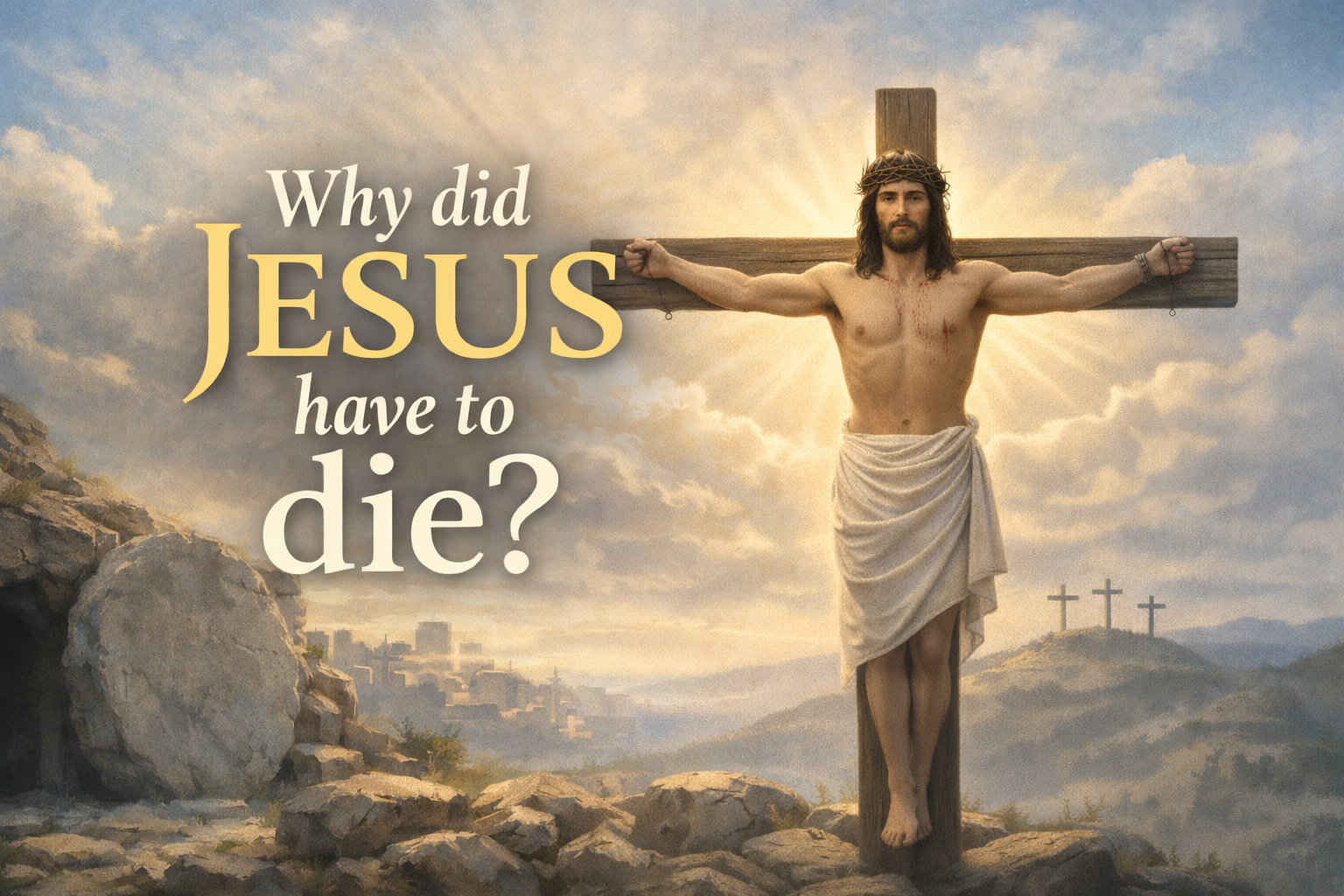
Why did Jesus have to die?
The cross is the center of Christianity. Every major doctrine connects to it. The entire Old Testament points toward it. The entire New Testament unpacks it. And yet a surprising number of people who call themselves Christians have never seriously asked why it had to happen — why God, if He is God, couldn’t simply forgive sin without the death of His Son. That question deserves a serious answer, and the New Testament gives one.
If God is all-powerful, couldn’t He have just forgiven everyone without all this? The question sounds simple. The answer goes to the heart of who God is and what sin actually costs.
The cross is not self-explanatory. That sounds strange to say, because it sits at the center of the Christian faith and Christians talk about it constantly. But most people — including many who have attended church for decades — carry an explanation of the cross that is either too thin to bear the weight the New Testament places on it or distorted in ways that produce a God who is either arbitrarily violent or a pushover who doesn’t take sin seriously.
The thin version goes like this: Jesus died to show us how much God loves us, and the death itself is primarily a demonstration. The distorted version goes like this: God was so angry at sin that He needed to punish someone, and Jesus volunteered to take the hit. Both versions have a fragment of truth in them. Both miss what the New Testament is actually doing when it explains the cross.
The actual explanation is richer and more demanding than either. It requires understanding something about the nature of God — specifically His holiness and His justice — and something about the nature of sin — specifically what it actually costs and who bears that cost. When you put those two things together, the cross stops looking like an arbitrary theological requirement and starts looking like the only possible resolution to the deepest problem in the universe.
The Problem: God Cannot Simply Overlook Sin
The question “Why couldn’t God just forgive everyone without the cross?” rests on an assumption worth examining: that forgiveness is a simple act that costs the forgiver nothing.
In human experience, genuine forgiveness is never free. When someone wrongs you seriously — steals from you, betrays you, destroys something precious — and you choose to forgive them, what happens to the cost of what they did? It does not evaporate. It lands on you. You absorb the loss, the pain, the injustice. True forgiveness is not the cancellation of a debt — it is the transfer of the debt from the offender to the forgiver. The forgiver pays what the offender owed.
Now scale that to what sin actually is. Sin is not primarily a social offense or a personal failing that makes life go poorly. It is a violation of the character and law of the God who made and sustains everything that exists. The universe is His. The creatures are His. The moral order is His. Sin is cosmic treason — it is the creature saying to the Creator that His authority, His character, and His claims on human life are rejected. That is not a small thing. And it does not come with a small price tag.
A God who responds to cosmic treason by shrugging and saying “don’t worry about it” is not a loving God. He is a God who does not take His own character seriously — a God for whom the moral order He established means nothing when it becomes inconvenient. That God cannot be trusted, because a God indifferent to justice is a God indifferent to everything. The victims of every injustice in history should find cold comfort in a God who lets it all slide.
This is why Paul’s argument in Romans 3:25–26 is structured the way it is. God presented Christ as a propitiation — a wrath-absorbing sacrifice — to demonstrate His righteousness. The argument has two parts: God was right to forgive sins committed before the cross (they were covered by the anticipated sacrifice), and God is right to justify the one who has faith in Jesus now. The cross is the public demonstration that God did not sweep sin under the rug. He dealt with it — at His own expense — in a way that vindicates His justice and accomplishes His mercy simultaneously.
What the Old Testament Was Building Toward
The cross did not arrive without preparation. The entire sacrificial system of the Old Testament was a centuries-long education in the costliness of sin and the necessity of a substitute.
The principle is established early. In the Garden, after the Fall, God makes garments of skin for Adam and Eve (Genesis 3:21). Something died so they could be covered. It is a quiet, understated beginning to a theme that will run through the entire Old Testament: sin requires the shedding of blood, and something innocent bears the cost that the guilty cannot pay.
The sacrificial system codified in Leviticus makes this explicit and systematic. The worshiper brings an animal without blemish. He places his hand on its head — a gesture of identification, of transferring his standing to the animal. The animal is killed. The blood is applied. The worshiper is declared clean (Leviticus 1:4, 16:21–22). The system is not magic. The writer of Hebrews is clear that “it is impossible for the blood of bulls and goats to take away sins” (Hebrews 10:4). The animal sacrifices did not accomplish what they pointed to. They were shadows, anticipations, the form without the ultimate substance. They were the pedagogy by which God was preparing His people to understand what the cross would finally accomplish.
Isaiah 53 is the Old Testament’s clearest preview of the cross. Written seven centuries before it happened, it describes a suffering servant who bears the iniquities of the people, who is pierced for their transgressions and crushed for their iniquities, upon whom the Lord lays the punishment that brings others peace (Isaiah 53:5–6). The language of substitution — one bearing the penalty that belongs to others — is unambiguous. The New Testament writers understood immediately that this was the text that explained the death of Jesus. Philip in Acts 8 uses it. Peter quotes it. Paul draws on it repeatedly. The cross was not an accident of history. It was the destination the entire Old Testament had been pointing toward.
The Theories of the Atonement
Christian theology has developed several frameworks for explaining what happened at the cross. These are sometimes called “theories of the atonement” — not theories in the sense of speculation, but models that illuminate different facets of what the cross accomplished. No single model exhausts the meaning. Together they form a richer picture than any one of them can produce alone.
Penal substitution is the framework most central to the Reformed tradition. The cross is understood as the place where Christ bore the penalty that sin deserved — in the place of sinners. God’s holy wrath against sin is real, and it was absorbed by Christ so that it would not fall on those He represented. The judicial language of Romans 3 and the Isaiah 53 servant language both support this framework most directly. It answers the question “Why couldn’t God just forgive?” most precisely: because the penalty was real and had to be borne, and Christ bore it.
Moral influence (or moral exemplar) understands the cross primarily as the supreme demonstration of God’s love — a love so costly that it breaks the power of sin’s hold on the heart that encounters it. There is genuine biblical support for this dimension: “We love because he first loved us” (1 John 4:19), and the cross is undeniably the fullest expression of that love. The weakness of treating this as the whole explanation is that it reduces the cross to a demonstration, which leaves the actual guilt of sin unaddressed. A demonstration of love, however costly, does not pay anyone’s debt.
Christus Victor understands the cross and resurrection as the decisive victory over the powers of sin, death, and the devil. Christ entered enemy territory, was killed, and rose — defeating the very powers that killed Him and liberating those held captive. This framework draws on Colossians 2:15, Hebrews 2:14–15, and the cosmic scope of the New Testament’s language about what Christ accomplished. It captures something real that the purely forensic models can underemphasize: the cross was not just a legal transaction but a battle won.
Reconciliation understands the cross as the restoration of the broken relationship between God and humanity — the making of peace between enemies. Paul’s language in Romans 5:10–11 and 2 Corinthians 5:18–20 is explicitly relational: we were enemies, we are reconciled, God was in Christ reconciling the world to Himself.
These frameworks are not rivals. They are facets of the same diamond. The cross simultaneously satisfies the demands of God’s justice (penal substitution), demonstrates the depth of His love (moral influence), defeats the powers that enslaved humanity (Christus Victor), and restores the broken relationship between God and His creatures (reconciliation). Any single model that claims to be the whole story has reduced the cross to something smaller than the New Testament presents.
Why a Substitute? Why This Substitute?
Two questions press at the heart of the atonement. First, why a substitute at all — why does someone else’s death solve my problem? Second, why does this particular death — the death of the Son of God — have infinite scope? Why can one death cover the sins of millions?
The answer to the first question lies in the nature of representation. Human beings do not exist as isolated individuals in the biblical framework — they exist as members of corporate bodies, represented by heads whose choices and standing affect the whole. Adam was not just one man making one choice. He was the head of the human race, and his fall implicated the race he represented (Romans 5:12–19). Christ is the second Adam — the new head of a new humanity — and His obedience and death accomplish for those He represents what Adam’s disobedience undid. Substitution is not an arbitrary mechanism. It is the logic of headship and representation that runs through the entire biblical story.
The answer to the second question lies in who Christ is. An ordinary human being dying for his own sins has no surplus merit to offer anyone else. But the eternal Son of God, who took on human nature without ceasing to be divine — His life has infinite value. His death is not the death of a finite creature absorbing a finite penalty. It is the death of the infinite Son bearing, in His human nature, the penalty of a human race. The scope of what the cross can cover corresponds to the infinite dignity of the one who suffered it.
For our sake he made him to be sin who knew no sin, so that in him we might become the righteousness of God.
— 2 Corinthians 5:21
That exchange — our sin credited to Him, His righteousness credited to us — is the heart of the atonement. It requires a substitute who is both genuinely human (able to represent us and die in our place) and genuinely divine (able to bear an infinite weight and emerge from the other side). No one else qualifies. That is why no one else could do it.
The Wrath of God: Is It Really There?
Modern theology is deeply uncomfortable with the idea that God has wrath — that He is personally and righteously angry at sin. The preferred alternative is to speak of impersonal consequences built into the moral order, or of a God whose love is so comprehensive that wrath has no real place in His character. Both alternatives distort the biblical picture and weaken the cross in the process.
The wrath of God is not a peripheral concept in the New Testament. Paul opens Romans with the declaration that “the wrath of God is revealed from heaven against all ungodliness and unrighteousness of men” (Romans 1:18). The same Paul who writes the most extended treatment of God’s love in the New Testament — “nothing can separate us from the love of God” (Romans 8:38–39) — is the same writer who treats divine wrath as real, personal, and serious. He does not see a contradiction between the two. The wrath and the love are both attributes of the same holy God.
The word propitiation — used in Romans 3:25, 1 John 2:2, and 1 John 4:10 — means the turning aside of wrath through a sacrifice. John Stott put it plainly: God himself, in the person of His Son, took the initiative to bear the wrath that we deserved. This is not cosmic child abuse — a common modern objection — because the Father and the Son are not two separate beings with competing wills. The Trinity acts together. The Father does not punish an innocent third party. He Himself, in the Son, absorbs the penalty that His own justice requires. The love and the wrath meet at the cross. That is why it is simultaneously the most terrible and the most glorious event in history.
The Resurrection Is Not Separate
The cross cannot be properly understood without the resurrection, and the resurrection cannot be properly understood without the cross. They are one event in two movements.
The cross without the resurrection is a tragedy — a righteous man executed unjustly, a movement crushed by the powers it opposed. It might be inspiring in the way that other martyrdom stories are inspiring, but it accomplishes nothing beyond the moment. There is no victory without Easter. There is no declaration that the penalty has been fully paid and accepted by the Father without the resurrection that vindicates the Son.
Paul makes this explicit: “If Christ has not been raised, your faith is futile and you are still in your sins” (1 Corinthians 15:17). He does not say “you are left without a moral example.” He says you are still in your sins — meaning the cross, without the resurrection, did not accomplish justification. The resurrection is God the Father’s public declaration that the sacrifice was accepted, the penalty was paid, and the Son’s claim to be the one who could bear it was vindicated.
The resurrection is also the beginning of the new creation. Christ is “the firstfruits of those who have fallen asleep” (1 Corinthians 15:20) — the first instance of the resurrection that all His people will share. The cross deals with sin and guilt. The resurrection inaugurates the age that sin and death will not define. Together they constitute the gospel: Christ died for our sins and was raised for our justification (Romans 4:25).
What the Cross Demands of Us
The cross is not primarily a doctrine to be understood — it is a reality to be responded to. And the response it demands is not merely intellectual agreement.
It demands faith — not as a work that earns the benefit of the cross, but as the hand that receives what Christ accomplished. “Believe in the Lord Jesus, and you will be saved” (Acts 16:31). The invitation is open. The accomplishment is complete. The only question is whether you will receive it.
It demands repentance — a genuine turning away from sin and toward God. Not as a prerequisite that earns grace, but as the honest response of a person who understands what their sin cost. If the cross reveals what sin actually costs — the death of the Son of God — then treating sin casually becomes impossible for the person who has genuinely grasped it. The cross is the most powerful anti-sin argument in existence.
It demands a new orientation to suffering. Paul’s conviction that “the sufferings of this present time are not worth comparing with the glory that is to be revealed” (Romans 8:18) is grounded in the cross. The God who did not spare His own Son in the darkest hour of history is the God who can be trusted with your darkest hour. The cross does not explain suffering. It transforms the person who carries it by establishing what God is willing to bear alongside His people.
And it demands a life shaped by the same self-giving love. Paul tells the Philippians to have the same mind as Christ, who did not count equality with God a thing to be grasped but emptied Himself, taking the form of a servant, being obedient to death, even death on a cross (Philippians 2:5–8). The cross is not just what saves you. It is the pattern of the life you are now called to live — a life of downward mobility, of preferring others, of absorbing cost rather than inflicting it.
A Word to Veterans
Veterans understand sacrifice at a level most civilians don’t. They know what it means to put yourself between threat and the people who can’t protect themselves. They know what it costs to hold a position when holding it is the only thing standing between your people and catastrophe. And they know, better than most, that some debts cannot be repaid — that you carry the weight of those who didn’t make it home, and that no amount of achievement afterward closes that account.
The cross addresses that weight at a depth no human framework can reach. The debt that sin accumulates — before God, in the conscience, in the ledger of all the things done and left undone — is real, and no amount of subsequent good behavior cancels it. What the cross offers is not a fresh start earned by trying harder. It is the actual payment of an actual debt by the only one who could pay it, offered freely to those who cannot pay it themselves.
For veterans carrying moral injury — the weight of decisions made under impossible circumstances, actions that can’t be taken back, the faces that don’t go away — the cross is not a religious sentiment. It is the claim that Someone has gone into the worst of what human existence can produce, absorbed its full cost, and emerged on the other side. Not by surviving it. By defeating it.
That is not a small claim. It is worth taking seriously at full strength.
Key Takeaways
- Forgiveness is never free — it always costs the forgiver. God could not simply overlook sin without abandoning His own justice and the moral order He established. The cross is how God paid the cost Himself rather than demanding it from those who owed it.
- The Old Testament sacrificial system was centuries of preparation for the cross. The principle — innocent substitute bearing the cost the guilty cannot pay — runs from Genesis 3 through Leviticus through Isaiah 53. The animal sacrifices were shadows pointing to the substance that only Christ could provide.
- The atonement has multiple dimensions, not one. Penal substitution, moral influence, Christus Victor, and reconciliation are not competing theories — they are facets of what the cross accomplished simultaneously. Reducing the cross to any single model shrinks what the New Testament presents.
- Only the God-man could do what the cross required. A purely human substitute could not bear an infinite penalty. A purely divine being could not represent humanity or die in its place. The incarnation — God becoming genuinely human while remaining fully divine — is the necessary precondition for the atonement.
- The wrath of God is real, personal, and present at the cross. Propitiation — the turning aside of wrath — is the New Testament’s own word for what the cross accomplished. God Himself, in the person of the Son, absorbed the penalty His own justice required. This is not cruelty — it is the love and justice of the Trinity acting together.
- The cross and resurrection are one event in two movements. Without the resurrection, the cross is a tragedy. Without the cross, the resurrection is inexplicable. Together they constitute the gospel: Christ died for our sins and was raised for our justification.
Key Scriptures: Isaiah 53:5–6 · Romans 3:25–26 · Romans 5:8–10 · 2 Corinthians 5:21 · Hebrews 10:4 · Hebrews 9:22 · Colossians 2:15 · 1 Corinthians 15:17 · Romans 4:25 · Philippians 2:8