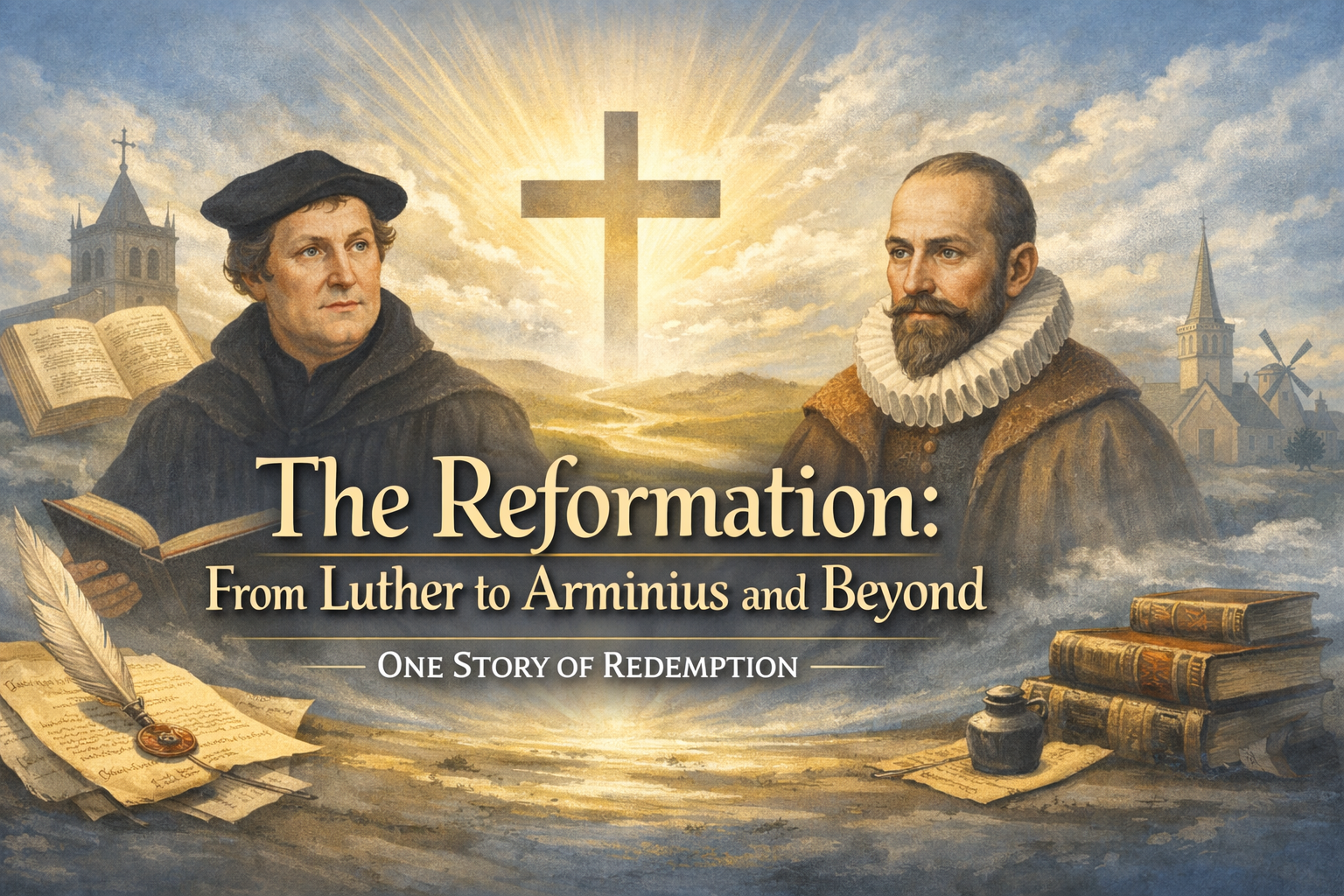
The Reformation: From Luther to Arminius and Beyond
From Wycliffe’s Quiet Dissent to the Synod of Dort — How the Church Fought for the Gospel of Grace
The Protestant Reformation was not a single event. It was a centuries-long movement — sometimes whispered, sometimes thundered — driven by one persistent conviction: salvation comes by grace through faith alone, not by the Church’s permission or human merit.
This post traces that movement from its earliest seeds in the 14th century through the dramatic debates over grace and free will that still shape Protestant theology today.
“For by grace you have been saved through faith — and this is not your own doing; it is the gift of God.” — Ephesians 2:8
The Timeline
Before 1517 — The Seeds
📜 The Dawn of Reformation: Wycliffe and Hus
Long before Luther nailed anything to any door, reform voices were stirring across Europe — often at great personal cost.
John Wycliffe (c. 1320–1384)
Called the “Morning Star of the Reformation.” Championed biblical authority over papal commands and translated Scripture into Middle English. His Lollard followers quietly planted seeds for 150 years.
Jan Hus (c. 1369–1415)
Inspired by Wycliffe, Hus preached boldly in Bohemia against papal corruption and insisted Scripture was the clearest standard. Martyred at the Council of Constance — his ashes, as he predicted, became embers for later reformers.
“Your word is a lamp to my feet and a light to my path.” — Psalm 119:105
1517–1540s — The Explosion
🔨 The Spark: Martin Luther and the Reformation Ignites
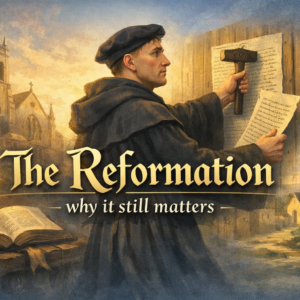
In 1517, an Augustinian monk in Wittenberg set the world on fire — not with a weapon, but with 95 theological arguments and a printing press.
- 1517 — Luther posts his Ninety-five Theses, disputing indulgences and asserting that forgiveness comes by God’s grace alone — not papal dispensation.
- 1521 — At the Diet of Worms, Luther refuses to recant. “Here I stand, I can do no other.” He is excommunicated and becomes a hunted heretic — protected by a German prince.
- 1520s–1530s — Reform ideas spread with astonishing speed across Europe.
Ulrich Zwingli
Led reform in Zurich, rejecting relics and affirming communion as memorial rather than sacrifice.
The Anabaptists
Beginning around 1525 with Conrad Grebel and others: believer’s baptism, church-state separation, radical discipleship.
William Tyndale
Translated the New Testament into English. Thousands of smuggled copies changed hearts across England before he was executed in 1536.
The Printing Press
The Reformation’s most unlikely ally. Luther’s pamphlets reached towns across Germany before authorities could respond.
“The righteous shall live by faith.” — Romans 1:17
1530s–1560s — The Shaping
🏰 Calvin, England, and the Counter-Reformation
The Reformation’s second generation built institutions — confessions, catechisms, and churches — that would last for centuries.
- John Calvin (1509–1564) publishes the Institutes of the Christian Religion in 1536. His teachings on predestination, grace, and church discipline form the backbone of what we now call Reformed theology. Geneva becomes a training ground, sending ministers into France, Scotland, England, and beyond.
- Henry VIII breaks with Rome in 1534, establishing the Church of England — driven more by politics than conviction, but Archbishop Thomas Cranmer shaped its theological identity through the Book of Common Prayer.
- The Council of Trent (1545–1563) — the Catholic Church’s formal response. It reformed genuine abuses while firmly rejecting Protestant doctrines of grace. This is the heart of the Counter-Reformation, spearheaded by the newly formed Society of Jesus (Jesuits) under Ignatius of Loyola.
“Elect in Christ before the foundation of the world.” — Ephesians 1:4
1560–1600s — The Later Reformers
🕊️ Knox and Arminius: Presbytery and the Challenge to Predestination
John Knox (c. 1514–1572) brought Calvinist Reform to Scotland, establishing Presbyterianism and transforming a nation’s religious identity through sheer tenacity.
Then came a voice that would set off a new round of controversy — from within the Reformed tradition itself.
Jacobus Arminius (1560–1609) was born in Holland, trained under Theodore Beza in Geneva (Calvin’s successor), and later became professor of theology at Leiden. He came to question strict Calvinist predestination, emphasizing instead:
- Conditional election — God’s choice is based on His foreknowledge of who will believe
- Unlimited atonement — Christ died for all people, not only the elect
- Resistible grace — God’s grace can be rejected by the human will
- Possibility of falling from grace — genuine believers may depart from faith
“God so loved the world that He gave His only begotten Son, that whoever believes in Him should not perish.” — John 3:16
1610–1619 — The Defining Debate
⚖️ The Synod of Dort: Calvinism vs. Arminianism
Arminius died in 1609, but the controversy he ignited did not. The year after his death, his followers issued the Five Articles of Remonstrance, formally summarizing his theology. The Reformed establishment could not let it stand.
🌿 The Remonstrants (Arminian)
- Conditional election
- Unlimited atonement
- Partial depravity — grace can be resisted
- Salvation possibly lost
- God’s choice based on foreseen faith
🧱 The Contra-Remonstrants (Calvinist)
- Unconditional election
- Limited atonement (Particular Redemption)
- Total depravity — grace is irresistible
- Perseverance of the saints
- God’s choice sovereign and unconditional
The Synod of Dort (1618–1619), attended by Reformed leaders from across Europe, condemned the Arminian positions. The resulting Canons of Dort affirmed the five Reformed points — later remembered by the acronym TULIP. Franciscus Gomarus led the Calvinist side; the Arminian delegates were ultimately dismissed.
“It does not depend on human will or effort, but on God who shows mercy.” — Romans 9:16
1618–1648 — The Wider World
🌍 The Thirty Years’ War and the Peace of Westphalia
The theological tensions of the Reformation didn’t stay in lecture halls and church synods. They played out on a continental scale in the Thirty Years’ War (1618–1648) — partly a geopolitical struggle, partly a Catholic vs. Protestant conflict that devastated Central Europe.
The Peace of Westphalia (1648) ended the war and established a principle that would reshape the map of Christendom: cuius regio, eius religio — the ruler determines the religion of the region. It was an imperfect peace, but it was peace.
“Blessed are the peacemakers, for they shall be called sons of God.” — Matthew 5:9
The Long Legacy of Arminianism
Though condemned at Dort, Arminianism didn’t disappear. Arminius’s collected works were published in Leiden by 1629–1630, and his theological convictions found new homes across the centuries.
| Movement | Arminian Influence | Key Figure |
|---|---|---|
| General Baptists | Believer’s baptism + universal atonement | Thomas Helwys |
| Methodism | Open call of the gospel; prevenient grace for all | John Wesley |
| Pentecostalism | Free response to the Spirit; salvation available to all | Charles Parham, Aimee Semple McPherson |
| Modern Evangelicalism | Altar calls; “whoever will may come” | Charles Finney, Billy Graham |
Legacy Illustration
🌱 Wesley in the Open Fields
In the 18th century, John Wesley preaches in the open air to thousands of ordinary English workers — miners, farmers, factory hands. His message: salvation is open to anyone who will repent and believe. Every soul matters. Come to Christ and He will receive you.
It is Arminius’s theology, a century later, fueling one of the greatest revivals in English history.
“The Lord is patient toward you, not willing that any should perish but that all should come to repentance.” — 2 Peter 3:9
From Wycliffe’s quiet dissent to Arminius’s classroom debates and the dramatic Synod of Dort, the Reformation was more than a historical upheaval — it was a sustained, costly, multi-generational fight to recover the gospel of grace.
It remains alive today in every theological conversation on grace, election, and human response. The questions haven’t changed. The stakes haven’t shrunk. And the answer the Reformation kept returning to — by grace through faith alone, in Christ alone, to God alone be the glory — is still the only one that holds.
“If the Son sets you free, you will be free indeed.” — John 8:36
Key Scriptures: Ephesians 2:8 · Psalm 119:105 · Romans 1:17 · Ephesians 1:4 · John 3:16 · Romans 9:16 · Matthew 5:9 · 2 Peter 3:9 · John 8:36 · Romans 3:23 · Jude 1:3
Want to Go Deeper?
This post is part of an ongoing series on the Reformers and the theological traditions they built. If it helped you see how we got here, here are a few next steps:
- Read the companion posts — MVM’s posts on Martin Luther, John Calvin, Arminianism, and Calvinism give you the theological detail behind the historical movements traced here.
- Read further — Alister McGrath’s Christianity’s Dangerous Idea is the best single-volume history of how Protestantism spread and fractured; Diarmaid MacCulloch’s The Reformation is the comprehensive scholarly account.
- Subscribe to get new posts delivered straight to your inbox — gospel-rooted, plain-spoken truth for the week ahead.
“For by grace you have been saved through faith — and this is not your own doing; it is the gift of God.” — Ephesians 2:8
Mountain Veteran Ministries
Find Your Next Bearing
Every journey needs a direction. If you're wondering where to go from here, choose the path that best fits where you are today.
⚒️ I Want to Live Faithfully
Discover practical wisdom for following Christ in today's world.
→ Living as a Christian Today✝️ I Want to Understand the Gospel
Learn what salvation means and why Jesus came.
→ Understanding Salvation📖 I Want to Understand the Bible
Explore why Christians trust Scripture and how to read it well.
→ Understanding the Bible❓ I Still Have Questions
Explore thoughtful answers to some of Christianity's hardest questions.
→ Hard Questions