Martin Luther’s Philosophy: The Reformer Who Changed the World
The Monk Who Changed the World — His Key Teachings and Why They Still Matter
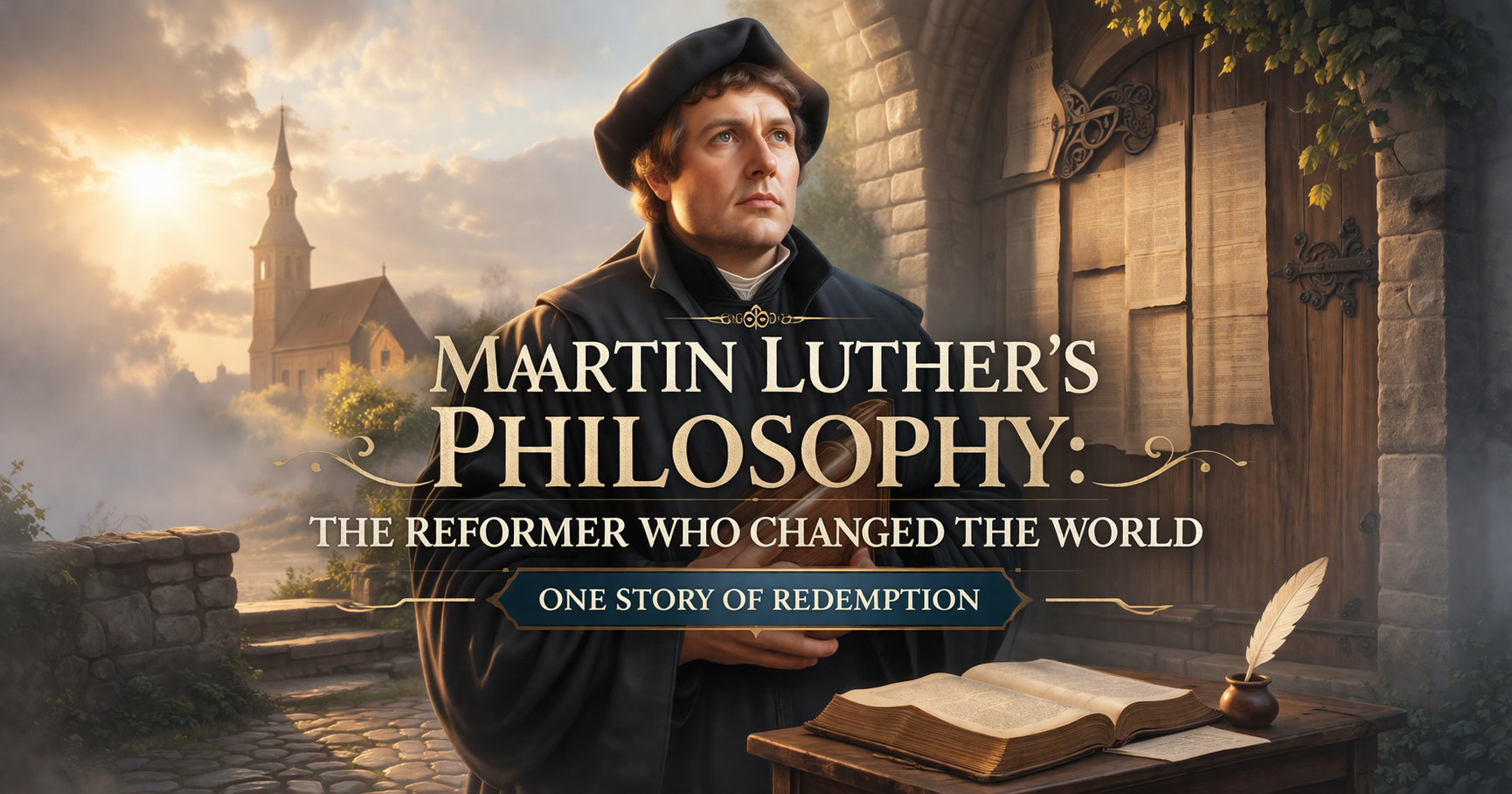
Few figures in Christian history have shaped the faith like Martin Luther. Born in 1483 in Eisleben, Germany, Luther was not just a monk and a scholar — he became the spark that ignited the Protestant Reformation. His philosophy and theology forever altered the way Christians understand the Bible, salvation, and the church itself.
Martin Luther — 1483–1546
German monk, professor, and Reformer. His 95 Theses (1517) launched the Protestant Reformation. His translation of the Bible into German made Scripture accessible to ordinary people. His pivotal stand at the Diet of Worms (1521) defined the Reformation’s conscience.
“My conscience is captive to the Word of God. I cannot and I will not recant anything. Here I stand, I can do no other. God help me. Amen.” — Martin Luther, Diet of Worms, 1521
Ten Teachings That Changed Christianity
Teaching One
📜 Sola Scriptura — Scripture Alone
Luther’s most foundational conviction: the Bible alone is the ultimate authority for the Christian — not church tradition, not papal decree, not councils. At a time when tradition carried enormous institutional weight, this was a declaration of revolution. He insisted that God’s Word must be placed above every human authority in matters of faith.
“All Scripture is God-breathed and is useful for teaching, rebuking, correcting and training in righteousness.” — 2 Timothy 3:16
Teaching Two
🙏 Sola Fide — Justification by Faith Alone
Luther’s most personally transforming discovery. While reading Romans 1:17, he found that the righteousness of God is not a standard we achieve — it is a gift we receive through faith. This discovery broke years of torment. He later wrote: “When I discovered that, I was born again of the Holy Ghost. The doors of paradise swung open and I walked through.”
“For in the gospel the righteousness of God is revealed — a righteousness that is by faith from first to last.” — Romans 1:17
Teaching Three
⛪ The Priesthood of All Believers
In medieval Christianity, ordained priests served as the necessary mediators between God and people. Luther shattered that system. Every believer, he taught, has direct access to God through Christ — no ecclesiastical gatekeeper required. This also meant that everyday work — farming, parenting, craftsmanship — could glorify God just as fully as monastic life.
“But you are a chosen people, a royal priesthood, a holy nation, God’s special possession.” — 1 Peter 2:9
Teaching Four
⚖️ Two Kingdoms — Church and State
Luther developed a careful theology of God’s rule through two distinct kingdoms: the spiritual kingdom, governing hearts through the Gospel and the Holy Spirit; and the temporal kingdom, maintaining order and justice through civil government. Both are ordained by God, but they operate by different means and must not be confused with each other.
Teaching Five
⛓️ The Bondage of the Will
In his famous debate with Erasmus, Luther argued that the human will — though real — is enslaved by sin and cannot freely choose God without divine grace. This is not determinism; it is the honest recognition that dead people don’t choose life. God must act first. This became one of Luther’s most lasting and controversial contributions to theology.
“No one can come to me unless the Father who sent me draws them.” — John 6:44
Teaching Six
✂️ Reforming the Sacraments
Luther reduced the seven Catholic sacraments to two — Baptism and the Lord’s Supper — holding that only these were directly instituted by Christ. He rejected transubstantiation but firmly affirmed Christ’s real presence in Communion. He taught baptism as a means of grace and a visible sign of God’s promise to cleanse sin — insisting the sacraments are anchored in God’s Word, not the church’s authority.
Teaching Seven
🛑 Challenging Papal Authority
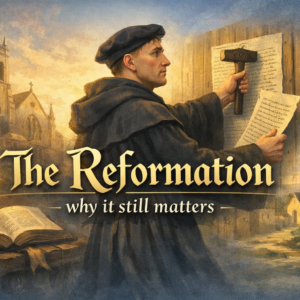
Luther’s 95 Theses protested the sale of indulgences — certificates sold by the church promising reduced time in purgatory. More broadly, he challenged the entire system of papal supremacy and the doctrine of purgatory, arguing neither had solid grounding in Scripture. His willingness to stand against institutional authority at personal risk became the defining act of the Reformation.
Teaching Eight
🌟 Christ-Centered Theology
For Luther, the entire Bible points to Christ (Luke 24:27). Every sermon, he insisted, should lead people to Jesus — not just moral principles or behavioral improvement. This Christ-focus freed believers from fear and works-righteousness, redirecting them from anxious striving toward grace and gratitude. The cross is the lens through which all of Scripture must be read.
Teaching Nine
🛠️ Vocation — Everyday Work as Worship
Luther elevated ordinary work as holy service to God. Against the medieval idea that monks and priests occupied the highest spiritual category, Luther argued that every calling — farmer, teacher, parent, craftsman — is a sacred vocation when done to the glory of God.
“Whatever you do, work at it with all your heart, as working for the Lord.” — Colossians 3:23
Teaching Ten
🌍 The Lasting Legacy
Luther’s philosophy unleashed a spiritual and cultural revolution whose effects are still felt five centuries later. He was not a perfect man — he had serious flaws, and honest historians acknowledge them. But his core theological commitments changed what Christianity looks like for hundreds of millions of people.
- The Bible became accessible in common languages for the first time.
- Salvation by grace through faith became central to Protestant Christianity worldwide.
- Everyday vocations were recognized as holy callings — not second-class spirituality.
- The individual’s conscience before God was given weight against institutional authority.
The Five Solas — Luther’s Theological Backbone
Five Latin phrases capture the heart of what Luther fought for. Together they form the theological backbone of Reformed Protestantism.
Sola Scriptura
Scripture alone — the final authority
Sola Fide
Faith alone — the only instrument of justification
Sola Gratia
Grace alone — the source of salvation
Solus Christus
Christ alone — the only mediator
Soli Deo Gloria
To God alone be the glory — the goal of everything
Together
Five phrases. One conviction: salvation is God’s work, from beginning to end.
Luther’s Legacy at a Glance
- Scripture in common hands. His German Bible translation gave ordinary people direct access to God’s Word for the first time.
- Grace restored to center. Salvation by grace through faith — not merit, not indulgences — became Protestant Christianity’s beating heart.
- Work sanctified. Farmers, parents, and craftsmen were told their daily work was as holy as any monk’s prayers.
- Conscience liberated. “Here I stand” — the individual conscience, captive to God’s Word, was given standing before God and man.
Questions to Take With You
- What is actually shaping your faith today — culture, tradition, or God’s Word? When did you last let Scripture overrule something you assumed was true?
- Do you approach God directly, with the confidence Luther fought for — or do you still feel like you need the right credentials to get through the door?
- Is your daily work — whatever it is — offered to God as worship? Or does faith feel like something that belongs only in a church building?
Luther’s theology can seem like ancient history — written in German, argued in dusty halls, settled five centuries ago. But his core convictions address questions every believer still faces: Am I truly forgiven? Can I really approach God? Does my ordinary life matter to Him?
Luther’s answer to all three was a resounding yes — grounded not in his own confidence, but in God’s Word, God’s grace, and God’s Son. That’s an answer that doesn’t go stale.
“For in the gospel the righteousness of God is revealed — a righteousness that is by faith from first to last, just as it is written: ‘The righteous will live by faith.'” — Romans 1:17
Key Scriptures: Romans 1:17 · Romans 3:28 · Ephesians 2:8–9 · 1 Peter 2:9 · Hebrews 4:16 · John 6:44 · Ephesians 2:1–5 · Colossians 3:23 · Luke 24:27 · 2 Timothy 3:16 · Matthew 7:24–27
Want to Go Deeper?
This post is part of an ongoing series on the Reformers and theologians who shaped Protestant Christianity. If Luther’s story stirred something in you, here are a few next steps:
- Compare traditions — read the MVM posts on John Calvin’s theology and the Five Solas for a fuller picture of Reformed thought and what Luther’s heirs built on his foundation.
- Read further — Roland Bainton’s Here I Stand is the classic readable biography of Luther; Heiko Oberman’s Luther: Man Between God and the Devil goes deeper for those who want more.
- Subscribe to get new posts delivered straight to your inbox — gospel-rooted, plain-spoken truth for the week ahead.
“Here I stand, I can do no other. God help me.” — Martin Luther, Diet of Worms, 1521
Mountain Veteran Ministries
Find Your Next Bearing
Every journey needs a direction. If you're wondering where to go from here, choose the path that best fits where you are today.
⚒️ I Want to Live Faithfully
Discover practical wisdom for following Christ in today's world.
→ Living as a Christian Today✝️ I Want to Understand the Gospel
Learn what salvation means and why Jesus came.
→ Understanding Salvation📖 I Want to Understand the Bible
Explore why Christians trust Scripture and how to read it well.
→ Understanding the Bible❓ I Still Have Questions
Explore thoughtful answers to some of Christianity's hardest questions.
→ Hard Questions