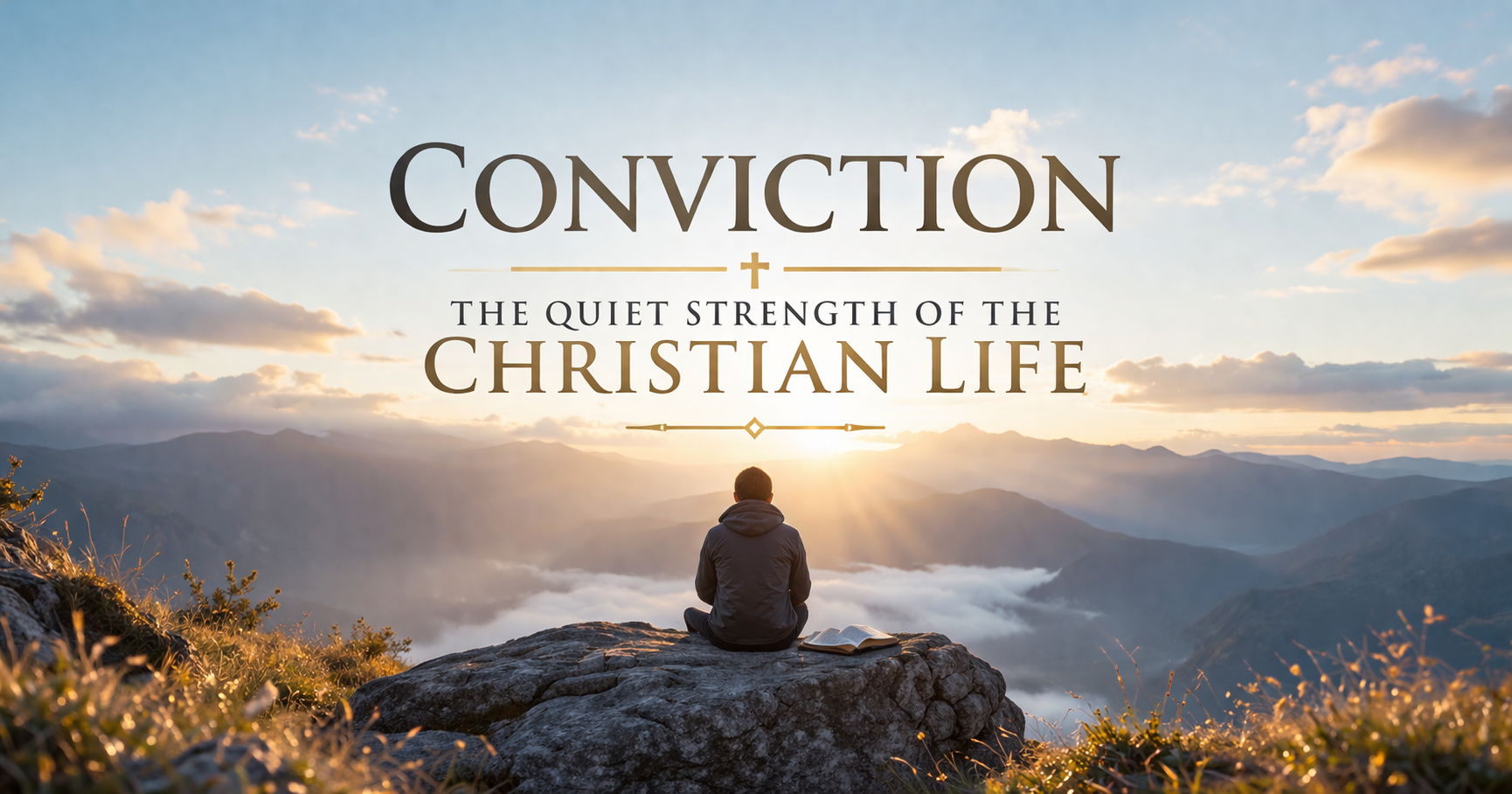
Conviction: The Quiet Strength of the Christian Life
Understanding the Power and Purpose of the Spirit’s Conviction in the Christian Life
We’ve all heard the word “conviction” — maybe in a courtroom scene on TV or from the pulpit during Sunday service. But in the Christian walk, conviction is more than just a guilty conscience or a gut feeling. It’s not just about being sure of something either.
Conviction, according to Scripture and the Christian tradition, is a profound work of the Holy Spirit — a heart-deep realization that aligns a person with God’s truth. It’s meant to awaken, not to crush. It’s the still, small voice of God whispering: “This isn’t right.” Or: “This is what’s true.” Or simply: “Come back to Me.”
“When He comes, He will convict the world concerning sin and righteousness and judgment.” — John 16:8
The Spirit doesn’t convict to condemn — He convicts to reveal what’s wrong, what’s right, and what’s eternal. That’s not just information. That’s transformation.
The Two Faces of Conviction
🔥 Conviction of Sin
Before someone can be saved, they have to realize they need saving. Conviction of sin is that deep, spiritual pang that says: I’ve fallen short. I’ve missed the mark.
It’s not the same as shame. Shame says “I’m worthless.” Conviction says “I’ve done wrong — but God is ready to make it right.” David felt it after his sin with Bathsheba: “Against You, You only, have I sinned…” (Psalm 51:4). Yet that psalm ends in restoration. Conviction leads to repentance. Repentance leads to life.
🧭 Conviction of Truth
The second face is the unshakable confidence that God’s Word is true — regardless of what the world says. This is where courage shows up.
Think of Daniel refusing to bow. Think of Peter and John preaching Jesus even when the authorities told them to stop. That wasn’t arrogance — it was conviction. Costly, deliberate, Spirit-sustained conviction.
Conviction vs. Condemnation — A Critical Distinction
One of the most damaging confusions in the Christian life is mixing up conviction with condemnation. They feel similar — but they have completely different sources and completely different destinations.
❌ Condemnation
“You’re guilty and there’s no way out.”
It points to your failure and leaves you there. No exit. No hope. No hand reaching in.
This is the devil’s voice — not the Spirit’s.
✅ Conviction
“You’ve sinned — but grace is waiting for you.”
It points to your failure and then immediately points to the cross. There is a way out. There is a hand reaching in.
This is the Holy Spirit’s work — always restorative.
“There is therefore now no condemnation for those who are in Christ Jesus.” — Romans 8:1
If the devil can’t destroy you, he’ll try to make you feel condemned. But the Holy Spirit never shames His children. He convicts to correct — not to crush. He convicts because He loves, and because He refuses to leave you where you are.
How Conviction Works in the Christian Life
Conviction Guides Our Choices
Conviction is a spiritual compass. When faced with a moral decision — how to handle money, how to speak to your neighbor, how to respond when you’ve been wronged — the Holy Spirit nudges you toward truth. He doesn’t make every decision obvious, but He never leaves you without direction if you’re listening.
Conviction Inspires Holiness
Conviction isn’t about being perfect — it’s about being sensitive to sin and hungry for righteousness. The Spirit helps you see your blind spots. He grows your desire to be more like Jesus. He won’t let you rest comfortably in rebellion — He’ll stir your heart until you come back home.
The holier a believer becomes, the more finely tuned their sense of conviction tends to grow. Spurgeon observed that the most mature saints are often the most aware of their remaining sin. That’s conviction working as it should.
Conviction Strengthens Our Witness
The world respects people who hold deep convictions — even when it disagrees with them. Christians who live with conviction demonstrate consistency and authenticity. That draws people toward truth more than any argument.
Conviction vs. Preference — Know the Difference
Not everything we feel strongly about is a matter of biblical conviction. One of the sources of unnecessary division in the Church is treating personal preferences as doctrinal hills to die on. The difference matters.
⚓ Conviction
- Rooted in Scripture
- Confirmed by the Holy Spirit across time and community
- Lived out with courage and consistency
- Worth standing firm on even at cost
🎵 Preference
- Based on personal comfort, culture, or tradition
- Often negotiable and situational
- Not binding on others in the Body
- Worth holding loosely for the sake of unity
You might prefer a certain worship style, a particular Bible translation, or a specific way of structuring your prayer life. Those things matter — but they’re not doctrine. As Paul said in Romans 14, we must not judge others for their honest convictions in disputable matters. Unity is preserved when we know the difference between hills worth dying on and hills worth overlooking.
“In essentials, unity; in non-essentials, liberty; in all things, charity.” — Attributed to Augustine
Two Illustrations Worth Keeping
The Compass
Imagine going on a hike in unfamiliar mountains. A GPS might fail — satellites go down, batteries die, signals get lost. But a compass will always point north. That’s what conviction is in the life of the believer. It doesn’t give you every detail of the trail — but it always points to what’s right. And in the dark, that’s enough.
Martin Luther at Worms
During the Reformation, Luther was brought before the Diet of Worms and given one final chance to recant. Church officials. Political power. The threat of death. Everything around him said: back down.
His response: “Unless I am convinced by the testimony of the Scriptures… I cannot and will not recant anything. Here I stand. I can do no other. God help me.”
That’s conviction. Not stubbornness. Not pride. A soul standing on the Word of God when everything else is shifting.
How to Stay Open to Conviction
You don’t manufacture conviction — it’s a gift from the Holy Spirit. But you can position your heart to receive it.
Voices from the Church
John MacArthur
“The conscience is God’s watchman in the soul.”
A.W. Tozer
“A man with a genuine conviction is not easily shaken. He may suffer, but he will not yield.”
Charles Stanley
“Conviction is not the end; it is the beginning of real change.”
Alistair Begg
“The Spirit does not convict to wound but to heal.”
In a noisy world full of half-truths and shifting standards, conviction is one of the clearest signs that God is at work in you. It might sting for a moment — but it leads to peace, holiness, and joy.
Don’t silence conviction. Don’t trade it for comfort. Don’t confuse it with guilt or legalism. Thank God for it — because every time you feel the Spirit whisper “this is the way,” you can know: you are not alone. The Good Shepherd is guiding you, one step at a time.
Let conviction shape you. Let it deepen you. And most of all — let it draw you closer to Christ.
“Blessed is the one whom God corrects; so do not despise the discipline of the Almighty.” — Job 5:17
Key Scriptures: John 16:8 · Hebrews 11:1 · Romans 14:5; 8:1 · Psalm 51:4, 10 · Acts 5:29 · Colossians 3:15 · Galatians 5:16 · 1 Peter 3:15 · 2 Timothy 3:16 · Hebrews 3:15 · Proverbs 27:6 · Job 5:17 · Hebrews 12:5–6
Want to Go Deeper?
Conviction sits at the intersection of the Spirit’s work and the believer’s response. Here are a few next steps:
- Read Psalm 51 slowly — the most honest expression of Spirit-wrought conviction in all of Scripture. Let David’s prayer become yours.
- Read A.W. Tozer’s The Pursuit of God — the best modern treatment of maintaining a soft, open heart before the Spirit’s work.
- Read the companion MVM posts on Sanctification and Justification — conviction connects directly to both: it’s what moves us from declaration (justification) into the journey of transformation (sanctification).
- Subscribe to get new posts delivered straight to your inbox — gospel-rooted, plain-spoken truth for the week ahead.
“Create in me a clean heart, O God, and renew a right spirit within me.” — Psalm 51:10
Mountain Veteran Ministries
Find Your Next Bearing
Every journey needs a direction. If you're wondering where to go from here, choose the path that best fits where you are today.
⚒️ I Want to Live Faithfully
Discover practical wisdom for following Christ in today's world.
→ Living as a Christian Today✝️ I Want to Understand the Gospel
Learn what salvation means and why Jesus came.
→ Understanding Salvation📖 I Want to Understand the Bible
Explore why Christians trust Scripture and how to read it well.
→ Understanding the Bible❓ I Still Have Questions
Explore thoughtful answers to some of Christianity's hardest questions.
→ Hard Questions