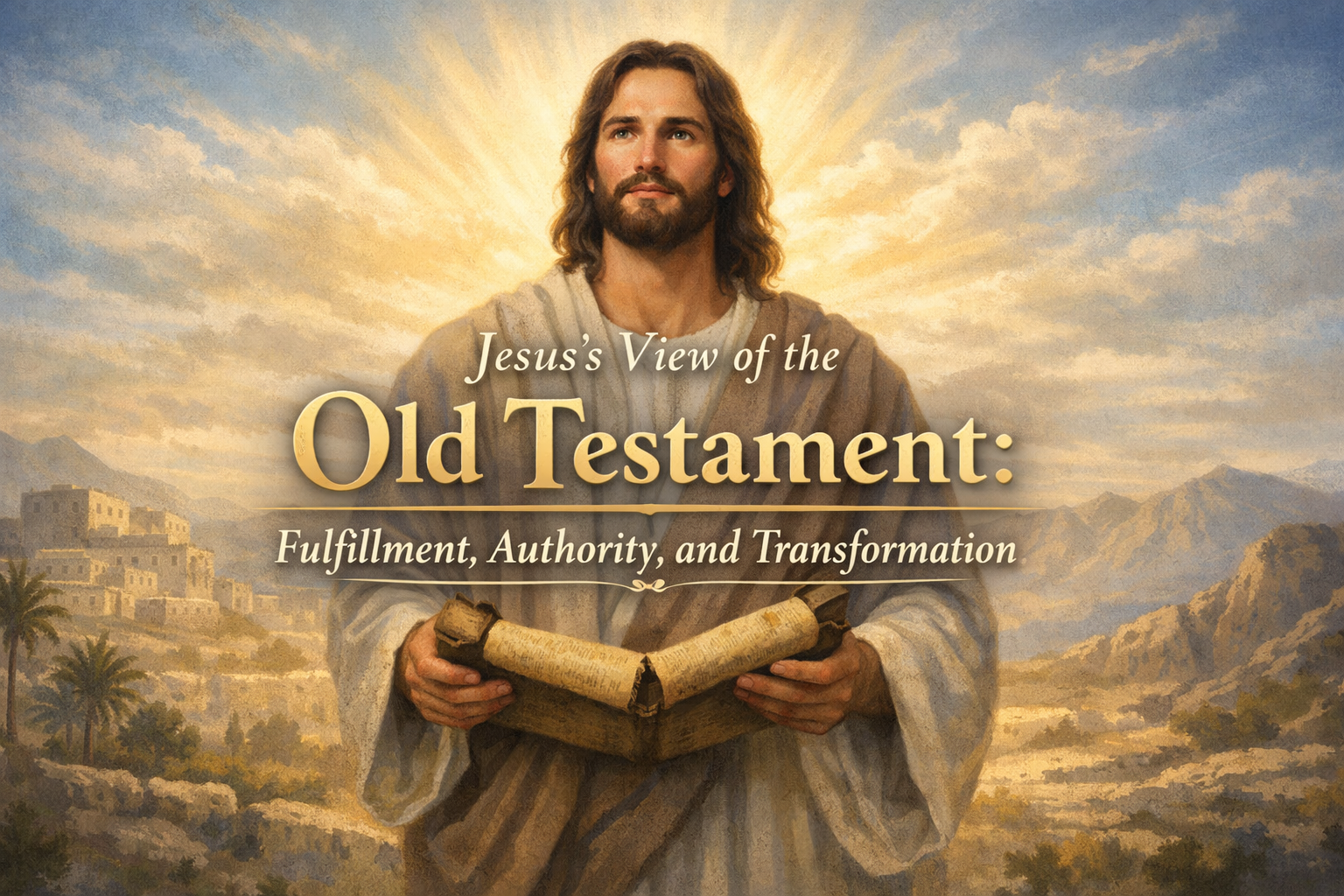
Jesus’s View of the Old Testament: Fulfillment, Authority, and Transformation
From Genesis to Malachi, Every Story Points to Christ — and Jesus Knew It
When we open the New Testament, it becomes clear that Jesus had a profound relationship with the Old Testament. For Him, it wasn’t a collection of ancient writings. It was the living Word of God, brimming with relevance, authority, and — most importantly — pointing directly to Him. Understanding Jesus’s view of the Old Testament isn’t just academic; it’s essential for grasping the entire flow of Scripture.
Jesus didn’t discard the Law and the Prophets. He affirmed them, fulfilled them, and interpreted them in light of the Kingdom of God. Let’s walk through six ways He did that — and what it means for how we read our Bibles today.
Six Ways Jesus Related to the Old Testament
Point One
📜 The Old Testament as God’s Unchanging Word
Jesus viewed the Hebrew Scriptures as the unchanging and authoritative Word of God. He quoted extensively from Moses, the Prophets, and the Writings — treating these texts as God’s revealed truth, not as cultural artifacts open to revision. In debates with the Pharisees and Sadducees, His constant refrain was: “Have you not read…?” — pointing them back to the authority of what was already written.
“Not an iota, not a dot, will pass from the Law until all is accomplished.” — Matthew 5:18
The smallest letter of the Hebrew alphabet and the tiniest stroke of a pen — nothing in Scripture was throwaway. It all had purpose. It all would be accomplished.
Point Two
✝️ Fulfillment: Jesus as the Living Completion of Scripture
The most defining statement Jesus made about His relationship to the Old Testament comes in Matthew 5:17. The Greek word translated “fulfill” — plēroō — means to bring to its fullest expression or complete purpose. Jesus saw Himself as the embodiment of the Law’s intention and the Prophets’ expectation.
“Do not think that I have come to abolish the Law or the Prophets; I have not come to abolish them but to fulfill them.” — Matthew 5:17
The sacrificial system, temple rituals, and Israel’s history weren’t random religious acts. They were types and shadows pointing forward to Christ. The Passover Lamb found its ultimate meaning in Jesus as the Lamb of God (John 1:29). The Day of Atonement prefigured His once-for-all atoning death (Hebrews 10:1–10).
Prophecies He fulfilled:
Born of a virgin
Isaiah 7:14 → Matthew 1:22–23
Born in Bethlehem
Micah 5:2 → Matthew 2:5–6
A suffering servant
Isaiah 53 → Acts 8:32–35
His own declaration
John 5:39 — “These are the very Scriptures that testify about me.”
Point Three
❤️ Correcting Misinterpretations: Heart Over Legalism
One of Jesus’s key engagements with the Old Testament was His correction of the Pharisees’ legalistic distortions. They had reduced the Law to external behavior without addressing the heart’s posture toward God. In the Sermon on the Mount, Jesus used a repeated pattern: “You have heard it said… but I say to you…” He wasn’t abolishing the Law — He was reclaiming its true, internal meaning.
- On murder: It’s not just physical killing — it includes harboring anger against a brother (Matthew 5:21–22).
- On adultery: It’s not just the act — it’s lustful intent (Matthew 5:27–28).
- On oaths: They’re unnecessary if your heart speaks truth consistently (Matthew 5:33–37).
Obedience flows from a transformed heart, not just external compliance. Jesus echoed the prophets Isaiah and Micah, who condemned empty rituals devoid of justice, mercy, and humility.
Point Four
🤝 Love as the Fulcrum of the Law
When asked which commandment was the greatest, Jesus summarized the entire Old Testament Law into two commands. Not just the most important two — the two that everything else depends on.
“On these two commandments depend all the Law and the Prophets.” — Matthew 22:40
Love for God vertically. Love for neighbor horizontally. For Jesus, love wasn’t one command among the 613 — it was the interpretive lens through which all the others must be understood. He boiled down centuries of law to a single relational principle.
Point Five
🏔️ Jesus as the True Israel and New Moses
Jesus deliberately aligned His life with key moments in Israel’s history — portraying Himself as the faithful Israelite who succeeded where Israel failed. The parallels are intentional and unmistakable.
- Israel wandered 40 years in the wilderness. Jesus fasted 40 days and was tested there (Matthew 4:1–2).
- Israel received the Law on Mount Sinai. Jesus delivered His definitive teaching on the mount (Sermon on the Mount).
- Israel failed repeatedly under temptation. Jesus remained obedient at every point.
He also fulfilled the role of the New Moses — not giving a new law, but interpreting and perfecting the Old Law in Himself. Deuteronomy 18:15 foretold a prophet like Moses who would come; Acts 3:22 identifies Jesus as that prophet.
Point Six
🌿 Transition from Shadow to Reality: The New Covenant
While Jesus revered the Old Testament, He also inaugurated a New Covenant — foretold in Jeremiah 31:31–34. This New Covenant didn’t discard the Old but fulfilled its promises in a new and better way.
| Old Covenant Element | How Christ Fulfilled It |
|---|---|
| The sacrificial system | Rendered complete through His once-for-all atoning death (Hebrews 10:10) |
| Temple worship | Superseded — Jesus Himself became the new Temple (John 2:19–21) |
| Dietary and purity codes | Holiness now comes through union with Christ, not external observance (Mark 7:18–23) |
| Moral imperatives (justice, mercy, humility) | Affirmed and empowered by the Holy Spirit within believers (Romans 8:4) |
What This Means for How We Read Our Bibles Today
- 1 Read the Old Testament as Christian Scripture. Many believers avoid it, but Jesus teaches us it’s all about Him. From Genesis to Malachi, every story, psalm, and prophecy finds its climax in Christ. Don’t skip it — read it as the lead-up to everything.
- 2 Focus on the heart of obedience. Jesus reoriented Law toward the heart. Our faith should not be about checking boxes but about a heart genuinely surrendered to God’s will — from the inside out, not the outside in.
- 3 Filter everything through love. Approaching every command through the lens of love for God and love for neighbor isn’t a shortcut — it’s the very path Jesus said the Law was always walking toward.
- 4 Embrace continuity, not contradiction. Jesus fulfilled, not abolished, the Law. The Old and New Testaments are one grand narrative — the same God, the same redemptive purpose, one story building toward one climax. Read them that way.
For Jesus, the Old Testament was neither outdated nor irrelevant. It was alive, authoritative, and entirely about God’s redemptive plan culminating in Himself. He came not to tear down the Law and the Prophets — He came to bring them to life in their fullest, truest form.
Every page of the Old Testament whispers His name. Every shadow points to His substance. Every command reveals the heart of a God who desires mercy, justice, and humble fellowship with His people.
And Jesus is the answer to every question those pages were raising.
“And beginning with Moses and all the Prophets, he explained to them what was said in all the Scriptures concerning himself.” — Luke 24:27
Key Scriptures: Matthew 5:17–20 · Matthew 22:37–40 · John 5:39 · Luke 24:27 · Hebrews 10:1–10 · Jeremiah 31:31–34 · Romans 8:4 · Deuteronomy 18:15 · Acts 3:22 · Isaiah 53 · John 1:29 · John 2:19–21
Want to Go Deeper?
This post is part of an ongoing series on understanding Scripture as one unified story. If it helped you see the Old Testament in a new light, here are a few next steps:
- Share it with someone who avoids the Old Testament or wonders why Christians still read it.
- Read Luke 24:13–35 slowly — the walk to Emmaus, where the risen Jesus walks two disciples through the Old Testament and shows them how it all points to Him. One of the most beautiful passages in the Bible.
- Subscribe to get new posts delivered straight to your inbox — gospel-rooted, plain-spoken truth for the week ahead.
“These are the very Scriptures that testify about me.” — John 5:39
Mountain Veteran Ministries
Find Your Next Bearing
Every journey needs a direction. If you're wondering where to go from here, choose the path that best fits where you are today.
⚒️ I Want to Live Faithfully
Discover practical wisdom for following Christ in today's world.
→ Living as a Christian Today✝️ I Want to Understand the Gospel
Learn what salvation means and why Jesus came.
→ Understanding Salvation📖 I Want to Understand the Bible
Explore why Christians trust Scripture and how to read it well.
→ Understanding the Bible❓ I Still Have Questions
Explore thoughtful answers to some of Christianity's hardest questions.
→ Hard Questions