
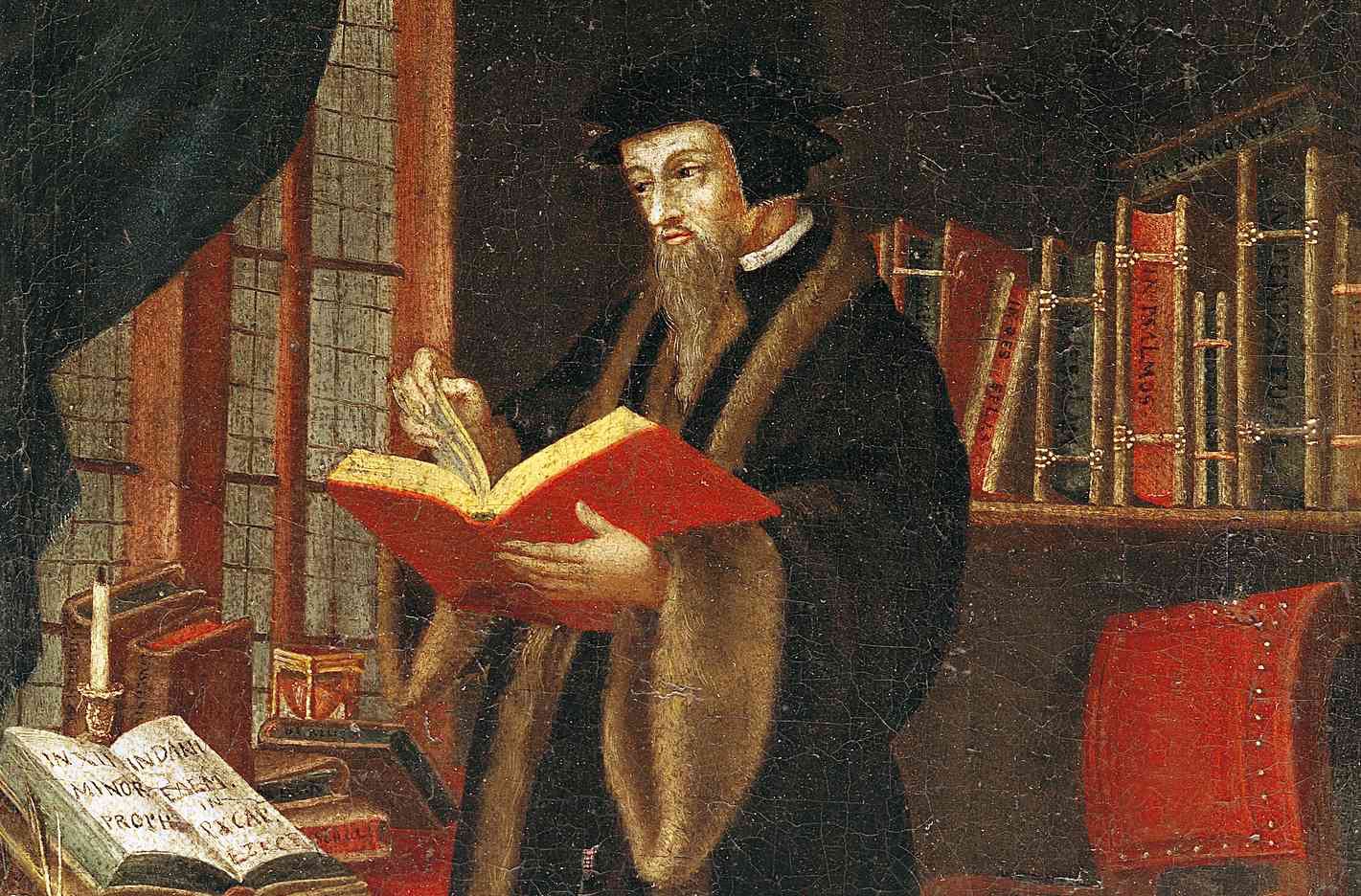
🕊️ John Calvin and the Book of Revelation: Why the Reformer Stayed Quiet—and What That Teaches Us Today
📖 “Where’s Calvin’s Commentary on Revelation?”
If you’ve ever poked around the writings of John Calvin—the big name behind Reformed theology—you probably noticed something missing: he never wrote a commentary on the Book of Revelation.
Now, Calvin wrote on just about every other book in the Bible. Genesis? Covered. Psalms? Sure thing. Romans? Oh, you better believe it. But Revelation? Not a word of commentary.
Some folks scratch their heads at that. Others make a whole doctrine out of his silence. But let’s not jump the gun. Calvin didn’t avoid Revelation because he didn’t believe it—it just didn’t fit the way he taught Scripture.
So in this post, we’ll take a good, long look at what Calvin really thought about the last book of the Bible, even if he never laid out a verse-by-verse take. We’ll also explore what that means for us today, as Christian believers navigating the end-time buzz all around us.
🔍 Why Calvin Held Back: A Matter of Caution, Not Cowardice
John Calvin wasn’t afraid of tough passages. He tackled Leviticus and Ezekiel like a lumberjack facing a thick oak. But Revelation? That was a different kind of forest.
He once said in a letter that he just didn’t feel confident enough in the interpretation of Revelation to write publicly about it. In his own words (loosely paraphrased):
“I’m not going to write commentary where I can’t say something helpful.”
Now that might seem like dodging—but it was really a matter of humility. He saw how some folks were twisting the text into wild predictions and political schemes. Calvin believed Scripture should comfort, correct, and point us to Christ, not stir up confusion.
📜 He Still Believed Revelation Was Scripture
Let’s get this clear: Calvin didn’t think Revelation was unbiblical or uninspired. In fact, he defended its place in the canon of Scripture.
He affirmed that it was written by the Apostle John, exiled on Patmos, and that it had spiritual value for the Church. He just didn’t think it needed to be treated like a secret codebook for figuring out world events.
He believed Revelation teaches the same Gospel truth as the rest of Scripture:
👉 Christ is King,
👉 evil will be judged,
👉 and the Church will be vindicated.
🛑 Calvin’s Warning: “Stay Away from Speculation”
Calvin didn’t have much patience for guesswork and end-times charts. He lived in a time when people were calling the Pope the Antichrist, linking current events to visions in Daniel and Revelation, and predicting Christ’s return on specific dates.
That didn’t sit well with him.
In his sermons and Institutes of the Christian Religion, he made it clear:
“Don’t try to predict what God has not revealed.”
Calvin believed it was spiritually dangerous to get wrapped up in interpreting symbols without Scripture to back it up. That approach, he said, leads to confusion, pride, and false hope.
Sound familiar?
🕊️ Calvin’s Main Lens: The Sovereignty of God
Even though he never taught through Revelation verse by verse, you can find his fingerprints on it if you know what you’re looking for.
Calvin’s theology is like a mighty oak with a strong trunk:
God is sovereign over all things.
From beginning to end, Revelation screams that message:
- Jesus holds the keys to death and Hades (Rev 1:18).
- The Lamb reigns on the throne (Rev 5:6).
- Not even Satan moves without permission (Rev 20).
If Calvin were to comment, he’d likely remind us that God is not fretting about the future—He already owns it.
🕰️ Calvin’s Likely View: Amillennial (Without Using the Word)
Now, Calvin didn’t throw around terms like amillennial, premillennial, or postmillennial—those labels came later. But based on what he wrote elsewhere, most Reformed scholars agree:
👉 Calvin held to an amillennial view.
That means:
- The “thousand years” in Revelation 20 is symbolic, not literal.
- Christ is reigning now from heaven.
- Satan is already bound in a limited way, allowing the Gospel to spread.
- The Church is living through the spiritual battle portrayed in Revelation.
- The Second Coming, final judgment, and New Creation all happen in one big finale.
To Calvin, the focus wasn’t on the “when,” but on the “Who.”
And that “Who” is Jesus Christ, the reigning Lord.
🔥 Revelation as a Story of Christ’s Triumph
Even without a commentary, Calvin’s sermons and writings show that he saw Revelation as a declaration of Jesus’ victory, not a timetable of destruction.
Here’s how he would probably lay it out:
- The dragon (Satan) is already defeated at the cross (Rev 12).
- The beasts represent human systems in rebellion against God.
- The Church, though persecuted, is safe in Christ.
- The New Jerusalem is the final promise for God’s people.
He didn’t see the point in arguing over what “ten horns” or “locusts with stingers” might symbolize. That stuff wasn’t the main event.
Calvin would say:
“The message of Revelation is simple—Christ wins. Stick with Him.”
🏡 Bringing It Home: What This Means for Us Today
In a world swirling with conspiracy theories, date-setters, and doomsday predictions, Calvin’s silence actually speaks pretty loud.
Here’s what we can learn:
🧭 1. Keep the Main Thing the Main Thing
Revelation isn’t about decoding news headlines. It’s about a faithful Savior and a triumphant Church. Let’s not get lost in the weeds and miss the Lamb on the throne.
🧤 2. Stay Humble in Mystery
Calvin didn’t pretend to understand it all—and neither should we. When Scripture gets symbolic and strange, we ought to say, “Lord, help me trust what I do know.”
⚒️ 3. Get to Work, Not Just Watching the Sky
Calvin wouldn’t have had much patience for Christians sitting around waiting for the rapture. He believed in working out your salvation, serving your neighbor, and building the Church—because Christ’s return should stir action, not apathy.
📖 4. Let Scripture Interpret Scripture
Revelation doesn’t stand alone. We read it in light of the Gospels, the Prophets, and the Epistles. That’s how Calvin approached all difficult texts—with the whole Bible open, not just one passage.
🖼️ A Picture to Remember: Revelation as a Mountain Range
Here’s a way to picture how Calvin might’ve seen Revelation:
Imagine you’re standing in a valley looking at a mountain range. You can see the peaks—Christ victorious, the judgment of evil, the glory of heaven—but you can’t make out every trail and ravine in between.
Calvin didn’t try to map every inch of the range. He simply said:
“I see the peaks. That’s enough for me to keep walking by faith.”
👣 Final Word from an Old Reformer
If John Calvin were here today, and we asked him what to make of Revelation, he might smile a little and say:
“Don’t chase after beasts and dragons so much that you miss the Lamb.”
And friend, that’s a word we still need. The Book of Revelation may be mysterious, but its message is clear for those with eyes to see:
🕊️ Jesus wins. Satan loses. The Church stands. God reigns.
Let’s live like that’s true—because it is.
✝️ Scripture References
- Revelation 1:18 – “I am the Living One… I hold the keys of death and Hades.”
- Revelation 5:6 – “Then I saw a Lamb, looking as if it had been slain, standing at the center of the throne.”
- Revelation 12:11 – “They triumphed over him by the blood of the Lamb and by the word of their testimony.”
- Revelation 21:1 – “Then I saw a new heaven and a new earth…”
📚 Suggested Reading
- Institutes of the Christian Religion – John Calvin
- The Returning King – Vern Poythress
- More Than Conquerors – William Hendriksen
- Revelation: Four Views – Steve Gregg (for perspective)
- The Gospel According to Revelation – Graeme Goldsworthy
📝 Published by Mountain Veteran Ministries
💬 Leave a comment below or share this blog if it stirred your heart.
📧 Subscribe to our newsletter for more gospel-rooted insights.
Related posts:
 📖 Speech, Civility, and Disagreement: A Christian Field Guide for a Loud Age
 🔥 Unveiling the End: How Five Prominent Theologians Interpret the Book of Revelation
 🔥 John Wesley’s View of the Book of Revelation: Holiness, Judgment, and Hope
 🧭 Exiles & 🕊️ Ambassadors: Living for God’s Kingdom in Today’s Culture (Week 1)