
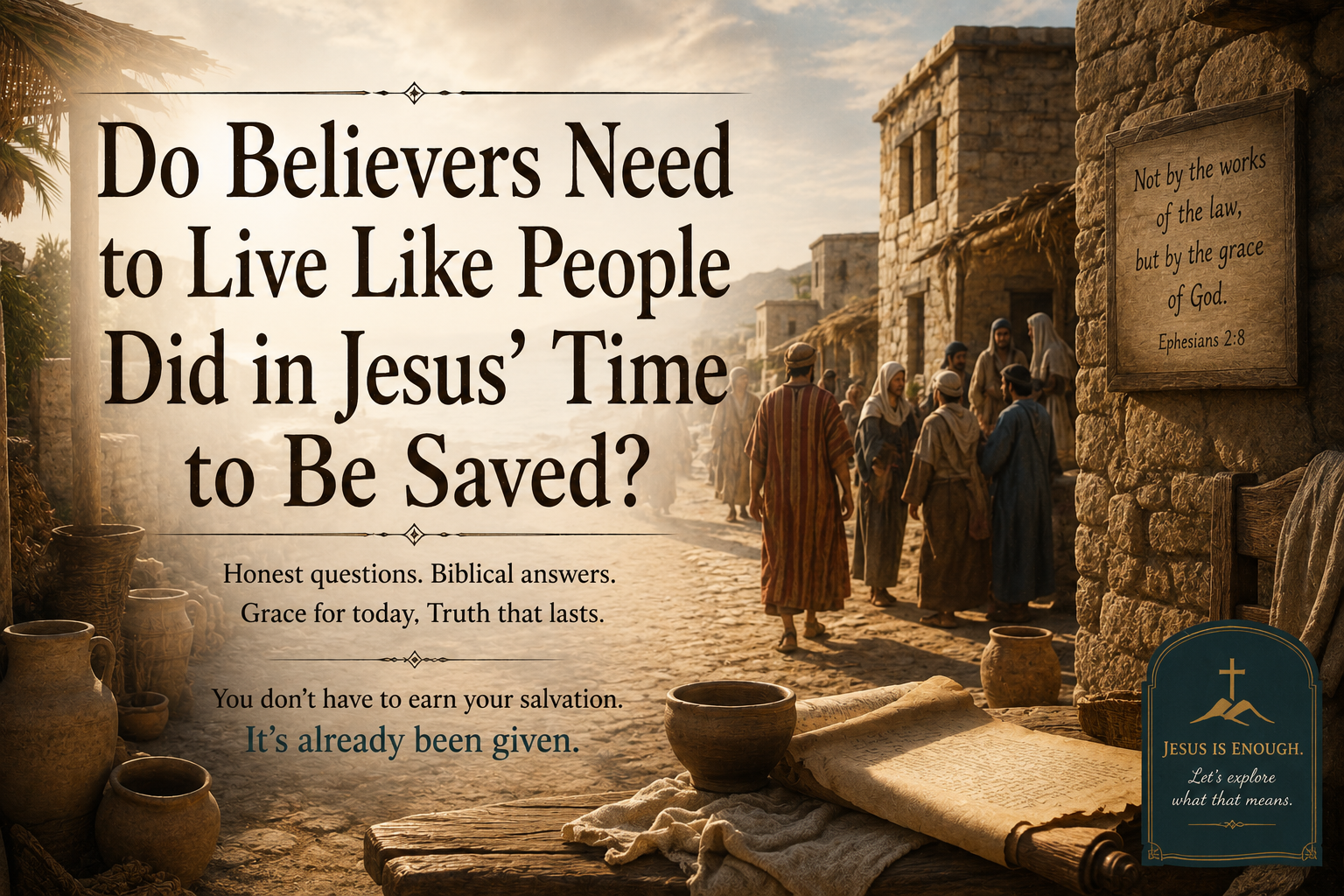
Do Believers Need to Live Like People Did in Jesus’ Time to Be Saved?
Every now and then a teaching comes around that sounds more serious than the ordinary gospel — more committed, more authentic, more rooted. One version of it goes something like this: if you really want to follow Jesus, you ought to live the way Jesus lived.
Keep the Jewish Sabbath. Observe the festivals from the Old Testament. Follow the food laws. Learn Hebrew. Wear the right clothes. After all, Jesus was a first-century Jew, and if you are going to call yourself His follower, shouldn’t you live like He did?
It sounds devout. And there is a kernel of something right in it — Jesus was a Jew, His roots matter, and the Old Testament is not a throwaway document. But the teaching itself, when it goes as far as saying these practices are necessary for real salvation or genuine Christian living, has a serious problem: it contradicts the plain teaching of the New Testament, and it puts on people’s backs a load that Jesus himself said He came to lift.
So let’s walk through this carefully — plainly, without a lot of religious jargon — because the question underneath it is one every honest believer ought to be able to answer.
The Question the Early Church Already Settled
Here is something worth knowing: this is not a new debate. The very first major controversy the Christian church faced was exactly this question. A group of teachers in the early church insisted that Gentile believers — non-Jewish converts to Christianity — needed to be circumcised and follow the laws of Moses to be truly saved. They were not fringe characters. They were serious, sincere people who believed they were protecting the integrity of the faith.
The Apostle Paul disagreed with them so strongly that he wrote an entire letter about it — the book of Galatians. And he did not mince words:
“I am astonished that you are so quickly deserting the one who called you to live in the grace of Christ and are turning to a different gospel — which is really no gospel at all.”
— Galatians 1:6–7 (NIV)
A different gospel. That is a strong phrase. Paul is not saying these teachers were slightly off on a minor point. He is saying they were redirecting people away from the actual good news. And the good news, as he goes on to explain, is that Jesus Christ has already done what no set of religious practices — first century or otherwise — could ever accomplish.
The Jerusalem Council in Acts 15 settled the question formally for the early church. The leaders gathered, debated, and came to this conclusion: Gentile believers were not required to take on the Jewish law to be saved. Peter stood up and said plainly that putting such requirements on people was “a yoke that neither we nor our ancestors have been able to bear” (Acts 15:10). The burden was being lifted, not added to.
What Jesus Actually Came to Do
The key to understanding this whole question is grasping what Jesus came to accomplish. He did not come simply to model a lifestyle for people to imitate. He came to fulfill what the entire Old Testament system was pointing toward — and then to open the door to everyone who trusts Him, regardless of their cultural background or the century they were born in.
Jesus said it himself:
“Do not think that I have come to abolish the Law or the Prophets; I have not come to abolish them but to fulfill them.”
— Matthew 5:17 (NIV)
Fulfill is the important word there. The Old Testament law had two broad purposes. The moral law — love God, love your neighbor, do not murder, do not steal — reflects the character of God and never changes. But much of the ceremonial law — the sacrifices, the food laws, the festivals, the cleanliness rituals — were always intended as a picture pointing forward to Christ. They were the shadow, and He is the substance.
Think of it this way. When a rancher puts up a sign at the gate pointing toward the house, you follow the sign to get to the house. But once you are standing on the porch, you do not keep driving back and forth past the sign. The sign did its job. The old ceremonial practices were signs pointing to Jesus. Now that Jesus has come, the signs have done what they were meant to do.
C. S. Lewis put it this way in Mere Christianity — that the Christian life is not about performing a set of religious duties from a particular culture and time, but about something far more radical: actual union with Christ, a real transformation of the person from the inside out. Lewis wrote that what God is after is not a set of behaviors but a fundamental change in what a person is — and that change comes through faith in Christ, not through adopting the customs of first-century Judea.
The Danger of Adding Requirements to the Gospel
Here is where this teaching becomes genuinely harmful, and it is worth saying plainly. When someone tells you that faith in Christ is not quite enough — that you also need to observe certain days, eat certain foods, follow certain cultural or ceremonial practices to be truly right with God — they have added a condition to grace. And the moment you add a condition to grace, it stops being grace.
Tim Keller addressed this kind of thinking directly in his work on Galatians. He pointed out that the human heart has a powerful pull toward religion as a performance — toward earning, toward proving, toward doing enough to feel secure. That pull feels serious and devout. It can dress itself up in the language of authenticity and depth. But underneath it is the same old problem: the belief that what Jesus did was not quite sufficient on its own, and that we need to add something to it.
Paul saw that danger clearly and came back to the same point over and over:
“For it is by grace you have been saved, through faith — and this is not from yourselves, it is the gift of God — not by works, so that no one can boast.”
— Ephesians 2:8–9 (NIV)
Not by works. That includes first-century Jewish works. That includes twenty-first-century religious works. That includes anything a person does, observes, wears, eats, or practices as a means of earning or completing their standing before God. Salvation is a gift received through faith — not a performance evaluated by what calendar you follow or what you had for dinner.
So Do the Old Testament and Jewish Roots Matter at All?
Absolutely — and this is important to get right. Saying that believers do not need to live like first-century Jews to be saved is not the same as saying the Old Testament does not matter, or that Jesus’ Jewish identity is irrelevant, or that the roots of our faith in Israel’s story should be ignored. Those roots matter enormously.
The Old Testament is the story that leads to Christ. You cannot fully understand the cross without understanding Passover. You cannot fully understand Jesus as the great High Priest without understanding the Temple. You cannot understand why His blood matters without understanding the whole sacrificial system that pointed toward it. The Jewish roots of Christianity are not a cage to be escaped — they are the soil that the tree grows from.
But there is a world of difference between understanding those roots and being required to replicate them as a condition of salvation. A farmer who understands how a seed works does not have to become a seed to benefit from what it produces. We benefit from the entire Old Testament system — its laws, its sacrifices, its festivals — by understanding what they pointed toward and trusting the One they pointed toward. Jesus is the Passover Lamb. He is the Temple. He is the High Priest. He is the fulfillment of it all.
Keller made a similar observation about the relationship between the Testaments — that the New Testament does not delete the Old, it completes it. The promises made to Abraham find their yes in Christ (2 Corinthians 1:20). Every thread of the Old Testament story runs toward the same destination, and that destination has arrived. Going back to observe the threads as if the destination had not yet come is to misread where the story ended up.
What Does God Actually Require?
Someone is going to ask the plain question: so what does God actually require of a person for salvation? And the New Testament answers that question with consistent simplicity.
“Believe in the Lord Jesus Christ, and you will be saved.”
— Acts 16:31 (NIV)
That is what the Apostle Paul told a Roman jailer in the middle of the night — a Gentile man with no background in Jewish culture, no knowledge of the festivals, no training in the law of Moses. Believe in the Lord Jesus Christ. That was the full requirement. Not: first go learn first-century Jewish customs. Not: observe these ceremonies and eat these foods. Believe.
Jesus himself said it in the simplest possible terms:
“For God so loved the world that he gave his one and only Son, that whoever believes in him shall not perish but have eternal life.”
— John 3:16 (NIV)
Whoever. Not whoever also keeps the Sabbath in the first-century manner. Not whoever also observes the dietary laws. Whoever believes. The door is that wide — and that simple.
C. S. Lewis wrote in Mere Christianity that the gospel has a disarming plainness to it. It is not the complicated, hard-to-reach thing that religious systems tend to make it. It is a Person — Jesus Christ — and the question is simply whether you will trust Him. Everything else flows from that. Genuine faith in Christ produces a changed life, a love for God’s Word, a desire to serve and obey. But those things are the fruit of salvation, not the price of admission.
A Word for the Person Who Feels the Pull of This Teaching
If you have encountered a teacher or a community that pushes this direction — that tells you real Christianity looks like first-century Jewish practice — here is what to take with you.
The desire to go deeper in your faith is a good desire. The hunger to understand your Bible better, to know the roots of what you believe, to take your walk with Christ seriously — those are right instincts. Do not let a wrong answer to a right question discourage you from the search.
But be careful about any teaching that makes you feel like faith in Christ alone is not quite enough. That feeling — that nagging sense that you need to do more, observe more, perform more to really be right with God — is not the Holy Spirit calling you deeper. It is the old trap that the church has fallen into since the very first generation. Paul warned about it. The Jerusalem Council addressed it. And the consistent answer of Scripture is the same:
Christ is enough. He was enough on the cross. He is enough now. And He will be enough on the last day.
What God requires, He has provided. The righteousness you could never earn by first-century practices or twenty-first-century ones, Jesus lived perfectly and offers freely to everyone who trusts Him. That is the gospel. It does not need an upgrade.
Key Takeaways
- This question was settled in the earliest days of the church. Acts 15 and the entire book of Galatians address exactly this issue — and the answer was clear: Gentile believers are not required to adopt Jewish cultural or ceremonial practices to be saved.
- Jesus came to fulfill the Old Testament system, not to lock everyone into it. The ceremonies, festivals, and food laws were always shadows pointing forward to Christ. Now that He has come, the shadows have done their job. Going back to observe them as requirements misreads what they were for.
- Adding requirements to the gospel is not going deeper — it is going sideways. The moment faith in Christ needs to be supplemented by cultural or ceremonial practices to be sufficient, it has stopped being the gospel of grace and become something else entirely.
- The Old Testament and Jewish roots of Christianity still matter enormously — but as fulfillment, not obligation. Understanding where the story came from enriches faith. Being required to replicate the practices as a condition of salvation contradicts what Christ accomplished.
- What God requires for salvation is faith in Jesus Christ — full stop. Not a particular diet, calendar, dress code, or cultural practice. The door is as wide as “whoever believes” — and that width is not a compromise. It is the point.
Final Word
The gospel is not a time machine. God is not asking a farmer in rural Oregon or a veteran in rural Texas to reconstruct first-century Galilean life in order to stand right before Him. He is asking every person in every century and every culture to do the same thing: look to His Son, trust what Christ has done, and receive the life He offers.
That has been true since the day Jesus rose from the dead. It was true for a Roman jailer with no Jewish background. It was true for an Ethiopian official reading Isaiah on a dirt road. It was true for a former soldier named Paul who met the risen Christ on a highway to Damascus and never looked back. And it is true for you — right where you are, in the century you actually live in, with the life you actually have.
Christ is sufficient. The empty tomb settled that question permanently. Nothing needs to be added.
Key Scriptures:
Galatians 1:6–7 | Acts 15:10–11 | Matthew 5:17 | Ephesians 2:8–9
Colossians 2:16–17 | Acts 16:31 | John 3:16 | 2 Corinthians 1:20
Mountain Veteran Ministries
Find Your Next Bearing
Every journey needs a direction. If you're wondering where to go from here, choose the path that best fits where you are today.
⚒️ I Want to Live Faithfully
Discover practical wisdom for following Christ in today's world.
→ Living as a Christian Today✝️ I Want to Understand the Gospel
Learn what salvation means and why Jesus came.
→ Understanding Salvation📖 I Want to Understand the Bible
Explore why Christians trust Scripture and how to read it well.
→ Understanding the Bible❓ I Still Have Questions
Explore thoughtful answers to some of Christianity's hardest questions.
→ Hard Questions