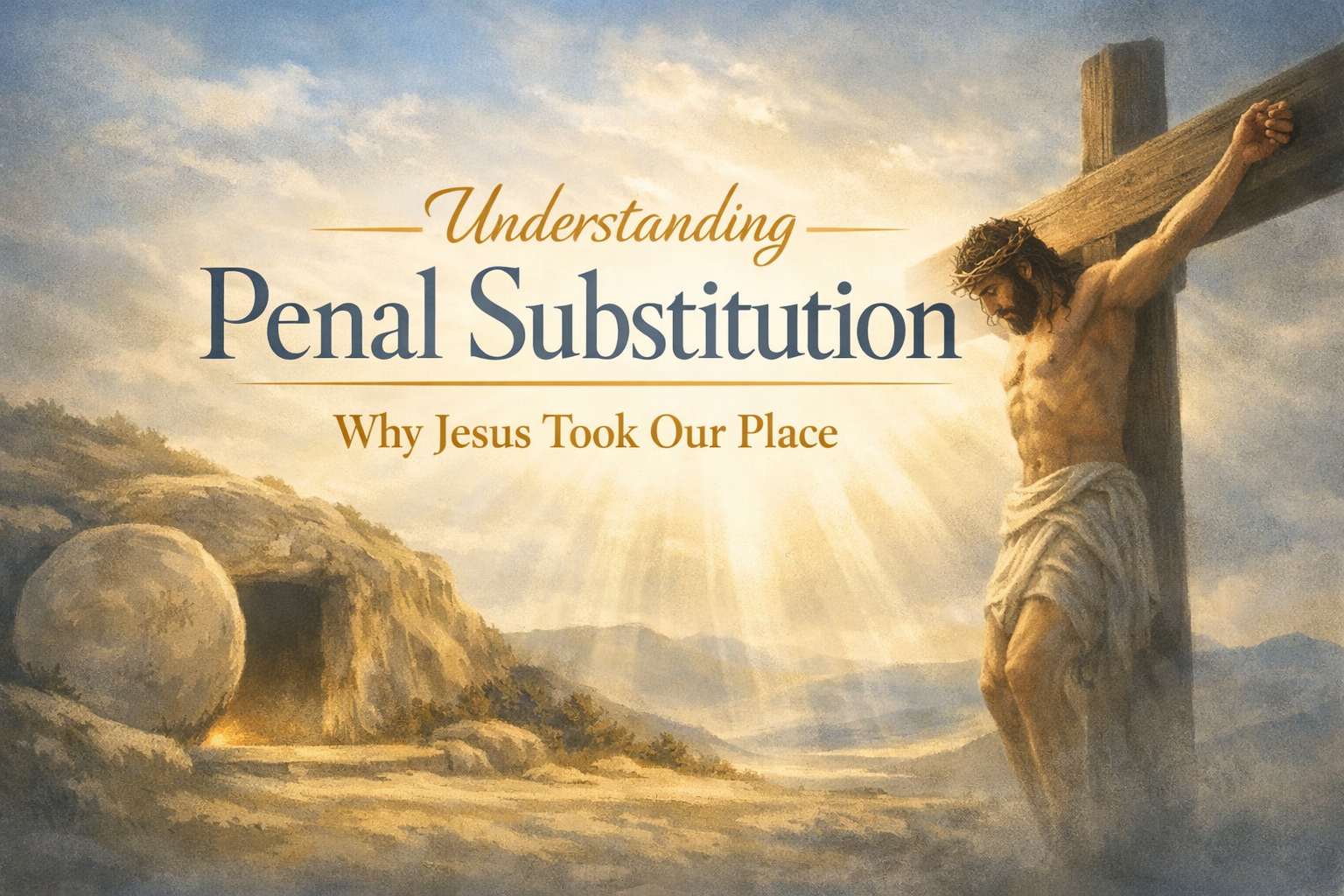
Understanding Penal Substitution: Why Jesus Took Our Place
How God’s Justice and Love Met at the Cross — and What That Means for You
In the heart of the Christian faith stands the cross of Jesus Christ. For centuries, believers have gazed upon that wooden instrument of death and found life, forgiveness, and hope. But why did Jesus die? What did His suffering actually accomplish?
One of the most influential answers to that question is known as penal substitution — the belief that Jesus bore the penalty of sin in our place, so that we might be forgiven and reconciled to God. This teaching has stirred hearts, sparked debates, and shaped much of Protestant theology since the Reformation. But beyond the seminaries and scholarly arguments, penal substitution is about real people finding real hope.
What Is Penal Substitution?
The phrase might sound complicated, but it breaks down simply:
Penal
Refers to penalty or punishment. Sin carries a penalty (Romans 6:23).
Substitution
Someone steps in and takes another’s place — bearing what the other deserved.
Together
Jesus Christ took the punishment we deserved as sinners. He became our substitute.
At the cross, God’s justice and love meet. Instead of humanity bearing the eternal consequences of sin, Jesus bore them. He stood in our place under the judgment of God.
“God made him who had no sin to be sin for us, so that in him we might become the righteousness of God.” — 2 Corinthians 5:21
The Biblical Foundation
Penal substitution isn’t a theological idea dreamed up in the Middle Ages. It’s woven through the whole Bible — from the very first sacrifice to the final pages of Revelation.
The Old Testament Sacrificial System
From the beginning, sin demanded atonement. In Leviticus, God provided animal sacrifices as substitutes for guilty sinners — blood shed to cover sin, pointing forward to a greater sacrifice that was coming.
Leviticus 16:21–22 · Exodus 12:13
The scapegoat carried Israel’s sins into the wilderness. The Passover lamb’s blood spared God’s people from judgment. These were not mere rituals — they were shadows of the Lamb of God.
Every substitutionary sacrifice in Israel’s worship was pointing to the cross.
Isaiah’s Suffering Servant
“But he was pierced for our transgressions, he was crushed for our iniquities; the punishment that brought us peace was on him, and by his wounds we are healed.” — Isaiah 53:5
Written seven centuries before Calvary, Isaiah describes a Servant who suffers not for His own sins but for the sins of others. The language of substitution — for our transgressions, for our iniquities — is explicit and unmistakable.
Jesus’ Own Words
Mark 10:45 · Matthew 26:28
Jesus described His mission in substitutionary terms: “The Son of Man came to give his life as a ransom for many.” At the Last Supper He said: “This is my blood of the covenant, poured out for many for the forgiveness of sins.”
Jesus wasn’t describing an accident or a martyrdom. He was describing a purposeful substitution.
The Apostolic Witness
Romans 3:25–26 · 1 Peter 2:24 · Galatians 3:13
Jesus is the “propitiation” who bore God’s wrath (Romans 3:25). “He himself bore our sins in his body on the tree” (1 Peter 2:24). “Christ redeemed us from the curse of the law by becoming a curse for us” (Galatians 3:13). The consistent picture across every New Testament writer is clear: Christ stood in our place.
Why Penal Substitution Matters
⚖️ God’s Justice
Sin is not a light thing. If God simply ignored it, He would not be just. Penal substitution shows that God takes sin seriously — seriously enough that His own Son bore its full weight (Romans 3:26).
❤️ God’s Love
The cross demonstrates love in its highest form. Jesus willingly gave Himself. The Father did not coerce the Son — the Son freely laid down His life (John 10:18; Romans 5:8).
✅ Our Assurance
Because the penalty has been fully paid, believers can rest in assurance. We’re not working off a debt. When Jesus cried “It is finished” (John 19:30), He declared it canceled — completely.
Common Objections — and Honest Answers
❓ “It sounds like divine child abuse — God punishing His innocent Son.”
This misunderstands the Trinity. The Father, Son, and Spirit are united in will. Jesus willingly laid down His life (John 10:18) — He was not a victim of divine cruelty. The cross was an act of divine love, not internal violence within the Godhead.
❓ “It’s too legalistic — a cold courtroom transaction.”
The Bible does use courtroom language (justification, judgment), but it’s never merely legal. God justifies us so we can be reconciled to Him as children (Romans 8:15). The courtroom language leads to the family table.
❓ “It neglects the resurrection.”
Penal substitution explains how sin was dealt with. The resurrection shows that sin and death were defeated. Both are essential and inseparable — the cross without the empty tomb is a tragedy, not a gospel.
❓ “Other atonement models are more biblical — Christus Victor, Moral Influence.”
These are not rivals but complements. Penal substitution answers God’s justice. Christus Victor emphasizes Christ’s triumph over evil. Moral Influence highlights His example. Together they form a fuller picture of a cross with more glory than any single angle can capture.
A Story from the Courthouse
The Neighbor’s Fine
Imagine your neighbor got into serious trouble with the law. He owed a fine he could never pay — thousands of dollars. The judge declared: “Pay this, or you go to prison.”
Now imagine you walked into that courtroom, pulled out your own hard-earned money, and paid the fine in full. The law was satisfied. Your neighbor walked free — not because he deserved it, but because someone else bore the cost.
That’s penal substitution. Jesus stepped into the courtroom of God’s justice, took our sentence, and paid our debt in full.
How Penal Substitution Speaks to Today’s World
⚖️ Justice and Forgiveness
We live in a world crying out for justice — against violence, corruption, and oppression. Penal substitution says God is not indifferent. Every wrong will be dealt with. But it also offers forgiveness for sinners like us.
🚫 Cancel Culture vs. Grace
In today’s culture, people are “canceled” for their sins and failures. Penal substitution proclaims a better word: you are forgiven, not canceled. Jesus bore the shame so we could stand free.
💔 Hope for the Broken
For those weighed down by guilt, penal substitution offers real hope. You don’t carry the penalty anymore. Jesus carried it to the cross and left it there when He rose.
🤲 A Call to Sacrifice
If Christ laid down His life for us, we’re called to lay down our lives for others (1 John 3:16). Penal substitution doesn’t just explain what happened — it fuels a life of sacrificial love.
Living in Light of the Cross
Paul told the Corinthians: “I resolved to know nothing while I was with you except Jesus Christ and him crucified” (1 Corinthians 2:2). The cross is central — because it is where the penalty of sin was dealt with once and for all. Here’s what that means for a Monday morning:
- Gratitude — Live with a thankful heart, knowing your debt is paid. Not earned, not working off — paid.
- Holiness — Because Jesus bore our sin, we strive to live free from sin’s grip. Not to earn favor, but to walk in the freedom He purchased.
- Forgiveness — As Christ forgave us at great cost, we forgive others. The size of our debts-forgiven shapes the generosity of our forgiving.
- Mission — We share the good news that others, too, can be free. The cross is not just our story — it’s the story we carry into every conversation.
“But God demonstrates his own love for us in this: While we were still sinners, Christ died for us.” — Romans 5:8
Penal substitution is not the whole story of the cross — but it is its cornerstone. It tells us that sin is serious, God is holy, and Jesus is Savior. It assures us that justice has been satisfied, forgiveness is available, and love has triumphed.
In a world still trying to make sense of guilt, shame, and justice, the cross of Christ stands as God’s final word: “It is finished.” And that changes everything.
🙏 A Closing Prayer
Lord Jesus, thank You for standing in my place. Thank You that justice has been satisfied and mercy has been extended — not because of anything I’ve done, but because of everything You are. Help me live each day in light of the cross: grateful, holy, forgiving, and ready to share the hope that is in You. Amen.
Key Scriptures: 2 Corinthians 5:21 · Isaiah 53:4–6 · Romans 3:25–26; 5:8; 6:23 · Mark 10:45 · 1 Peter 2:24 · Galatians 3:13 · John 10:18; 19:30 · Romans 8:15 · 1 Corinthians 2:2 · 1 John 3:16 · Leviticus 16:21–22 · Exodus 12:13
Want to Go Deeper?
This post is part of an ongoing series on the doctrines that define the gospel. If penal substitution stirred something in you, here are a few next steps:
- Share it with a new believer, or someone who’s heard the cross minimized or explained away.
- Read Isaiah 53 slowly — all twelve verses, aloud if you can. Then read Romans 3:21–26 right after. That’s the heartbeat of penal substitution in Scripture.
- Subscribe to get new posts delivered straight to your inbox — gospel-rooted, plain-spoken truth for the week ahead.
“He himself bore our sins in his body on the tree, that we might die to sin and live to righteousness. By his wounds you have been healed.” — 1 Peter 2:24
Mountain Veteran Ministries
Find Your Next Bearing
Every journey needs a direction. If you're wondering where to go from here, choose the path that best fits where you are today.
⚒️ I Want to Live Faithfully
Discover practical wisdom for following Christ in today's world.
→ Living as a Christian Today✝️ I Want to Understand the Gospel
Learn what salvation means and why Jesus came.
→ Understanding Salvation📖 I Want to Understand the Bible
Explore why Christians trust Scripture and how to read it well.
→ Understanding the Bible❓ I Still Have Questions
Explore thoughtful answers to some of Christianity's hardest questions.
→ Hard Questions