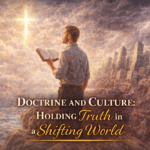

What do you do when the laws of the land drift away from the law of God — and you still have to live in it?
Your phone lights up. Again. And somewhere between the outrage and the highlights, the hot takes and the heartbreak, something is quietly happening to the way you think — and the way you believe. Christians have always lived in cultures that push back. Today the push comes through a screen. This post is about what Scripture says, and what to do about it.
What do you do when the laws of the land drift away from the law of God — and you still have to live in it?
What do I owe Caesar when Caesar has gone sideways? Where is the line between submission and complicity? How do I stay faithful to God without becoming either a rebel or a coward?
These are not rhetorical questions. The stakes are too high for slogans.
There was a time — not that long ago — when most Americans operated with a rough moral consensus. You didn’t have to be a Christian to agree that life mattered, that the family had a certain shape, that truth wasn’t something you invented for yourself. The legal system, however imperfect, generally rhymed with a biblical view of right and wrong.
That day is mostly gone. We are now living in a country where the law increasingly defines as rights what Scripture defines as sin, and defines as bigotry what Scripture calls faithfulness. And Christian men — husbands, fathers, business owners, soldiers, veterans, neighbors — are caught in the middle.
Let’s work through this carefully.
Romans 13 Is Not a Blank Check
Every conversation about Christians and civil authority eventually lands on Romans 13. Paul writes it plainly:
“Let every person be subject to the governing authorities. For there is no authority except from God, and those that exist have been instituted by God.” — Romans 13:1
That’s real. That’s binding. Christians are not anarchists, and the Bible does not give us license to ignore or overthrow governments we disagree with. We pay taxes. We obey traffic laws. We follow regulations we didn’t vote for. Submission to civil authority is a genuine Christian obligation — not optional.
But Romans 13 has to be read alongside the rest of Scripture, not extracted from it. And the rest of Scripture is clear that human authority has limits.
Acts 4:19–20 — Peter and John before the Sanhedrin
When ordered to stop preaching in the name of Jesus, they didn’t launch a political campaign. They said: “Whether it is right in the sight of God to listen to you rather than to God, you must judge. For we cannot but speak of what we have seen and heard.” That’s not rebellion — that’s the proper ordering of loyalties.
Daniel 3 · Daniel 6 · Exodus 1:15–21
Daniel prayed toward Jerusalem three times a day even when it became illegal. Shadrach, Meshach, and Abednego refused to bow to Nebuchadnezzar’s statue even when the furnace was already hot. The Hebrew midwives lied to Pharaoh rather than execute the infant boys. In each case, God commended — not condemned — their defiance of unjust human law.
The principle is ancient and consistent: civil authority is legitimate and must be respected, but it is not ultimate. When human law commands what God forbids, or forbids what God commands, the Christian’s answer is clear — obey God. The harder question is everything in between.
The Gray Zone Most Men Are Actually Living In
Most of us will never face a moment quite as clean as “bow to the statue or burn.” What we face is messier — the employer who pressures us to sign off on policies that violate conscience, the school curriculum our children sit through, the HR training we’re required to complete, the contract clause that edges toward complicity in something we can’t endorse.
These situations don’t come with a clear villain and clear hero. They come with ambiguity, pressure, real financial consequences, and the nagging question of whether we’re making a principled stand or just being difficult. Three principles help navigate it:
Distinguish participation from proximity
Living in a fallen society means we are always in some proximity to things we don’t endorse. We pay taxes that fund things we oppose. We shop at stores owned by people whose values we reject. Proximity is unavoidable — it is not the same as moral participation.
The question is not “am I near something sinful” — the answer to that is always yes. The question is “am I being asked to do something sinful, affirm something sinful, or enable something sinful in a direct and material way?” That’s where conscience kicks in.
Know what you’re willing to lose — before you need to know
Most of the pressure we face has an economic edge. Complying is cheaper. Refusing has costs — lost contracts, lost jobs, lost relationships. A Christian man providing for a family is not wrong to weigh those costs carefully.
But a man has to know his line before he reaches it. In the heat of the moment, with the mortgage due and the boss in the room, the temptation to rationalize is overwhelming. Men who haven’t thought through where their line is tend to discover they don’t have one. Jesus didn’t promise faithfulness would be cheap. He promised it would be worth it.
Conscience is serious — but it must be informed
Paul takes conscience seriously all through Romans 14 and 1 Corinthians 8. A violated conscience is a genuine wound. But conscience is not infallible — it must be trained by Scripture, not just inherited from our culture or our fear.
Do the work. Know what Scripture actually says, not just what you’ve always assumed it says. Bring your conscience to the Word, not the other way around.
What Our Fathers Knew About Living Under Imperfect Law
We are not the first Christians to live under governments hostile to faith. Not even close.
The early church lived under Roman imperial rule — a government that demanded emperor worship, that persecuted Christians in waves, that crucified their Lord. And yet the early Christians were not primarily known as political agitators. They were known as people who loved each other fiercely, who cared for the sick when plague swept through cities, who refused to expose unwanted infants, who told the truth in a world built on flattery. They changed the empire not by seizing its levers but by being undeniably different from it.
Luther, standing at Worms, did not defy the Emperor because he had a better political theory. He defied him because his conscience was captive to the Word of God, and he could do no other.
“Unless I am convinced by the testimony of the Scriptures or by clear reason — I am bound by the Scriptures I have quoted and my conscience is captive to the Word of God. Here I stand. I can do no other.” — Martin Luther, Diet of Worms, 1521
Not revolutionary fury. Not passive capitulation. A conscience anchored to something higher than the law of the land, and a willingness to bear the consequences quietly.
The Two Temptations
When culture and conscience diverge, Christian men tend toward one of two errors. Both are real. Both are worth naming.
The Error of Accommodation
This is the man who tells himself he’s being wise when he’s actually being afraid. He wraps cowardice in the language of prudence. He goes along quietly until he can no longer tell where his convictions end and his compromises begin. Salt that has lost its saltiness is good for nothing.
The Error of Combativeness
This is the man who has mistaken anger for faithfulness. He treats every cultural battle as a hill worth dying on. The watching world does not see Christ in him — they see a man who is furious that things didn’t go his way. Faithfulness is not the same as ferocity.
“Keep your conduct among the Gentiles honorable, so that when they speak against you as evildoers, they may see your good deeds and glorify God on the day of visitation.” — 1 Peter 2:12
In a culture drowning in outrage, a Christian man who is genuinely at peace — settled in his convictions, gentle in his manner, unafraid of what men can do to him — is a more powerful witness than any amount of political engagement.
The Sovereignty Question Underneath All of This
Here is what steadies the soul when the drift of the culture feels overwhelming: none of this is outside God’s governance. Not the Supreme Court decisions. Not the shifting definitions. Not the legislation that makes faithfulness costly. God is not wringing His hands over any of it.
Daniel served Nebuchadnezzar faithfully while refusing to bow to his idol. He served Darius faithfully while refusing to stop praying. He was not naive about the corruption of the empires he served. But he knew that the kingdoms of men rise and fall on a schedule set by the Ancient of Days — and that his job was faithfulness, not outcomes.
That’s the Reformed instinct at its best: a high view of God’s sovereignty produces not passivity but a particular kind of peace. We are not responsible for outcomes — we are responsible for obedience. God will take care of the rest. This is not fatalism. It is the ground that makes engagement possible without despair.
Practical Footing for the Long Haul
- Know your theology before you need it. The men who hold up under pressure are men who thought through what they believe before the pressure arrived. Read your Bible. Study church history. Know how Christians in harder circumstances than yours navigated similar questions.
- Build relationships across the line. The early church was not simply a fortress. Christians built genuine relationships with their pagan neighbors — which is part of why they had influence. You cannot be salt and light to people you have written off.
- Pick your battles honestly. Not every hill is worth dying on. Some things deserve firm resistance; others deserve patient endurance; others deserve creative navigation. Wisdom — not just courage — is required to tell the difference.
- Suffer well when it comes to that. If your faithfulness costs you something, bear it without self-pity or bitterness. A man who can lose without becoming bitter is a man who has something the world cannot manufacture.
- Root yourself in the local church. You will not make it alone. The drift of the culture is relentless, and isolated Christians are easy targets. The church is not a resource to be consumed on weekends — it is the community that keeps you sane, accountable, and anchored when everything else is shifting.
The law has stopped agreeing with God in a lot of places. That is hard. It will probably get harder. But Christians have been here before — have been in much worse situations than this — and the church has not only survived but flourished.
Not because it won the political arguments. Because it was undeniably, visibly, inconveniently different from the world around it.
Be different. Be faithful. Be at peace. And trust the God who holds the nations in His hands to take care of what you cannot.
Key Scriptures: Romans 13:1–7 · Acts 4:19–20 · Acts 5:29 · Daniel 3 · Daniel 6 · 1 Peter 2:12–17 · Matthew 5:13–16 · Philippians 3:20 · Exodus 1:15–21 · Hebrews 11:33–38
On the limits of civil authority — Revelation 13:1–10 · Micah 6:8 · Isaiah 10:1–4 · Proverbs 14:34
On living as exiles — 1 Peter 1:1 · 1 Peter 2:11 · Jeremiah 29:4–7 · Hebrews 11:13–16 · Philippians 3:17–21
On conscience and conviction — Romans 14:1–23 · 1 Corinthians 8:1–13 · Acts 24:16
On suffering for righteousness — Matthew 5:10–12 · 1 Peter 3:13–17 · Romans 8:18 · 2 Timothy 3:12
On God’s sovereignty over nations — Daniel 2:20–21 · Isaiah 46:9–10 · Psalm 22:28 · Acts 17:26
On honoring authority while fearing God — Matthew 22:15–22 · Titus 3:1–2 · 1 Timothy 2:1–4
Want to Go Deeper?
If you’re wrestling with how to live faithfully in a culture moving fast in the wrong direction, you’re not alone — and you don’t have to figure it out by yourself. Mountain Veteran Ministries exists to help men think clearly about faith, life, and what it means to follow Christ in a world that has largely stopped caring what He said.
Reach out, stick around, and keep reading. These are the conversations worth having.
“But we are citizens of heaven, and from it we await a Savior, the Lord Jesus Christ.” — Philippians 3:20