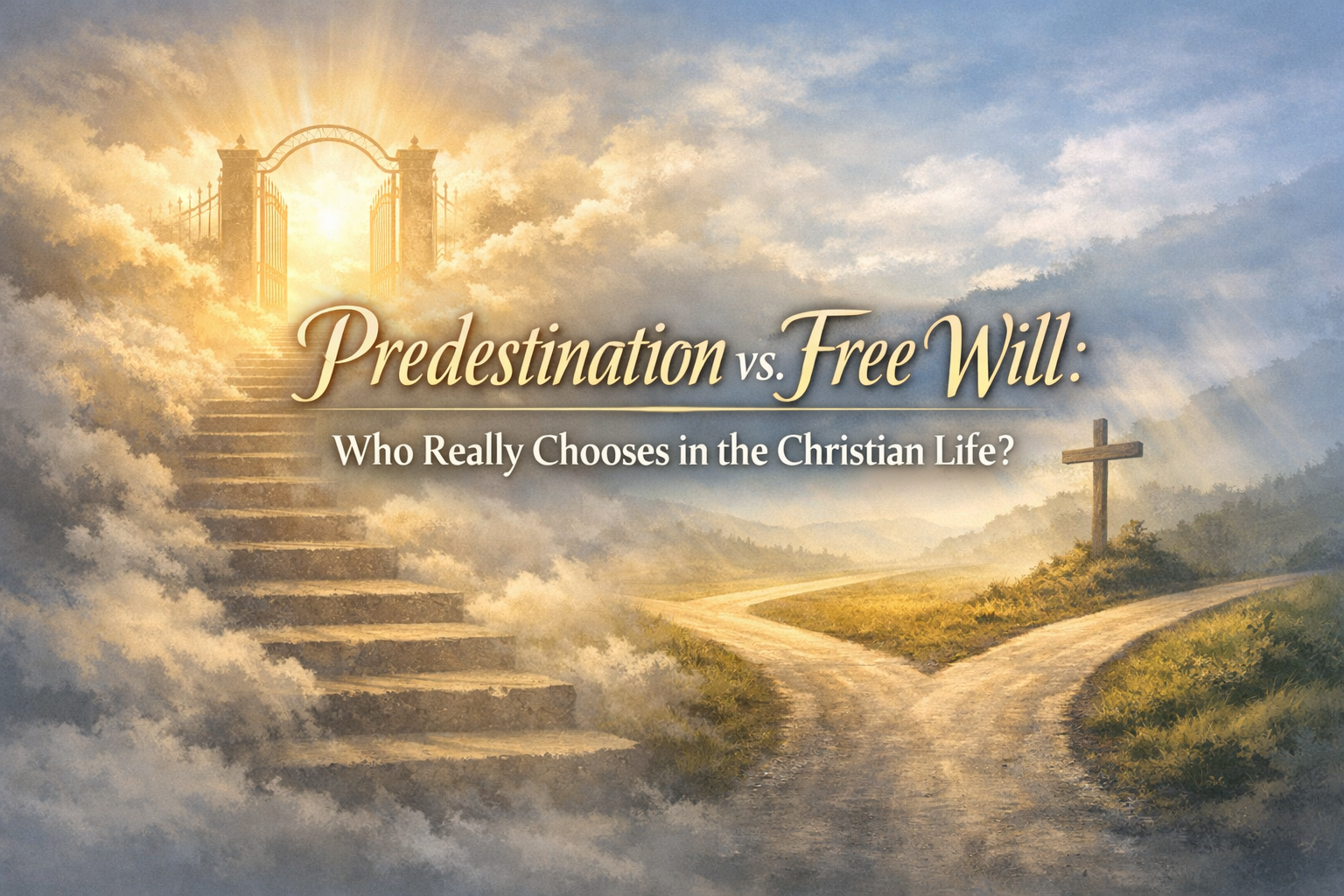
Predestination vs. Free Will: Who Really Chooses in the Christian Life?
An Honest, Scripture-First Look at One of Christianity’s Oldest and Most Personal Debates
If you’ve spent any time in a Bible study or a church fellowship hall, you’ve likely encountered the question that stirs up more than a few potluck debates:
Do we choose God, or does God choose us?
This is the heart of the long-running conversation about predestination and free will. And far from being merely a seminary abstraction, it touches how we pray, how we witness, how we raise our children, and how we understand the character of God. How we answer shapes what we believe about salvation, about assurance, and about why any person is in Christ at all.
Let’s work through it honestly, humbly, and always anchored in Scripture.
“For by grace you have been saved through faith, and that not of yourselves; it is the gift of God.” — Ephesians 2:8
Why This Question Matters
This is not merely theoretical. The predestination and free will debate has practical weight in every direction it turns.
The answers we land on shape how we share our faith, how we pray, how we counsel people in doubt, and how we understand the mercy of God.
The Two Main Positions
Position One — Reformed / Calvinist
Predestination: God’s Sovereign Choice
The Reformed view holds that God chose, before the foundation of the world, certain individuals to be saved — and that this choice was entirely unconditional. It was not based on anything foreseen in the person. Not their future faith, not their moral potential, not their eventual obedience. It is pure grace, freely and sovereignly given.
Augustine and Calvin are the tradition’s defining voices. Calvin’s “unconditional election” teaches that salvation is not earned or simply affirmed by foreknowing a future decision — it is bestowed by the sovereign mercy of God alone.
What this produces in the believer:
- Security — if God chose you, He will keep you (John 10:28)
- Humility — you did not save yourself; the credit belongs entirely to grace
- Worship — the undeserved nature of God’s choice produces profound gratitude
Position Two — Arminian / Wesleyan
Free Will: Man’s Responsibility to Respond
The Arminian view holds that God genuinely desires all people to be saved, offers salvation to all, and gives each person the grace-enabled capacity to respond in faith. Human freedom is real — the call can be genuinely accepted or genuinely refused. Election is conditional on faith, which God foreknew but did not foreordain.
Arminius and John Wesley are the tradition’s anchors. Wesley’s doctrine of prevenient grace — grace that goes before us and enables the response — preserves both the necessity of divine initiative and the reality of human choice. Salvation is available to all, but not automatic. Each person must respond.
What this produces in the believer:
- Responsibility — we are genuinely accountable for how we respond to the gospel
- Urgency — evangelism matters because real choices with real consequences hang in the balance
- Love — genuine love, in this framework, requires the genuine possibility of refusal
Three Ways to Hold Both
Some theologians and believers find both truths present in Scripture and decline to fully collapse one into the other. Here are three frameworks for holding the tension:
Foreknowledge
God predestines based on what He foreknows — He sees from eternity who will freely choose to believe, and His election is His eternal affirmation of that foreseen faith. The choice is genuinely human; the foreknowledge is genuinely divine. Many Arminians hold this view.
Compatibilism
God’s sovereignty and human freedom are not enemies — they operate on different levels and are ultimately compatible, even if we cannot fully explain the mechanism by which they work together. Many Reformed thinkers affirm genuine human responsibility while insisting that God’s will is not dependent on it.
Synergy
Eastern Orthodox Christianity teaches that salvation is cooperative: God initiates, man responds, and the two work together without either being rendered passive. Divine grace is necessary and prior; human assent is real and required.
Charles Spurgeon, himself a Calvinist, captured the pastoral posture well: “I never try to reconcile friends.” He preached both God’s sovereign election and human responsibility without apology, and trusted that the Author of both truths could hold them together even when the reader could not.
How Different Traditions Answer the Question
| Tradition | Core Position | Key Emphasis |
|---|---|---|
| Reformed / Calvinist | God chooses unconditionally | Salvation is entirely sovereign grace; the elect will persevere |
| Arminian / Wesleyan | God offers; man chooses | Prevenient grace enables genuine choice; salvation can be forfeited |
| Catholic | God initiates; man cooperates | Divine grace is necessary and prior; human cooperation is real |
| Eastern Orthodox | Salvation is synergy | God and man work together; neither is passive in the process |
| Pentecostal / Charismatic | Often Arminian | Strong emphasis on personal decision, freedom, and ongoing faith |
Across every tradition represented here, one conviction is held without exception: Jesus saves, and grace is essential. No one comes to Christ under their own power. Every tradition acknowledges the priority of God’s initiative. The debate is about the nature of the human response to that initiative — not about whether grace is necessary.
Living This Out — Regardless of Where You Land
Whatever position a believer holds on this question, the same practical responses follow from all of them:
We may not be able to fully resolve how God’s sovereign choice and our genuine response fit together — the mystery runs deeper than any theological system has successfully mapped. But we can rest in the grace that brings both sides of the debate to the same place: at the foot of the cross, dependent on what Christ accomplished, not on what we managed to contribute.
Whether you say “God chose me” or “I chose to follow Him” — if you are in Christ, you are His. Jesus still says “Come to me,” and everyone who comes will never be cast out (John 6:37).
It’s not about picking sides. It’s about pointing to Christ.
“All that the Father gives me will come to me, and whoever comes to me I will never cast out.” — John 6:37
Key Scriptures: Ephesians 1:4–5; 2:8 · Romans 8:29–30 · John 6:37, 44 · John 3:16 · 2 Peter 3:9 · Joshua 24:15 · Romans 9:10–21 · 1 Timothy 2:4 · John 10:28–29 · Acts 13:48
Want to Go Deeper?
This post sits at the center of MVM’s series on Reformed and Arminian theology. These companion posts explore the related questions it raises:
- The Elect: What Does It Mean to Be Chosen by God? — the full MVM treatment of election across Reformed, Arminian, and Catholic/Orthodox traditions, with the key texts worked through carefully
- Is Belief Really a Choice? — the companion post exploring the relationship between divine grace and human response in the moment of conversion itself
- Reformed vs. Arminian Theology — the broader comparison of the two major Protestant traditions across every major doctrinal point, not just salvation
- Chosen by God — R.C. Sproul; the clearest popular-level treatment of the Reformed position, written with pastoral warmth and honest engagement with the hard texts
- Arminian Theology: Myths and Realities — Roger Olson; the most careful modern treatment of the Arminian position, correcting common misrepresentations from both sides
- Subscribe to get new posts delivered straight to your inbox — gospel-rooted, plain-spoken truth for the week ahead.
“For by grace you have been saved through faith, and that not of yourselves; it is the gift of God.” — Ephesians 2:8
Mountain Veteran Ministries
Find Your Next Bearing
Every journey needs a direction. If you're wondering where to go from here, choose the path that best fits where you are today.
⚒️ I Want to Live Faithfully
Discover practical wisdom for following Christ in today's world.
→ Living as a Christian Today✝️ I Want to Understand the Gospel
Learn what salvation means and why Jesus came.
→ Understanding Salvation📖 I Want to Understand the Bible
Explore why Christians trust Scripture and how to read it well.
→ Understanding the Bible❓ I Still Have Questions
Explore thoughtful answers to some of Christianity's hardest questions.
→ Hard Questions