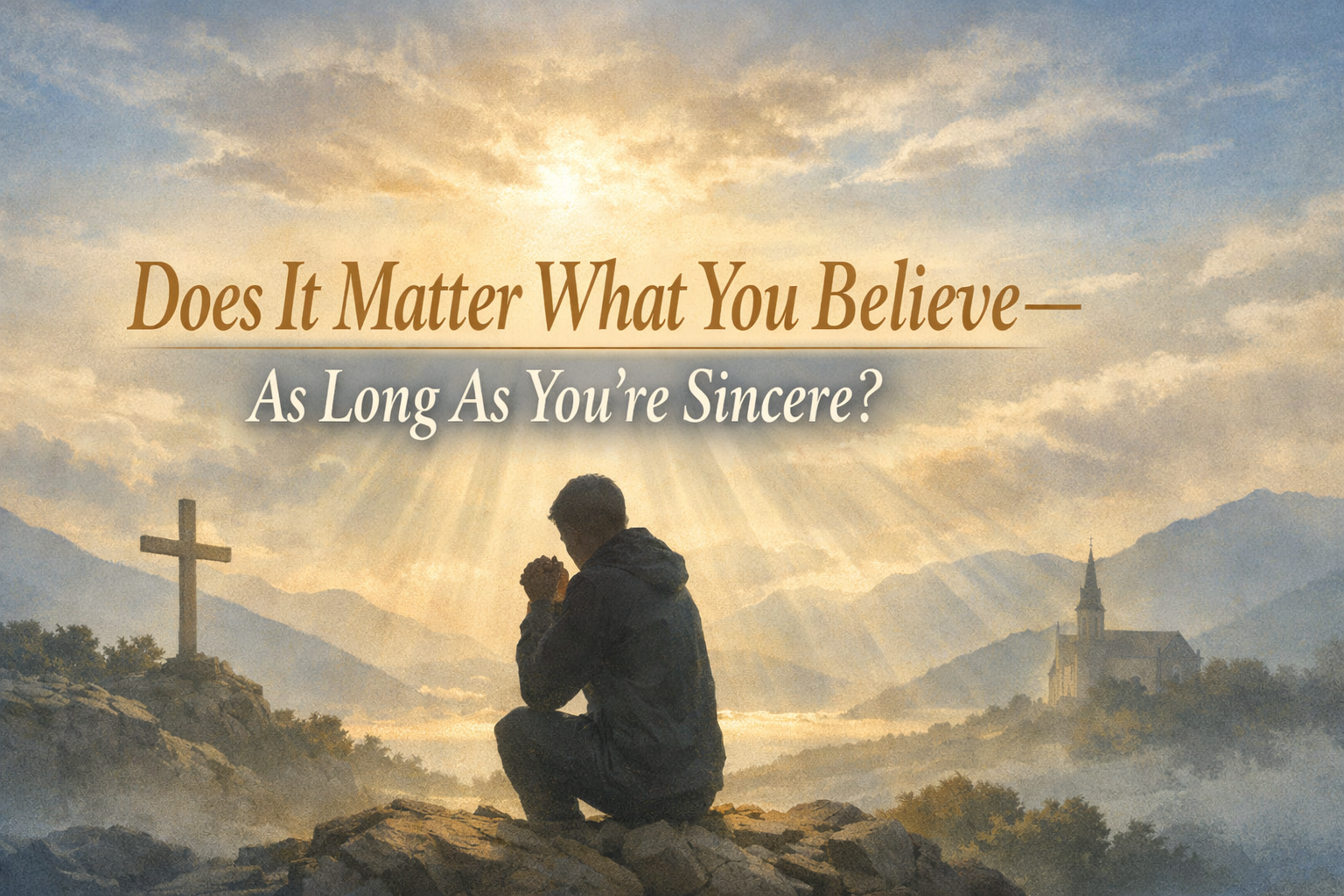
Does It Matter What You Believe—As Long As You’re Sincere?
What the great theologians — ancient and modern — say about one of the most popular ideas of our time.
Here’s a sentence you’ve probably heard more than once, maybe at a family dinner table, maybe from a coworker, maybe from someone you love: “It doesn’t matter what you believe as long as you’re sincere.”
It sounds generous. It sounds humble. In a culture that prizes personal authenticity above almost everything else, sincerity has become something close to a virtue in its own right — maybe the highest virtue. And there’s something in us that wants to agree, because disagreeing feels harsh, even arrogant.
But there’s a question that needs asking before we accept that claim: Is it true? And more pointedly — can sincerity save you?
Christians across twenty centuries have thought carefully about exactly this question. What follows is a survey of what some of the most important theological voices — from the early church fathers to contemporary scholars — have said about sincerity, truth, and the content of saving faith. Their answers are worth sitting with.
A Broken Compass
Before turning to the theologians, consider a simple picture. You’re hiking in the mountains — not hard to imagine if you’ve spent any time in the hills around Mount Hood. You pull out a compass and head off with complete confidence in the direction you’re sure leads home. You’re not guessing. You’re not being careless. You are entirely, genuinely sincere.
But the compass is broken.
Sincerity doesn’t fix a broken compass. It doesn’t change which direction is north. And it doesn’t change where you end up. You can be sincerely, completely, heartbreakingly lost — and your sincerity won’t help you one step toward home.
“You can be sincere and still be sincerely wrong.” — R.C. Sproul
That’s the issue. Sincerity speaks to the quality of our belief — how earnestly we hold it, how deeply we feel it. But it says nothing about whether what we believe is actually true. And in matters of eternal consequence, the difference between those two things is everything.
Voices from the Early and Classical Church
Augustine was a North African bishop whose writings shaped Western Christianity more profoundly than almost any other figure outside the apostles. He came to faith after years of sincere searching through Manichaeism, Neoplatonism, and his own restless intellectual wandering — which gave him a particular insight into the limits of earnest seeking.
Augustine understood from his own experience that a person can pursue something with passionate intensity and still miss the truth entirely. The heart’s sincerity does not correct the mind’s error. God’s mercy, not the quality of our longing, is what saves.
“It is not by the merits of our will, but by the mercy of God, that we are saved… for even error can be held with passion.” — Augustine, Confessions
The phrase is worth reading twice: even error can be held with passion. Augustine knew this firsthand. He had held error with great passion for years. His sincerity during those years was not in question. His direction was.
Justin Martyr was one of the earliest Christian apologists — a philosopher who converted to Christianity and then spent his life making the intellectual case for the faith before both Jewish and pagan audiences. He was eventually executed for his beliefs, which gives his words a weight that armchair theology rarely carries.
Justin acknowledged something generous and important: that some pagan philosophers, in their sincere pursuit of reason and truth, were unknowingly reaching toward the Logos — the divine Word who would be revealed in Christ. He did not dismiss their seeking. But he was clear that sincere reaching toward truth is not the same as knowing the truth. The Logos himself, not the sincerity of the search, is what saves.
“Those who lived according to reason are Christians… yet those who lived in error, though sincere, did not know the Logos.” — Justin Martyr, First Apology
Justin’s framing is both compassionate and clear. He honors the sincerity of those who sought. He insists that seeking, apart from finding Christ, is not enough.
Wesley, the founder of Methodism, is often associated with a warm, generous, experiential Christianity that emphasized the transformation of the heart. He genuinely believed that true religion was more about holy love than cold doctrinal precision. And yet Wesley never reduced faith to sincerity.
He was famously willing to extend fellowship widely — “if your heart is as my heart, give me your hand” — but that generosity operated within the boundaries of genuine Christian confession. Wesley drew a clear distinction between orthodoxy as the whole of religion (which he rejected) and right belief as a necessary component of religion (which he insisted on).
“Orthodoxy or right opinion is at best a very slender part of religion… yet right belief is still important.” — John Wesley, A Plain Account of Christian Perfection
For Wesley, a warm heart divorced from a true object is not yet saving faith. The heart must be aimed correctly — and that requires truth, not merely sincerity.
Contemporary Voices
C.S. Lewis came to faith as a reluctant convert — his own phrase — after years of atheism and rigorous intellectual resistance. That journey made him unusually sensitive to the way sincere people can be sincerely wrong, because he had been one of them. As a logician and literary scholar, Lewis had no patience for the idea that earnest feeling could substitute for true belief.
He was not harsh about sincerity. He recognized it as a genuine virtue — a quality of character worth admiring. But he was relentless about its limits. Sincerity speaks to how you believe. Truth speaks to what you believe. And only the second question has anything to do with salvation.
“A man may be sincerely wrong… sincerity does not make error into truth.” — C.S. Lewis, The Problem of Pain
No figure in the twentieth century preached the gospel to more people than Billy Graham, and few did so with more evident love for those who had not yet believed. Graham was not a man who dismissed or belittled sincere seekers. He took their longings seriously and spoke to them with genuine compassion.
And yet his message never shifted. The grace of God reaches sinners — not because of their sincerity, but because of the finished work of Christ. To tell someone that their sincerity is enough, Graham understood, would be the cruelest kind of kindness — affirming a comfort that offers no actual safety.
“You may be sincere in what you believe, but if you are wrong, you are wrong eternally.” — Billy Graham, Crusade Sermon, 1978
Sproul spent his career as one of the most rigorous defenders of Reformed theology in the modern era, and he returned repeatedly to the confusion between sincerity and truth as one of the defining errors of contemporary religious culture. He understood why the idea was appealing — it is emotionally comfortable, socially peaceable, and it requires nothing of us except that we feel strongly about something.
But Sproul argued that this comfort is borrowed. Truth is not a product of our conviction. It is independent of our conviction. God’s revealed Word does not become more or less true based on how passionately we believe or disbelieve it.
“Truth is not determined by how sincerely we believe it.” — R.C. Sproul, Essential Truths of the Christian Faith
Keller spent three decades in Manhattan engaging precisely the kind of thoughtful, secular, well-meaning people who are most likely to embrace sincerity as a substitute for truth. He understood their instincts — they were not being lazy or dishonest. They were responding to a genuine and understandable discomfort with religious exclusivity.
But Keller’s response was not to soften the exclusive claims of Christianity. It was to show why those claims, if true, change everything — and why sincerity, in a world where objective truth exists, is simply not a sufficient anchor for eternal hope.
“If truth is relative, then sincerity becomes the highest virtue — but that’s a poor substitute for truth itself.” — Timothy Keller, The Reason for God
Wright brings the lens of serious New Testament scholarship to this question. As someone who has spent a lifetime studying the historical and theological claims of early Christianity, Wright is careful about both compassion and precision. He acknowledges freely that sincere seekers exist in every culture and tradition, and he does not dismiss their seeking.
But Wright’s scholarship has led him to a conviction that cannot be softened: Christianity does not make claims about the quality of our sincerity. It makes claims about the identity and resurrection of Jesus of Nazareth. Those claims are either true or they are not — and if they are true, they are the most important facts in the universe, regardless of what any of us sincerely believes about them.
“Christianity makes radical claims — not about our sincerity, but about the identity of Jesus.” — N.T. Wright, Simply Christian
What Scripture Says
The theologians surveyed above are not creating a doctrine — they are reflecting one. Scripture itself speaks directly to the relationship between sincerity, truth, and salvation.
Proverbs 14:12 cuts to the heart of the matter with a quiet precision that has echoed through three thousand years of human experience: “There is a way that seems right to a man, but its end is the way to death.” The person on that road is not described as malicious or indifferent. The path seems right. The conviction is genuine. But the destination does not change based on the traveler’s confidence.
Jesus himself left no room for ambiguity: “I am the way, and the truth, and the life. No one comes to the Father except through me” (John 14:6). This is not a claim about the quality of our seeking. It is a claim about his identity. And Peter, preaching in Jerusalem just weeks after the resurrection, made the same point before a crowd that had every reason to resist it: “There is salvation in no one else, for there is no other name under heaven given among men by which we must be saved” (Acts 4:12).
These are not passages that can be smoothed into a general affirmation of sincere religious feeling. They are specific, exclusive, and grounded in the particular person and work of Jesus Christ.
The Cross Makes the Question Unavoidable
There is one argument against the sufficiency of sincerity that is more decisive than any philosophical or theological point. It is the cross itself.
If sincerity were enough — if any genuinely heartfelt belief about God could bring a person into right relationship with him — then Jesus did not need to die. The crucifixion becomes, on that view, an unnecessarily dramatic gesture. God could simply have affirmed the sincere seekers of every tradition and called it done.
But the gospel says something categorically different: “Christ died for our sins in accordance with the Scriptures” (1 Corinthians 15:3). The cross was not a gesture or an illustration. It was the only possible answer to the actual problem — the guilt and separation that human sin creates before a holy God, which no amount of human sincerity can undo. Salvation required a Savior, not merely a sincere effort. And that Savior gave everything he had to provide what sincerity never could.
This is why the gospel is simultaneously the most exclusive and the most inclusive message in the world. Exclusive, because there is only one way — through Christ and his atoning work. Inclusive, because that way is open to anyone who comes to it, regardless of their background, their history, or how long they spent walking in the wrong direction.
Speaking Truth in Love
None of this means we treat sincere seekers with contempt or impatience. It means exactly the opposite. The person who is sincerely heading the wrong direction on a mountain trail needs someone who cares enough to say so — gently, clearly, and without leaving them to figure it out alone.
Jesus said, “You will know the truth, and the truth will set you free” (John 8:32). Not sincerity. Truth. And the truth he had in mind was not a proposition to be memorized but a Person to be known — himself, the way, the truth, and the life. Our job is not to condemn the sincere seeker. It is to point them, as lovingly and clearly as we can, toward the One who can actually get them home.
So the next time someone says it doesn’t matter what you believe as long as you’re sincere, you might gently ask: “But what if you’re sincerely wrong?”
Then share the truth — because truth spoken in love is the most sincere thing we can offer.
For Further Study
The works quoted in this post are all worth your time. C.S. Lewis’s Mere Christianity and Tim Keller’s The Reason for God are the most accessible starting points. For deeper theological grounding, R.C. Sproul’s Essential Truths of the Christian Faith and N.T. Wright’s Simply Christian reward careful reading.
If this post raised questions you’d like to think through with someone, Mountain Veteran Ministries would welcome that conversation. These are the kinds of questions worth getting right.
“Then you will know the truth, and the truth will set you free.” — John 8:32
Key Scriptures: Proverbs 14:12 • John 14:6 • Acts 4:12 • Mark 1:15 • 1 Corinthians 15:3 • John 8:32 • Romans 10:9–10
Mountain Veteran Ministries
Find Your Next Bearing
Every journey needs a direction. If you're wondering where to go from here, choose the path that best fits where you are today.
⚒️ I Want to Live Faithfully
Discover practical wisdom for following Christ in today's world.
→ Living as a Christian Today✝️ I Want to Understand the Gospel
Learn what salvation means and why Jesus came.
→ Understanding Salvation📖 I Want to Understand the Bible
Explore why Christians trust Scripture and how to read it well.
→ Understanding the Bible❓ I Still Have Questions
Explore thoughtful answers to some of Christianity's hardest questions.
→ Hard Questions