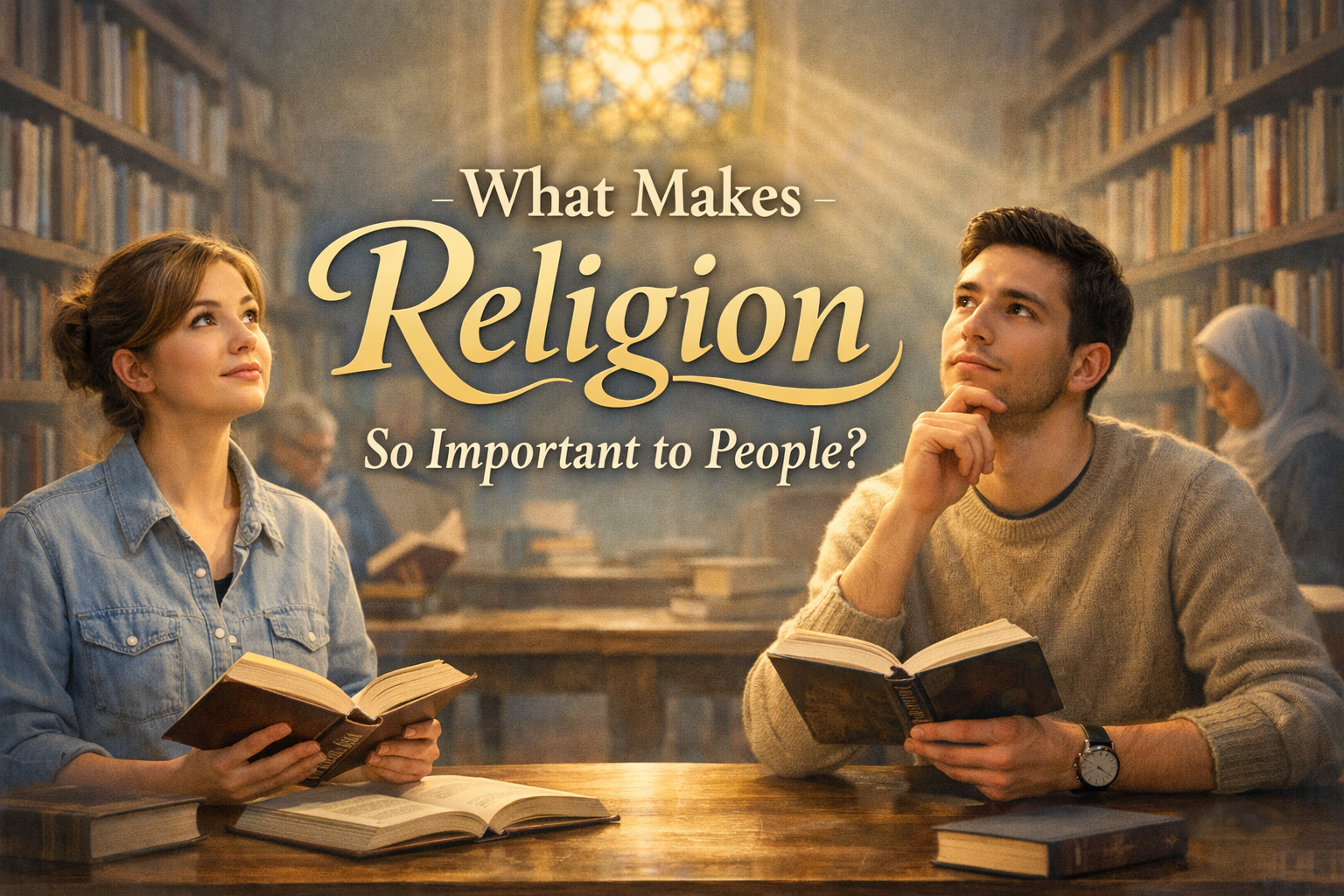
What Makes Religion So Important to People?
Across every culture, every continent, and every century of recorded history, human beings have reached toward something beyond themselves. They have built temples and cathedrals, recited prayers and sacred texts, gathered in community around shared beliefs, and organized their lives around invisible realities. Religion is not a fringe phenomenon. It is one of the most persistent and universal features of human existence. So what is actually going on? What makes religion so important to so many people — and what does the Christian faith say about why that is?
Across every culture, every continent, and every century of recorded history, human beings have reached toward something beyond themselves. They have built temples and cathedrals, recited prayers and sacred texts, gathered in community around shared beliefs, and organized their lives around invisible realities. Religion is not a fringe phenomenon. It is one of the most persistent and universal features of human existence. So what is actually going on? What makes religion so important to so many people — and what does the Christian faith say about why that is?
This is not merely a sociological question. It is a theological one. And the answer takes us right to the heart of who human beings are and who God is.
The Numbers Don’t Lie
Start with the sheer scale of religious belief worldwide. Despite decades of predictions that modernization would erode religious devotion, the numbers tell a stubborn story. Roughly 84 percent of the global population identifies with a religious faith. Christianity alone claims around 2.4 billion adherents. Islam follows with nearly 1.9 billion. Hinduism, Buddhism, Judaism, and hundreds of other traditions account for billions more. The secular West, where atheism and agnosticism have made the most visible gains, remains the outlier on the global stage, not the vanguard of where humanity is heading.
Sociologist Peter Berger, who once championed the secularization thesis — the idea that modern education and prosperity would naturally produce a godless society — publicly reversed himself in his later career. The world, he concluded, is “as furiously religious as it ever was.” That reversal deserves weight. The expectation that human beings would simply grow out of religion has not been borne out by the evidence. Something deeper is at work.
What Religion Provides: Seven Reasons People Need It
1. A Framework for Meaning
The most fundamental thing religion does is answer the question every thoughtful person eventually asks: Why does any of this matter? Why are we here? What is the point of suffering, of love, of death? Secular ideologies have tried to answer these questions, but they struggle. If the universe is a product of blind chance and human beings are nothing more than highly organized matter, the honest conclusion is that nothing ultimately means anything. Albert Camus called this the absurd — the gap between our hunger for meaning and the universe’s silence.
Religion fills that gap. It offers a narrative large enough to hold the whole of human experience — the joy and the grief, the triumph and the tragedy. It says that there is a story, that the story has a purpose, and that each human life fits into that purpose in a way that matters. This is not wishful thinking. It is the kind of account of reality that actually squares with what human beings find inside themselves — an irreducible sense that things like justice, love, and truth are real and not merely useful fictions.
“You have made us for yourself, O Lord, and our heart is restless until it rests in you.” — Augustine of Hippo, Confessions
Augustine wrote those words in the fifth century, but they describe something that has not changed. The longing for transcendent meaning is built into the human frame. Religion takes that longing seriously rather than explaining it away.
2. A Moral Compass
Every functioning human society requires a shared sense of right and wrong. Laws can codify behavior, but they cannot generate the kind of internalized moral commitment that makes communities actually hold together. Religion does what law cannot — it grounds morality in something greater than human preference or social contract. It says that the difference between right and wrong is not merely a matter of cultural convention but reflects something real about the universe and the God who made it.
The Christian tradition holds that human beings are made in the image of God — the imago Dei of Genesis 1:26–27 — and that this dignity carries genuine moral weight. Every person you meet is not a random arrangement of matter to be used or discarded. Every person bears the image of the Creator. That conviction reshapes how you treat people, how you structure institutions, how you think about justice. It is no accident that the long history of human rights advocacy — from the abolition of slavery to the defense of the vulnerable — has so often been driven by religious conviction.
3. A Community of Belonging
Loneliness has become one of the defining crises of the modern world. The U.S. Surgeon General’s office has described it as a public health epidemic. Social media has given people the appearance of connection while often leaving them more isolated than before. Religion — practiced in its fullest form, in actual gathered community — offers something the algorithm cannot: real human belonging rooted in shared conviction and shared story.
The New Testament word for the church is ekklesia — the called-out assembly. This is not a metaphor for a loose network of like-minded individuals. It is a body, a family, a covenant community. The writer of Hebrews urges believers not to forsake “the assembling of ourselves together,” and the reason is not merely sentimental — it is because human beings were made for this kind of belonging, not the digital simulation of it. Religious community at its best provides the kind of mutual accountability, shared celebration, and genuine care that holds people together across the hardest seasons of life.
4. A Way of Coping with Suffering and Death
Every human life eventually runs into the wall of suffering. Illness. Loss. Grief. The death of people we love. The approach of our own death. How a person navigates those realities is one of the most consequential questions of their life, and religion — across traditions — has always offered resources for that navigation that secular frameworks struggle to match.
The Christian faith does not paper over suffering with easy answers. Jesus wept at the grave of Lazarus (John 11:35). He cried out from the cross, “My God, my God, why have you forsaken me?” (Matthew 27:46). The grief is real. The darkness is real. But the resurrection is also real, and it changes everything. The apostle Paul, writing to a community well acquainted with suffering, does not tell them to pretend it doesn’t hurt. He tells them they do not grieve “as others do who have no hope” (1 Thessalonians 4:13). Hope — anchored in the empty tomb — gives grief a horizon it could not otherwise have.
This is one reason study after study has found that religiously active people tend to show greater resilience in the face of hardship, lower rates of depression and anxiety, and a stronger sense of well-being. Religion provides not just comfort but a framework within which suffering can be endured and even redeemed.
5. A Sense of the Sacred
Philosopher William James, in his landmark work The Varieties of Religious Experience, documented something he called the “sense of something more” — a numinous awareness that reality extends beyond what can be measured or touched. This experience is remarkably common across cultures and is not easily explained by neuroscience or evolutionary psychology, whatever attempts have been made. People encounter what Rudolf Otto called the mysterium tremendum — the awe-inspiring mystery that seems to press in from the edges of ordinary life.
Religion gives that experience a name, a context, and a community. It says that the sense of the sacred is not a cognitive malfunction or a byproduct of brain chemistry but a genuine perception — however partial and distorted — of what is actually there. The God who spoke creation into existence (Genesis 1:1), who revealed himself in the burning bush and the still small voice, who took on flesh in the person of Jesus of Nazareth, is not an abstract concept. He is a person who makes himself known. Religion, at its best, is the human response to that self-disclosure.
6. Ritual and Sacred Time
Human beings are not only rational animals — they are also embodied, rhythmic, and deeply formed by repetition and practice. Religion has always understood this. Worship is not merely an intellectual exercise. It involves the body: kneeling, singing, eating together at a common table, marking births and deaths and marriages with sacred ceremony. The rhythms of the liturgical calendar — Advent and Christmas, Lent and Easter, Pentecost and ordinary time — structure the year around a story larger than any individual life.
These practices do something that no amount of private spiritual reflection can fully replicate. They form people over time. They inscribe the story of God’s redemptive work into the habits and rhythms of daily life. This is why the Psalms were meant to be sung, why Israel was commanded to keep the Sabbath, why Jesus instituted a meal to be repeated until he comes again. The physical practices of religion are not ornamental. They are formative.
7. An Answer to Ultimate Questions
Philosophy has wrestled for millennia with questions that resist purely naturalistic answers. Why is there something rather than nothing? What is consciousness? What gives human life its peculiar dignity? Where did the moral law come from? These are not questions that can be resolved by more data or better technology. They are metaphysical questions, and every attempt to escape them simply smuggles in unexamined assumptions from somewhere else.
Religion — and Christianity in particular — does not pretend to resolve every mystery. But it offers a coherent, integrated account of reality that takes the full range of human experience seriously: reason and emotion, individual and community, time and eternity, sin and redemption. It is not anti-intellectual. The long tradition of Christian philosophy and theology includes some of the most rigorous thinkers in human history — Augustine, Aquinas, Pascal, Kierkegaard, Plantinga, Lewis. It is precisely because the questions are serious that serious people have found the Christian faith to be the most compelling answer to them.
What the Bible Says About Why This Is
Here is what separates the Christian account of religious longing from all purely sociological explanations: the Bible says that human beings reach toward God because God made them to do exactly that.
The opening chapters of Genesis establish that human beings are unique among creatures. They are made in the image of God (Genesis 1:26–27), which means they are uniquely fitted for relationship with him — capable of genuine communion, moral responsibility, and meaningful response to divine address. When that relationship was fractured by sin, the communion was broken but the longing was not extinguished. Human beings continued to reach for what had been lost, which is why religion is universal even when it is badly distorted or misdirected.
“For although they knew God, they did not honor him as God or give thanks to him, but they became futile in their thinking, and their foolish hearts were darkened.” — Romans 1:21
The apostle Paul’s argument in Romans 1 is remarkable. He does not say that pagan religion is simply irrational superstition. He says it is a distortion of a genuine perception — a perception of the divine reality that is evident in creation itself, suppressed and redirected by the fall, but never fully silenced. The hunger is real. The direction it has been sent is often wrong. But the hunger points toward something — or someone — who actually exists.
Paul makes this same argument at the Areopagus in Acts 17, standing before the philosophers of Athens and pointing to their altar to “the unknown God.” He does not mock their religious instinct. He redeems it. That unknown God, he tells them, is the God who made the world and everything in it, who gives life and breath to all things, in whom we live and move and have our being. Their reaching was real. The One they were reaching toward had now revealed himself fully in the resurrection of Jesus Christ.
This is the Christian claim about religion in its broadest sense: it is not simply a human invention. It is a human response — however broken, however misdirected in its fallen forms — to the reality of God pressing in on his image-bearing creatures. The longing for transcendence is not something evolution accidentally produced. It is something the Creator intentionally inscribed on the human heart.
When Religion Goes Wrong — and Why That Doesn’t Disprove the Longing
A fair objection at this point is that religion has not always been a force for good. The history of religious violence, manipulation, and exploitation is real. Crusades, inquisitions, cults, and the weaponizing of sacred language for political ends are all part of the historical record. Does that not undermine the case for religion’s importance?
The Christian answer is that it confirms it. The very intensity with which human beings pursue religion — the willingness to die for it, to kill for it, to organize entire civilizations around it — is evidence of how fundamental the longing is. A hunger this powerful can be misdirected. It can be corrupted. But the corruption of something does not disprove its value — it confirms how valuable the genuine article is.
G. K. Chesterton put it sharply: the fact that counterfeit money exists does not prove that real currency is worthless. The existence of false religion confirms that there is something real that false religion is counterfeiting. The distortions of human religiosity are real, but they are distortions — which presupposes something to be distorted.
The Reformed tradition, following Calvin, speaks of the sensus divinitatis — a sense of the divine that is, as Calvin put it, “engraved upon men’s minds.” It is not infallible. It is not a sufficient path to salvation on its own. But it is real, and it is why religion is universal and persistent even among people who have never encountered Scripture. The general revelation of God in creation and conscience primes the human person for the specific revelation of God in Christ.
The Gospel as the Answer to What Religion Is Reaching For
Here is the final turn, and it is the most important one. The Christian faith does not merely explain why religion is important. It claims to be the fulfillment of what all genuine religion is reaching toward.
Every religion in the world is trying to answer the same set of questions: How do I deal with my guilt? How do I find peace with whatever ultimate reality exists? How do I live a life that means something? How do I face death? The answers vary enormously. But the questions are shared, which is further evidence that the longing is built in.
The gospel answers these questions not with a program or a philosophy but with a person. Jesus of Nazareth — fully God and fully human — entered into the brokenness of human existence, bore the weight of human guilt on the cross, rose bodily from the dead, and offers a real and living relationship to everyone who comes to him. This is not one religious option among many. It is the claim that the One all the longing was pointing toward has actually shown up, and that the emptiness that religion in all its forms has been trying to fill can finally and fully be filled.
“Jesus said to him, ‘I am the way, and the truth, and the life. No one comes to the Father except through me.'” — John 14:6
That is an exclusive claim, and it is meant to be. Not because the longing of other traditions is dismissed, but because the longing has a specific answer. The person reaching for the altar to the unknown God is not doing something irrational. He is doing something profoundly human. The gospel says: the unknown God is unknown no longer. He has a name. He has a face. He has wounds in his hands and feet. And he is alive.
Conclusion: The Longing Points to the Lord
What makes religion so important to people? The simple answer is that human beings were made for relationship with God, and nothing else can finally satisfy that longing. Psychology can describe it. Sociology can map it. Neuroscience can locate it in the brain. But none of those disciplines can fill it, because the longing is not for a concept or a community or a coping mechanism — it is for a Person.
The persistence of religion across history and culture is not evidence of human irrationality. It is evidence of a Creator who made his creatures for himself, who has not left himself without witness in creation and conscience, and who in the fullness of time sent his Son so that the reaching might finally find what it was reaching for.
If you are someone who has felt that longing — the sense that there must be more, that something is missing, that the ordinary furniture of life cannot quite satisfy the depth of your hunger — the Christian faith says you are right. You were made for more. And the more has a name.
Come and see.
Key Takeaways
- Religion is a universal human phenomenon. Roughly 84 percent of the global population identifies with a faith tradition, and centuries of predictions about religion’s decline have not been borne out. The longing for transcendence is a feature of human nature, not a phase humanity will outgrow.
- Religion meets needs nothing else can fully meet. Meaning, morality, community, comfort in suffering, the sense of the sacred, ritual formation, and answers to ultimate questions — religion addresses the full range of what it means to be human in ways that purely secular frameworks struggle to replicate.
- The Bible explains why this longing exists. Human beings were made in the image of God for relationship with their Creator. The fall fractured that relationship but did not extinguish the longing. Romans 1 and Acts 17 both affirm that the hunger for God is a genuine response to genuine divine reality pressing in on every human person.
- The corruption of religion does not disprove the longing. The existence of false religion and religious violence confirms rather than undermines the power of the longing — just as counterfeit currency confirms the existence of something real worth counterfeiting.
- The gospel is not one religious option among many — it is the fulfillment of what all genuine longing points toward. Jesus Christ is the specific answer to the universal question. The God all the reaching was directed toward has revealed himself fully and finally in the person and resurrection of Jesus of Nazareth.
Mountain Veteran Ministries exists to bring the full, uncompromising gospel to men and women who have served — and to anyone else who has felt that longing for something more.
If this post raised questions, stirred something in you, or you simply want to go deeper, we want to hear from you. Reach out, explore our resources, or share this post with someone who is searching.
The God who made you for himself is not hard to find. He has already come looking for you.
Key Scriptures: Genesis 1:26–27 | Ecclesiastes 3:11 | Psalm 19:1–4 | Romans 1:18–23 | Acts 17:22–31 | John 14:6 | 1 Thessalonians 4:13 | Hebrews 10:24–25 | Colossians 1:15–20
Mountain Veteran Ministries
Find Your Next Bearing
Every journey needs a direction. If you're wondering where to go from here, choose the path that best fits where you are today.
⚒️ I Want to Live Faithfully
Discover practical wisdom for following Christ in today's world.
→ Living as a Christian Today✝️ I Want to Understand the Gospel
Learn what salvation means and why Jesus came.
→ Understanding Salvation📖 I Want to Understand the Bible
Explore why Christians trust Scripture and how to read it well.
→ Understanding the Bible❓ I Still Have Questions
Explore thoughtful answers to some of Christianity's hardest questions.
→ Hard Questions