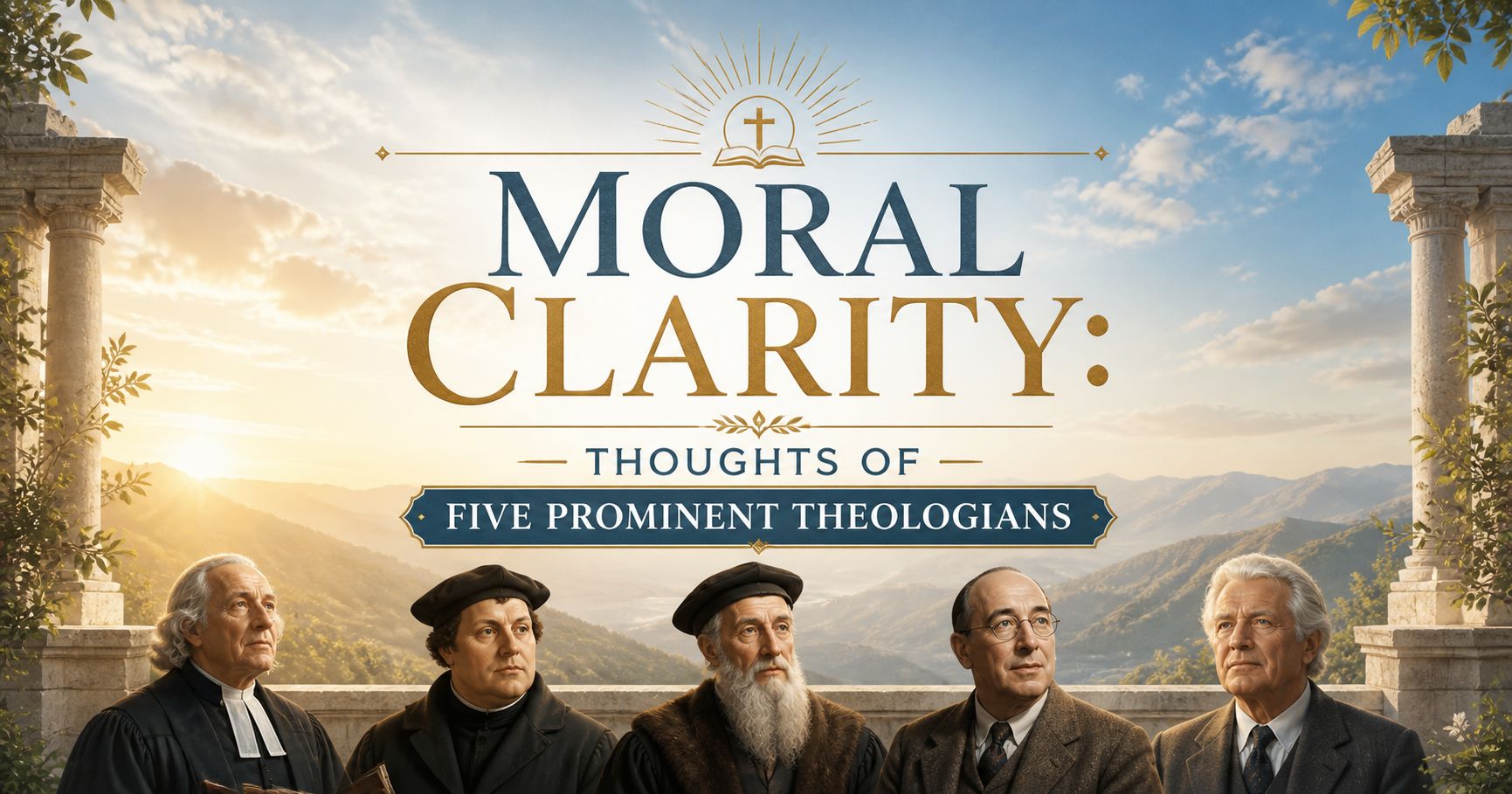
Moral Clarity: An Analysis by Five Prominent Theologians
Five of the church’s greatest thinkers agree: moral clarity isn’t found by looking inward — it’s recovered by looking up. And that changes everything about how we live.
Here’s a question that cuts through all the noise: How do you know what’s right?
Not how does your culture answer it. Not how does your political party frame it. Not what does social media tell you this week. How do you — standing before God, accountable for your life — know what is right and what should be?
This question has never been more urgent. We live in a moment where moral certainty is treated like arrogance and moral confusion is dressed up as humility. Men — veterans especially — often come home from service having seen evil up close, carrying a gut-level conviction that some things really are right and wrong, only to find a culture that shrugs and says “that’s just your perspective.”
It isn’t. And five of the greatest theological minds in Christian history can help us articulate why.
Why We Need More Than Instinct
Scripture is clear that moral knowledge is not the exclusive property of seminaries. Romans 2:14–15 tells us that even those without God’s written law show “the work of the law written on their hearts.” There’s something in every human being — a conscience, a moral register — that knows better.
But that register gets bent. Sin warps our perception of reality. Pride makes us rationalize. Fear makes us compromise. The culture presses in with its definitions. And suddenly a man who knew in his gut what was right finds himself uncertain, or worse — silent.
That’s why the testimony of the church’s wisest voices matters. These men didn’t just feel their way through ethics — they built frameworks from Scripture, creation, and hard experience. Let’s hear from five of them.
Augustine of Hippo — Disordered Love, Disordered Life
Augustine (354–430 AD) came to faith the hard way. He spent years chasing pleasure, philosophy, and prestige — and found all of them hollow. When he finally broke before God in a Milan garden, he didn’t just discover forgiveness. He discovered the structure of the problem.
In his masterwork City of God and the deeply personal Confessions, Augustine argued that sin is fundamentally a problem of disordered love. God created a world with a right order — love God supremely, love everything else in its proper place under Him. Moral evil enters not when we love bad things necessarily, but when we love good things in the wrong order, or to the wrong degree.
“Our heart is restless until it rests in Thee.” — Augustine, Confessions
The man who loves his family more than God doesn’t have a family problem — he has a worship problem. The soldier who finds his identity entirely in the mission, the uniform, the brotherhood — nothing wrong with any of those loves — but when they crowd out God, life goes sideways. Not because those things are evil. Because they were never meant to bear the weight of ultimate allegiance.
Moral clarity, for Augustine, comes from asking a diagnostic question: What am I loving most? And then the harder one: Is that ordered rightly under God?
Matthew 22:37–39 — “Love the Lord your God with all your heart and with all your soul and with all your mind… and love your neighbor as yourself.” That’s not just a command. It’s a description of the rightly ordered life.
Thomas Aquinas — Moral Truth Is Built Into the World
Thomas Aquinas (1225–1274) was a different kind of thinker — methodical, systematic, patient. A Dominican friar who wrote enough theology to fill a library, Aquinas brought Aristotle’s philosophical rigor into conversation with Christian Scripture and came out with something remarkable: a case that moral truth is not imposed on reality from outside, but woven into it from the beginning.
His doctrine of Natural Law holds that God’s moral order is embedded in creation itself — in the nature of things, in the purposes for which God made us. Human reason, though fallen, retains enough capacity to recognize basic moral truths: preserve life, tell the truth, live in community, seek God. These aren’t arbitrary rules. They’re the grain of the wood, the slope of the mountain — go with them and things work, fight them and things break.
This is why Paul can write in Romans 1:19–20 that what can be known about God “is plain” to all people, because “God has shown it to them” through the created order. Creation itself is a moral classroom. And the fact that virtually every human civilization throughout history has condemned murder, theft, and betrayal — despite wildly different religions and philosophies — is not a coincidence. It’s evidence of Aquinas’s point.
For veterans, this resonates at a gut level. You don’t need a theology degree to know that leaving a man behind is wrong, that protecting the innocent is right, that keeping your word matters. That’s natural law at work. Aquinas would say: trust that instinct — and then trace it back to its source.
Moral clarity, for Aquinas, comes not from inventing new ethics but from discovering the ethics God already built in.
John Calvin — Revelation Corrects What Reason Corrupts
Calvin (1509–1564) is where things get sobering. He agreed with Aquinas that God’s moral truth is written into creation. But he pushed back on how far fallen human reason can actually take us. His doctrine of the sensus divinitatis — the sense of the divine — acknowledges that all people have an inborn awareness of God. But he paired it immediately with its tragic companion: suppression.
We don’t just fail to follow moral truth. We actively suppress it. Romans 1:18 — “the wrath of God is revealed from heaven against all ungodliness and unrighteousness of men, who by their unrighteousness suppress the truth.” Natural law is real, but sin corrupts our reading of it. Culture distorts it. Pride bends it in our favor. The man who trusts only his own moral compass is trusting an instrument that has been knocked sideways.
This is why Calvin insisted on the absolute necessity of Scripture. The Bible isn’t a helpful supplement to good reasoning — it’s the headlights in the fog. Without God’s revealed Word, we drive by feel in the dark and call it wisdom. Calvin called Scripture the “spectacles” through which we finally see clearly what creation was already showing us.
Psalm 119:105 — “Your word is a lamp to my feet and a light to my path.” Not a candle we can leave at home. The lamp. The one we actually need when the terrain gets rough.
The application is direct: any man who says “I know what’s right — I don’t need the Bible” has misread himself. The question isn’t whether you have moral instincts. You do. The question is whether those instincts are calibrated to truth or to your own convenience.
C.S. Lewis — The Argument from Moral Experience
C.S. Lewis (1898–1963) came at this from outside the church before he came at it from inside. A stubborn atheist and Oxford don, he found himself undone by the very moral arguments he was trying to dismiss. The turning point appears in raw form in Mere Christianity: he noticed that people — including himself — appealed constantly to a standard of fairness when arguing with each other. Not just “I prefer this,” but “that’s not fair.” “You ought to know better.” “How would you like it?”
The moment you say “ought,” you’ve stepped onto Lewis’s terrain. Because “ought” implies a standard that exists outside both of you. You can’t appeal to something that isn’t there.
“My argument against God was that the universe seemed so cruel and unjust. But how had I got this idea of just and unjust? A man does not call a line crooked unless he has some idea of a straight line.” — C.S. Lewis, Mere Christianity
Lewis called this the Moral Law — distinct from instincts, distinct from cultural conventions, distinct from herd behavior. It’s the standard by which we judge even our instincts. When two impulses fight inside you (help the man who’s drowning, but it’s dangerous to try), the thing that decides between them is not another instinct. It’s something else — something that functions like a law.
Romans 2:15 gives this the theological name: the law “written on their hearts,” with conscience bearing witness. Lewis gave this phenomenon its apologetic weight: the universality of moral experience is one of the strongest signposts pointing toward a Moral Lawgiver.
Lewis is particularly useful in the culture we inhabit right now. When someone says “morality is just relative,” you don’t need to argue philosophy — just wait. Within five minutes they’ll say something is unfair, cruel, or wrong. Hold them to it. They’re already standing on ground they claimed not to believe in.
Tim Keller — The Gospel Shapes Moral Character
Tim Keller (1950–2023) spent his ministry in Manhattan — one of the most secular mission fields in America — and he developed a way of engaging moral questions that was simultaneously uncompromising and disarming. His central insight: moral clarity without the gospel becomes either pride or despair.
Here’s the problem. If you know what’s right and you’re doing it, morality becomes a scoreboard. You start comparing yourself to others, keeping track of your righteousness, looking down at the less disciplined. That’s pride. And if you know what’s right and you’re not doing it, morality becomes a crushing weight with no relief. That’s despair. Both are dead ends.
The gospel interrupts both. Jesus doesn’t just tell us what we should do — He does what we could not do and gives us His righteousness as a gift. 2 Corinthians 5:21 — “For our sake he made him to be sin who knew no sin, so that in him we might become the righteousness of God.” That’s not moral self-improvement. That’s substitution. And it changes the entire motivation for moral living.
You no longer obey to earn standing before God. You obey because you have standing before God — and you want to live like it’s true. Keller called this “grace-motivated obedience,” and it produces a different kind of moral character: humble, because you know you’re a sinner saved by grace; courageous, because you’re not performing for approval; honest, because you have nothing to hide.
Moral clarity, for Keller, isn’t a code you follow — it’s a character you receive, shaped by the gospel and lived out in community.
Titus 2:11–12 ties it together: “For the grace of God has appeared, bringing salvation for all people, training us to renounce ungodliness and worldly passions, and to live self-controlled, upright, and godly lives in the present age.” Grace doesn’t cancel moral seriousness — it trains it.
What All Five Are Saying Together
Line these five men up — separated by centuries, different traditions, different audiences — and they converge on the same ground:
Moral truth is objective. It isn’t invented — it’s discovered. It exists outside of us, grounded in the character of a God who is himself the standard of goodness. Augustine, Aquinas, Calvin, Lewis, and Keller all stand on this together.
We are morally capable but morally broken. We have enough of God’s image left to recognize right from wrong. We have enough sinful nature to suppress, distort, and rationalize that recognition when it costs us something. Both are true simultaneously.
Recovery requires more than effort. Moral clarity isn’t recovered by trying harder. It requires returning — to God’s order (Augustine), to God’s design (Aquinas), to God’s Word (Calvin), to God’s moral law within us (Lewis), to God’s grace in Christ (Keller).
Put it plainly: the world keeps asking “what feels right to me?” The gospel asks a different question entirely — “what reflects the character of God?”
That shift — from self as center to God as center — is the whole game.
For the Man in the Transition
Here’s where this lands practically, especially for veterans navigating the disorientation of post-service life.
Military culture, for all its flaws, gave you a moral framework: mission, brotherhood, duty, honor, country. Those aren’t bad things. But they’re not sufficient things either. When the uniform comes off, that framework doesn’t automatically transfer. And the civilian world will offer you replacements — comfort, individual freedom, personal authenticity, identity politics — that are thinner and less honest than the ones you left behind.
What Augustine, Aquinas, Calvin, Lewis, and Keller together are pointing you toward is something more stable than any of those frameworks: a God who is the standard, who revealed that standard in Scripture, who wrote it on your heart, and who redeemed your capacity to live by it through Jesus Christ.
You don’t have to figure out what’s right from scratch. The work has been done. The question is whether you’ll anchor yourself to it.
Micah 6:8 — “He has told you, O man, what is good; and what does the Lord require of you but to do justice, and to love kindness, and to walk humbly with your God?”
He has told you. It’s not hidden. It’s not uncertain. Walk humbly with your God — and the clarity comes with the walking.
Key Takeaways
- Moral clarity is not invented — it’s recovered. God is the source and standard of all moral truth, grounded in His own character and revealed in creation, conscience, and Scripture.
- Augustine: examine your loves. Sin is disordered love. Moral clarity begins when you stop asking “what do I want?” and start asking “am I loving this the way God intended?”
- Aquinas: trust the grain of the wood. God’s moral design is embedded in creation itself. Human reason can recognize it — but must trace it back to its source in God’s nature and law.
- Calvin: you need the headlights. Fallen reason alone will always bend toward self-justification. Scripture is not optional — it’s the external corrective our corrupted moral compass requires.
- Lewis: the “ought” is the evidence. Every time anyone argues about fairness, they’ve already conceded the existence of an objective moral standard — and that standard points to a Moral Lawgiver.
- Keller: the gospel changes the motive. Moral clarity apart from grace produces pride or despair. The gospel frees us to obey not to earn standing but because we have standing — in Christ alone.
Want to go deeper? Mountain Veteran Ministries produces theological content specifically for veterans and the men who walk alongside them. Browse our blog at mountainveteran.com — or share this post with someone who’s asking hard questions about what’s right and where it comes from.
Key Scriptures: Romans 1:18–20 · Romans 2:14–15 · Matthew 22:37–39 · Psalm 119:105 · 2 Corinthians 5:21 · Titus 2:11–12 · Micah 6:8
Mountain Veteran Ministries
Find Your Next Bearing
Every journey needs a direction. If you're wondering where to go from here, choose the path that best fits where you are today.
⚒️ I Want to Live Faithfully
Discover practical wisdom for following Christ in today's world.
→ Living as a Christian Today✝️ I Want to Understand the Gospel
Learn what salvation means and why Jesus came.
→ Understanding Salvation📖 I Want to Understand the Bible
Explore why Christians trust Scripture and how to read it well.
→ Understanding the Bible❓ I Still Have Questions
Explore thoughtful answers to some of Christianity's hardest questions.
→ Hard Questions