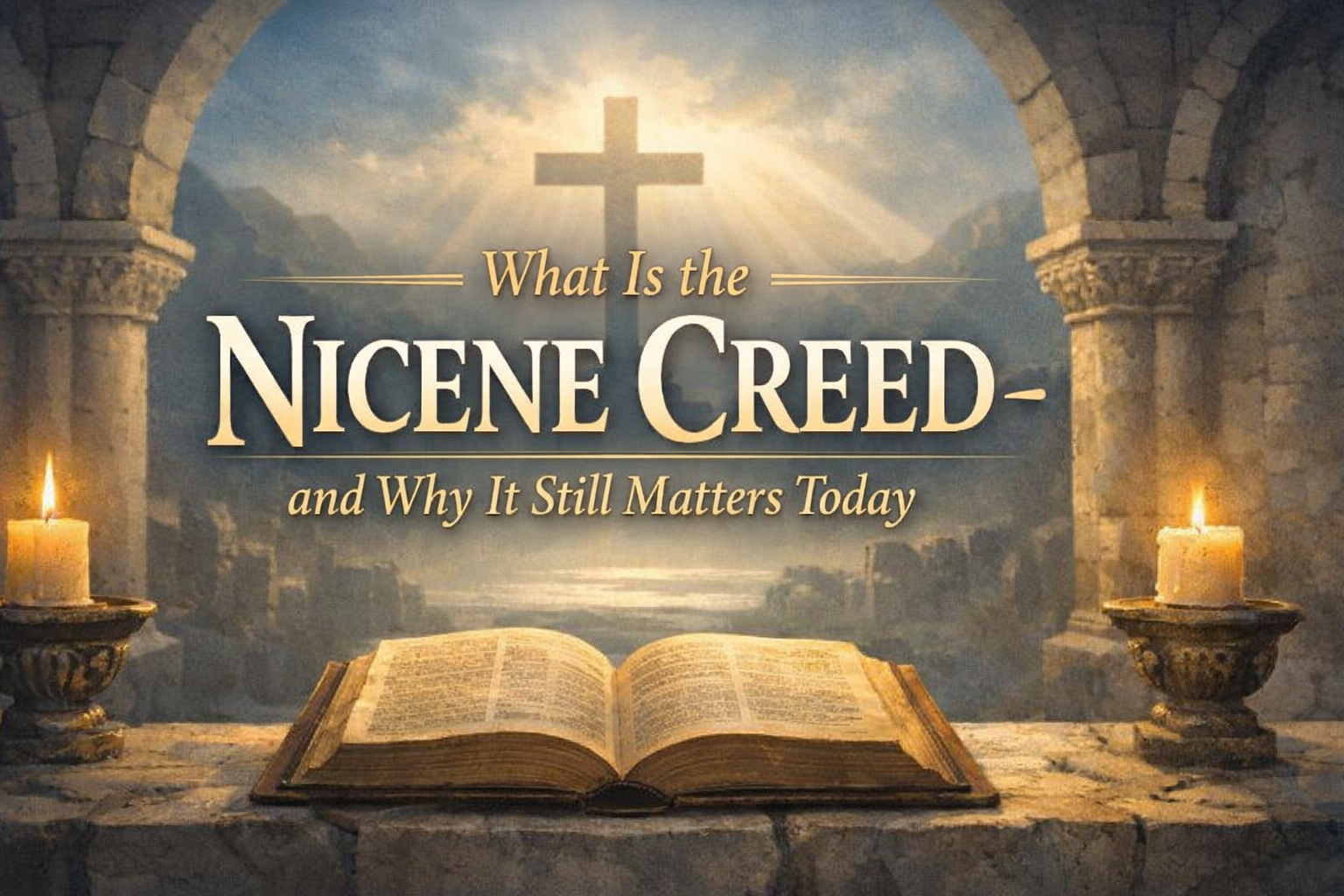
What Is the Nicene Creed—and Why It Still Matters Today
The 325 AD Council That Defined the Christian Faith — and Why Every Line Still Matters
The Nicene Creed is more than just a set of old words. It’s a bold declaration, a battle-tested confession, and a lighthouse in a stormy sea of theological confusion. It’s one of the earliest and most foundational statements of Christian faith, trusted by millions across centuries, denominations, and continents.
In a world full of shifting opinions and spiritual half-truths, the Nicene Creed brings clarity. It asks the question every generation must face: What do we actually believe about God, Jesus, and salvation?
“We believe in one Lord Jesus Christ, the only-begotten Son of God… Light of Light, very God of very God, begotten, not made, being of one substance with the Father.”
Where the Nicene Creed Came From
325 AD — The Council of Nicaea
The Nicene Creed was first drafted at the Council of Nicaea in 325 AD — a gathering of over 300 Christian bishops from across the Roman Empire, called by Emperor Constantine, who had recently legalized Christianity. The church was exploding in growth. And so were false teachings.
The creed was refined and expanded at the Council of Constantinople in 381 AD, and the version produced there is what most churches use today. It represents the consensus of the early church on the most disputed doctrinal question of the first four centuries: the identity of Jesus Christ.
❌ The Heresy of Arius — Why the Council Was Called
Arius was a popular and persuasive teacher in Alexandria who claimed that Jesus was not eternal — that He was a created being, the first and greatest of God’s creations, but a creature nonetheless. His famous slogan: “There was a time when He was not.”
That may sound like a minor theological nuance, but it is a direct assault on the gospel. If Jesus is not fully God, then His death cannot fully atone for sin — only an infinite sacrifice can cover an infinite debt. If He is a creature, He cannot be the mediator between God and humanity. The bishops at Nicaea understood this clearly: get Jesus wrong, and you lose the gospel.
The Full Text of the Nicene Creed
We believe in one God, the Father Almighty,
Maker of heaven and earth,
and of all things visible and invisible.
And in one Lord Jesus Christ,
the only-begotten Son of God,
begotten of the Father before all worlds,
Light of Light, very God of very God,
begotten, not made,
being of one substance with the Father;
by whom all things were made;
who for us men and for our salvation
came down from heaven,
and was incarnate by the Holy Spirit
of the virgin Mary,
and was made man;
and was crucified also for us under Pontius Pilate;
He suffered and was buried;
and the third day He rose again,
according to the Scriptures;
and ascended into heaven,
and sits on the right hand of the Father;
and He shall come again, with glory,
to judge the quick and the dead;
whose kingdom shall have no end.
And we believe in the Holy Spirit,
the Lord and Giver of Life;
who proceeds from the Father [and the Son];
who with the Father and the Son
together is worshiped and glorified;
who spoke by the prophets.
And we believe in one holy catholic and apostolic Church.
We acknowledge one baptism
for the remission of sins;
and we look for the resurrection of the dead,
and the life of the world to come. Amen.
What Each Section Teaches
“We believe in one God, the Father Almighty, Maker of heaven and earth, and of all things visible and invisible.”
We begin where Scripture begins: with God the Creator. He is not one god among many — He is the one true God who made everything that exists, visible and invisible. That last phrase matters: not just the material world but the spiritual realm, angels, powers, and principalities all owe their existence to Him.
Notice the creed opens with “We believe” — not “I believe” as in the Apostles’ Creed. This is a corporate confession, a statement of the gathered Church across time and place.
📖 Genesis 1:1 · Isaiah 44:6 · Colossians 1:16
“And in one Lord Jesus Christ, the only-begotten Son of God… Light of Light, very God of very God, begotten, not made, being of one substance with the Father;”
This is the section the Council of Nicaea was convened to write — a direct, precise refutation of Arius at every point. Each phrase was chosen with surgical care:
- “Begotten of the Father before all worlds” — His sonship is eternal, not temporal
- “Light of Light” — as light proceeds from light without diminishment, so the Son from the Father
- “Very God of very God” — not a lesser deity, not a god-like being, but genuinely and fully God
- “Begotten, not made” — this phrase directly answers Arius. There was no “time when He was not”
- “Of one substance with the Father” — the Greek word is homoousios — same essence, same being, same God
📖 John 1:1–3 · Philippians 2:6–11 · Colossians 1:15–20 · Hebrews 1:3
“…who for us men and for our salvation came down from heaven, and was incarnate by the Holy Spirit of the virgin Mary, and was made man;”
The creed now pivots from who Christ is to what He did — and why. “For us men and for our salvation” — His coming was not accidental, not merely instructional. It was purposeful rescue. He came down. He became flesh. He was made man — fully and really, not in appearance only.
And then the creed races through His work in the same verbs the Gospels use: crucified, suffered, buried, rose, ascended, sits, shall come. Each verb is an event in real history. Each event is load-bearing in the structure of our salvation.
📖 Isaiah 7:14 · Luke 1:35 · 1 Corinthians 15:3–4 · Acts 1:9–11
“And we believe in the Holy Spirit, the Lord and Giver of Life; who with the Father and the Son together is worshiped and glorified;”
The creed does not allow the Spirit to be treated as a force, an influence, or a lesser divine power. He is Lord. He gives life. He is worshiped and glorified alongside the Father and Son — which means He is equally God. The Spirit who spoke through the prophets, descended at Pentecost, and now dwells in every believer is the third person of the one true God.
📖 Acts 5:3–4 · John 14:26 · 2 Corinthians 3:17 · Genesis 1:2
“We believe in one holy catholic and apostolic Church… the resurrection of the dead, and the life of the world to come.”
“Catholic” means universal — the one body of Christ across every nation, century, and denomination. “Apostolic” means founded on and accountable to the teaching of the apostles recorded in Scripture. The creed closes with the most forward-looking declaration: resurrection and the life of the world to come. Not just heaven, but a renewed world. Not just survival, but transformation. The end is not escape — it’s new creation.
📖 Ephesians 4:4–6 · 1 Corinthians 15:52 · Revelation 21:1–4
The Trinity — Visualized
The Nicene Creed is the most precise Trinitarian statement in the ancient church. This ancient diagram — the Shield of the Trinity — captures what it affirms:
The Shield of the Trinity
The Father, Son, and Spirit are each fully God — and one in essence.
But they are not each other. This guards against both modalism (one God in three masks) and tritheism (three separate gods).
Four Reasons the Nicene Creed Still Matters
It Draws the Line Between Truth and Error
In a time when people say “it doesn’t matter what you believe about Jesus,” the Nicene Creed says it matters entirely. The identity of Christ is not a secondary theological question — it’s the question on which the gospel stands or falls.
It Guards Against Ancient Heresies That Never Went Away
Arianism didn’t die at Nicaea. It came back in every century in new forms — from Jehovah’s Witnesses to New Age spirituality to prosperity theology that reduces Christ to a helper. The creed teaches us to recognize the pattern.
It Unites the Global Church
Roman Catholics, Eastern Orthodox, and virtually all Protestant denominations confess the Nicene Creed. It is the broadest and most durable statement of Christian unity that exists — a common confession that outlasts every denominational division.
It Centers Our Worship on Received Truth
Reciting the Creed in worship reminds the congregation: we are not inventing the faith. We are receiving it. We are joining with bishops in ancient councils, with martyrs in Roman arenas, with believers in every nation who said these same words when it cost them everything.
Personal Reflection — What Do You Actually Believe?
The Nicene Creed is not just a church document or a historical artifact. It’s a mirror that asks each of us directly:
In the chaos of modern life and all its spiritual noise, the Nicene Creed is a clear trumpet sound. It tells us who God is, what Christ has done, who the Spirit is, and what our hope is built upon. It is Scripture condensed into confession, theology turned into praise, and doctrine turned into devotion.
Men bled and died to give us these words precisely. The least we can do is say them — and mean them.
So when the world tempts you to believe a lesser Jesus, a vaguer God, a softer gospel — stand where the ancient church stood, and say it plain: We believe in one Lord Jesus Christ, very God of very God, begotten not made, of one substance with the Father. And we look for the resurrection of the dead, and the life of the world to come. Amen.
“In the beginning was the Word, and the Word was with God, and the Word was God.” — John 1:1
Key Scriptures: Genesis 1:1 · John 1:1–3, 14 · Philippians 2:6–11 · Colossians 1:15–20 · Hebrews 1:3 · Isaiah 7:14 · Luke 1:35 · Acts 1:9–11; 5:3–4 · 1 Corinthians 15:3–4, 52 · Ephesians 4:4–6 · Revelation 21:1–4 · John 14:26 · 2 Corinthians 3:17
Want to Go Deeper?
The Nicene Creed is the theological backbone of historic Christianity. Here are the best resources for going further — and companion posts that connect directly:
- Read the companion MVM post on the Apostles’ Creed — the two creeds were designed to work together; the Nicene Creed expands and defends what the Apostles’ Creed confesses
- Read Knowing God by J.I. Packer — the modern classic on the God the Nicene Creed describes
- Read The Forgotten Trinity by James White — a clear, accessible defense of Trinitarian theology against modern Arian revivals
- Read the MVM posts on Justification and Salvation — the Nicene Creed’s insistence on Christ’s full deity is the foundation on which those doctrines stand
- Subscribe to get new posts delivered straight to your inbox — gospel-rooted, plain-spoken truth for the week ahead.
“In the beginning was the Word, and the Word was with God, and the Word was God.” — John 1:1
Mountain Veteran Ministries
Find Your Next Bearing
Every journey needs a direction. If you're wondering where to go from here, choose the path that best fits where you are today.
⚒️ I Want to Live Faithfully
Discover practical wisdom for following Christ in today's world.
→ Living as a Christian Today✝️ I Want to Understand the Gospel
Learn what salvation means and why Jesus came.
→ Understanding Salvation📖 I Want to Understand the Bible
Explore why Christians trust Scripture and how to read it well.
→ Understanding the Bible❓ I Still Have Questions
Explore thoughtful answers to some of Christianity's hardest questions.
→ Hard Questions