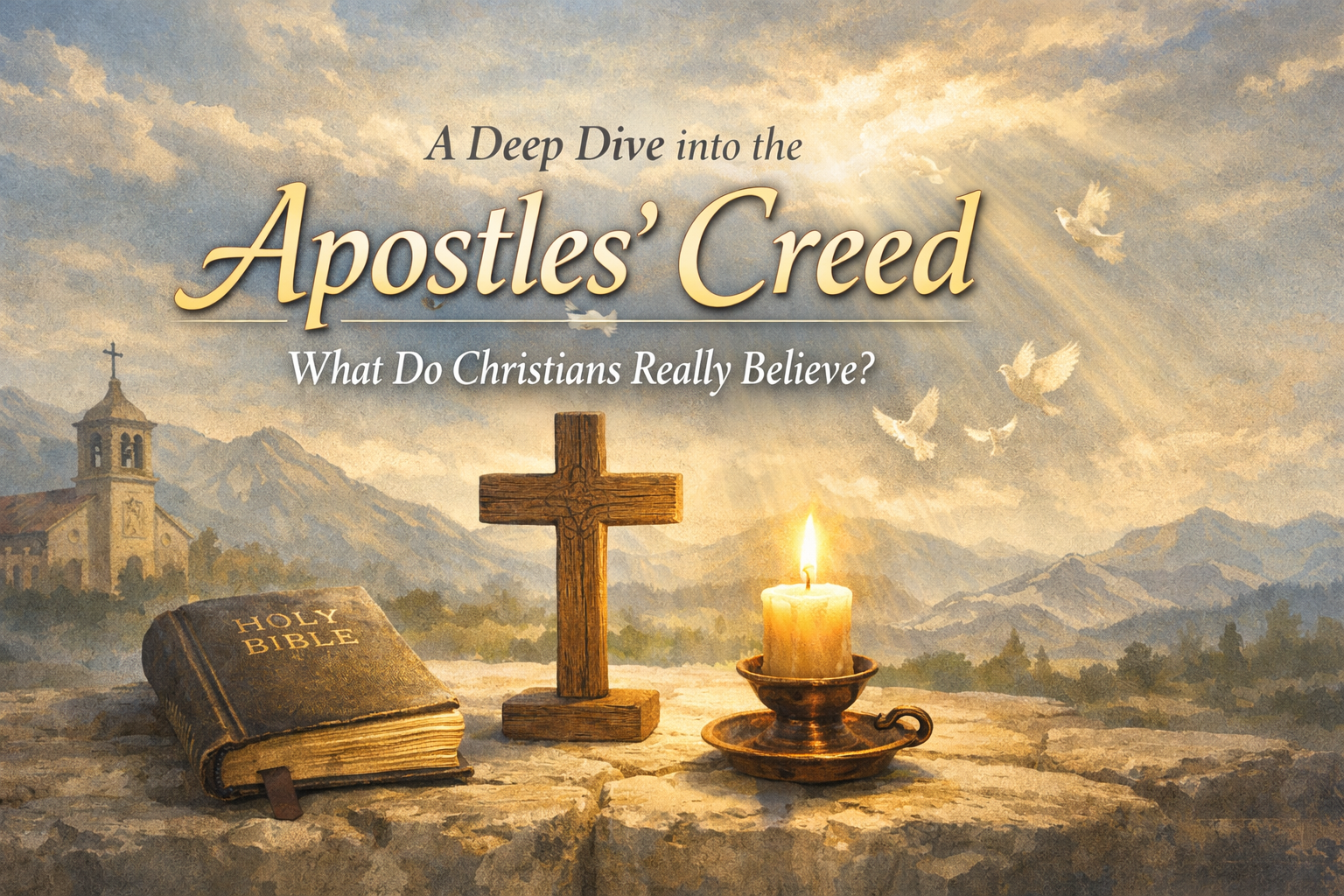
A Deep Dive into the Apostles’ Creed – What Do Christians Really Believe?
A Line-by-Line Exploration of the Oldest Summary of the Christian Faith
If you’ve ever wondered what Christians actually believe — boiled down to the core — look no further than the Apostles’ Creed. It’s one of the oldest summaries of the Christian faith, and it’s been uniting believers across time, continents, and denominations for nearly two thousand years.
The Apostles’ Creed isn’t Scripture, but it’s saturated with Scripture. It’s not a sermon, but it preaches the gospel in just a few powerful lines. It’s not merely words — it’s a declaration of spiritual identity, community, and hope that has been whispered in prison cells, shouted in cathedrals, and handed down to children by dying parents across twenty centuries.
“I believe in God the Father Almighty, Maker of heaven and earth…”
The Full Text of the Apostles’ Creed
I believe in God the Father Almighty,
Maker of heaven and earth.
And in Jesus Christ, His only Son, our Lord,
Who was conceived by the Holy Spirit,
born of the Virgin Mary,
suffered under Pontius Pilate,
was crucified, dead, and buried.
He descended into hell.
The third day He rose again from the dead.
He ascended into heaven,
and sitteth at the right hand of God the Father Almighty.
From thence He shall come to judge the quick and the dead.
I believe in the Holy Spirit,
the holy catholic Church,
the communion of saints,
the forgiveness of sins,
the resurrection of the body,
and the life everlasting. Amen.
Line by Line
“I believe…”
The word “believe” in the ancient Christian context means something far more than vague opinion. It means to trust, to rely on, and to stake your life upon. This is a personal and public confession: This is what I hold to be true, even if the whole world walks the other way. It begins with the first person singular — I. Not “our tradition teaches” or “most theologians hold.” It’s personal before it’s communal.
“In God the Father Almighty, Maker of heaven and earth.”
We begin with God the Creator — the one who made everything seen and unseen. But He’s not just a cosmic force or an abstract first cause. He’s a Father. This single phrase holds two truths in tension: power (Almighty) and relationship (Father). The Christian God is both transcendent and personal — and He made you on purpose.
📖 Genesis 1:1 · Matthew 6:9 · Revelation 4:11
“And in Jesus Christ, His only Son, our Lord;”
This line is the hinge of the whole creed. Christianity isn’t about a vague higher power or a general spiritual sensibility — it’s about Jesus, the Son of God, Lord of all. “Lord” means master. We don’t just admire Him or borrow His teachings. We follow Him, obey Him, and love Him. The claim is total.
📖 John 1:1–14 · Romans 10:9 · Acts 4:12
“Who was conceived by the Holy Spirit, born of the Virgin Mary;”
This is the Incarnation in two short clauses. Conceived by the Spirit, born of Mary — Jesus is both fully divine and fully human. This is one of the most contested claims in all of Christian history, and the creed refuses to soften it. God became man. Not appearing as man. Not adopting a human body. Becoming one of us.
📖 Isaiah 7:14 · Luke 1:35 · John 1:14
“Suffered under Pontius Pilate, was crucified, dead, and buried;”
Notice the proper name. Not “suffered under oppressive authorities” — under Pontius Pilate. This roots the gospel in verifiable history. Jesus’ suffering wasn’t mythological. It happened under a known Roman governor, at a known time, in a known place. His crucifixion is the turning point of all human history. And He was buried — really, truly dead.
📖 Mark 15:15–47 · 1 Peter 3:18 · Isaiah 53:5
“He descended into hell.”
This line has generated more theological debate than almost any other in the creed. It may mean that Jesus fully experienced death in all its darkness — the complete absence of God’s blessing — or that He proclaimed His victory to those who had died before His coming (1 Peter 3:19). Different traditions read it differently. But the direction of the claim is clear: Jesus went as low as it is possible to go. He entered the darkness that sin had made. And He did not stay there.
“The third day He rose again from the dead;”
This is the axis on which all of Christianity turns. If this line is false, Paul says, we are to be pitied above all people and our faith is empty (1 Corinthians 15:17–19). But if it’s true — and it is — then everything changes. Death has been defeated. The grave could not hold the Author of life. He rose in the same body that was buried, glorified and real.
📖 Matthew 28 · 1 Corinthians 15:3–8 · Romans 4:25
“He ascended into heaven, and sitteth at the right hand of God the Father Almighty;”
Jesus didn’t just rise and disappear. He ascended — bodily, visibly — to the right hand of the Father. “Right hand” in the ancient world means the place of supreme authority and honor. He is not waiting in the wings. He is reigning now — interceding for His people, governing history, and preparing the place He promised.
📖 Acts 1:9–11 · Hebrews 1:3; 7:25 · Ephesians 1:20–22
“From thence He shall come to judge the quick and the dead.”
He is coming back. Not as a suffering servant this time — as the righteous Judge of all. “The quick and the dead” means the living and the dead — every human being who has ever lived will give account. This is not a threat for those in Christ; it is the promise that every wrong will finally be made right, every injustice answered, every tear explained.
📖 Revelation 20:11–15 · 2 Timothy 4:1 · Acts 17:31
“I believe in the Holy Spirit;”
The third person of the Trinity — co-equal, co-eternal with the Father and Son. He was present at creation (Genesis 1:2), spoke through the prophets, descended at Pentecost, and now dwells in every believer. He convicts, comforts, empowers, guides, and seals. He is not an influence or a force — He is a person, and He is present.
📖 John 14:16–17 · Acts 2:1–4 · Romans 8:26–27
“The holy catholic Church, the communion of saints;”
“Catholic” here means universal — not Roman Catholic, but the global, timeless Body of Christ: every believer in every nation in every century who has confessed this same faith. We are in communion with them all. The saints who died singing psalms in dungeons, the martyrs of the early centuries, the faithful grandmother in her kitchen — we belong to each other.
📖 Ephesians 4:4–6 · Hebrews 12:1 · Revelation 7:9
“The forgiveness of sins;”
At the heart of the gospel: forgiveness. Not earned. Not deserved. Not proportioned to the severity of what was done or the sincerity of the regret. Freely given — entirely through the blood of Christ. This is the word that releases the prisoner from his cell, lifts the weight from the shoulders, and silences the accuser.
📖 1 John 1:9 · Psalm 103:12 · Colossians 2:13–14
“The resurrection of the body, and the life everlasting.”
This is where the creed ends — not with death, not with heaven as a disembodied spiritual existence, but with bodily resurrection and everlasting life. Just as Jesus rose in His body, we will rise in ours — transformed, glorified, real. Heaven isn’t the final destination; the new creation is. We are headed somewhere, not nowhere. The last word is life.
📖 1 Corinthians 15:42–44 · Revelation 21:1–4 · Romans 8:23
Why the Apostles’ Creed Still Matters
It Keeps Us Grounded
Culture shifts. Emotions fluctuate. Circumstances change. But truth remains. The creed holds fast to the biblical core that has been handed down for twenty centuries, unchanged by fashion or political pressure.
It Unites Us
Whether you’re in a cathedral in Rome, a hut in Africa, a prison in China, or a rural chapel in Oregon — reciting the creed connects you to the same faith, the same Lord, the same story.
It Strengthens Us
Reciting it reminds us: I’m not alone. I’m part of a great cloud of witnesses. I stand on the shoulders of the faithful who said these same words when it cost them everything.
🙏 A Prayer Inspired by the Creed
Father Almighty, Maker of all —
thank You for Jesus, Your only Son,
born for us, crucified for us, risen for us.
Thank You for the Holy Spirit who comforts and guides.
Thank You for the Church, the saints, and the hope of resurrection.
Keep us rooted in truth, united in faith, and strong in love.
In Jesus’ name, Amen.
The Apostles’ Creed is not just an old document — it’s a living confession. Every line is soaked in the blood of martyrs and the prayers of the faithful. Every word is a flag planted in the soil of truth.
Whether you whisper it alone in a quiet morning or say it with a room full of believers, remember: this is our story. This is our song. And it has not grown old.
Stay strong in the faith, fellow pilgrims. The One we confess is alive — and He is coming.
“I am the resurrection and the life. Whoever believes in me, though he die, yet shall he live.” — John 11:25
Key Scriptures: Genesis 1:1 · Matthew 6:9 · John 1:1–14; 11:25; 14:16–17 · Luke 1:35 · Mark 15:15–47 · Acts 1:9–11; 2:1–4 · Romans 4:25; 8:26–27 · 1 Corinthians 15:3–8, 17–19, 42–44 · Ephesians 1:20–22; 4:4–6 · Hebrews 1:3; 7:25; 12:1 · 1 John 1:9 · Revelation 7:9; 20:11–15; 21:1–4
Want to Go Deeper?
The Apostles’ Creed is the theological skeleton for nearly everything else MVM covers. Put it alongside these companion posts:
- Justification — the creed’s “forgiveness of sins” line unpacked in full doctrinal depth
- Children of God — what it means that we address God as Father, and what that relationship costs and provides
- Baptized into the Body of Christ — what “the communion of saints” and “the holy catholic Church” mean in lived practice
- Five Views on the Rapture / Revelation Series — the creed’s final lines on judgment and the life everlasting explored across major eschatological traditions
- Read Apostles’ Creed by Ben Myers — a short, luminous modern commentary on every line
- Subscribe to get new posts delivered straight to your inbox — gospel-rooted, plain-spoken truth for the week ahead.
“I am the resurrection and the life. Whoever believes in me, though he die, yet shall he live.” — John 11:25
Mountain Veteran Ministries
Find Your Next Bearing
Every journey needs a direction. If you're wondering where to go from here, choose the path that best fits where you are today.
⚒️ I Want to Live Faithfully
Discover practical wisdom for following Christ in today's world.
→ Living as a Christian Today✝️ I Want to Understand the Gospel
Learn what salvation means and why Jesus came.
→ Understanding Salvation📖 I Want to Understand the Bible
Explore why Christians trust Scripture and how to read it well.
→ Understanding the Bible❓ I Still Have Questions
Explore thoughtful answers to some of Christianity's hardest questions.
→ Hard Questions